


Hey! Juan here.
August was professionally intermittent and family bundled. Soccer with the kids (I still play, believe it or not). Beach in Connecticut. Niantic is nice, if you haven’t been there. Movies, escape rooms, etc. Quality time with my wife and the kids. Feeling blessed.
Somehow, in the middle of all that, Build to Thrive hit #26 Rising in Business on Substack. That one is on you. Your comments, replies, shares, and the constant feedback on what I should dig into next. Thank you. Keep it coming.
I also had three new people join Experience to Authority, the program I started back in March.
That one came from a bunch of conversations with people in corporate and academia who kept telling me some version of the same thing:
I know I can do the work. I just don’t know how to turn what I know into a business.
That’s really the problem we’re solving. What’s the offer? Who is it for? How do you become visible to those people? How do you build authority before you need the sale? And how do you use AI so you’re not creating another job for yourself?
Five weeks. We build the machine together. Then you drive it.
If that sounds like you, check it out here: learn.buildtothrive.co/build-authority
Anyway, I did manage to write in August. 🙂
Nine articles.
Some are about getting your time back. Some about positioning and visibility. Some about building with AI without handing the machine your judgment.
Here they are.
Join me on a journey to scale your business. The Build the Machine subscription gets you started on your pathway to build your AI-Powered Business
1. Your Business Remembers Nothing
If every new AI conversation feels like starting over, read this one.
Your AI probably doesn’t sound generic because the model is bad. It sounds generic because it has never been handed your business.
Who you serve. What you charge. Why you dropped that service. What you believe. The decisions you already made.
Most of that is still sitting in your head.
Put the important stuff on one page and give it to the machine. Suddenly a new session, a new hire, or a follow-up doesn’t have to start from zero, or from you.
Take it with you: Before asking AI to understand your business, give your business a memory.
Tools: The Business Memory Page. The Quiet Deal Finder. The Repeat Work Audit..
2. Why Building With AI Is Slower Than I Expected
If AI made production faster but somehow the work still isn’t moving, this might be why.
I kept running into a strange contradiction.
The machine could draft something in minutes, yet the project still felt slow.
Eventually I realized the bottleneck had moved.
Old work could hide unfinished decisions inside a six-week build. AI removes a lot of that production time, so suddenly all those decisions are sitting in front of you.
The machine can draft the page.
It cannot decide what you actually want the page to say.
Take it with you: You may not be behind on production. You may be behind on decisions.
Tools: The Decision Debt Audit. Paid subscribers also get the Loop Audit.
3. Building a Foundational Brain
If your AI is brilliant at 9 a.m. and confused by 3 p.m., read this one.
The problem isn’t necessarily that the model got dumber.
The problem is that nothing in a long conversation is really the boss.
An early wrong turn gets carried forward. Instructions compete. Context piles up. The answers begin to drift.
My fix is surprisingly low-tech: put the important rules outside the chat.
One page. The things that should remain true. Bring it into every session.
Take it with you: The goal isn’t one brilliant AI answer. It’s getting the same good judgment twice.
Tools: The Four-Answer Memory Page. The Session Handoff. The One Sentence. Plus the free Operator Second Brain starter pack
4. How a $379 Bill Survived the AI That Should Have Killed It
If you’re paying a vendor every month because leaving feels scarier than the bill, this one is for you.
I thought this was a story about a $379 monthly charge.
It wasn’t.
It was about what that $379 was buying: the ability to keep operating without discovering who actually owned the domain, customer list, bookings, and other pieces underneath the business.
AI has made rebuilding things dramatically cheaper.
It has not made leaving a vendor safe.
First find the keys. Then decide whether to stay.
Take it with you: Don’t negotiate from fear. Know what you own first.
Tools: The free Keys and Accounts Inventory. Paid subscribers get the Vendor Negotiation Pack.
If your AI org chart is starting to look like a Fortune 500 company, stop.
Agents are seductive.
Sales agent. Marketing agent. Research agent. Operations agent. Another agent to coordinate the agents.
Pretty soon you’ve recreated the organization you were trying to avoid.
My conclusion: don’t build a swarm.
Start with one seat. Give it a short, testable job. Give it an off switch. Make sure it can actually do the work reliably.
Only then earn the next box on the org chart.
Take it with you: Don’t build the AI company. Fill one useful seat.
Tools: The Agent Org Chart. The Orchestrator Brief. The Agent Job Description.
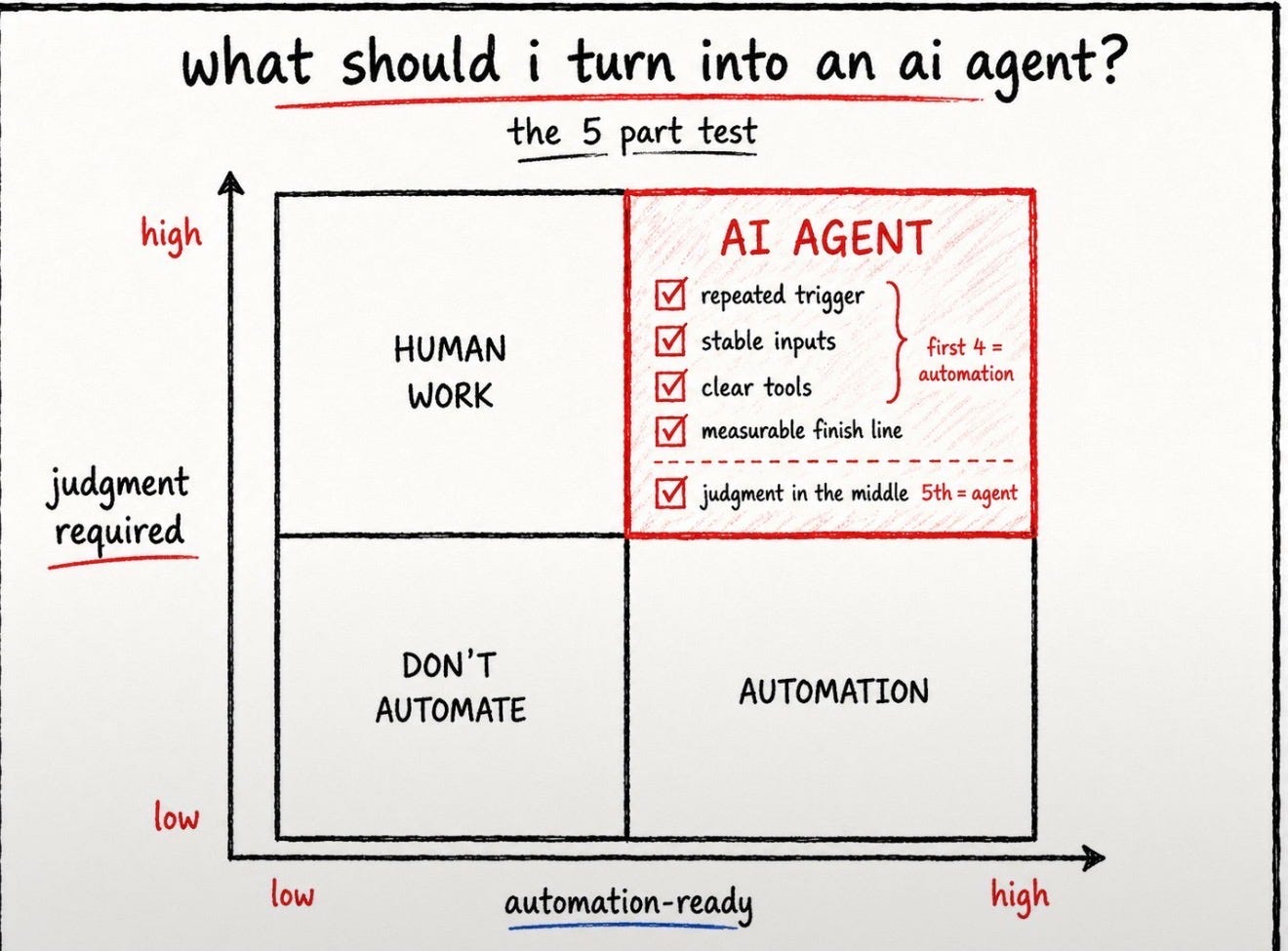
Credit: Greg Isenberg
6. The Consultant Communication Overhead Trap
If you’re a consultant spending half the week talking about the work instead of doing the work, this one has numbers.
Meet Devon.
Fifteen hours a week disappeared into email, Slack, calendar, and CRM.
Templates helped. Better habits helped. But they still required Devon to operate them.
So I redesigned the problem.
Instead of helping her process communication faster, the system brings her only the three to five calls that actually require her judgment.
She spends about 30 minutes deciding.
The machine handles the rest.
Before: 15 hours a week.
After: 8 hours.
Recovered: 7 hours a week. At $175 an hour, that’s 364 hours a year, or $63,700 in reclaimed billable capacity.
And if some of those hours go into business development, there may be another $38,000 to $63,000 sitting on the table.
She still decides.
She just doesn’t have to sit in every chair.
Take it with you: Don’t automate your judgment. Automate everything that keeps your judgment from getting to the right place.
7. The Problem With AI Is Often That It Answers Too Soon
If AI keeps giving you perfectly reasonable solutions to the wrong problem, read this one.
Tell AI you spend too much time on follow-up and it will happily automate follow-up.
But what if follow-up isn’t the problem?
What if the offer is?
A good mechanic doesn’t replace the tires just because you pointed at them.
So I built a sequence that makes the model earn the right to recommend:
Outcome → Current state → Constraint → Working hypothesis → Economics → Solution
Diagnosis first. Prescription second.
Take it with you: Stop asking AI for solutions before it understands the problem.
Tools: The diagnostic sequence is free. Paid subscribers get the full instruction set.
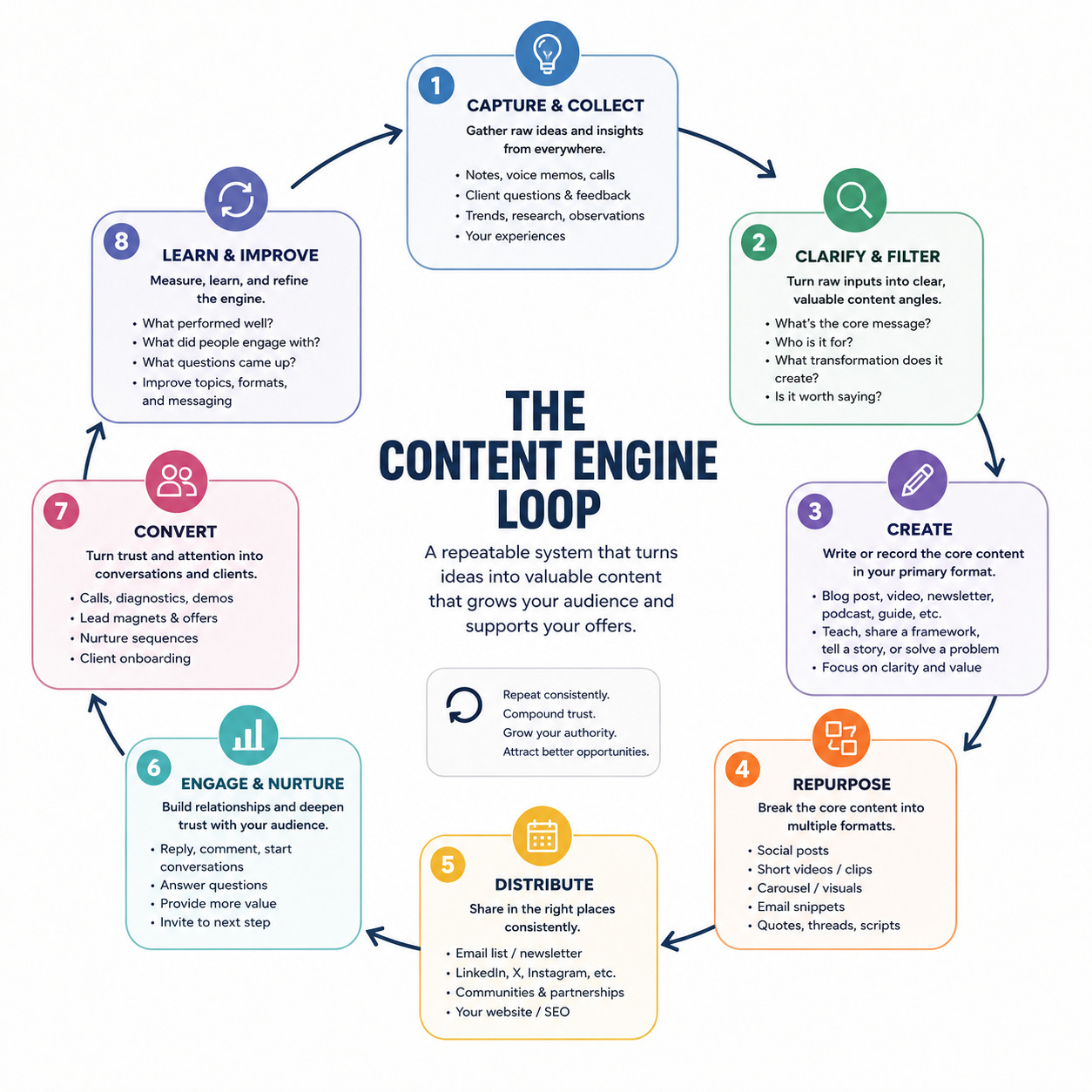
8. Are you hesitating to leave the corporate world?
If you know you can do the work but don’t know whether anyone will buy it, this one is for you.
That’s the fear I keep hearing from people thinking about leaving corporate or academia.
Usually they aren’t questioning their craft.
They’re questioning the market.
And those are two very different problems.
An offer without a market is still a hope.
So research the buyer while you still have the job. Publish to them. Watch what they respond to. Test the angles. See what gets ignored.
Then make the decision with evidence.
Take it with you: Don’t leave with a vision. Leave with proof that somebody wants what you know.
Tools: Start with the assessment of your background and what is actually marketable. If there’s something there, we build the content and market-intelligence system around it.
Build the Machine members gets my AI content, repurposing and market intelligence agent
9. The Consultant Proposal Prison
If a good sales call ends and then you lose most of a day writing the proposal, meet Nathan.
Nathan isn’t short of leads.
The problem starts after a good call when somebody says:
Send me a proposal.
In the old version, most of a billable day disappeared into the file. Research. Restating what the prospect already said. Writing. Formatting. Pricing.
AI created another problem: a beautiful finished-looking proposal with a price nobody had actually approved.
So the new system produces two drafts after the call.
One is the honest internal read. No invented price.
The other is the short client-facing page.
Anything the machine doesn’t know stays blank.
Nathan keeps three seats:
The sentence. The price. The send.
Before: Most of a billable day per proposal. Two or three a week. Leftover names waited, and some went cold.
After: About 15 minutes of judgment. Two or three files can be out by late morning.
Take it with you: The machine can write the proposal. It shouldn’t make the promise.
Nine very different problems.
But there’s a thread running through most of them.
The point isn’t to hand your business to AI.
It’s to get clearer about what matters, become easier to find and trust, remove the work that shouldn’t require you, and keep your judgment where it creates the most value.
In the words of Dan Koe, the renaissance is already here.
The people who get crushed will be the ones who treat AI as a religion or as a replacement for their own judgment.
The people who get their time back will keep the craft and let a system run the rest.
Taste. Direction. The yes.
That’s the lab.
Build to Thrive is about helping non-tech entrepreneurs build AI-powered businesses that earn more, serve clients better, and give them more of their time back.
Thank you for reading.
Quick question: What should I write about next?
Juan
Two of my best moments in August. My two son’s goals! Sign them up!
Powerful roundup, Juan. Glad to hear you enjoyed the shore with family and are still out there playing futbol. And congrats on your top seller recognition!
If you have too many agents, pretty soon you find yourself working for the agents. Nice goals by your sons Juan. So much fun!