


Hey! Juan here. Thank you for reading Build to Thrive, the newsletter for operators and professionals turning hard-won experience into leverage, income, and opportunity in the AI economy. More than 5000 of you read along each week.
A word on why I write it. I have started four companies, and I am building my fifth: this one, a media company I run almost entirely solo, on a fleet of about thirty AI agents that draft this newsletter, scan my inboxes, prep my client work, and write my morning brief. I am not reporting on this shift from the sidelines. I am living it, and I share what works and what breaks, openly, as I go.
There is a strange thing that happens when you ask AI for business advice.
It is almost too helpful.
Tell it, “I spend too much time following up with leads,” and within seconds you have a proposed CRM workflow, three automated sequences, an AI qualification agent, and a list of software you should connect.
It feels productive.
But there is a problem.
Nobody stopped to ask whether follow-up was actually the reason you were losing sales.
Maybe you do not have enough qualified leads. Maybe the leads are good but the offer is wrong. Maybe prospects are interested but there is no clear next step. Maybe your CRM is perfectly capable and nobody uses it consistently.
You complained about follow-up.
AI heard: automate follow-up.
That is the difference between answering a question and diagnosing a problem.
And I think it explains a lot of disappointing AI implementations.
The mechanic who replaces whatever you point at
Imagine taking your car to a mechanic because it shakes at 60 mph.
You say, “I think I need new tires.”
A bad mechanic says, “Absolutely,” and starts replacing them.
A good mechanic asks questions.
When did it start? Does it happen while braking? Is it in the steering wheel or the whole car? Did you hit anything recently?
Then he inspects the car.

Because the customer’s proposed solution is not the same thing as the diagnosis.
We understand this instinctively with doctors, mechanics, accountants, and good consultants.
Yet with AI, we routinely do the opposite.
We tell it:
Help me automate client onboarding.
Or:
Build me an AI sales system.
Or:
I need a better content strategy.
And the machine obliges.
The better the model becomes, the more convincing the answer sounds.
That can actually make the problem worse.
A sophisticated answer to the wrong problem is still the wrong answer.
I realized I was optimizing the prompt instead of the thinking
For a long time, the conventional advice was to write better prompts.
Give AI a role. Provide context. Specify the output. Add examples. Tell it to think carefully.
All useful.
But I became interested in something slightly different:
What if I could change what AI is required to do before it is allowed to give me an answer?
Instead of trying to make the answer better, could I improve the process that produces the answer?
Think about hiring a senior operator.
You would not value her because she can produce longer reports than a junior employee.
You value her because she knows when not to answer yet.
She asks the uncomfortable question.
She notices that the problem you described is probably a symptom.
She wants to know what you have already tried.
She asks what success actually means.
And occasionally she says:
I don’t think that’s the problem we should solve.
That is much closer to how I want AI to work with me.
So I gave AI a process
The framework I ended up with looks roughly like this:
Outcome → Current State → Constraint → Working Hypothesis → Economics → Solution → Measurement
The order matters.

Start with the outcome
“I want to automate sales” is not an outcome.
Do you want more qualified conversations? Higher conversion? Faster follow-up? More revenue? Less founder time?
Those can lead to completely different systems.
Understand what happens today
Before redesigning something, AI should understand what already exists.
What works? Where does the process stop? What requires judgment? What is repetitive? Where are people waiting? Where are they hunting for information?
Otherwise, AI tends to design the business it imagines rather than improve the business you actually have.
Find the constraint
This may be the most important part.
Suppose you have 30 qualified prospects each month but only 12 ever reach a sales conversation.
You could spend months doubling your audience.
Or you could ask why 18 people who were already qualified disappeared.
It is like adding water pressure to a hose with a kink in it.
More water isn’t necessarily the answer.
Find the kink.
Then I added one rule that changed everything
Before recommending a solution, I require AI to state a working hypothesis.
Not a conclusion.
A hypothesis.
For example:
Working hypothesis: The primary revenue constraint is not lead generation. It is inconsistent movement of qualified prospects from initial interest to a sales conversation.
Then it has to answer two more questions:
Why do I think this?
And, more importantly:
What would prove me wrong?
That second question matters.
Without it, AI is remarkably good at constructing an argument for whatever it has already decided.
Humans are pretty good at that too.
Requiring disconfirming evidence changes the conversation from:
“Give me a convincing recommendation.”
to:
“Give me an explanation we can test.”
That is a much higher standard.
Only then do we talk about AI
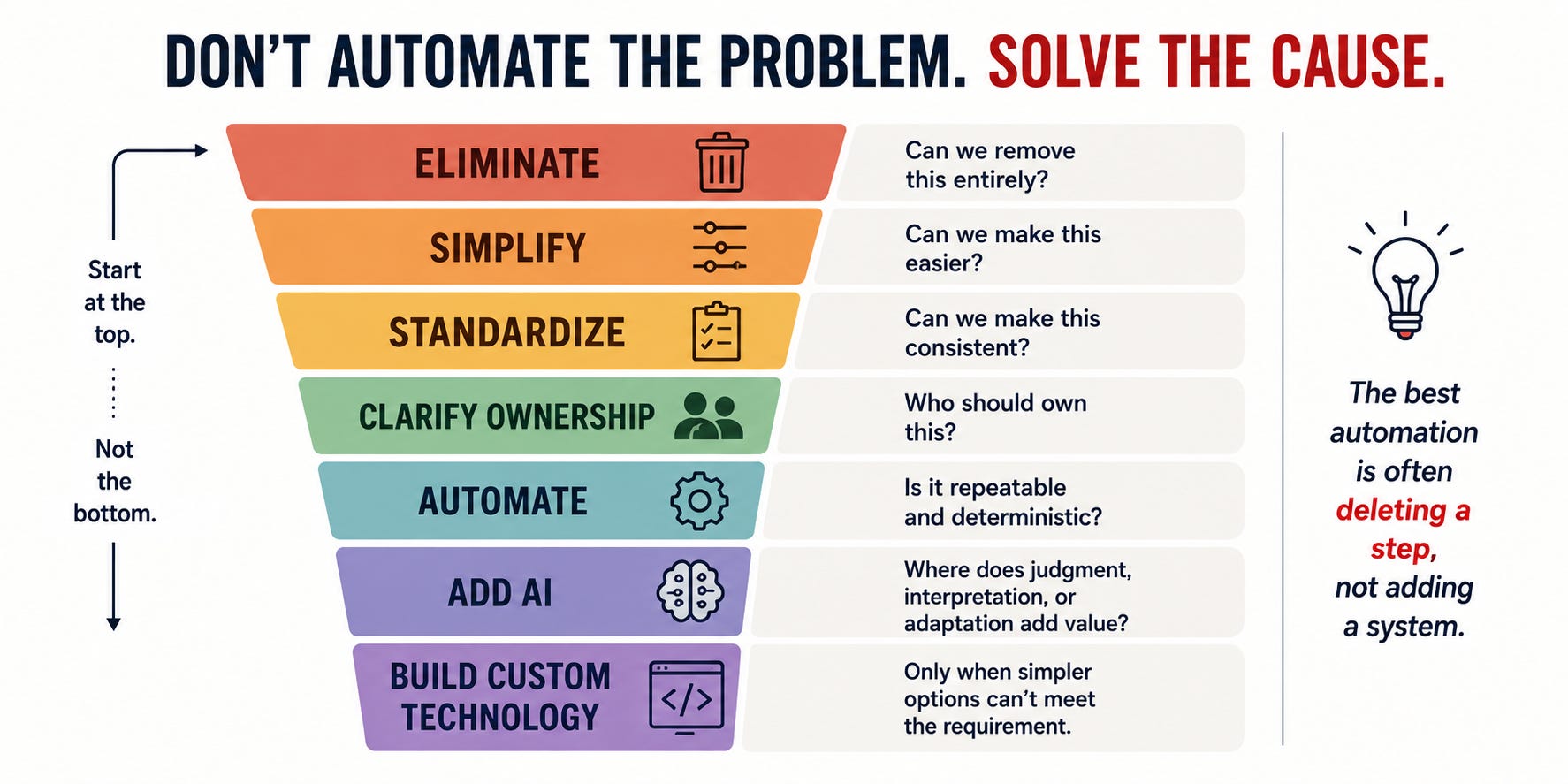
Here is another rule I built into the system:
Do not assume automation is the solution.
Sometimes the best automation is deleting the task.
Sometimes the process needs to be standardized.
Sometimes the same decision is being made 40 times when it could be made once as a rule.
Sometimes information is scattered across five places.
Sometimes the work simply belongs to someone else.
Only after those possibilities have been considered should we ask what AI can do.
My preferred sequence is closer to:
Eliminate → Simplify → Standardize → Clarify ownership → Automate → Add AI → Build custom technology
It is the business equivalent of not buying a robotic lawn mower before checking whether you actually need to mow that part of the yard.
And building it isn’t enough
This is another place where I think businesses will get AI wrong.
An automation runs successfully.
Everyone celebrates.
But “it ran” tells you almost nothing.
Imagine hiring a salesperson and measuring performance by the number of emails they sent.
That is activity, not value.
The same distinction applies to AI.
I now think about four different states:
BUILT → RUNNING → WORKING → CREATING VALUE
Those are not synonyms.
An AI follow-up system might be built and running perfectly while annoying good prospects and reducing conversion.
A client-onboarding agent might process every client while creating more work for the team fixing its mistakes.
So before building, the system should define what working means.
Maybe follow-up falls from 48 hours to 8.
Maybe founder administration falls from six hours a week to two.
Maybe qualified-lead conversion moves from 12% to 17%.
Now we have something to test.
This is becoming my default way of working with AI
I don’t want AI to agree with me faster.
I want it to make it harder for me to solve the wrong problem.
I want it to challenge assumptions, distinguish facts from hypotheses, look at economics, identify what should remain human, consider how a system could fail, and tell me what evidence would change its recommendation.
In other words, I don’t just want a better answer.
I want a better thinking process before the answer.
So I turned all of this into a reusable set of AI instructions.
It forces the model to begin with three high-value questions, diagnose before recommending, state a falsifiable working hypothesis, test the economics, choose the simplest intervention, separate human judgment from automation, define failure conditions, and establish how we will know whether the result actually worked.
That’s the what.
For paid subscribers, the rest of this article is the how.
🔒 PAID: Install the AI Thinking System
Below is the complete instruction set I use, ready to copy into your AI.
I’ll also show you:
how to install it
how to bypass the three questions when you want an immediate answer
how to make AI interrogate the problem further when necessary
how to use it to diagnose a real business problem
and the complete master instruction set
The goal isn’t to make AI give you more answers.
It’s to make it earn the right to give you one.
🔒 PAID: Install the AI Thinking System
If you made it this far, the useful part is not just understanding the framework.
It is making your AI behave this way by default.
The goal is to create a reasoning layer that sits between your question and the answer.
Instead of:
Prompt → Answer
you get:
Prompt → Clarify → Diagnose → Form hypothesis → Test economics → Recommend → Measure
That changes the interaction completely.