


Hey! Juan here. Thank you for reading Build to Thrive, the newsletter for operators and professionals turning hard-won experience into leverage, income, and opportunity in the AI economy. More than 5000 of you read along each week.
A word on why I write it. I have started four companies, and I am building my fifth: this one, a media company I run almost entirely solo, on a fleet of about thirty AI agents that draft this newsletter, scan my inboxes, prep my client work, and write my morning brief. I am not reporting on this shift from the sidelines. I am living it, and I share what works and what breaks, openly, as I go.
Contents
Why Advice Fails and Systems Win
What this Build Sprint Series is
What Consultants and Operators should expect
Mini Case Study: The Solo Consultant Communication Crisis
2021 vs 2026 Consulting Approach
The Machine that I build
AI Impact
How the Build Sprints Work
Why Advice Fails and Systems Win
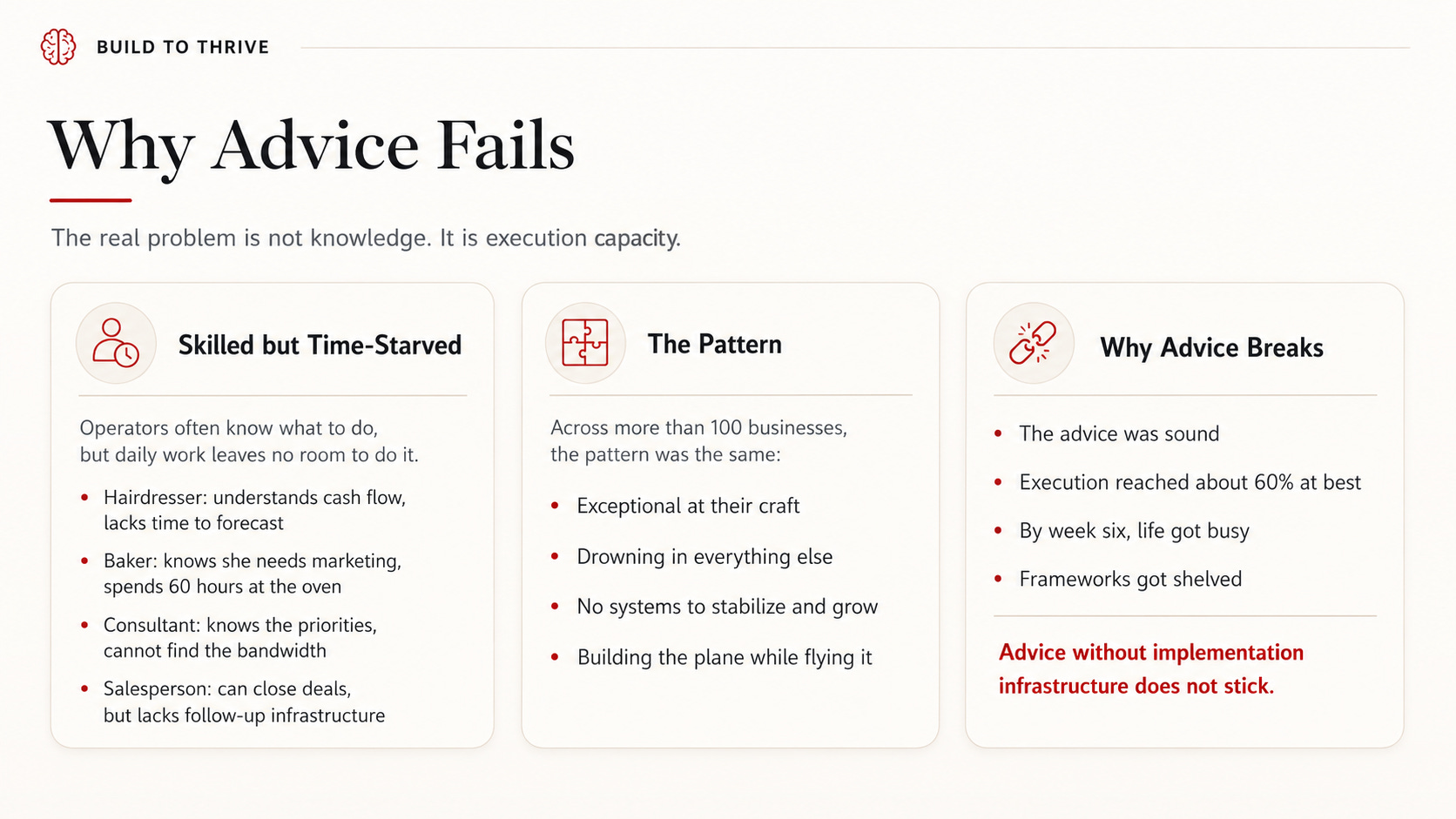
Most entrepreneurs suffer from a failure of the human operating system. You finish a high-level coaching program feeling energized, only to watch that momentum dissolve into systemic entropy within weeks. The talented hairdresser understands cash flow perfectly yet remains too busy cutting hair to build a forecast. The baker knows she needs marketing but spends sixty hours a week at the oven. You do not lack knowledge. You lack the functional capacity to execute that knowledge while surviving the daily grind.
For 25 years, I’ve launched, developed, grown, failed, and sold businesses across Finance, Real Estate, Hospitality, and Business Education. The most important and painful lesson I learned is this: building systems that automate repetitive tasks is everything. Knowledge without infrastructure is just noise.
In 2021, I founded a business accelerator program designed to help solopreneurs and small business operators—hairdressers, plumbers, consultants, photographers, bakers, service providers—break through the ceiling trapping them. We advised over 100 businesses that year.
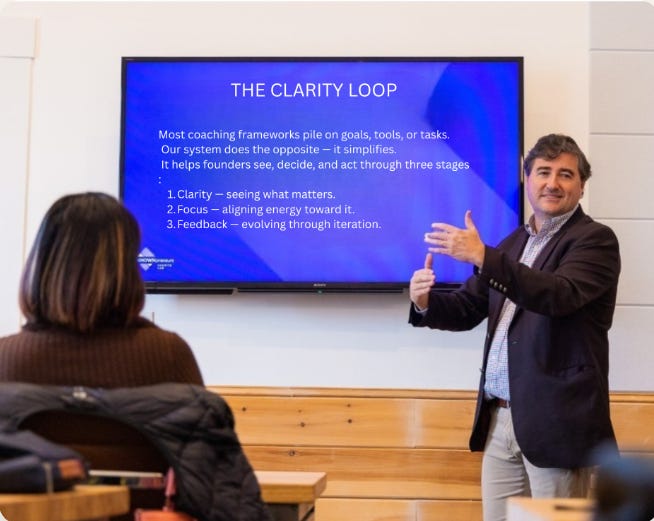
Teaching my first Business Accelerator Cohort. 2021
The pattern was identical across every single one: exceptional at their craft but drowning in everything else. These weren’t people who lacked knowledge or ambition. They lacked the systems to stabilize and grow. A consultant knew exactly what to prioritize but couldn’t find the bandwidth to do it. A photographer had great ideas but no system to execute them. A salesperson could close deals but had no follow-up infrastructure. Everyone was building the plane while flying it.
We diagnosed problems, designed solutions, handed over frameworks. The advice was sound. Execution? 60% at best. By week six, life got busy, frameworks got shelved.
The lesson stuck: Advice without implementation infrastructure doesn’t stick.
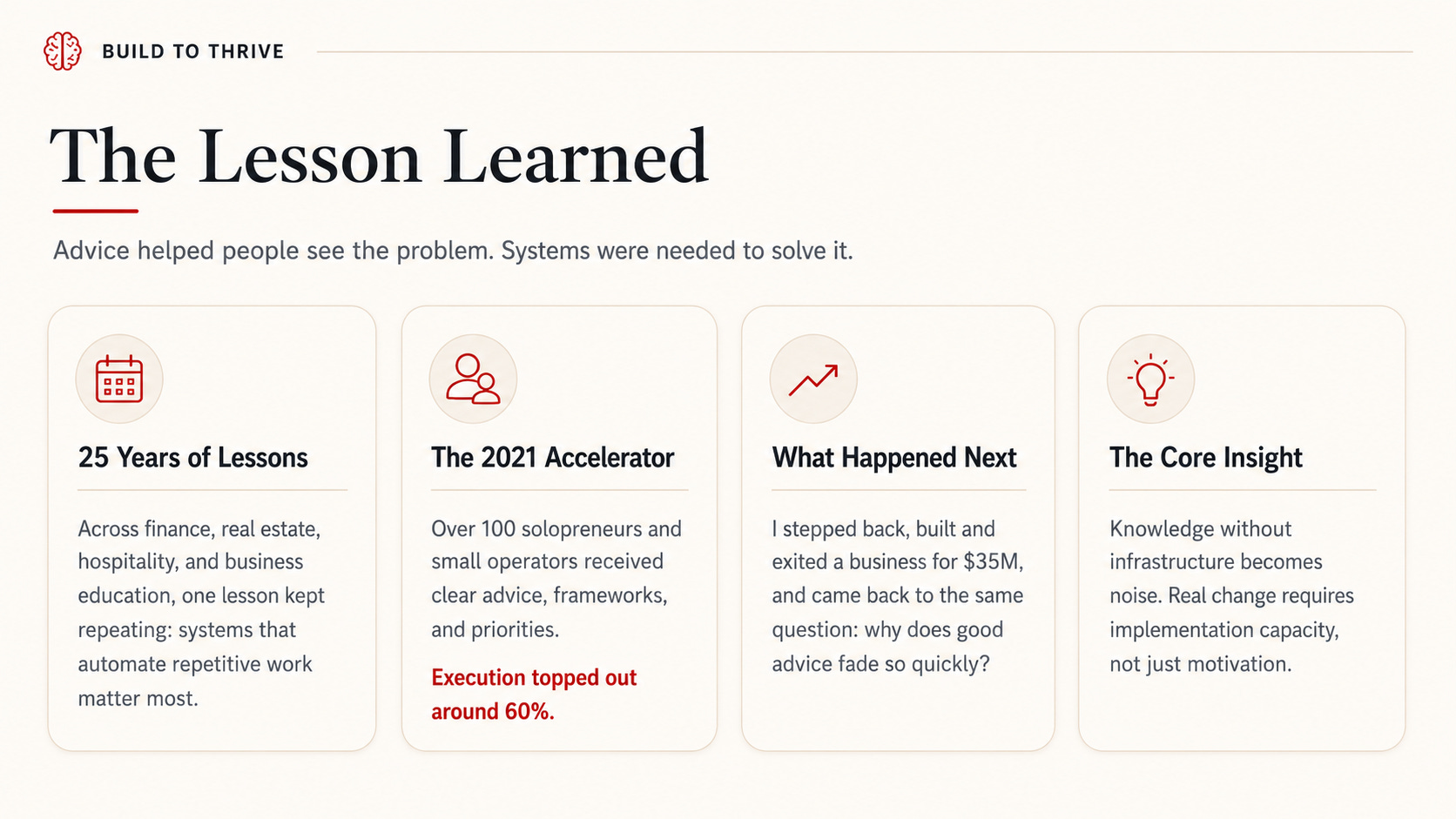
I stepped back. Built, grew, and exited a business for $35M. Took a year to ask the real question: what if I didn’t have to accept that 60%? What if infrastructure could be built, not just recommended?
In October 2025, I started working with some of the same operators from 2021. This time, I brought AI. The impact was immediate and profound. The problems were identical: time starvation, coordination chaos, growth ceiling. But the solutions were fundamentally different. Instead of frameworks that required discipline and personal bandwidth, we built machines that executed independent of personal effort.
The operators stayed time-strapped. But now they controlled systems that gave them time back.
This is the shift: AI has moved us from “learning what to do” to “building machines that do it for you.” Strategy is no longer something you learn and implement. It’s hard-coded into your business infrastructure. The goal isn’t to become a better manager. It’s to build an independent system that functions regardless of your personal discipline.
What This Build Sprints Series Is
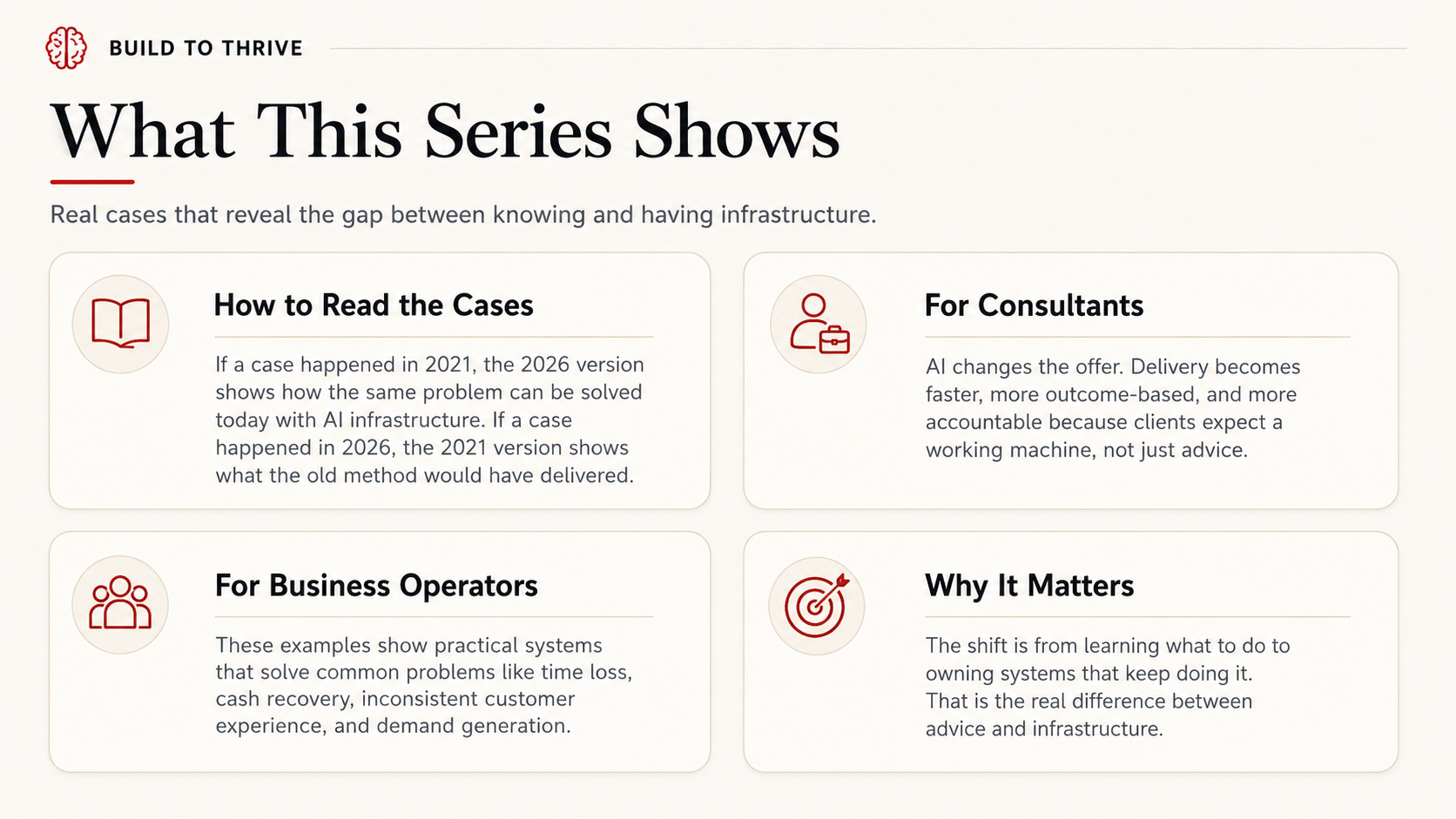
The cases that follow are actual engagements from either 2021 or 2026. When an engagement happened in 2021, the 2026 approach represents what that same problem would look like solved today with AI infrastructure. When an engagement is from 2026, the 2021 approach shows what the old methodology would have delivered. This illustrates the real gap between advice and infrastructure.
If you’re a consultant: AI has fundamentally changed what you can deliver. It’s no longer an hourly charge. It’s outcome-based. Execution time has shrunk dramatically, both for you and your clients. They now expect a machine built that they can take and drive. That changes your pricing, your accountability, and your competitive advantage.
If you’re a business operator: Here are real ideas from operators like you, using AI infrastructure that actually works. These solve business problems that are incredibly common: time loss, cash recovery, customer consistency, demand generation. These aren’t theoretical. They’re from the last eight months of actual work.
Case Study:
Meet Devon: The Solo Consultant Communication Crisis
Devon runs a solo strategy and operations consulting practice. She’s sharp, credentialed, and her clients love her work.
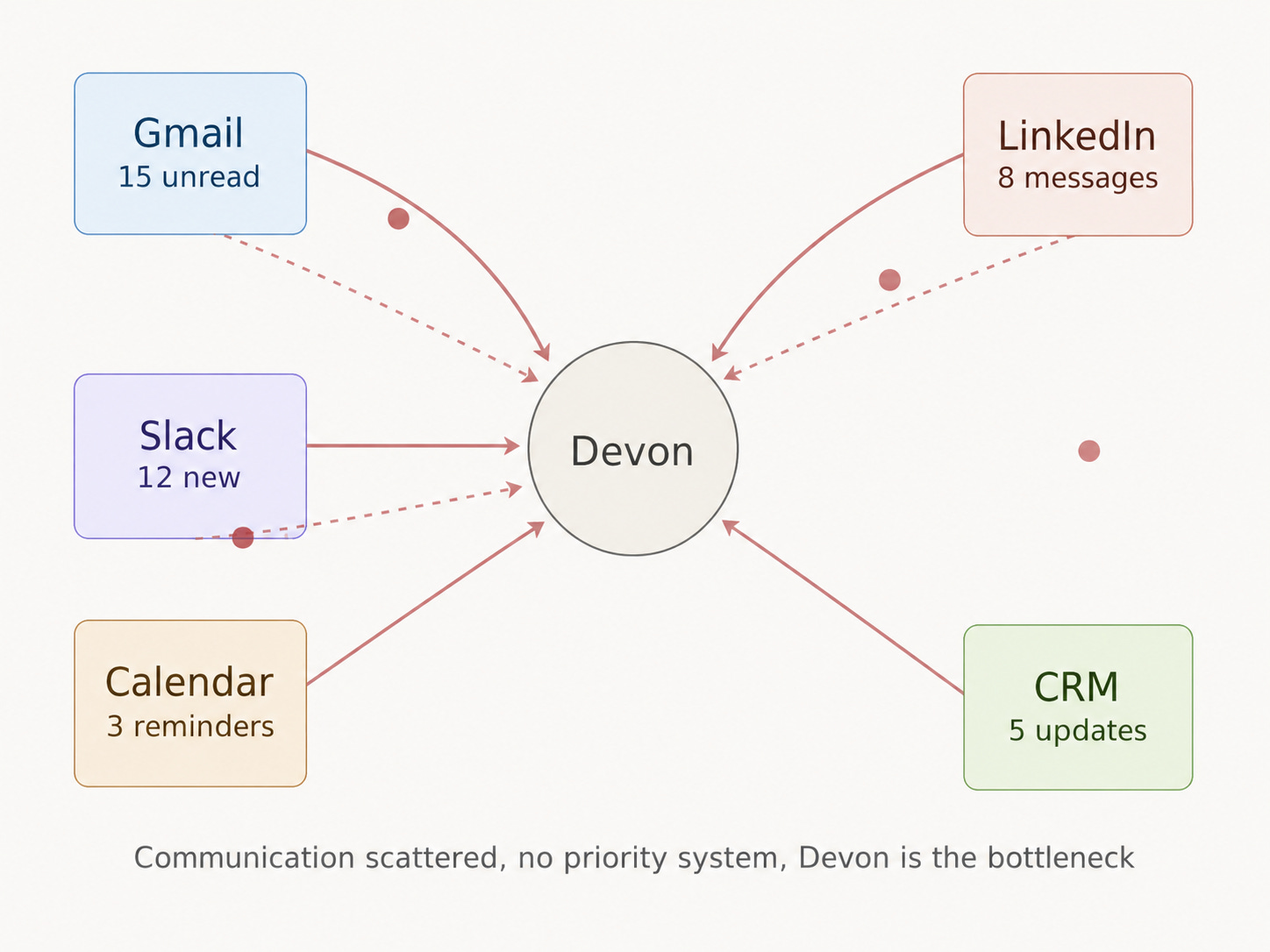
But she’s stuck. She spends about 3 hours a day roughly 15 hours a week across email, Slack, calendar, and CRM managing communication instead of doing client work, sales, or business development.
The real problem: Every new client adds more communication burden. She can’t scale her practice without drowning in coordination overhead. The constant switching, prioritizing, remembering, and following up has become the ceiling on her growth.
2021: The Advice-Based Approach
The solution focused on helping Devon manage communication more efficiently:
Email batching
Response templates
CRM discipline
Calendar blocking
Follow-up routines
Weekly prioritization
The system worked. Communication workload dropped from 15 hours a week to 11 hours. Devon recovered roughly 4 hours a week.
But Devon still had to operate the system herself. She had to keep the CRM current, maintain the routines, remember follow-ups, and decide what needed attention.
The system improved how Devon worked. It still depended on her to keep it running.
2026: The AI System-Based Approach
Same problem. Completely different solution.
An AI Communication System was developed, built around the tools Devon already uses: Gmail + Slack + Calendar + HubSpot integrated into a lightweight AI infrastructure powered by Claude Cowork.
The architecture:
A Chief of Staff Agent handles the coordination work: organizing communication, tracking commitments, preparing context, drafting routine responses, keeping important information current.
Instead of opening multiple tools and figuring out where to start, Devon begins with a prioritized view of what needs a decision, response, meeting preparation, or follow-up.
How Devon operates it:
Each morning, a priority brief surfaces the 3-5 things requiring her attention, ranked by impact. Client status. Pipeline updates. Meeting prep. Everything else is organized and tracked. Devon spends 30 minutes reviewing context and making decisions. The system runs the rest.
Communication workload drops from 15 hours a week to 8 hours. Devon recovers roughly 7 hours a week.
The system does not replace Devon. It removes more of the coordination work around her, plus helps her prioritize her actions to optimize the time she dedicate to achieve her goals.
The Shift: Before and After
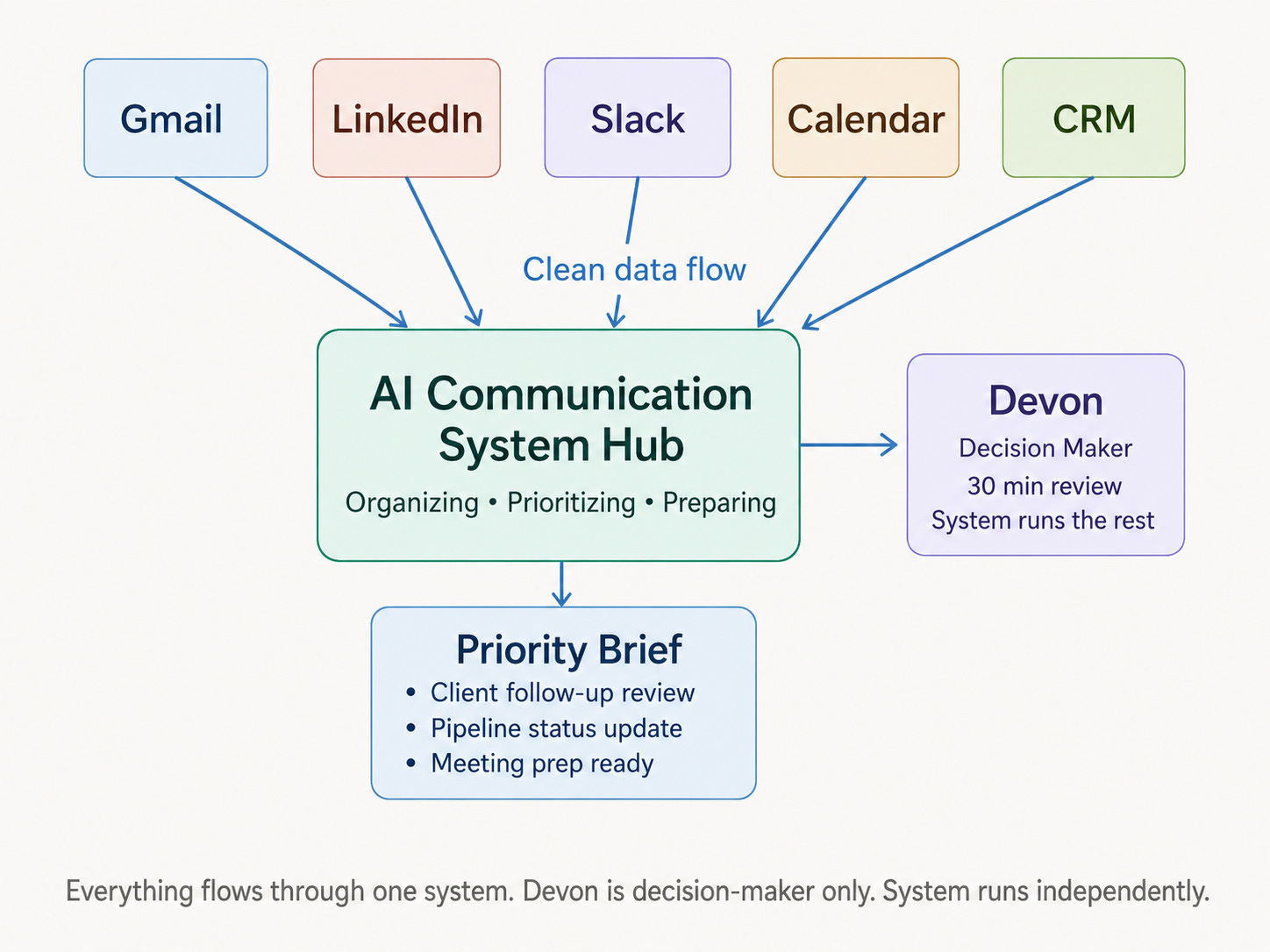
All communication flows through one system. Devon is decision-maker only. System manages the coordination. Time: 15 hours/week managing communication → 8 hours/week. 7 hours recovered.
The Time & Money Impact
Devon charges $175/hour.
Time Savings:
Pre-AI: 15 hours/week in communication management
Post-AI: 8 hours/week in communication management
Time recovered: 7 hours/week
Annual Value:
7 hours/week × 52 weeks = 364 hours/year
364 hours × $175/hour = $63,700/year in reclaimed billable capacity
Potential: If recovered time gets deployed for business development, add $38,000–$63,000+ in new revenue annually. Most operators recover time but don’t have a plan to deploy it strategically.
How This Works: The Build Sprint Methodology
Every engagement follows a five-stage process called the Build Sprint. It’s simple, repeatable, and designed to move from diagnosis to a running system in weeks, not months.
Phase 1: Design + Define + Diagnose
Diagnose. Real listening. We map the actual workflow—not the one you think you have—and trace visible problems back to their root. A solo consultant spending 15 hours a week in email isn’t the problem. The problem is scattered communication across five tools with no priority system. Visible problems are usually symptoms of invisible system failures.
Define. Once we understand what’s broken, we agree on what success looks like. Measurable success. How many hours per week should this reclaim? What’s the financial impact? What would change in your business if this problem disappeared?
Design. We design the system. What agents do we need? Which tools integrate? How does data flow? This is architecture work. The design phase produces a blueprint everyone agrees on before a single line of code is written.
If you decide to Build it, you will get all spec, the design for you to install and drive the machine.
If you decide to build it together, we work on a new engagement for another $999.
If you decide to have me build it including training and setup, we will work on a proposal.

Phase 2: Delivery + Drive
Deliver. We build the system, test it, install it, and train you to operate it. This is execution. The system gets built, not handed off as a framework to implement. You don’t have to figure out how to use it. You don’t have to maintain it yourself. You open it, it works, you make decisions on what it surfaces. This phase typically takes two to four weeks depending on complexity. When it’s done, you have a running machine, not a homework assignment.
Drive. You operate the system forward. This is the part that’s different from 2021. You’re not struggling to implement something new. You’re running something that already works. The system adapts as your business grows. New tools integrate when you need them. Rules evolve based on what you learn. The operator owns the outcomes, and the system runs the coordination work.
This five-stage approach works because it separates the thinking from the doing. It separates the strategy from the infrastructure. It separates what you have to do from what the machine does for you.
Let’s Connect
Schedule a 15-minute conversation. Listen to what’s keeping you up at night, then get one idea, tool, or workflow you can implement this week.
If it can’t give you a quick solution in 15 minutes, I will get back to you with the answer.
The only ask: If it works, let’s continue the conversation.


Read my Hotel Turnaround Story. At the New Haven Village Suites. Former Residence Inn. 2015
Visit: juansalasromer.com for more information about my programs and assessments.
Thanks for this Juan! Im bookmarking this to read later.
The outcome-based framing is the right direction.
Once the work is delivered through infrastructure rather than hours, the value shifts from time spent to business capacity created.