


Hey! Juan here. Thank you for reading Build to Thrive, the newsletter for operators and professionals turning hard-won experience into leverage, income, and opportunity in the AI economy. More than 5000 of you read along each week and we recently hit the Top 50 fastest growing business newsletter on Substack.
A word on why I write it. I have started four companies, and I am building my fifth: this one, a media company I run almost entirely solo, on a fleet of about thirty AI agents that draft this newsletter, scan my inboxes, prep my client work, and write my morning brief. I am not reporting on this shift from the sidelines. I am living it, and I share what works and what breaks, openly, as I go.
TLDR
A recurring bill is easy to see and easy to argue about. What the bill is buying is usually invisible, and the expensive part is almost never the amount. It is whether you could leave. The AI make or buy decision.
Last summer I went through my own AI spend line by line, expecting to find one expensive tool I could cut. That is not what I found. The cost was spread across a dozen small automatic things that were each too minor to question on their own. I cut the bill roughly in half without changing any of the work.
What stayed with me was not the savings. It was that I had been paying that bill every month for months and could not have told you what most of it was for. Not because I am careless with money. Because a subscription is designed to stop being a decision.
I thought about that this week reading a thread I have not been able to stop turning over.
The thread
A man in a small town runs a mobile auto-detailing business. He has been paying $379 a month for six years for what he was told is a custom booking system. His nephew opened the developer tools on the site.
The custom booking system is a single script that embeds Square. The service-area map is a screenshot. There is no custom backend at all.
The provider has now quoted him $2,400 for a platform upgrade, after which the monthly goes to $469. Changing the price of a wash package costs $95.
The internet did what the internet does. Ninety-three upvotes and a hundred and sixteen comments, most of them arguing about whether $379 is too much.
What most of the room got right, and why it still misses
The obvious answer is that he is being overcharged, and plenty of people said so. One version of it sat at eighty-two upvotes.
Then something more interesting happened. The top comment of the entire thread, at two hundred and forty-six upvotes, told the nephew not to touch it.
“If you don’t know the answer to this question you are not qualified to be managing it. I would charge a bit more than your current guy. Not messing with it is the least risky option.”
Another, at forty-four: “OP is out of his depth here. So fixated on a few hundred dollars a month he is about to wipe out his uncle’s business.”
Someone pointed out the six years of accumulated search history a rebuild would throw away. Someone else called the nephew “the one who can do it cheaper that the prophecies foretold.”
I want to be careful here, because that camp is right about something real. The instinct to rebuild the thing yourself, now that the tools are cheap, is the second most expensive mistake available in that situation. It is not the first.
The three comments nobody upvoted
Buried under all of it, at single-digit upvotes, three people were having a completely different conversation.
“The 379 a month isn’t really the problem, and neither is the 2400. What he’s paying for is not being able to leave.”
“The biggest issue here is not what your uncle is paying this vendor but that he doesn’t have the keys to his business.”
“The thing I’d check before touching anything is whose name the domain and the business email are actually in. Six years with one provider usually means both sit inside their account, and that is the real leverage, not the booking widget.”
Three people, arriving from three directions, at the same answer. The number is not the problem. The lock-in is the problem, and the number is what the lock-in costs.
None of them wrote down what to check.
The broader pattern
I think this shows up in a lot of operations, and almost never as a website.
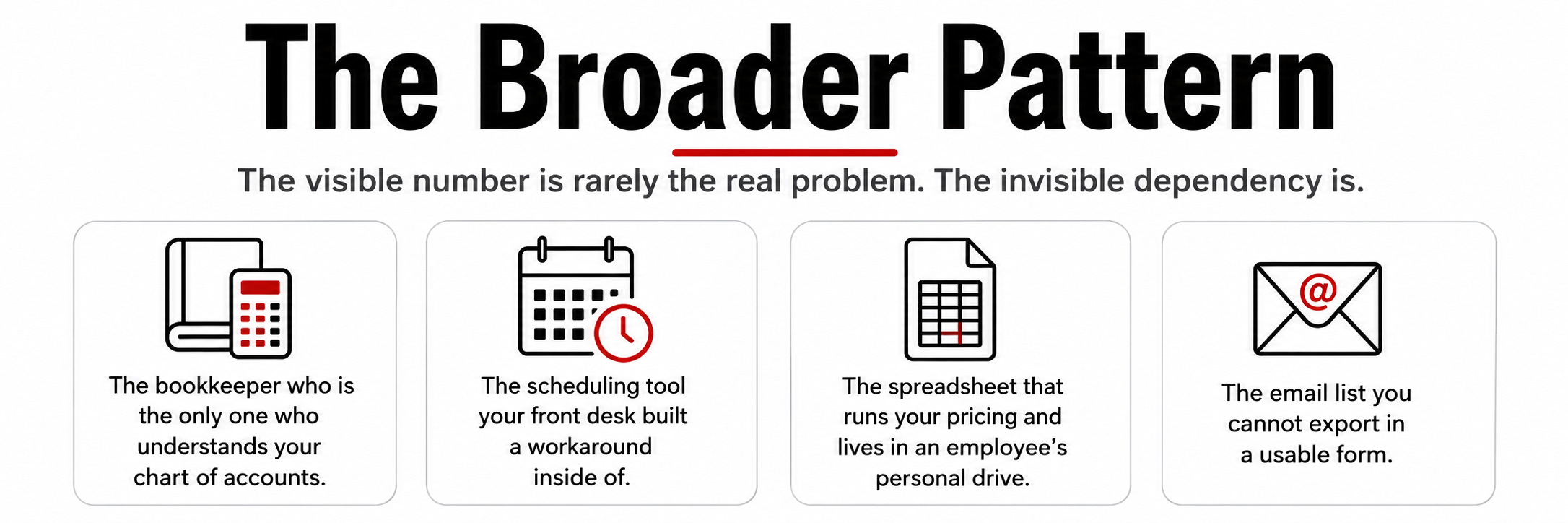
It looks like the bookkeeper who has been doing your books for nine years and is the only one who understands your chart of accounts. The scheduling tool your front desk built a workaround inside of. The one spreadsheet that runs your pricing, which lives in an employee’s personal drive. The email list you cannot export in a usable form.
In each case there is a visible number and an invisible dependency, and the operator is looking at the number because the number arrives once a month with a subject line.
Here is the test I have started using on my own business. It is not about cost.
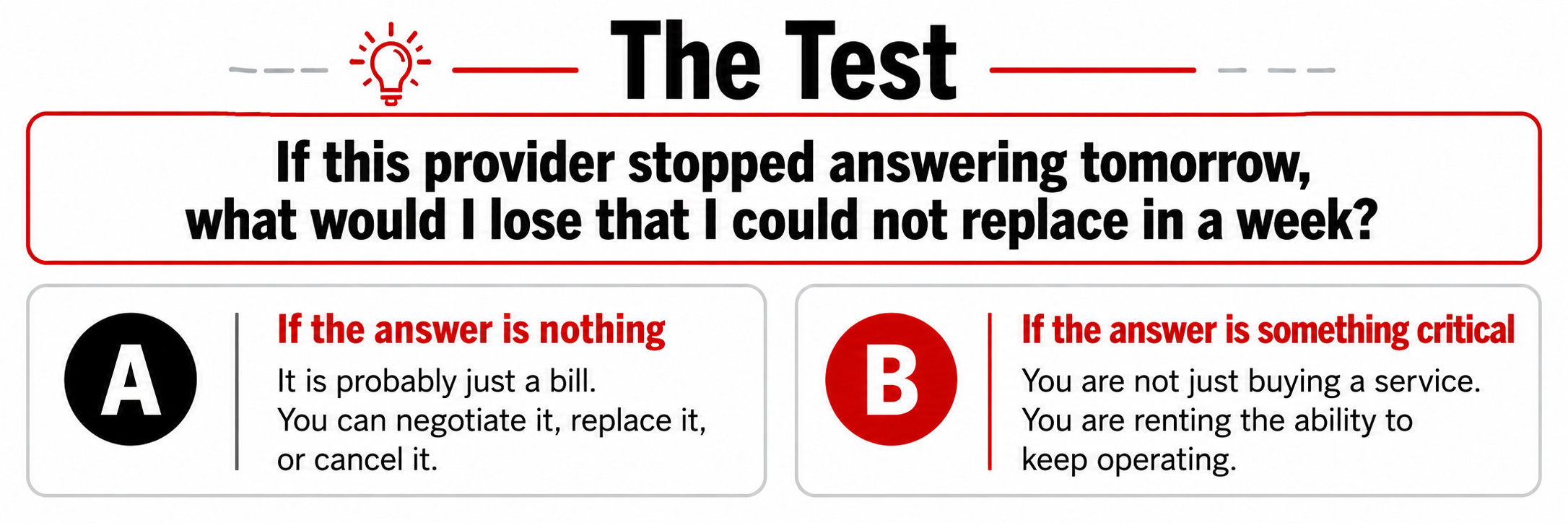
If this provider stopped answering tomorrow, what would I lose that I could not replace in a week?
If the answer is nothing, the bill is just a bill and you can negotiate it like one. If the answer is my customer list, my domain, my search history, or my ability to take a booking, then you are not buying a service. You are renting the ability to keep operating, and the price of that is whatever they decide next year.
Why this matters now
Two things changed at once and they pull in opposite directions.
The cost of rebuilding almost anything fell through the floor. That is real, and it is why the nephew’s instinct is not stupid.
But the cost of a bad migration did not fall at all. Six years of search history, a customer database you assumed was yours, a business email address printed on the side of a van. AI made the build cheap. It did nothing to make leaving safe.
Which means the gap between those two things is now the most expensive place in a small operation, and almost nobody is measuring it.
So should you just rebuild it with AI?
Everyone reading this has already had the thought, so let me take it seriously rather than waving at it.
A weekend and a decent model will get you a booking page. That was not true three years ago and it is true now. The people saying otherwise are defending something.
But look at what the rebuild accomplishes if nothing else changes. The uncle stops paying a provider he could have fired, and starts depending on a nephew he cannot. The lock-in did not go away. It moved, and it moved to the person hardest to replace. That is what the do-not-touch camp is sensing when they say he is not qualified. They are right about the risk and wrong about the reason.
And the same is true of anyone else he brings in, including someone he pays properly. The question is never who builds it. It is whose name is on it when they are finished. Set up inside the uncle’s own accounts, a nephew has done him a favor. Set up inside the nephew’s, he has quietly become the new provider at a better price and worse terms, because now the exit is a family conversation.
This is the make-or-buy call, and the reason it goes wrong is that most operators run it on the whole vendor at once, when the two halves of what they are buying have opposite answers.
The inventory sorts it, because it separates two kinds of line that look identical on an invoice.
Records are the domain, the business email, the merchant account, the customer list, the analytics history. A record is never a make-or-buy decision. You do not build one and you do not really buy one. You get your name on it. That is paperwork, and no model has ever made paperwork happen.
Surfaces are the site, the booking flow, the forms, the page that shows the service area. Those are cheap to rebuild now, genuinely, and getting cheaper. Surfaces are where make-or-buy is a real question.
Once you know it is a surface, three questions decide it
How often does it change? The man in the thread pays $95 to change the price of a wash package. If he does that twice a year it is an irritation. If he does it monthly it is the entire argument. Frequency is what turns a small fee into a structural cost, and it is the question people forget to ask because each individual fee looks survivable.
What breaks if it is wrong? A page listing your service area can be wrong for a day and nothing happens. A booking flow that takes payment cannot. The closer a surface sits to money, the higher the bar for building it yourself, and the more of that monthly bill was quietly buying you insurance.
Can you describe it completely? This is the one people skip and it is the one that decides. AI builds what you specify. If you cannot write down every rule your booking flow follows, including the ones you have never said out loud, you are not ready to make it. You will also not be able to tell whether anyone else built it correctly.
Two yeses and a low blast radius, build it. Anything else, keep buying and negotiate better.
And the sequence matters more than the answer
Own the records first. Then run make-or-buy on the surfaces, at your own pace, from a position where leaving is possible. Rebuild before your name is on the registrar and you have put a new house on land somebody else owns.
And if you bring somebody in to help, that is the thing to settle before they start. Not the price. Whose name goes on what, and what you are left holding when the work is done. Anyone good will find that an easy conversation. The reaction to being asked tells you most of what you need to know.
One more thing the invoice hides. Part of what you pay a provider is not software at all. It is somebody answering on a Saturday when the booking form breaks. If you build, that person is you. Price it before you decide, not after.
What I would do first
Not renegotiate. Not rebuild. Find out what you own.
Before you touch the invoice, sit down for one afternoon and answer a single question for each piece of your operation: whose name is on it?
Not who manages it. Not who set it up. Whose name is on the account.
For the man in the thread, the answer to one of those lines is probably worth more than the entire six years of $379 payments. And here is the part that should be encouraging rather than alarming: two commenters pointed out that his booking history and customer data sit inside Square, not with the developer. His switching cost is almost certainly far lower than it feels. He does not know that, so he is negotiating from a position of fear he may not actually be in.
That is the whole thing. You cannot negotiate a dependency you have not located, and you cannot price a risk you have not named.
The Keys and Accounts Inventory
One page. One afternoon. Whose name is on each line.
This is the procedure the thread never wrote down. It is yours, no email required.
Work through each row. For each one you need three answers: who is named on the account, who can add or remove that name, and what happens to the business if access stops tomorrow.
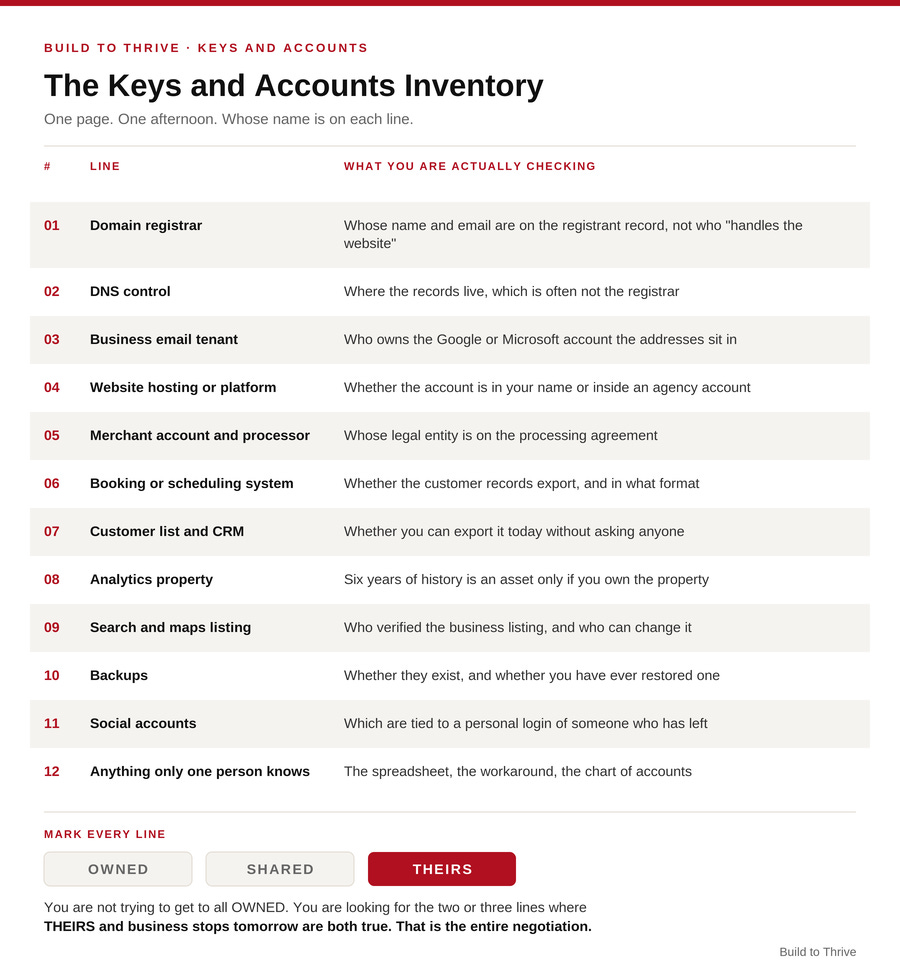
Here is a fillable sheet you can print and use The Keys and Account Inventory
How to score it
Mark each line OWNED, SHARED, or THEIRS.
You are not trying to get to all-owned. Plenty of THEIRS lines are fine and normal. You are trying to find the ones where THEIRS and business-stops-tomorrow are true at the same time. That intersection is usually two or three lines, and it is the entire negotiation.
The one move after the inventory
Take your THEIRS-and-critical lines and ask for one thing per line: to be added as an owner, not to take it over.
It is a small ask, it is hard to refuse without saying something revealing, and the answer tells you what kind of provider you have. A good one adds you the same week. The response is the diagnostic.
That is the whole free method. If you only do the inventory and nothing else, you are already ahead of the hundred and sixteen people arguing about the invoice.
SOFT NEXT STEP
I am still running this inside my own business, and the lines that came back THEIRS surprised me more than the ones that came back OWNED. I am sharing the parts that break because those are usually the parts other operators need help naming.
Two things tend to happen after someone fills the sheet in.
The first is that one line turns out to matter more than the other eleven, they sort it out themselves, and that is the end of it. That is the sheet doing its job. You do not owe me anything for it.
The second is that the sheet raises a question it cannot answer. You now know what you could stop paying for. You still have to work out which of those you could actually replace, in what order, and whether any of it is worth a month of your attention. That depends on how your week really runs, which parts only work because you are the one running them, and what your own time is worth against the invoice. A checklist cannot see any of that.
If that is where you have landed, let’s connect over a virtual coffee.
Here is exactly what happens in it, so you know before you book anything.
I ask you three questions. What is taking time away from you. Where could you be making more. Where are your customers being served worse than you would like. You pick the one that matters most right now, and we spend the rest of the call on that one rather than surveying all three.
Then, before we hang up, I come back to you with something. A tool, a prompt, a different way to run the thing. Not notes to action later. Something you can use that afternoon.
Sometimes that solves it and there is nothing else to discuss, which is a good outcome and a common one. Sometimes it turns out to be bigger than fifteen minutes, and then we can talk about going deeper with an AI Leverage Assessment. That is your call, at your pace, not mine.
If it is useful, take fifteen minutes with me and we will look at your week together.
Most of the time we find five hours or more sitting somewhere fairly obvious. Sometimes we do not, and I would rather say so than stretch for it.
I am doing these because seeing how other people actually run their week is how I learn what is really breaking out there. If you get something out of it, a sentence I can quote back is more helpful to me than you would guess.
The Vendor Conversation Pack (Paid subscribers)
Six prompts for the part that happens after the inventory.
The inventory is the easy half. It is a list, and lists are calm.
The hard half starts the moment you have to open the conversation. You are asking someone you depend on to give up a piece of their leverage, usually while you still need them, often while you are not certain what you are entitled to. Most operators either send nothing, or send something that reads like an accusation and gets a defensive reply that costs them six months.
These six prompts cover that arc end to end. They assume you have done the inventory and know which two or three lines are THEIRS-and-critical.
