


Hey! Juan here. Thank you for reading Build to Thrive, the newsletter for operators and professionals turning hard-won experience into leverage, income, and opportunity in the AI economy. More than 5000 of you read along each week.
A word on why I write it. I have started four companies, and I am building my fifth: this one, a media company I run almost entirely solo, on a fleet of about thirty AI agents that draft this newsletter, scan my inboxes, prep my client work, and write my morning brief. I am not reporting on this shift from the sidelines. I am living it, and I share what works and what breaks, openly, as I go.
If you want the right AI solution for your business, not just another list? Book a 15-minute call. I will assess your bottleneck and point you to the right system or app that fits. If it needs more digging, I will come back with the answer on a follow-up call.
Editorial
For most of this year I have not been using AI. I have been managing it. There is a real difference, and it took me a while to see it. A tool is something you pick up when you need it. What I run now is closer to a small staff. Something scans the market before I wake up. Something drafts from my own notes. Something checks the numbers and flags what moved. I sit at the top of it, deciding and approving, the way you would with people. I wrote about the first version of this in how I build my AI chief of staff. This issue is the org chart underneath it, and how you build your own, even if the whole company is just you.
Here is the shape, because the shape is the whole idea.
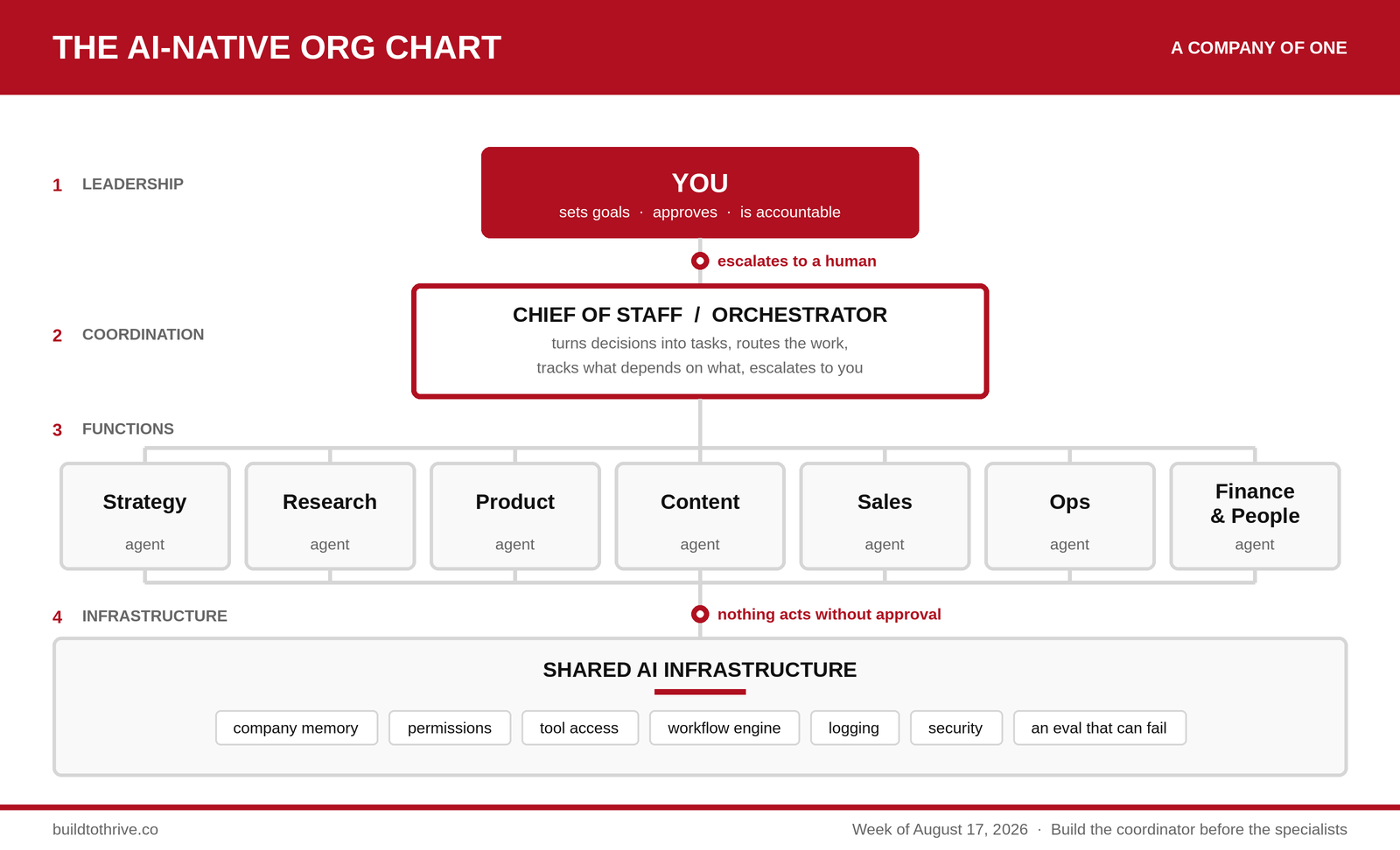
Three findings from the last eight weeks changed how I would build this, and two of them cut against what is being sold. Competence at individual jobs does not add up to a working system. The agent-to-agent coordination layer everyone is selling has the thinnest evidence behind it of any part of the stack. And in the sectors AI touches most, people have stopped starting companies that intend to hire.
Read together they say something specific. Do not build a swarm. Build one coordinator that routes to you, keep every seat short and testable, and accept that you are the part that cannot be automated. Pick the one seat your business needs most this week, and fill only that one.
Juan
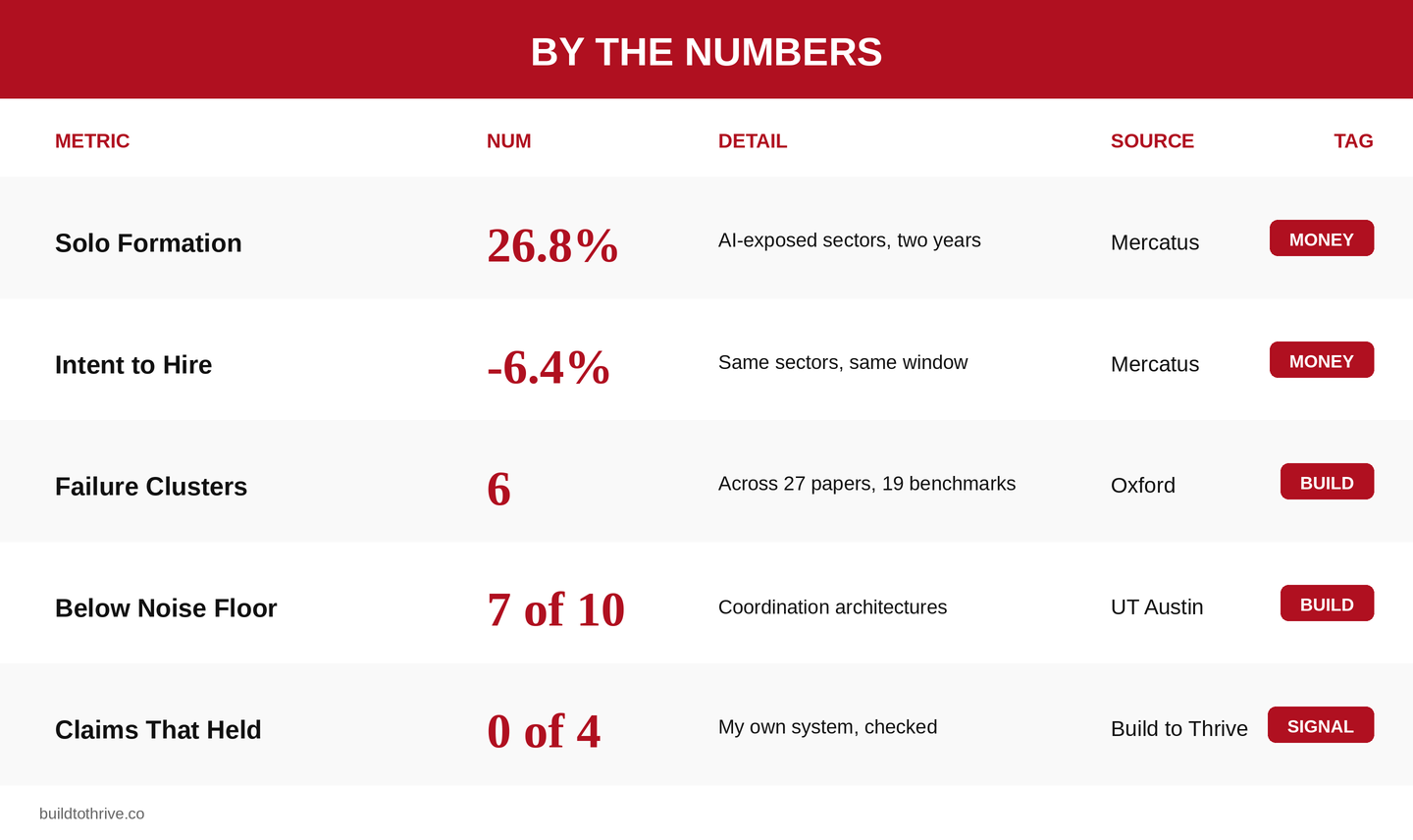
26.8 percent, against 6.4 percent down. In sectors most exposed to AI, solo-type business applications rose 26.8 percent from Q1 2024 to Q1 2026 while a construction-and-wholesale comparison group sat flat at negative 0.4 percent. Over the same window, applications in those AI-exposed sectors carrying markers of intent to hire fell 6.4 percent. The growth came entirely from filings with no employer intent. (Mercatus Center, 17 July 2026, on Census Business Formation Statistics and CPS microdata)
Six clusters, twenty-seven papers. An Oxford synthesis across nineteen benchmarks found that failure compounds non-linearly with task length, that sub-skill competence does not reliably compose into end-to-end success, and that adding scaffolding does not uniformly improve reliability. (University of Oxford, July 2026 preprint, not peer reviewed)
Seven of ten. Recent multi-agent coordination architectures whose headline improvement is smaller than the measured run-to-run noise of the same model on the same benchmark. The clean paired contrast came to five percentage points, with a confidence interval crossing zero. (UT Austin and Uber, 15 June 2026 preprint, not peer reviewed)
Zero. How many of the four confident claims my own system handed me last month survived a check. All four traced to real files. All four were wrong. Nothing was invented, which is the harder failure to catch, and it is why an evaluation step is infrastructure and not a nicety.
79 percent. The share of multi-agent failures blamed on specification and coordination rather than the models, quoted all summer as this year’s finding. It comes from a paper published in March 2025. The work is solid and I would have used it, except seventeen months is not recent, and a new date on an old number is not a new number.

Story 1: Your Agents Can Each Pass and the Company Can Still Fail
What is happening. Researchers at Oxford pulled twenty-seven benchmark, taxonomy and audit papers spanning nineteen benchmarks into six failure clusters (July 2026 preprint). Three conclusions matter more than the taxonomy. Failure compounds non-linearly as tasks get longer. Competence at the sub-skills does not reliably compose into end-to-end success. Adding more scaffolding does not uniformly improve reliability. They are careful about where agents have genuinely improved: single-turn tool selection, short web navigation, narrowly scoped coding.
What it means for you. Notice the shape. Agents are good at short, bounded jobs and degrade as the job gets longer and more connected. That is not an argument against an agent organization. It is an argument for how to draw one: short seats with clear edges, not one agent asked to run a whole function. It also kills the common fix. When your setup is flaky the instinct is another layer, another tool, another wrapper. The synthesis says that does not dependably help. Smaller seats do.
The uncomfortable part if you are buying: each piece can demo perfectly and the assembled thing can still fail, because composition is where it breaks. A vendor demo is a sub-skill test.
What I would do this week. Draw the chart above for your own business. Then ask one question of every box: can this be finished in a few steps with a clear end? If not, split it. Do not automate anything yet. Getting the boxes the right size is most of the work.
Story 2: The Coordination Layer Is the Least Proven Part of the Stack
What is happening. Two researchers, one at UT Austin and one at Uber, asked what the multi-agent field had skipped: before you claim your coordination architecture beat another, how much do two identical setups differ by chance? They measured that floor on one model against a retail benchmark, then held the published claims against it. Seven of ten recent coordination architectures report gains below that floor (15 June 2026 preprint). Their own clean contrast came to five percentage points with a confidence interval crossing zero, which means not significant.
What it means for you. Be careful what this says. It does not say coordination is worthless. It says the evidence that elaborate agent-to-agent schemes work is thinner than the marketing, and some of it may be noise. The practical read: the least proven thing you could build right now is agents negotiating with each other, and it is what is being sold hardest.
Which is why the orchestrator in the chart is drawn the way it is. Its job is not to let agents talk. Its job is to take what came back, decide what needs you, and put it in front of you. The value sits in the escalation, and the escalation ends at a human. I have watched my own system hand me four confident wrong answers in a month. No amount of agents conferring would have caught that. I caught it.
What I would do this week. Build one coordinating routine with exactly one job: gather what happened, sort by what needs your decision, hand you a short brief. Do not let anything act on another agent’s output without you in between. Not yet.
Story 3: AI Is Changing What Kind of Company People Start
What is happening. A Mercatus study published 17 July 2026 compared business formation in sectors most exposed to generative AI against construction and wholesale as a control. From Q1 2024 to Q1 2026, solo-type applications in the exposed group rose 26.8 percent while the comparison group sat flat at negative 0.4 percent. Then the finding that reframes it: applications carrying markers of intent to hire fell 6.4 percent in those same sectors, even as total applications rose. Census Business Formation Statistics and Current Population Survey microdata agree.
What it means for you. The story is not that more people are going solo. It is that where AI reaches, the kind of company people choose to start has changed. Fewer are built to hire. More are built to stay one person. That lands on you directly: if your growth plan never included headcount, your org chart is not a metaphor. It is the staffing plan, and the seats get filled with agents or they stay empty.
That is also the honest limit. This is early evidence of a correlation in exposed sectors, not proof AI caused it, and the authors say so. What it does establish is that you are not unusual for planning a company that runs without employees.
What I would do this week. Take your chart and pick the single function that eats the most of your week and needs your judgment the least. Recurring admin, first-draft content, lead follow-up. That is the first seat. One. The point is not a full company by Friday. It is proof that one box can run without you.

Move 1: Draw the chart, then size the boxes. Your functions, an orchestrator, you at the top. Split any box that cannot be finished in a few clear steps. Long connected jobs are where agents fail, so the sizing is the work.
Move 2: Fill the orchestrator seat, and point it at yourself. One routine that gathers, sorts by what needs your decision, and briefs you. Not agents conferring. The escalation to a human is the part with evidence behind it.
Move 3: Stand up one specialist, the highest-drag lowest-judgment one. Give it a job, the access it needs and no more, a place its output lands, and an off switch. If you cannot write those four things down, it is not ready.
Move 4: Put a test on it that can fail. Not “does this look right,” which the system will always say yes to. A number that clears a bar or does not. Resist adding a wrapper when something is flaky. Check what stays in your hands against the six things that should stay human.
None of these needs a developer, and none starts with buying an agent.
PROMPTS
The Agent Org Chart. Walks away with their business drawn as an org chart of functions, an orchestrator, and a human accountability layer, every box sized against the short-and-testable rule and the safest one marked to fill first.

The Orchestrator Brief. Walks away with the spec for one coordinating routine: what it gathers, how it sorts by what needs a decision, and what it escalates to a human.
The Agent Job Description. Walks away with one specialist defined before it is built: job, access, output, off switch, and the test that has to pass. If they cannot fill it in, the agent is not ready, and that is the useful answer.
Run in order they produce three documents: a map, a spec, and one job description. This is the thinking that happens before anything gets built, and it is the part most people skip on their way to a mess.

If you run a business and want to know which seat is costing you most, the free Diagnostic takes fifteen minutes and names your biggest constraint and what it costs. learn.buildtothrive.co/diagnostic. When you want the org chart mapped rather than guessed, Find the Operational Drag is the $999 assessment that walks your operation function by function and tells you which seat to fill in what order.
If you would rather build it with someone, take fifteen minutes with me and we will draw your agent org chart together and pick the first seat.
Check out my Builder’s Store (Work in progress)
…and remember
Build assets. Create freedom. Thrive on your terms.
Juan
Oh…I almost forgot.
Want more free resources? Fifty operators shared the prompts behind the first six months of our AIBlueprint Edition. 50 Creators share their rockstar prompts →
Liked, downloaded and shared by more than 1000 people…you can’t go wrong!
I've definitely tried to build stuff that was too big and complicated, and it always ends up a mess. Split things into small boxes before automating anything.
Building the orchestrator before the pieces is the key, Juan