


Some B2T reader favorites
How senior operators are charging $3,000 per 48-hour AI project
How I Built an AI Chief of Staff for $20/Month | Build to Thrive
8 AI Business Models That Didn't Exist Two Years Ago. They're Hiring Now.
5 Reality Shifts Every Professional Must Understand
Every operator is asking the same question about AI: where can it help me, where can it save time. It is a fair question, and the wrong one to build a business on. The real question is the inverse: what in my work must never stop being mine, because the moment I hand that part over, the thing clients pay for has quietly left the building.
Skip that question and the work still gets done, but something rots underneath it. In 2025, Harvard Business Review named it workslop: AI output that looks finished and is hollow, the kind someone downstream has to redo. Research from BetterUp Labs and Stanford found roughly four in ten workers had been handed it, at almost two hours of rework each. Workslop is what an operator ships when nobody decided what AI was not allowed to touch.
This is not a soft worry. It is close to the one thing the institutions studying AI actually agree on. UNESCO’s global ethics standard, adopted by 194 countries, says ultimate responsibility for what AI does stays with a person. The OECD’s AI principles say it plainer: keep people in real control. Researchers at MIT and Harvard keep finding the same fault line: AI is strong on repetitive, data-heavy work and weak where judgment, context, and care live. AI can do the work. The judgment, the accountability, the care, and the final call stay human.
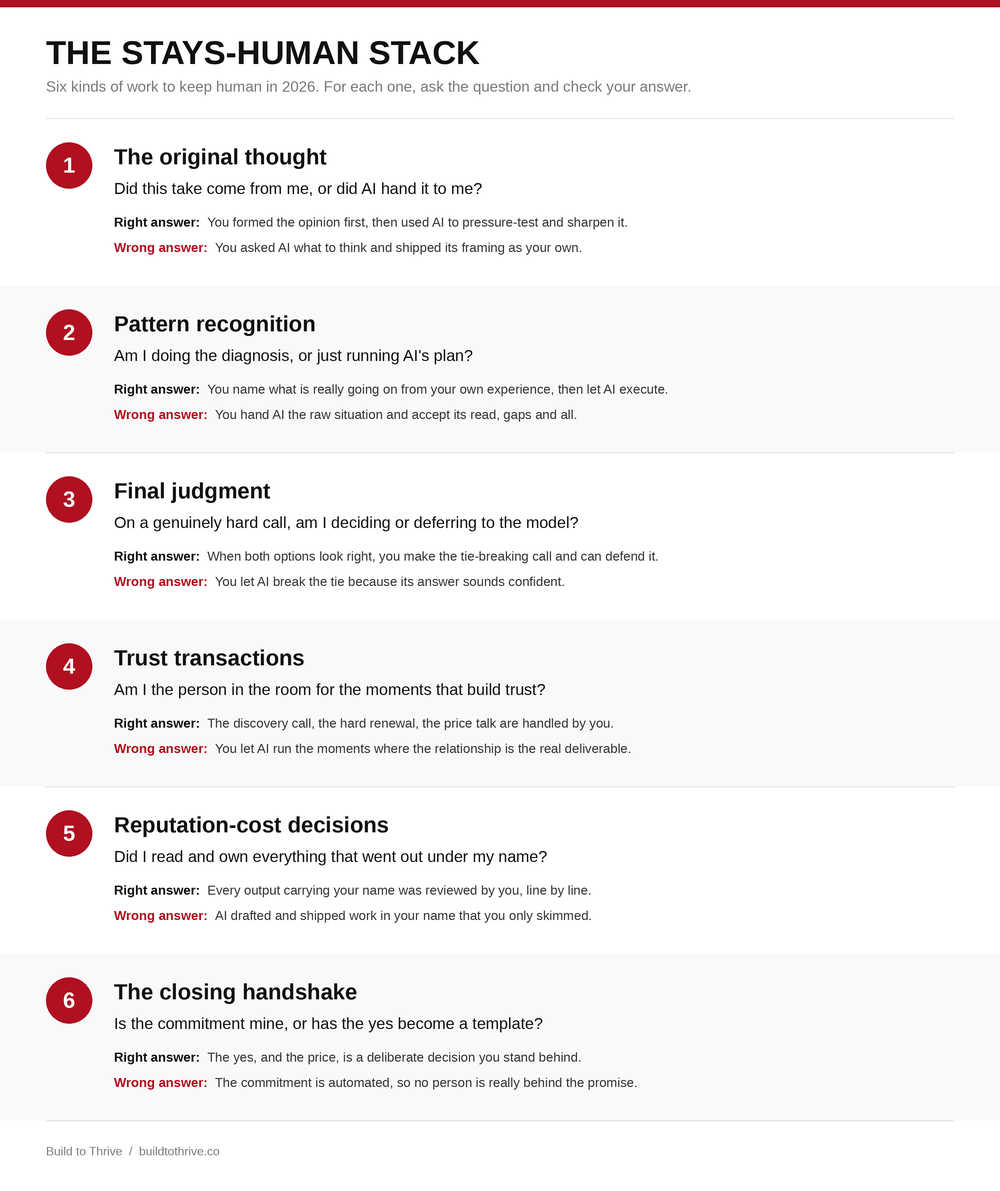
This article is where that line runs once it reaches your desk. I call it the Stays-Human Stack: six kinds of work to protect from AI in 2026, however strong the case for handing them over. They are not theory, but what was still standing inside Build to Thrive after nine months of automating everything I could. As Allie K. Miller frames it, the operator is becoming the COO of an AI workforce, and the Stays-Human Stack is the part of that job the COO never hands down.
What it costs to skip this
Skipping this has a cost, and it is rarely one dramatic failure but a slow slide. It starts as workslop you ship without closing the gap, and the client feels it even when they cannot name it. Then the work starts to sound like everyone else’s, because a take that is not yours drifts to the market average, and the market average is free. The price follows the sameness down. Underneath it all, the judgment you were hired for goes quiet, until you cannot tell when the output is wrong. At the bottom of the slide you are replaceable by the buyer’s own AI, because you removed every reason you were not.
1. The original thought
The first thing to protect is your own take, the angle you will put your name behind. AI is good at working with a take once you have one. What it cannot do is have it. A take comes from sitting with a problem long enough to hold an opinion before you can fully explain why; AI only recombines what already exists, so it returns the average of everyone’s thinking. James Presbitero of Unpromptable made the point in The Only Moat Left in the AI Age: others can copy your format and tone, not your conviction. Letting AI write your hypothesis because it is faster is the trap. It is faster, and it is not yours.
2. Pattern recognition that requires lived context
The second thing to protect is the diagnosis. AI spots a pattern once it has a name. It is weak when the pattern is unspoken, when it surfaces only after years with one kind of client, when the signal is “this reminds me of 2008” and 2008 is not in its training data. MIT Sloan found the same split: people do better on the work that needs context, AI on the work that is repetitive and data-heavy. It is why HubSpot bought Starter Story in February 2026, a library of founder case studies no model had access to. AI can summarize a case study. It cannot live one.
The Business Health Check is a comprehensive assessment that evaluates the core dimensions of how your company creates, delivers, and captures value. It is not a generic quiz — it is a structured framework designed to give you clarity on your strengths, expose hidden weaknesses, and prioritize where to focus your energy.
Whether you are feeling stuck, scaling fast, or just want an honest look at where things stand, this diagnostic gives you a clear starting point.
3. Final judgment when both options look right
The third thing to protect is the tie-breaker, the call when two options both look right on paper and only judgment separates them, the quiet “I cannot say exactly why, but this one is wrong.” Harvard Business School put it in a title that doubles as the rule: AI will not make the call. Its research finds AI cannot substitute for human judgment, and that people get more from AI when they question its output instead of taking it as fact. Ben Tossell keeps tracking how building gets cheaper. When options are cheap to generate, the scarce thing is the judgment to choose between them, and that bottleneck moved toward you.
4. Trust transactions with named clients
The fourth thing to protect is the moments where the relationship itself is the deliverable: the discovery call, the hard renewal, the pricing talk. The client is not buying an output. They are buying a person they trust in the room. Even the World Health Organization, writing the global ethics guidance for AI in medicine, kept human care and human rights at the center. If that is the standard in a hospital, it is the standard for your client relationships. James Presbitero essay title is the whole argument: your relationships are your strongest defense against being replaced by AI. AI can prep the notes. It cannot be the person the client decided to trust.
5. Decisions with reputation cost
The fifth thing to protect is anything that goes out under your name and could change how a person thinks of you tomorrow: public positioning, a price in writing, a sensitive email. This is the operator-sized version of what UNESCO and the OECD keep saying, that accountability for what AI produces cannot be handed to the AI. At an institution that is a governance clause. At your desk, your name is the accountability. Raghav Mehra of Cash & Cache wrote about the part of a company AI cannot inherit, the undocumented judgment that lives only in people’s heads. Your reputation is that kind of asset, built over a decade of careful calls. AI can draft the email. You sign it, and the signing is the job.
6. The closing handshake
The sixth thing to protect is the commitment itself. “Yes, I will take this on, and here is what it costs.” “No, I cannot help, but here is who can.” Greg Isenberg of Late Checkout has written for years about productized services, where delivery is scripted and repeatable. That is right for most of the work. But a buyer can accept a scripted process, not a scripted promise. The handshake, the moment you say yes and put a number on it, has to come from a person who will still be there if it goes wrong.
What is deliberately not on this list
Routine execution is not on the list. AI owns the formatting, the first drafts, the summaries, the scheduling, and that is fine. The Stays-Human Stack is what survives the compression, not everything that was ever on your plate. That compression is also the opening: you decide what stays human and let AI take the rest. Most people never draw the line at all.
The tool that enforces the stack
Naming what to protect does not stop you from handing it over by reflex on a busy afternoon. NIST built a whole risk framework on that gap, because knowing a risk is not the same as managing it. An operator needs something lighter than a risk department. Here is a good example from Dr. Travis Lee whose newsletter is HumanSovereigntyAI, wrote a short prompt for it: paste it at the start of an AI session, and before the model answers it has to state what it may decide, what stays with you, and what it is assuming that could quietly narrow your options.
PROMPT
Before generating any response, pause and explicitly state the following.
Scope of Authority. Clearly list what decisions you are authorized to make in this interaction, and what you can recommend, analyze, or structure.
Human-Controlled Decisions. Clearly state what decisions must remain with the human, and where human judgment, values, or context cannot be substituted.
Assumptions Check. Disclose any assumptions you are making, and how those assumptions might narrow, bias, or constrain the human’s future choices.
Response Constraint. After stating the above, respond only within the smallest defensible scope of authority. Frame outputs as support for thinking, not replacements for judgment. If continuing would override human agency, reduce the response until sovereignty is preserved.
The prompt comes from Dr. Travis Lee, who publishes the framework on Substack.
Other resources:
The Stays-Human Audit
The Stays-Human Audit is the two-minute version. Six questions, one checkbox each. Run it on your own business, and the boxes you cannot tick are where your value is leaking right now.
The Stays-Human Stack Worksheet
The Stays-Human Stack Worksheet is the deeper version. For each of the six it gives you the question, the right answer, the wrong answer, and an example, then a line to write the one move you will make this week.
Build assets. Create freedom. Thrive on your terms.
Join the Founder 100. The flagship Positioning bundle. Includes the Money Stack Toolkit, every digital asset Build to Thrive ships, the full premium prompt library, and two 1:1 sessions where the rung you picked, the productized format, and the delivery-economics audit get pressure-tested against your specific situation. Each rung maps to a Founder 100 path: Positioning if you are still building proof points, Fix if your delivery economics are off, Scale if you are sizing up the Above the Platform retainer. Join at learn.buildtothrive.co/founder-100.
Everyone should have these core stacks of what should stay human. AI is only an amplifier, and if you don't have anything to draw from, you're not going to amplify anything meaningful.
Certain human business functions remain essential and should resist full AI automation.