Two years ago, if you described a company that charges per task completed instead of per employee hired, replaces an entire department with a software workflow, and reaches $250 million in annual revenue with fewer than 50 people, you would have been writing science fiction.
In March 2026, there are at least 50 companies on track to hit that number. Bessemer Venture Partners published their framework for it. Forrester is writing predictions around it. The Agentic AI Conference just released a list of 120 companies operating in this space.
This is not a trend piece about what AI might do. These are business models that are forming right now, pulling in capital, generating revenue, and creating roles that did not exist when most of us were building our careers.
If you are an operator, consultant, or fractional professional watching from the sideline, this is your map. Not to build one of these companies necessarily, but to understand the architecture well enough to know where you fit inside it, sell into it, or build a practice around it.
Here are eight business models that are new.
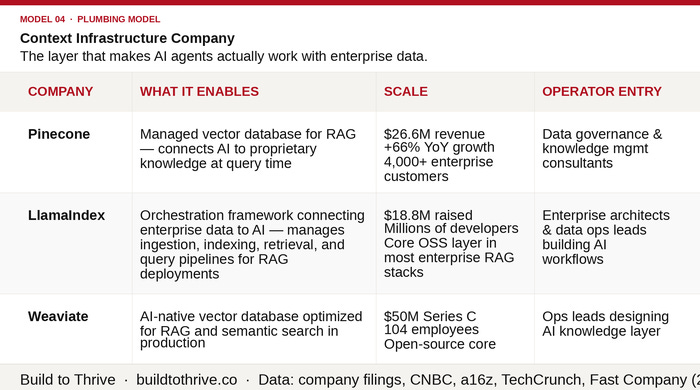
1. The AI-Native Service Company
What it is: A company that delivers what used to require a 30-person agency using software, AI agents, and a small team of operators.
Why it is new: Traditional service companies sell people's time. AI-native service companies sell outcomes delivered by software. The pricing anchors to what a legacy provider would charge, but the margins are fundamentally different because the delivery cost collapsed. A company can undercut a traditional agency by 40% and still run at 70%+ margins.
What is forming: Legal document review firms that process 10x the volume with 20% of the staff. Marketing execution companies that produce and distribute campaign assets without a creative department. Financial analysis shops that deliver quarterly reporting packages in hours, not weeks.
Where operators fit: These companies need people who understand the domain, not the technology. A fractional CMO who knows what good marketing looks like is more valuable to an AI-native marketing firm than a machine learning engineer. The work is quality control, client relationship, and strategic direction. The AI handles production.
The number: BCG estimates a $200 billion opportunity in AI-enabled tech services. The companies capturing it are lean, fast, and looking for experienced operators who can manage outcomes without managing headcount.
2. The Vertical AI Agent Company
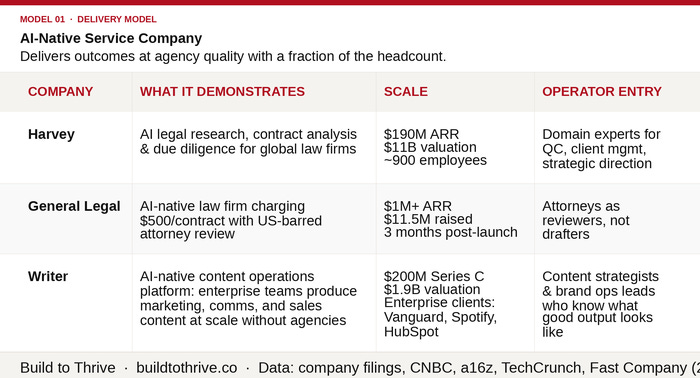
What it is: A company that builds and deploys AI agents designed for one specific industry's workflows.
Why it is new: The AI agents of 2026 are not chatbots. They are systems that run multi-step processes: qualifying leads, processing claims, scheduling appointments, handling intake forms, routing documents, and following up with clients. They work 24/7, cost a fraction of a human employee, and improve with every interaction. The technology is now mature enough to deploy reliably in regulated environments like healthcare, legal, and financial services.
What is forming: Companies building AI receptionists for dental practices. AI intake systems for personal injury law firms. AI scheduling and follow-up agents for home services companies. AI claims processing for insurance brokers. Each one is a focused product serving a $50-$200/month pain point for thousands of small businesses in a single vertical.
Where operators fit: The winning vertical agent companies are not founded by AI researchers. They are founded by people who spent 10 to 15 years inside an industry and know exactly where the workflow breaks. If you have spent your career in healthcare operations, insurance, legal, or real estate, you are sitting on the domain knowledge these companies are built around. The founding teams need people who know the client's world. The AI is the easy part.
The number: Vertical AI is where Forrester, Gartner, and the major VC firms are pointing their 2026 predictions. Domain-trained, industry-specific systems are outperforming general-purpose AI in every regulated sector.
3. The Copilot Company
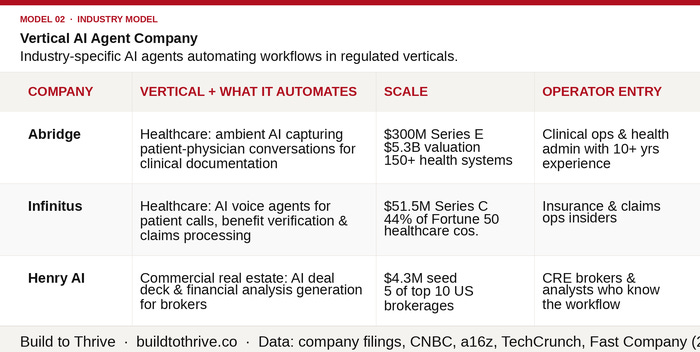
What it is: A software company that embeds AI directly into an existing professional workflow, making the human worker faster without replacing them.
Why it is new: Copilots are not a feature added to existing software. They are an entirely new product category. The business model is familiar (per-seat SaaS pricing tied to headcount), but the product does something no previous software could do: it watches what you are working on and actively helps you do it better in real time.
What is forming: Copilots for financial analysts that draft reports from raw data. Copilots for sales teams that research prospects and draft personalized outreach before a rep opens their inbox. Copilots for project managers that monitor timelines and flag risks before they become problems. Copilots for recruiters that screen, score, and shortlist candidates overnight.
Where operators fit: Copilot companies need two things operators provide. First, workflow expertise. You cannot build a copilot for financial analysts if you have never done financial analysis. The product design requires someone who knows what "good" looks like in a specific role. Second, go-to-market credibility. These products sell to experienced professionals who will not buy from a team that has never done their job. Operators who join copilot companies as advisors, fractional product leads, or go-to-market consultants bring both.
4. The Context Infrastructure Company
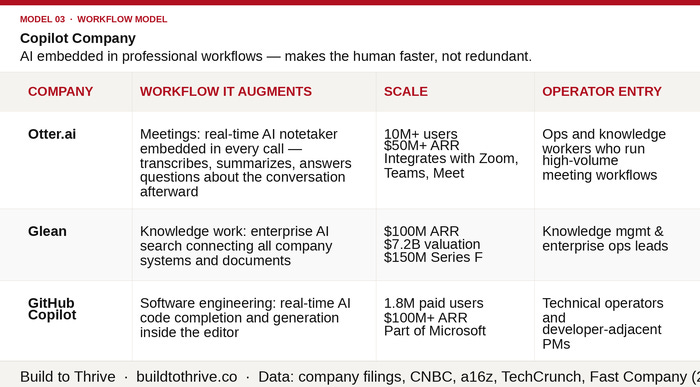
What it is: A company that builds the plumbing layer that makes AI agents and copilots actually work inside an enterprise.
Why it is new: By mid-2026, context engineering is emerging as its own discipline. The problem is not building AI. The problem is giving AI the right information at the right time so it produces useful output instead of hallucinated garbage. Context infrastructure companies build the systems that connect an organization's data, documents, workflows, and institutional knowledge to the AI layer. Without them, every AI deployment is a science project.
What is forming: Companies building semantic layers that sit between enterprise data and AI models. Context engines that manage metadata, retrieve relevant information, and optimize what the AI "sees" before it responds. RAG (retrieval-augmented generation) infrastructure companies that make it possible for AI to work with proprietary data without retraining the model.
Where operators fit: This is infrastructure, so the direct operator play is narrower. But there is a significant consulting opportunity. Every enterprise deploying AI agents needs someone to audit their data, organize their knowledge base, and design the context layer. If you have spent your career in knowledge management, data governance, or enterprise operations, this is a category where your expertise has suddenly become high-value technical consulting.