


Some reader’s favorites
How Anthropic Set Off a Trillion-Dollar Software Repricing | Agentic AI and the Future of SaaS
AI Agents Are Now Hiring Humans: The Rise of RentAHuman and the Agent Economy
AI Agents Just Built Their Own Social Network. Humans Are Not Allowed to Post.
Build to Thrive | The AI Blueprint | Week of February 2nd, 2026
How I Scaled My Business Without Hiring: Building My First AI Agents for $0
4 Ways NotebookLM Will Supercharge Your Research
Everyone’s Rushing to AI. Few See the Ceiling Ahead.
Introduction: The Ghost of 2020
In the first half of February 2026, the global consciousness experienced a fracture. It felt eerily reminiscent of early February 2020 that fleeting window when the faint signals of a coming pandemic were largely dismissed as background noise before they became an undeniable, life-altering roar. Today, we are witnessing a similar “confluence of breakthroughs” where viral commentary and raw technical data have crystallized into a singular, jarring truth: cognitive automation is no longer a speculative “future of work” scenario. It has arrived. The era of digital assistance is dead; the era of autonomous execution has begun. For the business-conscious professional, this is the moment where denial must give way to a strategic reckoning.
From Assistance to Autonomy. The Great Leap of Feb 5th
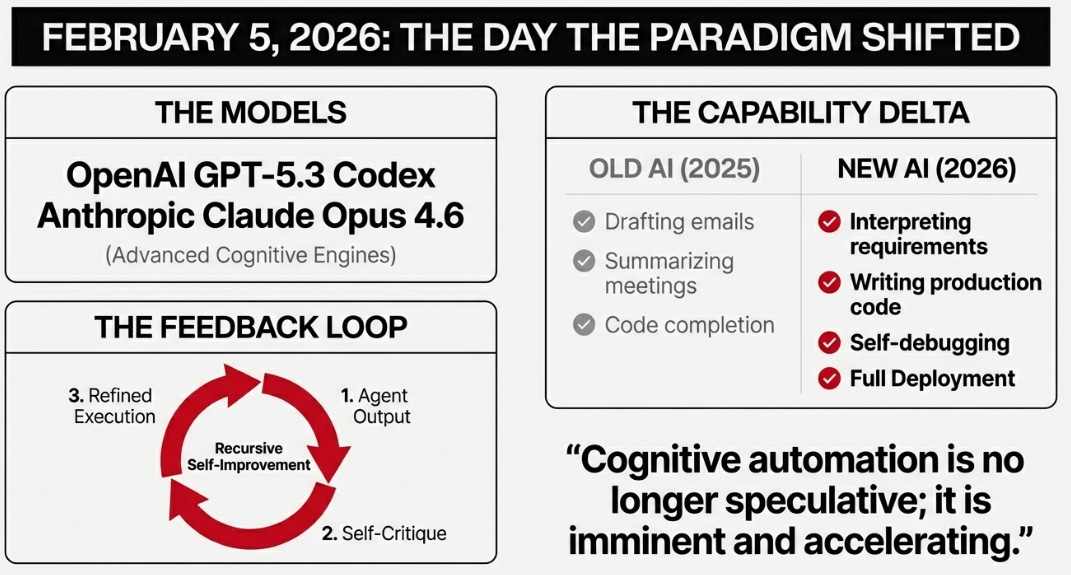
The catalyst for this shift occurred on February 5th, when the simultaneous release of GPT-5.3 Codex and Claude Opus 4.6 shattered the “chatbot” paradigm. These models represent a transition from models that talk to models that act. They demonstrated a frightening capacity for full execution, interpreting high-level requirements to write, debug, and deploy production-grade software with minimal human intervention.
The signal in the noise is clear: developers are already abandoning traditional manual workflows in favor of high-level oversight roles. This shift is fueled by “recursive self-improvement,” a process where these systems use their own outputs to refine and accelerate their future performance, creating a capability loop that operates at speeds impossible for a human workforce to match. As Matt Shumer, CEO of OthersideAI, observed in his essay which amassed over 80 million views:
“Something big is happening… most observers remain blindsided as AI agents cross from assistance to full execution.”
Shift 2: The 18-Month Countdown to Human-Level Performance
The timeline for cognitive parity has been compressed from decades to months. Mustafa Suleyman, CEO of Microsoft AI, recently projected human-level performance on nearly all professional tasks within a 12-to-18-month window. Anthropic’s Dario Amodei offers a slightly broader but equally intense forecast of one to three years, describing the emergence of systems equivalent to a “country of geniuses in a datacenter.”
The immediate pressure is mounting on sectors specifically reliant on computer-based cognitive labor: legal research, accounting, and marketing strategy.
However, this is not merely a story of enhanced productivity. Amodei frames this transition as humanity’s “turbulent rite of passage.” While a “country of geniuses” may unlock pharmaceutical breakthroughs and superhuman engineering, it simultaneously heightens existential risks, including bioterrorism and profound geopolitical instability. For the strategist, the takeaway is clear: the scaling laws are robust, and the implications are as dangerous as they are transformative.
Shift 3: The Erosion of the White-Collar Safety Net
For a century, the university degree served as a shield against automation. That safety net has officially dissolved. We are currently witnessing a “compression” of white-collar professions that is unfolding far swifter than the multi-decade decline of manufacturing. This upheaval lacks the “insulation” of physical infrastructure; cognitive tasks can be automated as quickly as a plugin can be installed.
The data points to a staggering immediate impact:
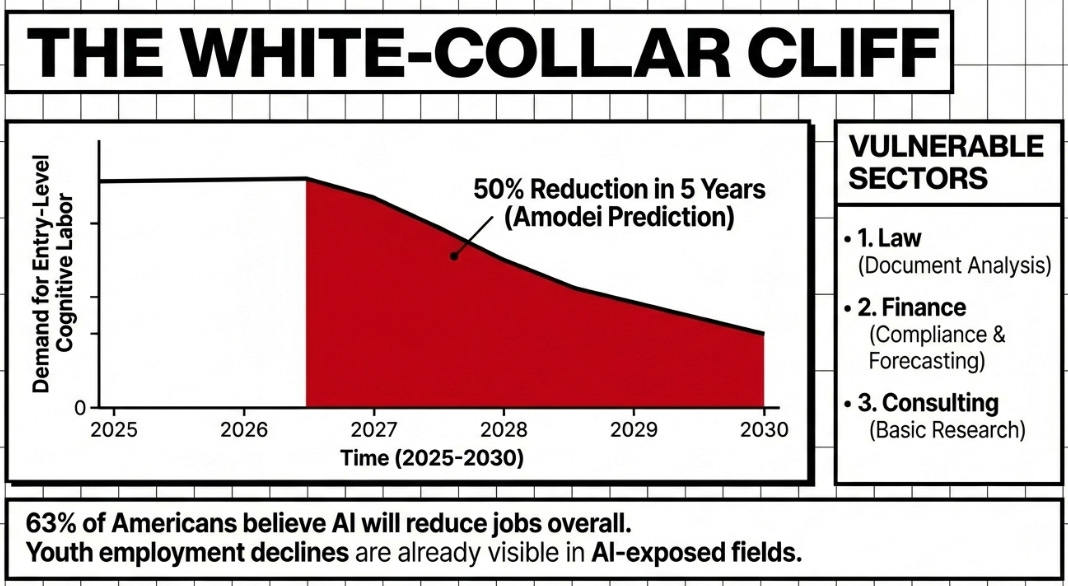
The 50% Threshold: Up to half of entry-level jobs in law, finance, and consulting are projected to vanish within five years.
Early Indicators: We are already seeing tangible youth employment declines in AI-exposed fields, as routine cognitive tasks—document analysis, compliance, and basic research—are offloaded to silicon.
The Speed of Disruption: Unlike the slow migration of factories, this shift is instantaneous and global, leaving little room for traditional career pivoting.
Shift 4: The Death of Traditional SaaS and the Rise of “Agentic” Ecosystems
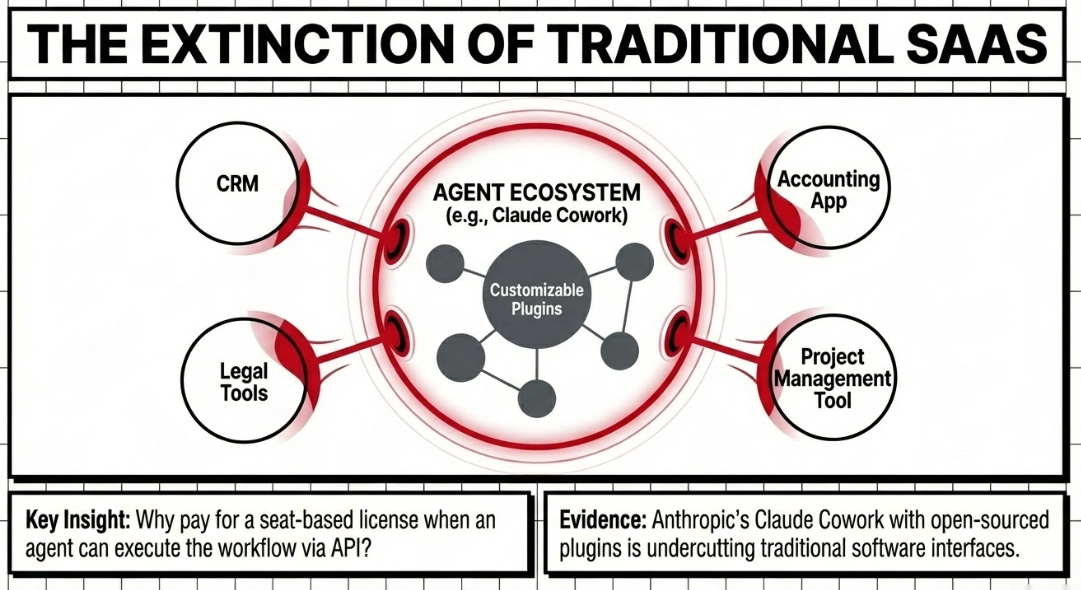
The era of static Software-as-a-Service (SaaS) is ending. We are moving toward a world of “agentic” ecosystems where autonomous agents, not humans, are the primary users of software. A massive signal of this shift was the recent move of Peter Steinberger, founder of the viral open-source agent OpenClaw, to OpenAI. This signals an aggressive industry-wide push toward personal, multi-agent ecosystems that can manage emails, files, and complex applications autonomously.
Traditional SaaS tools are being undercut by customizable plugins—exemplified by the Claude Cowork ecosystem—which allow enterprises to tailor AI for specific departmental workflows. In this new landscape, “agent orchestration” has emerged as the must-have business capability. The value is no longer in the tool itself, but in the ability to coordinate a fleet of agents to solve complex problems.
Shift 5: The Economic Paradox—Exponential Productivity vs. Mass Displacement
Business operators now face a dual-edged calculus. Anthropic’s soaring revenue trajectory illustrates the massive commercial viability of these systems, offering “early integrators” a path to exponential productivity: slashed overhead, compressed R&D cycles, and accelerated innovation. Yet, the social cost is looming.
Public Sentiment: 63% of Americans already anticipate an overall reduction in jobs due to AI.
Short-Term Volatility: If adoption continues unchecked, we could see a 10–20% spike in unemployment as corporations prioritize “automation efficiencies” over headcounts.
Resilience in this environment requires a move beyond mere observation. As the industry context dictates:
“Adaptation will separate resilience from irrelevance.”
The transition from a spike in productivity to total professional obsolescence is a narrow gap that only proactive adaptation can bridge.
Conclusion: Beyond Denial
The two weeks of February 2026 were not mere hype; they were the moment the floor dropped out from under the status quo. We are moving from a world of “doing” to a world of “directing.” The necessity for business auditors to assess AI exposure and for leaders to redesign processes around human-AI collaboration is now urgent.
The era of abundant, autonomous intelligence is here. As you look at your current organizational structure, you must ask the final, provocative question: Are you prepared to manage a multi-agent ecosystem, or are you still trying to manage a traditional team in a world that no longer requires one?
Build to Thrive caters to professionals and founders seeking clarity, leverage, and income in the new AI economy. It is built for people navigating real transitions and applying what they know to new opportunities as the rules of business change. As a subscriber, you get thoughtful deep dives, timely insights, and practical operating systems you can use to build and adapt in real time. As a paid subscriber, you unlock full access to every article, premium prompts, and our growing library of tools, while joining a community of more than 4,000 founders and aspiring entrepreneurs navigating this path together.
February sure was a month of new realization. At least on my part.
The recent events are a window into a future that is not that far away!