


Build to Thrive caters to professionals and founders seeking clarity, leverage, and income in the new AI economy. It is built for people navigating real transitions and applying what they know to new opportunities as the rules of business change. As a subscriber, you get thoughtful deep dives, timely insights, and practical operating systems you can use to build and adapt in real time. As a paid subscriber, you unlock full access to every article, premium prompts, and our growing library of tools, while joining a community of more than 4,000 founders and aspiring entrepreneurs navigating this path together.
Editorial Note
Hello folks,
Quick heads up before we dive in. I’ve had this low-level “wait…that’s new” feeling all week.
Nothing huge happened. No big launch that everyone’s dunking on. But when you step back and look at the prompts, the automation news, and the market chatter together, it’s pretty clear something shifted.
The work moved.
Like, not “AI gives you ideas” moved. More like it’s starting to live inside the work. Inside the files. Inside the handoffs. Inside the little coordination loops that used to require you (or someone you paid) to keep a bunch of plates spinning. Drafts show up faster than you can think. Follow-ups get queued. Summaries get passed along. The annoying glue work starts happening without a whole ritual around it.
Clawbot is the clearest example of that vibe. Clawbot isn’t another prompt toy, it’s trying to be a persistent operator that sits alongside your work, keeps context, and actually handles small actions across your tools, the kind of stuff that quietly eats a solopreneur alive. Follow-ups, routing, moving info between places, keeping threads from dying, turning notes into something usable. Less “tell me what to do,” more “I’ll take care of the boring parts and bring you exceptions.”. It’s not really about chatting. It’s about having something that sits in your day-to-day flow, holds context, and takes care of the small “move this from here to there, remind this person, keep this thread alive” stuff that usually dies in the inbox. Which is great, but it also raises the real question: what are you comfortable letting run without you hovering over it?
As we follow this edition, we have the Clarity prompts lead this edition. They’re not hustle tools. They’re guardrails for your brain: a way to see a pitch without getting hypnotized by it, a way to get momentum when you’re overloaded, and a way to give feedback without flattening someone’s voice.
Then you’ll see the same pattern everywhere else: Automation is about orchestration and fewer handoffs. Strategy is basically saying coordination is becoming optional, and paying humans for repeatable glue is starting to look like a quiet tax. Capital Narratives is the reminder that the market isn’t buying vibes. It’s buying margins, security, and proof.
Enjoy your AI Blueprint. JS
—🔴—🔴—🔴
Table of Contents
Clarity Prompts
VC-Grade Pitch and Report Analyzer
AI Execution Momentum Builder
Feedback Studio for teachers
Featured Article: How I Reclaimed My Attention by Making One Decision Stick
AI Automation Leverage
Practical automations that increase output without adding headcount
Strategic Terrain
How AI is reshaping operating models and competitive advantage
AI Capital Market Narratives
The stories shaping risk, margins, and valuation
—🔴—🔴—🔴
Clarity Prompts
This week, I’m introducing three prompts that act like guardrails for thinking. One helps you see a pitch the way an investor does—clear, structured, and allergic to hype. One is built for pressure moments, when you don’t need a plan, you need momentum. And one turns AI into a teaching assistant, helping you draft actionable feedback while protecting student voice and academic integrity.
—🔴
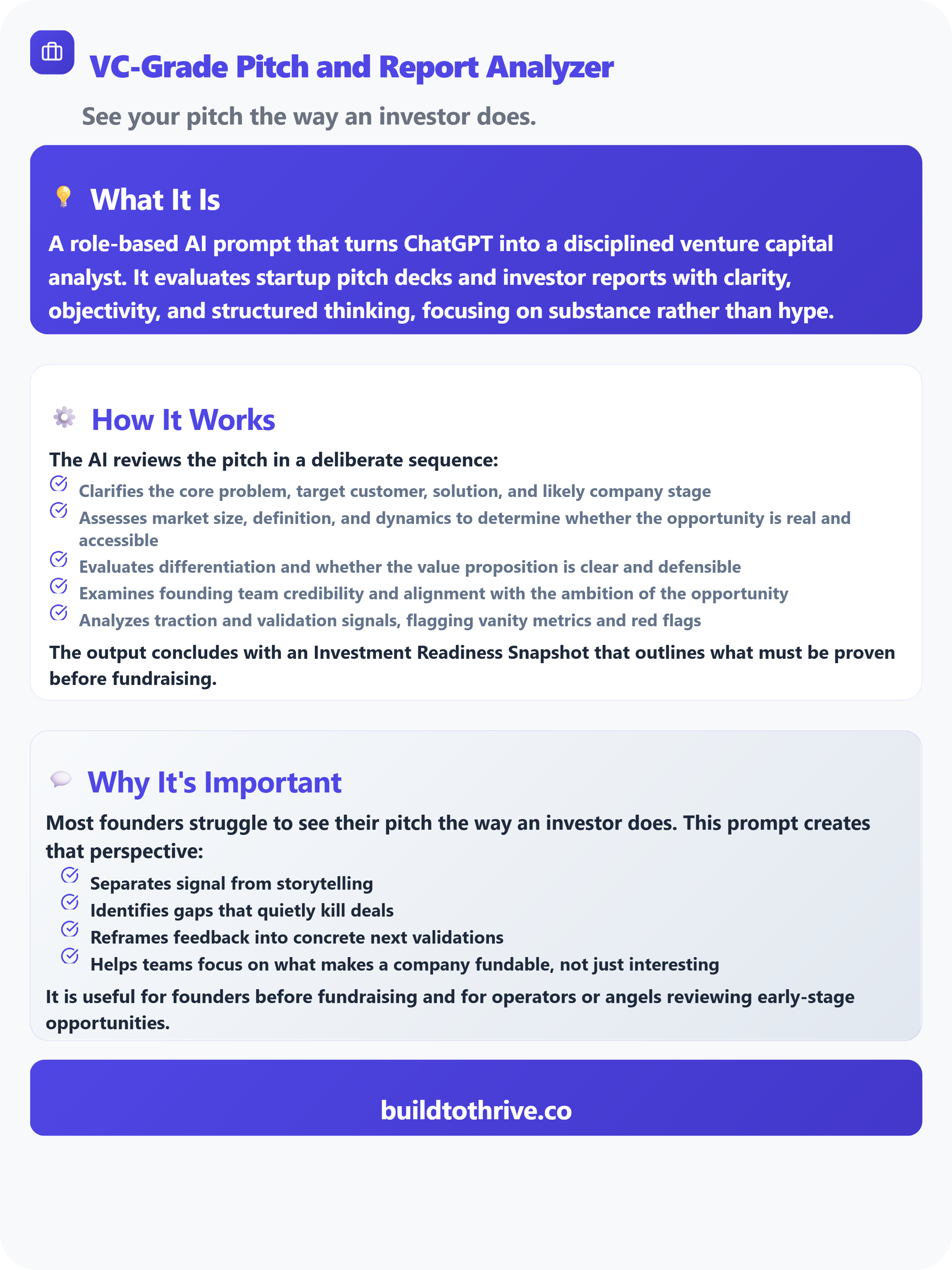
VC-Grade Pitch and Report Analyzer
By Charu
The The Founder-VC Vibe is a signal-driven newsletter focused on global startup ecosystems, venture, innovation, AI, and emerging technologies. It cuts through the noise and surfaces practical lessons and patterns you can actually use, whether you are building, investing, advising, or trying to stay oriented as the landscape shifts. In a market where startup content often swings between hype and cynicism, The Founder-VC Vibe stands out for its clarity and ecosystem-level perspective.
If you care about where innovation is really moving, how capital and talent are flowing, and what trends in AI and emerging tech are worth paying attention to before they become obvious, this is a perspective worth following.
—🔴
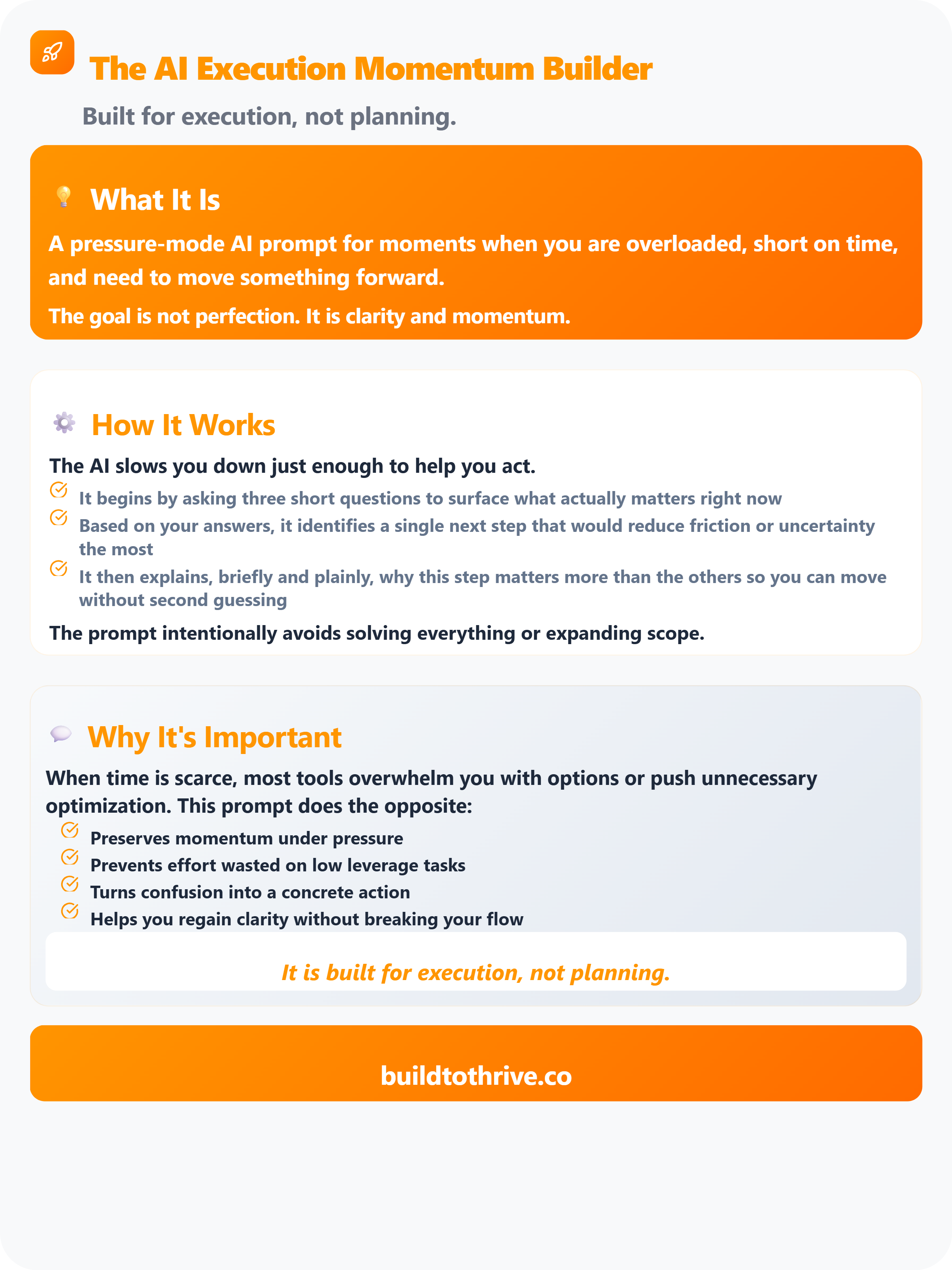
The AI Execution Momentum Builder
By ClariSynth
ClariSynth is built around a simple idea that most people underestimate: clarity is a competitive advantage. Instead of adding to the AI noise, it aims to subtract. The lens is AI minimalism and calm execution. Fewer tools, tighter workflows, and practical templates that make work easier, faster, and less stressful. It is written for small business owners, creators, and professionals who want AI to feel like an assistant, not another source of overwhelm.
If you’ve been curious about AI but turned off by the constant flood of prompts, trends, and tool lists, this is a perspective worth following. ClariSynth focuses on repeatable workflows, paste-ready templates, and clear before-and-after examples designed to save time and reduce cognitive load. It’s not hype. It’s a weekly reset toward simpler, more intentional work.
—🔴
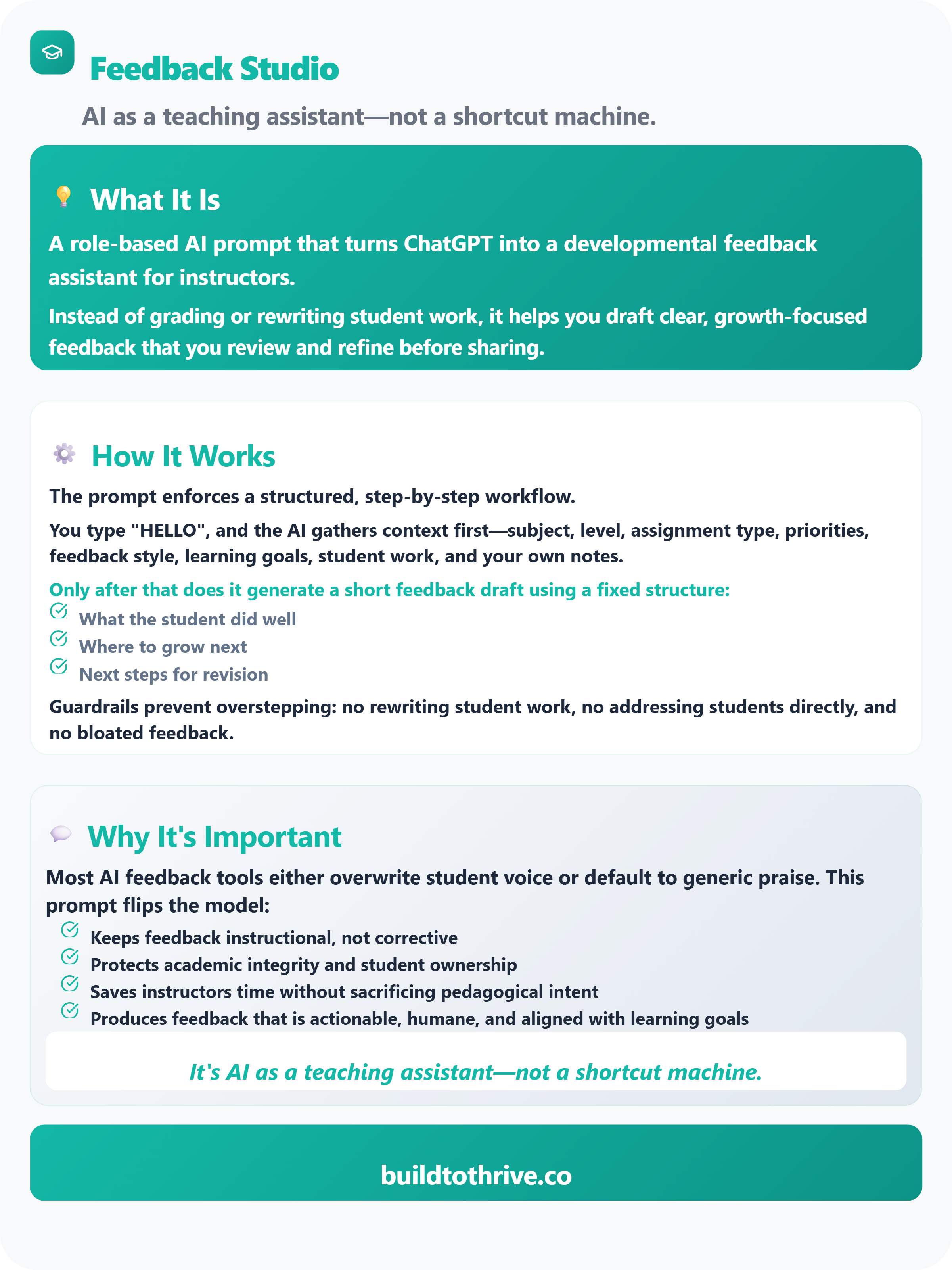
Feedback Studio
By Doan Winkel
How to Teach With AI is Doan Winkel’s field guide for educators trying to make sense of what changed when GPT arrived and what to do with it next. It’s written from inside the work. Doan didn’t just read threads and repost prompts. He tested tools daily, shared experiments publicly, and then took what he learned into real classrooms and institutions through workshops, keynotes, and faculty training programs across multiple countries.
If you teach, train, or design learning experiences and you’re asking “how do I actually use AI to improve engagement and learning without turning my course into a gimmick,” this is a perspective worth following. It’s practical, teacher-first, and built around simple steps, guides, and examples that help you move from curiosity to competence.
—🔴—🔴—🔴
Featured Article:
Navigating AI's Shadow - by Juan Salas-Romer
Grief, Adaptation, and the Quiet Unbundling of Value

—🔴—🔴—🔴
AI Automation Leverage - Grow Margins
Practical automations that increase output without adding headcount
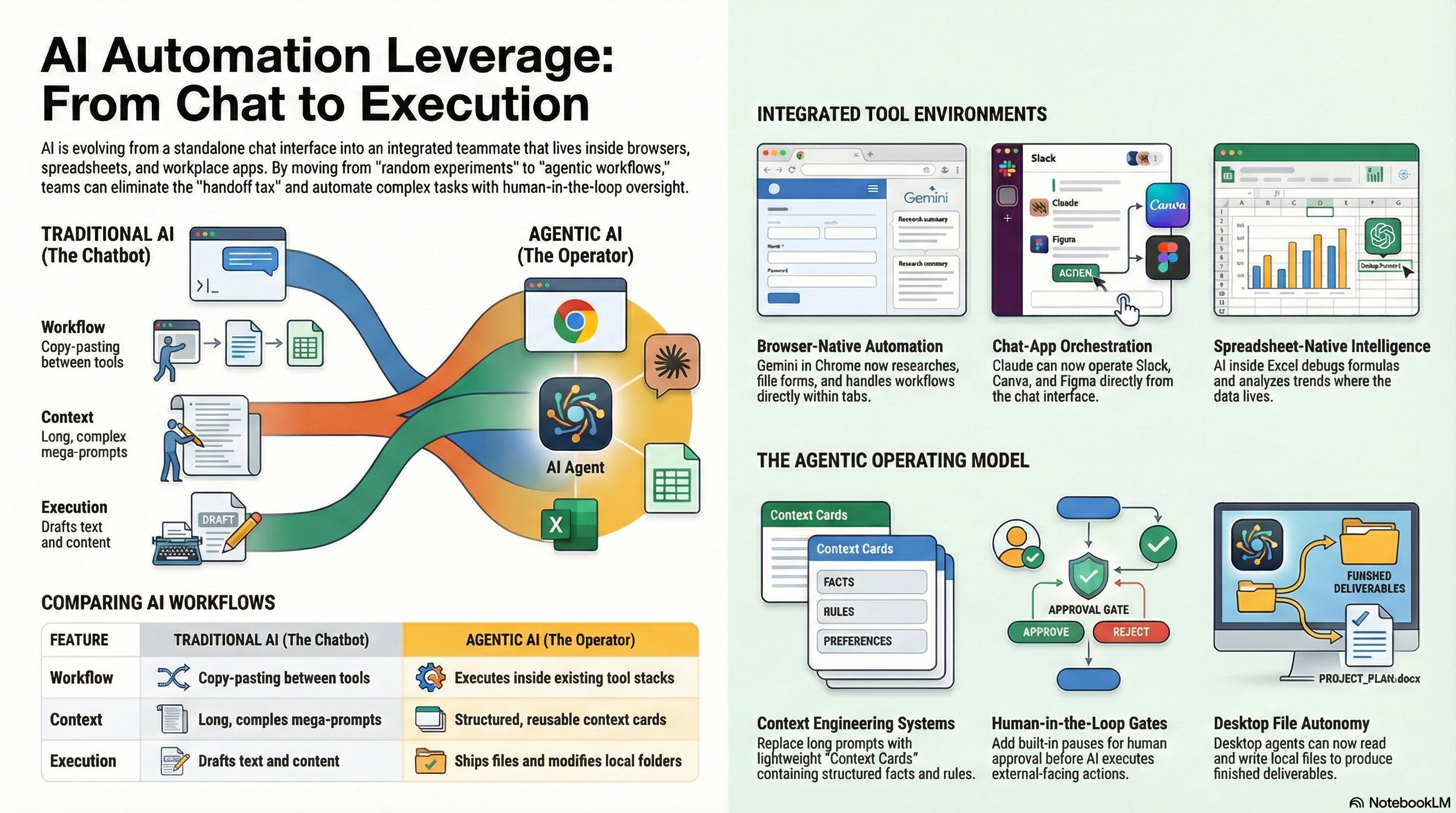
This week’s AI landscape clearly shows AI moving from isolated tools to central operational hubs for small teams. From interactive integrations inside chat assistants to unified creative platforms, the trend is about streamlining workflows, reducing app switching, and saving hours of manual work. Whether you’re automating communications or consolidating creative and project workflows, these developments make AI more actionable and accessible for small operators.
AI as Your Control Center
MCP Apps turn Claude into a productivity hub
MCP unites Claude chat with apps like Slack, Figma, and Canva (The Verge)
Anthropic’s Claude now integrates major workplace tools (Slack, Asana, Figma, Canva, and more) directly into the chat interface so you can draft messages, manage projects, edit designs, and update dashboards without switching tabs. This reduces friction and increases focus on real work. (The Verge)
Practical Takeaway: Connect your Slack, project boards, and design tools to Claude and start automating routine cross-app tasks right from your AI assistant.
Expand Automation to Everyday Tasks
New AI tool “Cowork” targets non-tech users
Claude Code chief on Anthropic’s new AI tool: Non-programmers will soon be … (Times of India)
Anthropic is broadening AI assistance with “Cowork,” an AI agent for file and task management built for everyday productivity, not just coding. It aims to make AI automation accessible to non-technical users. (The Times of India)
Practical Takeaway: Try “Cowork” (if available) to automate organizing files, summarizing documents, or task batching without coding.
Unified AI Tool Platforms Simplify Workflows
FLORA raises $42M to unify AI tools for creative workflows
FLORA raised $42 million for its creative platform that pulls together top AI tools (Business Insider)
FLORA’s platform lets teams use multiple AI models (ChatGPT, Nano Banana) within one interface for ideation, assets, and output, eliminating subscription chaos and frequent tool switching. (Business Insider)
Practical Takeaway: Evaluate whether a unified AI platform like FLORA can replace multiple single-purpose tools in your workflow and reduce context switching.
Small Business Automation Is Proven ROI
Best AI tools for small business automation
Best AI Tools for Small Business Automation in 2025 (Superprompt)
Recent analysis finds that small businesses using AI tools see 25–40% cost savings and up to 800+ hours saved monthly, with workflow automation platforms like Zapier and Lindy offering fast impact. (Superprompt)
Practical Takeaway: Start with one workflow automation tool (e.g., Zapier or Lindy) this week to automate email follow-ups or CRM updates and track time saved.
Workflow Automation Tools Still Essential
Still consider AI workflow automation platforms
7 Best AI Workflow Automation Tools in 2025 (Diaflow)
Comprehensive platforms (no-code AI workflow builders) can replace fragmented tools, handle lead qualification to internal approvals, and let small teams build intelligent workflows with minimal coding. (Diaflow)
Practical Takeaway: Pick a no-code workflow automation tool and build a documented workflow (e.g., lead → follow-up → CRM update) to reduce repetitive tasks.
Why It Matters
AI is now becoming a central operations layer, not just a helper. Features like embedded apps in Claude and unified platforms like FLORA show that work isn’t something you switch between, it’s something AI orchestrates for you. For small teams with limited headcount, this means less manual context switching, more consistency, and measurable time savings. Early adoption of workflow automation builds a compounding capacity advantage as tasks that once required manual input now run reliably in the background.
Founder Reflection
What routine task that currently steals hours from your day could be fully automated by AI this quarter if you built a simple workflow for it this week?
—🔴—🔴—🔴
Strategic Terrain - Design Smarter
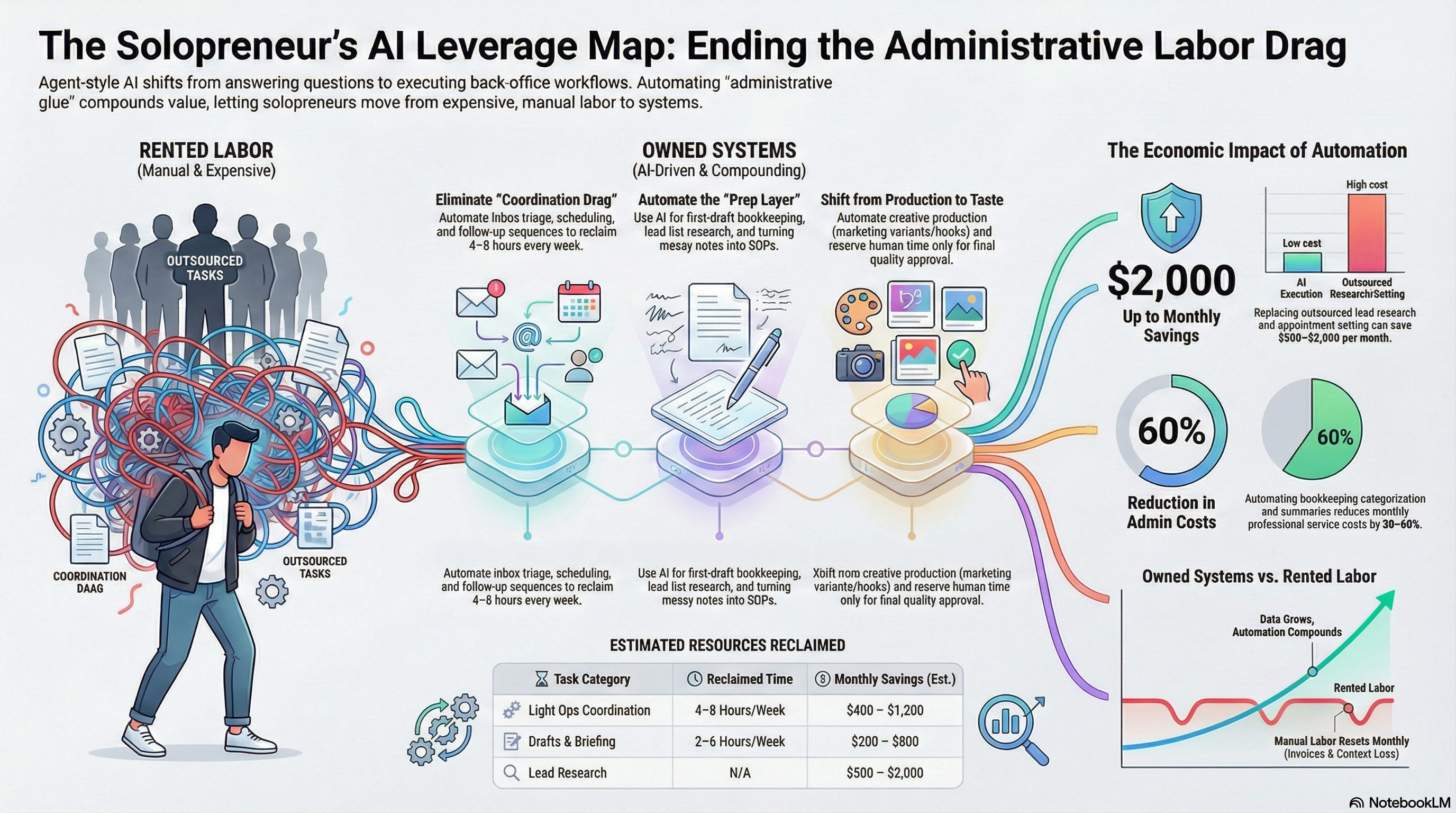
This week, the practical shift is that agent-style AI isn’t just answering you, it’s starting to run repeatable back-office workflows end-to-end (draft → route → check → ship), which is where solo execution actually bottlenecks. (HBR)
Solopreneurs are still overpaying humans for admin glue: inbox triage, follow-ups, reporting, basic bookkeeping prep, and “turn these notes into something usable.” Delay is expensive because every week you keep renting labor, you’re also delaying the compounding effect of owned automation (systems that get better as your business produces more data). (Yahoo Finance)
Strategic Signals
Coordination work is now optional.
Work that’s now unnecessary: paying a VA to triage inbox + schedule + chase confirmations. Replaced human task: “light ops” coordination. Translation: reclaim ~4–8 hours/week or ~$400–$1,200/month by having AI draft responses, queue follow-ups, and hand you only exceptions. (HBR)
First drafts are no longer a job.
Work that’s now unnecessary: paying someone to turn messy notes into client briefs, proposals, or SOPs. Replaced human task: junior writer/ops assistant. Translation: cut 2–6 hours/week (or $200–$800/month) by having AI produce first drafts + structured checklists you approve once. (HBR)
“creative throughput” is cheap now, taste is the bottleneck.
Work that’s now unnecessary: outsourcing basic marketing variants, hooks, angle-testing, repurposing. Replaced human task: freelancer copy/design production. Translation: save $300–$1,500/month by generating batches and keeping a human-only final taste pass for what you personally care about. (HBR)
Prep-layer bookkeeping is automatable.
Work that’s now unnecessary: paying a bookkeeper for data-entry-style prep (categorization, summaries, “what happened last month” drafts). Replaced human task: transactional bookkeeping prep. Translation: reduce monthly bookkeeping cost and/or meetings by 30–60% by automating the prep layer and reserving paid time for judgment calls. (Yahoo Finance)
Outsourced lead research is increasingly a bad trade.
Work that’s now unnecessary: outsourcing lead list research + first-touch personalization as a “cheap SDR substitute.” Replaced human task: list builder/appointment setter. Translation: save $500–$2,000/month by automating research + first drafts and only stepping in for high-intent replies. (Yahoo Finance)
Why It Matters
At solo scale, AI competence is no longer a nice-to-have, it’s becoming assumed, which quietly raises the execution baseline for everyone who competes with you.
Renting labor for repeatable work is structurally inferior to owning execution, because your process doesn’t compound — it resets every month with invoices, context loss, and coordination drag.
How It Affects Solopreneurs
Your leverage expanded most in the unsexy places: follow-ups, drafts, summaries, routing, and “make this usable,” because those are predictable and high-frequency. (HBR)
When you keep quality in your hands (taste, positioning, final decisions) and automate throughput, your output compounds faster without adding people — and continued outsourcing quietly taxes your margin and attention every single week. (HBR)
Top Articles of the Week
Is Your Workplace Set Up for AI Agents?
Source: Harvard Business ReviewGetting Creative with AI
Source: Harvard Business Review7 AI Tools That Run a One-Person Business in 2026
Source: EntrepreneurMIT report: 95% of generative AI pilots at companies are failing
Source: Yahoo FinanceGoldman: Small businesses using AI say it has a positive impact — and not because it is replacing workers
Source: Yahoo Finance
Pause and Reflect
What are you still paying a human to do that is basically “move text from here to there, then remind someone,” and why haven’t you fired that invoice yet?
If a competitor automates their back office this month, what do they ship in March that you’ll still be “coordinating” into April?
—🔴—🔴—🔴
AI Capital Market Narratives - Move Early
The stories shaping risk, margins, and valuation
Top 5 AI Narratives
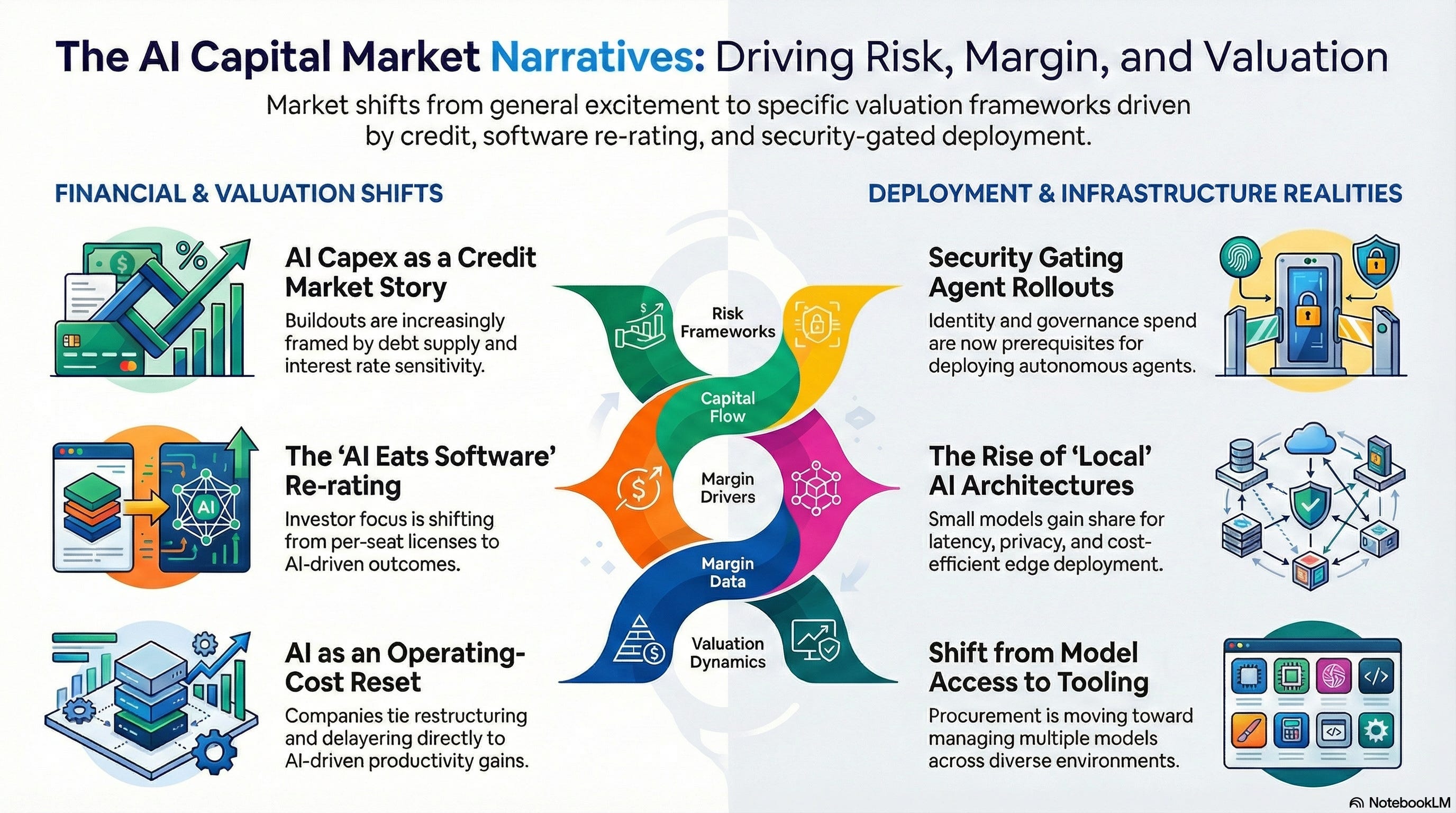
AI capex is becoming a credit-market story
What authoritative voices are saying: AI buildouts are increasingly framed through IG supply, spreads, and rate sensitivity—not just equity upside.
What critics are arguing: Balance sheets can absorb it; the “macro spillover” angle is overplayed.
Signal: Track funding mix (debt vs. internal cash) as a real constraint on pace and discipline.
“AI eats software” is now a mainstream re-rating framework
What authoritative voices are saying: Investors are treating portions of app software as structurally exposed as AI shifts value from seats to outcomes and embedded capability.
What critics are arguing: Incumbents still own distribution, data, and workflow—AI is additive, not substitutive.
Signal: Watch who can repackage pricing (usage/outcomes) without margin leakage.
AI is being underwritten as an operating-cost reset
What authoritative voices are saying: More companies explicitly tie delayering and restructuring to AI/automation, reframing productivity as a margin lever.
What critics are arguing: Cost cuts are outrunning proven deployment; benefits may lag reality.
Signal: Treat “AI efficiency” as an audit: demand measurable throughput, not slogans.
Security and identity are the gating factors for agents
What authoritative voices are saying: As agents touch systems of record, spend shifts toward identity, governance, and fraud defense as deployment prerequisites.
What critics are arguing: It’s mostly rebranding of existing IAM and monitoring.
Signal: Security share-of-wallet is a cleaner proxy for real agent rollout than pilot counts.
Small models are driving “local” AI architectures
What authoritative voices are saying: Smaller models are gaining share for latency, privacy, and cost—moving workloads closer to the edge and into hybrid stacks.
What critics are arguing: Fragmentation raises complexity; centralized models still win on breadth/quality.
Signal: Watch procurement drift from “model access” to tooling that manages many models across environments.
Really enjoyed being part of this piece. Grateful for the collaboration, Juan!
One thing that stands out to me is how AI is quietly shifting from being a content tool to a thinking partner especially in high-context work like evaluating ideas, strategies, and opportunities. When used well, AI doesn’t replace judgment, it helps us surface blind spots, ask sharper questions, and be more consistent in how we think.
That’s powerful for creators, founders, operators, and investors alike. 'Build to Thrive' is driving that shift every week.
Thank you for the opportunity and sharing!