


Some reader’s favorites
AI Agents Are Now Hiring Humans: The Rise of RentAHuman and the Agent Economy
AI Agents Just Built Their Own Social Network. Humans Are Not Allowed to Post.
Build to Thrive | The AI Blueprint | Week of February 2nd, 2026
How I Scaled My Business Without Hiring: Building My First AI Agents for $0
4 Ways NotebookLM Will Supercharge Your Research
Everyone’s Rushing to AI. Few See the Ceiling Ahead.
—🔴—🔴—🔴
Tuesday morning, February 3, 2026.
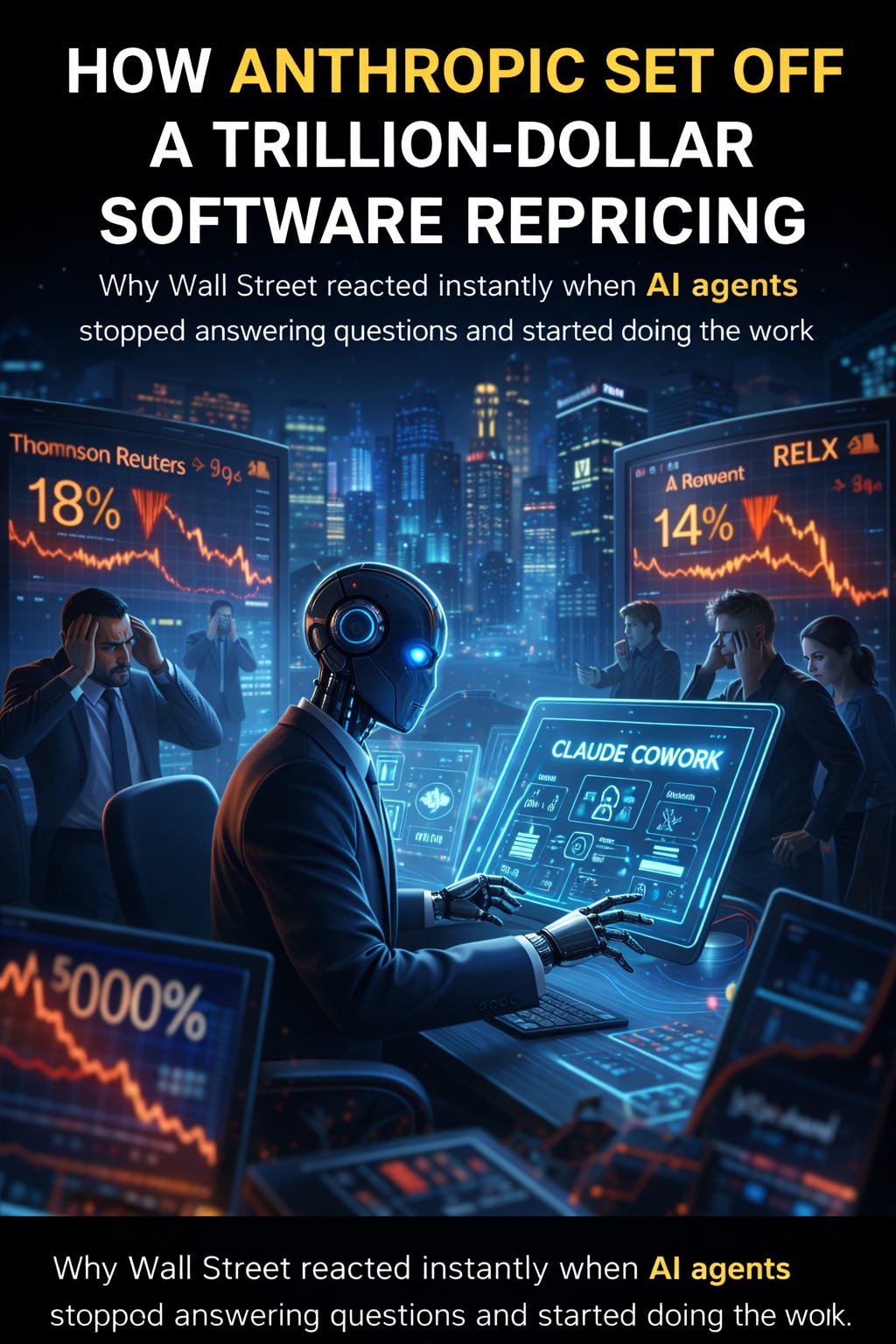
Thomson Reuters, after more than 200 years as the backbone of legal research, fell as much as 18 percent intraday, closing down roughly 16 percent. RELX, the parent of LexisNexis, dropped between 13 and 15 percent. Across software, data, and legal tech, stocks bled hundreds of billions in market value in a single session.
No earnings miss, no regulation, no macro surprise.
Just a product release.
In late January, Anthropic open-sourced eleven plugins for Claude Cowork, its agentic desktop workspace. On paper, the release looked incremental, another AI tool with another set of features.
That is not how the market read it.
When trading opened on February 3, Bloomberg and Reuters tied the selloff directly to Anthropic’s release. The concern was not that Claude became marginally smarter, but that something structural broke, namely the economic logic holding up large parts of the enterprise software stack.
Bloomberg estimated the rout at roughly $285 billion across exposed sectors. This was not panic, it was recognition.
Markets do not price rollout timelines, they price pressure.
This release applied pressure exactly where modern organizations are weakest.
From assistant to coworker
Claude Cowork is not a chat window, it is an execution layer.
You give it a goal, Claude plans the steps, invokes the relevant plugins, chains actions together, and delivers a finished output. Not a suggestion, not a draft to babysit, but an output.
The plugins make that execution role-specific.
Claude is no longer framed as “helping” legal, sales, or finance teams. It is designed to perform the work those functions exist to do.
The plugins that rattled investors map cleanly to how real companies operate:
Legal plugin
Reads full contracts, flags risk using green, yellow, and red severity, triages NDAs, suggests redlines, and tracks compliance playbooks, often in under two minutes.
Sales plugin
Researches prospects, pulls CRM context, drafts outreach and deal documents, reviews pipelines, and prepares negotiation strategies.
Finance plugin
Checks margins, evaluates discounts, runs variance analysis, builds forecasts, and supports audit preparation.
Marketing plugin
Drafts content, plans campaigns, enforces brand voice, analyzes competitors, and reports performance.
Data plugin
Queries datasets in plain English, writes SQL, visualizes trends, and builds dashboards.
The remaining plugins fill in the rest of the org chart: productivity orchestration, customer support, product management, enterprise search, bio-research, and a builder for custom agents.
None of these capabilities are magical in isolation.
What destabilizes the stack is that Cowork chains them.
Each plugin can operate independently, while Cowork turns them into a single execution flow. That is the break.
The disruption does not come from eliminating humans, but from collapsing triage. Even when people remain final approvers, shrinking review cycles from hours to minutes changes the economics.
Why Wall Street panicked
To understand the reaction, it helps to look past abstractions and focus on something painfully familiar: closing a $50,000 annual SaaS contract at a mid-size company.
What follows is a close illustration, grounded in commonly cited enterprise deal timelines and the published capabilities of Anthropic’s plugins, rather than a verbatim replay of one specific transaction.
A traditional workflow
9:00 AM — A sales rep receives a qualified lead. Five tabs open almost immediately: CRM, LinkedIn, search, old proposals, Slack. Most of the day disappears into research and drafting. The proposal goes out late.
The next morning — Finance opens the deal. Margin history is pulled, spreadsheets are updated, prior invoices are reviewed, and a question is sent to accounting that will not be answered until after lunch. Hours pass before a response comes back: a 20 percent discount is acceptable.
Sales forwards the deal to operations. Ops checks onboarding capacity, pings engineering, and waits. A couple of hours later, next Monday is confirmed.
Legal receives the contract. A full read-through follows, along with markups and internal discussion. One clause feels off, so outside counsel is looped in. Calendars enter the picture.
The client pushes back on language, triggering another revision cycle. Emails pile up, nobody feels slow, yet nothing moves quickly.
Total human time across departments often reaches 20 to 25 hours.
Elapsed time stretches across seven to ten business days.
This is not inefficiency, it is structure.
A best-case agentic workflow
In a best-case Cowork flow, a single operator initiates the same process inside one workspace.
The Sales plugin researches the lead and drafts the initial contract in minutes.
The Finance plugin checks margins and discount thresholds in seconds.
The Operations plugin queries onboarding capacity in near real time.
The Legal plugin scans the full contract, flags risk, and suggests fixes in under two minutes.
A human attorney still reviews and approves the flagged sections.
End to end, the process compresses to under an hour.
One person, one screen, one voice.
The exact numbers will vary, but the structure is instantly recognizable to anyone who has closed a deal inside a modern organization.
That delta, measured in days versus minutes, is what the market reacted to.
This shift does not require companies to be visionary, it only requires budgets to tighten.
The math that broke the spell
Twenty-plus human hours collapse into under one hour.
Across dozens of deals each month, the traditional process consumes hundreds of labor hours and thousands in outside legal fees, while the agentic version barely registers as cost.
Cycle times shrink, throughput rises, and headcount remains flat.
That is the repricing.
Not all software disappears. Systems of record persist, infrastructure persists, and deeply regulated cores persist.
Software that exists primarily to move work between humans, including handoffs, approvals, and coordination layers, suddenly looks fragile.
When execution becomes cheaper than coordination, value migrates.
Claude is no longer answering questions, it is executing work.
This transition will not land evenly or cleanly. Organizations will resist, lawyers will slow it down, and procurement will stall.
Resistance, however, does not remove the pressure, it concentrates it.
On Tuesday morning, the market decided that pressure was real.