How senior operators are using AI to charge $3,000 per 48-hour project
Here’s the buyer-side trade, the operator economics, the retainer math, and the nine domains shipping right now. Every number sourced.
Let me show you what’s happening in the consulting market right now.
If you’re a senior consultant, fractional, or advisor with five to fifteen years in your domain, this is the most useful math you’ll see this week.
A new model is emerging. Some call it AI Micro Consulting (Digital Applied). Others call it productized AI consulting (ManyRequests, Consulting Success), or solo-tier AI consulting (Bushe). The name is still settling. The economics are not.
Start from the buyer’s side
Imagine you’re leading finance at a mid-sized company. You need a defensible recommendation by the end of the month.
The old way: you hire a large consulting firm. They assign a team. It takes four to six weeks and costs around $40,000.
The new way: one experienced operator, using AI tools, spends a focused day or two and ships a clear answer in 48 hours. For roughly $3,000.
Same defensible artifact. A tenth the cycle time. A fraction of the cost.
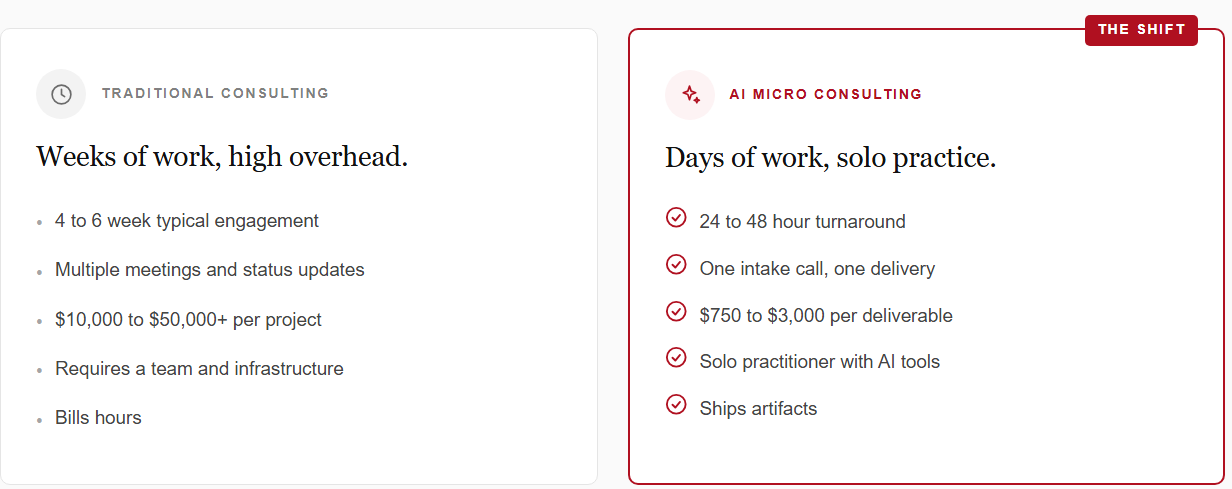
Traditional consulting AI Micro Consulting 4 to 6 week typical engagement 24 to 48 hour turnaround Multiple meetings and status updates One intake call, one delivery $10,000 to $50,000+ per project $1,500 to $3,000 per deliverable Requires a team and infrastructure Solo practitioner with AI tools Bills hours, not outcomes Ships artifacts, not status updates
If you’re the buyer, why pay $40,000 and wait six weeks when you can get a defensible answer in 48 hours for a fraction of the cost? You don’t, anymore. That’s the shift.
So why is this happening now?
Two shifts, working together.
AI compresses the work. Research, structuring, and first drafts that used to consume a junior team for two weeks now take a senior operator a focused day and a half. Same output. Fraction of the cycle time.
Companies are flattening layers. Meta started this with the year of efficiency in 2023, and the direction has held across multiple sectors since (Deltek 2026 Consulting Trends). The roles cut in those flattenings are the coordination layer. The work that remains is judgment.
AI handles the coordination. You handle the judgment. That’s the trade.
What does a project actually pay?
Public marketing materials and industry reports place productized AI consulting projects in 2025 and 2026 commonly between $1,500 and $3,000 for the entry tier. Here’s the breakdown by domain:
A tightly scoped audit or analysis runs roughly four to ten hours of focused senior judgment. So $1,500 to $3,000 across that hour band puts the effective rate at $250 to $500 per hour, right where Stack, Leanware, Groovy Web, and Nicola Lazzari put senior independent AI consultants in 2026.
Who actually pays for this?
Six buyer profiles keep showing up across published case studies. Each one has a specific trigger moment, the thing that makes them pick up the phone:
Same shape every time. Urgent problem. Boss or board waiting. Budget that doesn’t stretch to a six-week Big 4 engagement.
A $3,000 engagement often falls into the range a manager can approve directly, without procurement review. Discretionary spending thresholds vary, but the $5,000 to $10,000 band is common at mid-market firms. No procurement queue. No three-meeting evaluation. Just a quick yes to a clear scope.
Picture a CMO staring at a CAC spike on a Tuesday with the board meeting Friday. They don’t have six weeks. They have a checkbook and a problem. You’re the person who turns that into a defensible answer in 48 hours. Speed becomes pricing power. The urgency is the leverage.
How projects evolve
The bigger number isn’t the first project. It’s the second.
In many of these cases, the scope then evolves, as it is natural, to retainer ranges in the $2,000 to $10,000 per month.
What does the retainer actually cover? Three things, typically:
A recurring project on a slower cadence. Same domain as the first deliverable, lighter scope. A monthly board package after the initial three-statement model. A quarterly competitive refresh after the initial five-firm analysis. A monthly channel performance review after the initial marketing audit.
Ongoing advisory access. Two to four calls a month. Email turnaround within a day. The client routes domain questions to you instead of paying agency rates for one-off advice.
Emergency 48-hour turnarounds. When something defensible has to ship by Friday, you are already on the inside. You re-run the artifact with new data. Faster than starting fresh with a new vendor.
The retainer is recurring senior judgment plus a recurring artifact plus speed on demand. Not a discount on hours.
Run the math on a documented mid-band example:
First project $3,000, monthly retainer (6 months) $5,000 × 6 = $30,000 Illustrative total from one client $33,000
This is where the practice stops feeling like freelance and starts feeling like a business.
Key takeaways
So how do you set one up?
To help you get started, I’ve built a few tools you’re welcome to use. You can also join the Founder-100 program for $99/year, which includes an annual subscription to Build to Thrive with full access to paywalled content, a growing library of 100+ prompts, digital tools, and agents. Through the end of May, it also includes a bonus of two hours of coaching.
If you need help defining your ideal client, articulating the problem you solve, the transformation you deliver, your pricing logic, and a compelling offer, I’ve built a sequenced series of prompts that walks you through it yourself. It’s the same work I do with clients.
If you are interested in learning about other AI Business Models, here is an article where you can see 8 AI Business Models that didn’t exist two year ago.
I hope you find this article useful. Thank you for reading,
Juan
A note on these numbers. Everything below is aggregated from public marketing materials, published rate guides, and 2026 industry reports. Individual firm quotes vary. The pattern across the category matters more than any single price.


