


Editorial
I have spent this year putting AI into my own business one area at a time, keeping track of which areas paid off and which wasted my time. The wins came from three ordinary parts of the business where I had been carrying everything in my head, and where writing it down once helped my scale my business in multiple levels. This is a topic I keep coming back as it has several benefits and it is foundational to any succesful AI operation. Two related pieces you might want to read talk about why the tools kept making me busier, and the value of loops and how I built the daily brief that runs my mornings where I tell that story of my Chief of Staff and how it made me so much more productive. In this particular issue I am going to walk your through three areas where AI pays off first.
Area One: your business remembers nothing. Positioning, pricing logic, how you handle a difficult client, why you dropped a service. Most of it lives in your head, and when it lives there, AI gives you generic output because it is working with nothing about you. New team members restart from zero. So do you, every time you sit down.
Area Two: follow-up runs on mood. Leads go quiet, proposals stall, past clients disappear. Not because anyone decided to drop them, but because following up depends on remembering, and remembering competes with everything else in your week. The fastest place to find money you already earned.
Area Three: the invisible work eats the week. Copying between tools, rewriting the same email, rebuilding a document you have built forty times. It never appears on a plan and it takes most of the day.
The three connect. What lives only in your head cannot be handed to anyone, human or otherwise, which is why the business still runs through you.
This edition will give you the right tips to make AI compound your memory. I hope you enjoy it.
Juan

68 to 77 percent. Small business AI adoption between April 2025 and January 2026, per Intuit’s 2026 AI Impact Report, with generative AI use climbing 40 to 58 percent. It went up, not down.
42 to 28 percent. The decline everyone is still quoting, from a survey fielded April 2025. Fourteen months old as a description of now.
$201.9 billion. Gartner’s 2026 figure for money going into AI that acts on its own, up 141 percent in a year. Spending runs well ahead of anyone checking what it produced.
1 to 15 people. The size of business this issue is written for. Most AI coverage assumes an IT department, which is why so little of it is usable.
95 percent. Big-company AI pilots that stall before going live, per MIT NANDA. Company, not evidence: August 2025, disputed, not peer reviewed.
If you like to know where your business is dragging and its costs, try my AI Leverage Assessment. It will help you diagnose how much it is costing you. If you like to chat afterwards about how to implement a solution, I help you get started with the right direction and tools. You can do it on your own (free), with me by subscribing to Build to Thrive’s founder subscription, or I can do it for you.

Story 1: Your Business Remembers Nothing, So Your AI Sounds Like Everyone Else’s
What is happening. The most common complaint I hear about AI is that the output is generic. People assume they need a better tool or better wording. Usually the business has never written anything down. Your positioning, how you price, what makes a good client, why you stopped offering that one service. Real knowledge, all in one head.
What it means for you. AI can only work with what you give it. Handed nothing about your business, it returns the average of the internet, which is what generic means. This is also why the business cannot run without you. Knowledge that was never written down cannot be handed to a new hire, a contractor, or software.
What I would do this week. Open one document. Write four things: what you sell and to whom, what makes a client a good fit, how you decide pricing, and three lessons you would tell someone taking over tomorrow. One hour. Paste it at the top of your next AI conversation and watch the output stop sounding like a brochure. Highest-return hour in this issue.
Story 2: Follow-Up Is Where Your Money Is Already Sitting
What is happening. Leads go quiet. Proposals stall. Clients from two years ago, who liked you, have not heard from you since. Nobody decided to let those go. They went because follow-up depends on remembering, and remembering loses to whatever is on fire today.
What it means for you. This is money you already paid to earn. You ran the ads, had the conversations, did the work that made those people trust you. Letting it lapse means paying for the same lead twice. It is the cheapest revenue a small business has and the easiest to lose, because nothing breaks when you drop it. It just quietly does not happen. A warm relationship is also the shortest path to a paid short engagement.
What I would do this week. Put every open relationship in one list with three columns: who, what the next step is, and when. I run mine in three tracks by how warm they are, so the hot ones get worked first and nobody sits in an undifferentiated pile. Then have AI draft the follow-ups from your own notes and send them yourself. The drafting was never the hard part. The remembering was.
Story 3: The Number Telling You to Give Up Is Fourteen Months Old

What is happening. The stat circulating says small business AI use fell from 42 percent to 28 percent in a year. James Presbitero surfaced it in When To Not Build Your Own AI, which sent me to check where it came from. It traces to a survey fielded April 2025. Intuit’s report, running through January 2026, has adoption moving the other way: 68 to 77 percent.
What it means for you. If you tried AI, it did not stick, and you concluded the market was turning against it, the evidence you are using describes a window that closed over a year ago. Adoption did not reverse. The newer numbers suggest most people who quit were doing it alone, with nobody to tell them which part to start with. Different problem, different fix.
What I would do this week. Stop trying to fix everything at once. Pick the one area above where the pain is loudest and give it a single hour. Attempting all nine is how people conclude AI does not work for them. One area, finished, is how it starts paying.
THE PLAYBOOK

Move 1: Write the four-answer memory page. What you sell and to whom, what makes a good client, how you price, and three lessons you would hand your successor. One page, one hour. Paste it into every AI conversation from now on.
Move 2: Put every open relationship in one list. Name, next step, date. Sort by how warm they are. You will find revenue in the first ten minutes, because at least one person went quiet who was ready to buy.
Move 3: Name the task you have rebuilt forty times. The document, the email, the report you make from scratch every month. Write down how you do it, step by step, as if explaining to a new assistant. That written version is what AI can finally take over. Check it against the six things that should stay human before you hand any of it over.
Move 4: Do one area, not nine. Finish one before starting the next. The people who conclude AI does not work for their business are usually the ones who tried everything at once.
Not one of these needs a developer, and none of them need a new subscription.
HELPFUL PROMPTS

The Business Memory Page. Walks away with a one-page description of your business that makes every future AI conversation specific instead of generic. Answers four questions, produces the document, and tells them where to keep it. Open the prompt

The Quiet Deal Finder. Walks away with a list of every relationship that went quiet, ranked by how close it was to money, with a first follow-up line drafted for each. Built for people whose pipeline lives in their inbox and their memory. Open the prompt

The Repeat Work Audit. Walks away with the three tasks you rebuild most often written down as steps, so the work can be handed off. Names which of the three to hand over first and why. Open the prompt
Run in order they cover the same three areas: what your business knows, who it owes a reply, and what it keeps redoing by hand.
HELPFUL TOOLS
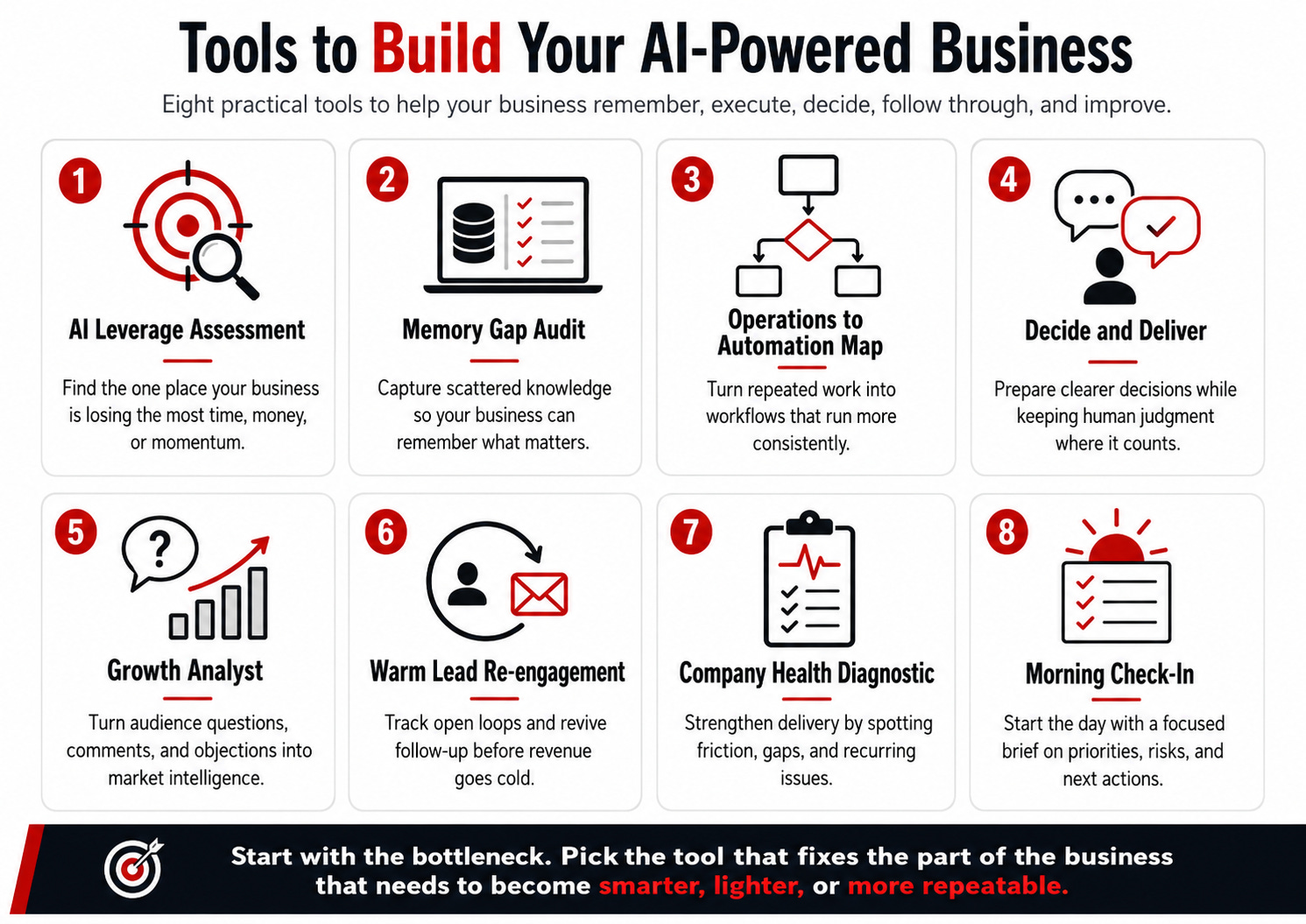
Scattered knowledge? Build memory. Start with the Memory Gap Audit.
Inconsistent execution? Build workflows. Start with the Operations to Automation Map. 🔒Get it →
Stalled decisions? Build decision support. Start with the Decide and Deliver prompt. Get it →
Weak marketing? Build an authority flywheel. Start with the Authority Flywheel Audit. 🔒 Get it →
Lost revenue? Build follow-up tracking. Start with the Warm Lead Re-engagement prompt. Get it →
Inconsistent delivery? Build delivery support. Start with the Company Health Diagnostic. Get it →
Founder dependency? Build a Chief of Staff layer. Start with the Morning Checkin 🔒. Get it →
To unluck the rest of the resources and access our full library of more than 200 prompts, skills and loops
Build to Thrive just hit #26 Rising in Business on Substack last week
Thank you for reading my newsletter and helping me grow at a pace of 600 subscribers per month. I started this newsletter in April of last year and it is now a resource to more than 5000 entrepreneurs. I would love for you to take the next step by offering a 25% discount over my paid subscription. By becoming a paid subscriber you have access to my library of prompts, workflows and timely content to help you gain your time back, improve your income and have happier customers and stakeholders. All for the price of a latte or capucchino. (Offer valid until August 15th
Thanks for sharing this. It’s always so interesting seeing what works for other people and what doesn’t!
Powerful, interlocking set of tools, Juan. Great stuff.