


I want to start with something I’ve been sitting with for a while.
In my conversations with founders and experienced professionals over the past year, I keep hearing a version of the same thing. Not panic. Not urgency. Something quieter. A sense that the role is doing less of the explaining than it used to. That what worked before the title, the track record, the institutional presence is still there, but somehow thinner.
No layoff. No reorg. No warning email. Just a slow rearrangement of the conditions that made professional value legible.
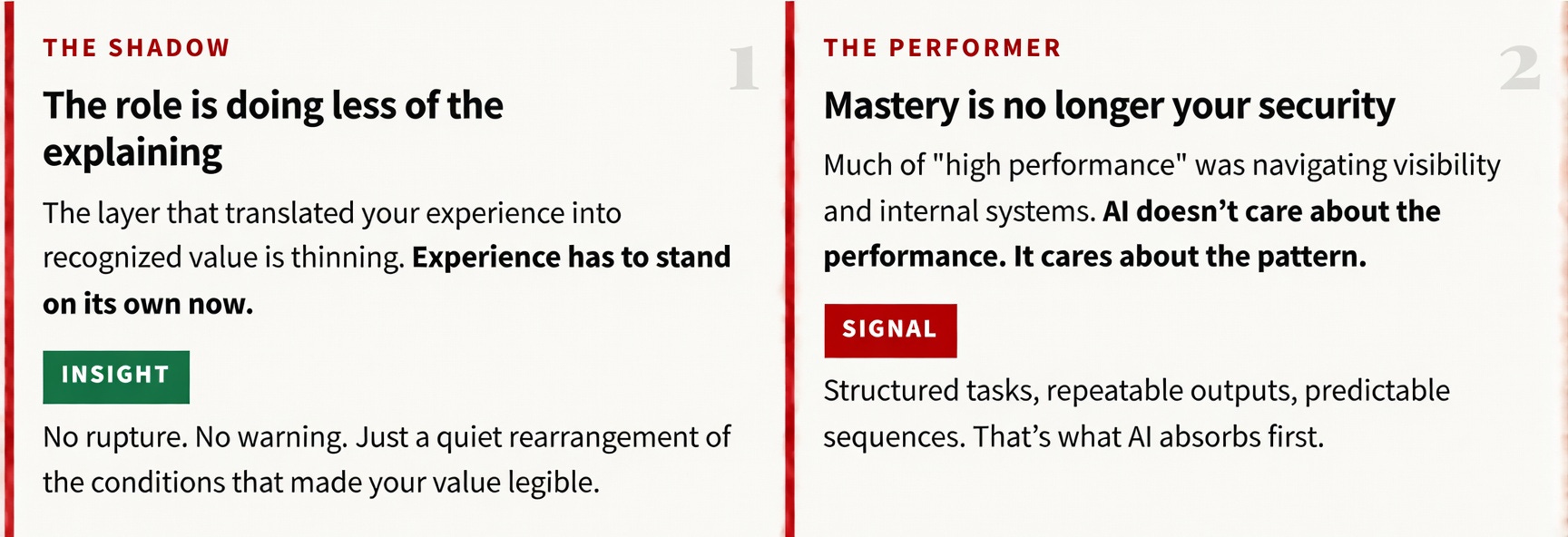
I wrote about this in “Navigating AI’s Shadow.” I called it the quiet unbundling. The layer that once translated your experience into recognized value the role, the org chart, the internal reputation is thinning. And as it does, experience has to stand on its own.
For most of your career, personal value didn’t need articulation. The role handled that. What’s changing now isn’t your skill. It’s how much translation the role still performs on your behalf.
New research from Anthropic’s economists Maxim Massenkoff and Peter McCrory just gave us the data underneath that feeling. And it confirms the pattern I’ve been watching more precisely than anything I’ve seen published to date.
—🔴—🔴—🔴—
Build to Thrive caters to professionals and founders seeking clarity, leverage, and income in the new AI economy. It is built for people navigating real transitions and applying what they know to new opportunities as the rules of business change. As a subscriber, you get thoughtful deep dives, timely insights, and practical operating systems you can use to build and adapt in real time. As a paid subscriber, you unlock full access to every article, premium prompts, and our growing library of tools, while joining a community of more than 4,000 founders and aspiring entrepreneurs navigating this path together.
—🔴—🔴—🔴—
What the Data Actually Shows
Most AI-and-jobs research asks a theoretical question: what could an LLM handle if fully deployed? This paper asks the sharper one: what is AI actually doing, right now, in professional settings?
The researchers built a metric called Observed Exposure combining theoretical AI capability with real usage data from millions of Claude conversations, then weighting automated uses more heavily than augmentative ones. The result is the first honest map of where AI is genuinely displacing work versus where it’s just assisting.
And the headline finding is one every professional needs to sit with:
The gap between potential and deployment
94% of Computer & Math tasks are theoretically AI-ready.
Claude currently covers just 33% of them in practice.
Junior hiring into exposed occupations: down 14% since ChatGPT launched.
That gap is not a safety net. It’s a countdown.
No mass unemployment yet. The headline “AI is firing everyone” is not supported by the data. What the data does show is something more structural, and in some ways more consequential.
The front door is closing. Not the building.
—🔴—🔴—🔴—
The Death of the High Performer
I’ve been thinking and talking about this for months most recently in a live session on the “Death of the High Performer” with Katie Barnes and John Brewton . The Anthropic data puts hard numbers on what we were describing.
For decades, the high performer was the gold standard. Fast promotions. Loud visibility. A reputation for getting things done. Organizations built compensation models and leadership pipelines around that identity.
Here’s what’s changing: a meaningful percentage of what made someone a “high performer” was not exceptional at the work itself. It was exceptional at navigating systems that rewarded visibility, coordination, and proximity to power. Managing up. Owning the room. Controlling information flow.
🔴
Reference article here:

🔴
AI does not care about the performance. It cares about the pattern.
When execution becomes cheaper, faster, and more legible, the stories we tell about ourselves matter less than the signals the work emits. Cycle time. Decision quality. Dependency reduction. Outcomes, not narratives. The professional who was “good at their job” because they were good at the internal game is the one most exposed.
The cost of knowledge, execution, and coordination is collapsing at the same time. For decades, professionals created value inside those layers. Now those layers are becoming software.
The Anthropic data confirms this quietly. The most exposed occupations computer programmers at 74.5%, customer service reps at 70.1%, data entry keyers at 67.1% share one thing: structured tasks, repeatable outputs, predictable sequences. Work that follows a pattern. That’s what AI is absorbing first.
The high performer who built their reputation on executing those patterns faster than everyone else is watching their edge compress in real time.
—🔴—🔴—🔴—
Why Professionals Struggle to Monetize What They Know
Here’s the part that stays with me from every coaching conversation I’ve had over the past two years.
The people I work with are not lacking skill. They are not lacking experience. They are not even lacking confidence, exactly. What they’re lacking is a way to make the value of that experience visible outside the system that used to do it for them.
One conversation in particular stuck with me. When I asked a senior professional what was holding her back from taking consulting seriously, she paused. Then she said: “If I admit I need to do this, I have to accept that what I’ve been building my whole career may not carry me the same way anymore. I don’t know how to sit with that yet.”
That wasn’t indecision. That was grief.
And it’s exactly what the Anthropic data is pointing at, even if the paper never uses that word. The researchers found that workers in the most exposed professions are more likely to be older, female, more educated, and higher-paid. These are not entry-level workers with nothing invested. These are mid-to-senior professionals who built their careers on the assumption that mastery compounds. That experience, over time, becomes security.
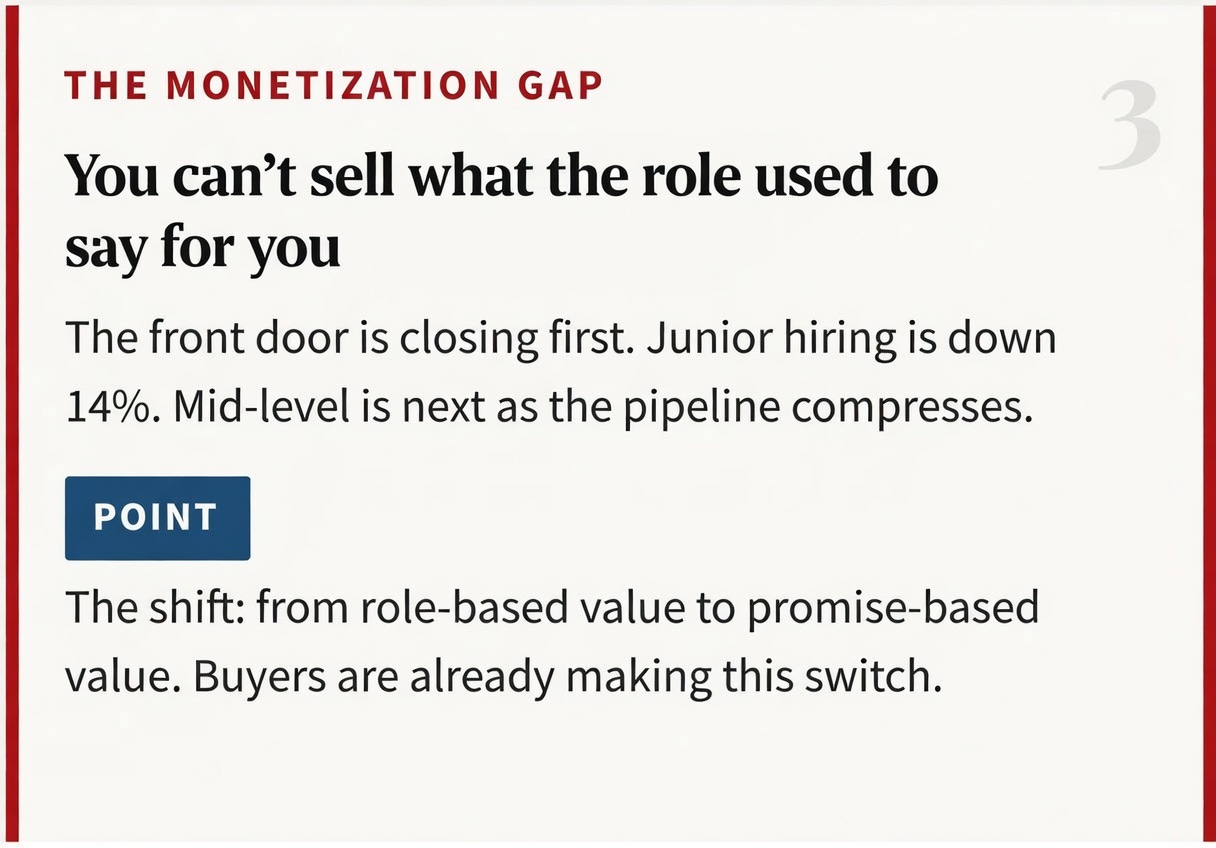
What’s changing isn’t that experience stops mattering. It’s that the structure that converted experience into income the title, the role, the employer brand, the org is no longer doing the same translation work it once did.
🔴
Reference article here:

🔴
The role used to buffer you. Problems arrived pre-framed. Outcomes arrived pre-named. Strong performance made contribution legible. As that layer thins, experience has to stand on its own.
Most professionals don’t know how to do that yet. Not because they can’t but because they’ve never had to. The system always translated for them.
That system is now being automated.
—🔴—🔴—🔴—
The Signal Most People Are Still Missing
I said earlier that there’s no mass unemployment yet. That’s true. But here’s the signal buried in the data that I think matters most for experienced professionals:
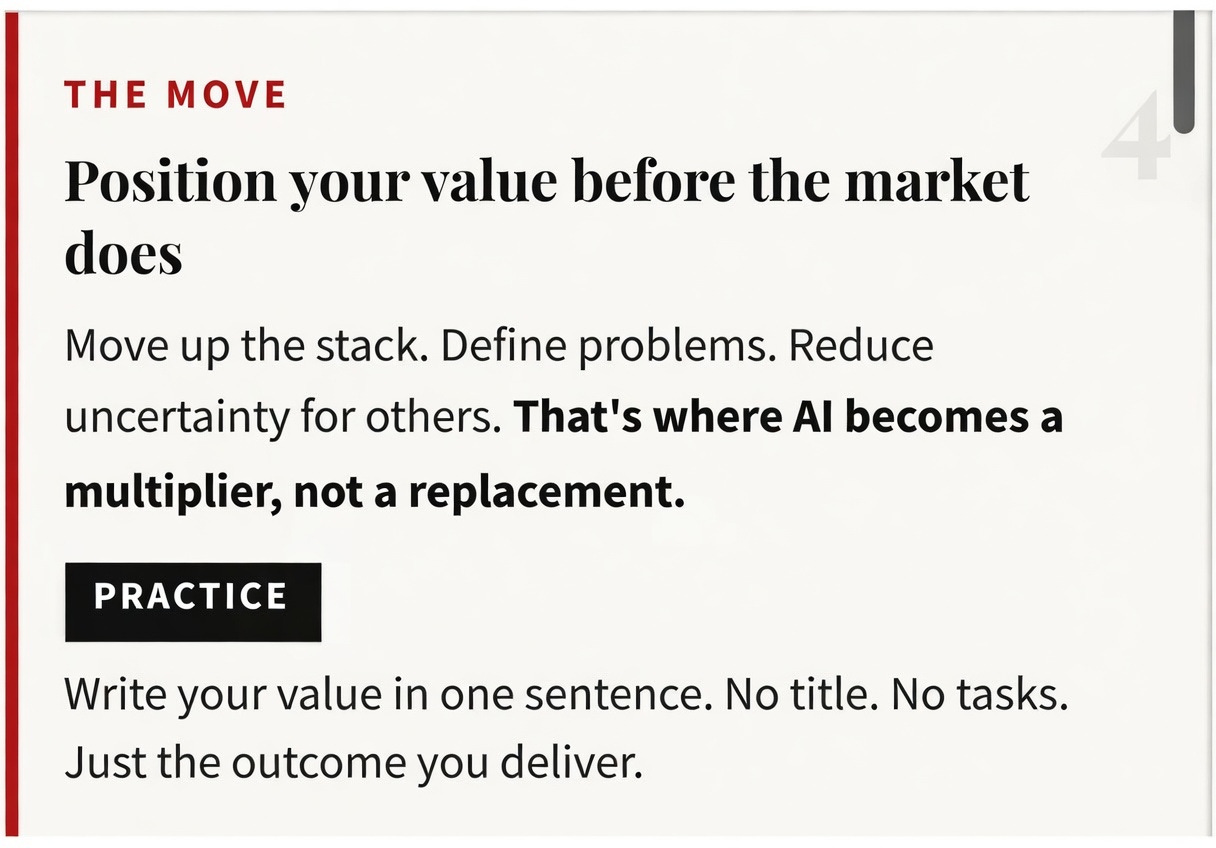
Hiring of workers aged 22–25 into exposed occupations is down 14% since ChatGPT launched.
The junior layer is being quietly automated away. Companies aren’t laying off their experienced people. They’re just not replacing them at the bottom of the funnel.
Think about what that means structurally. The traditional white-collar career ladder is being dismantled from the bottom up. The entry-level roles that once fed into mid-level roles that once fed into senior roles that pipeline is compressing. The ramp is getting steeper. And the people at the top of the current pyramid are one reorganization cycle away from discovering that the org beneath them is thinner than they thought.
That changes the talent pipeline. It changes how you build teams. And if you’re an experienced professional, it changes how you need to position your value.
The mistake is to wait for the shock. AI’s impact on the labor market, as the paper’s authors note, is more like the internet or trade with China than it is like COVID. The effects won’t be immediately clear from aggregate unemployment data. They will arrive gradually, then all at once.
The front door closes first. Then the building.
—🔴—🔴—🔴—
The New Positioning Imperative
Here’s where I land after reading this research through the lens of everything I’ve been working on with founders and professionals over the past two years.
The question is no longer “Is my job safe?”
The question is: “Does my value stand on its own or is it still being carried by the structure around it?”
If you’re waiting for the role, the title, the employer, or the org chart to keep translating your value for you, you are building on a foundation that is actively being automated. Not tomorrow. Incrementally. Every quarter, the red area on Anthropic’s radar chart grows. Every quarter, the gap between theoretical AI capability and observed deployment closes.
The professionals who will navigate this well are the ones who can answer a different question:
“What uncertainty do I eliminate for other people? What changes when I’m in the room? What would stay unresolved without my involvement?”
That’s not a resume question. It’s not a LinkedIn summary question. It’s the question of someone who has unbundled their value from the role that used to carry it and learned to make it visible on its own terms.
That’s the shift from role-based value to promise-based value. And it’s the most important professional repositioning of this decade.
AI is not your replacement. It’s the thing that’s eliminating everything that was buffering you from having to make that shift.
—🔴—🔴—🔴—
What to Do With This
I’ve been helping businesses and professionals navigate AI-driven change long enough to see the pattern clearly: the people who panic lose, the people who dismiss it lose, and the people who adapt systematically win.
Here’s how I’d act on this research:
• Map your exposure honestly. The Anthropic data is public at huggingface.co/datasets/Anthropic/EconomicIndex. Look up your role. Identify which of your tasks follow a predictable sequence. That’s your risk map and your starting point.
• Stop competing at execution. Move up the stack. Define problems. Design systems. Reduce uncertainty for others. That’s where leverage lives now. That’s where AI becomes a multiplier rather than a replacement.
• Learn to articulate your value without the role doing it for you. Write one sentence describing the outcome you deliver not your title, not your tasks. If you can’t do it in twenty words, your positioning needs work.
• Watch entry-level hiring in your field as a leading indicator. When it slows, mid-level is next. Monitor it. It’s the earliest signal the data gives us.
This isn’t about learning another tool. It’s about leverage. About understanding that the stack we built our careers on is compressing and choosing to move up it deliberately, before the market forces the move.
Build assets. Create freedom. Thrive on your terms.
Juan
—🔴—🔴—🔴—
The Case for Going Fractional Series
The Case for going Fractional Series - The Fractional CFO
The Case for Going Fractional Series. The Fractional COO
Going fractional series: AI at work. Rethinking the value of your experience
Some reader’s favorites
How Anthropic Set Off a Trillion-Dollar Software Repricing | Agentic AI and the Future of SaaS
AI Agents Are Now Hiring Humans: The Rise of RentAHuman and the Agent Economy
AI Agents Just Built Their Own Social Network. Humans Are Not Allowed to Post.
Build to Thrive | The AI Blueprint | Week of February 2nd, 2026
How I Scaled My Business Without Hiring: Building My First AI Agents for $0
If you nail your problem and outcomes statement, you've come a long way.
Great stuff! I feel like this is some great data to also further my "Guardians will be the hottest hire of 2026" prediction. ;-) At least once they know how to frame their roles...