


Build to Thrive caters to professionals stepping into entrepreneurship and founders who need clarity, leverage and ways to monetize in the new AI economy. As a subscriber you get deep dives, timely insights, and operating systems that shape tomorrow’s business. As a paid subscriber you unlock all articles, gain access to our library of tools and become part of our active community of more than 4000 aspiring entrepreneurs and founders.
Why capable professionals feel more replaceable than ever
If you’re good at your job but feel less secure than you used to, you’re not imagining it.
You may still be performing well.
You may still be valued.
You may even be getting positive feedback.
And yet, something feels off.
Work feels different.
Decisions feel tighter.
Roles feel more fluid and less protected.
For many professionals, this is the first time they’ve seriously wondered:
If my role changed or disappeared, would I actually know how to earn money on my own with what I know?
Not hypothetically.
Practically.
The Uncomfortable Realization Beneath the Anxiety
Most professionals have never needed to answer that question.
They built careers by being capable, adaptable, and reliable.
They were rewarded for mastering skills and applying them inside well-defined systems.
And for a long time, that worked.
What recent changes are exposing isn’t a lack of talent. They’re exposing something deeper:
Most professionals don’t actually understand why they’re paid beyond the role they occupy.
This isn’t about personal inadequacy.
It’s about how value is being expressed and exchanged.
The rules didn’t disappear.
But the scaffolding did.
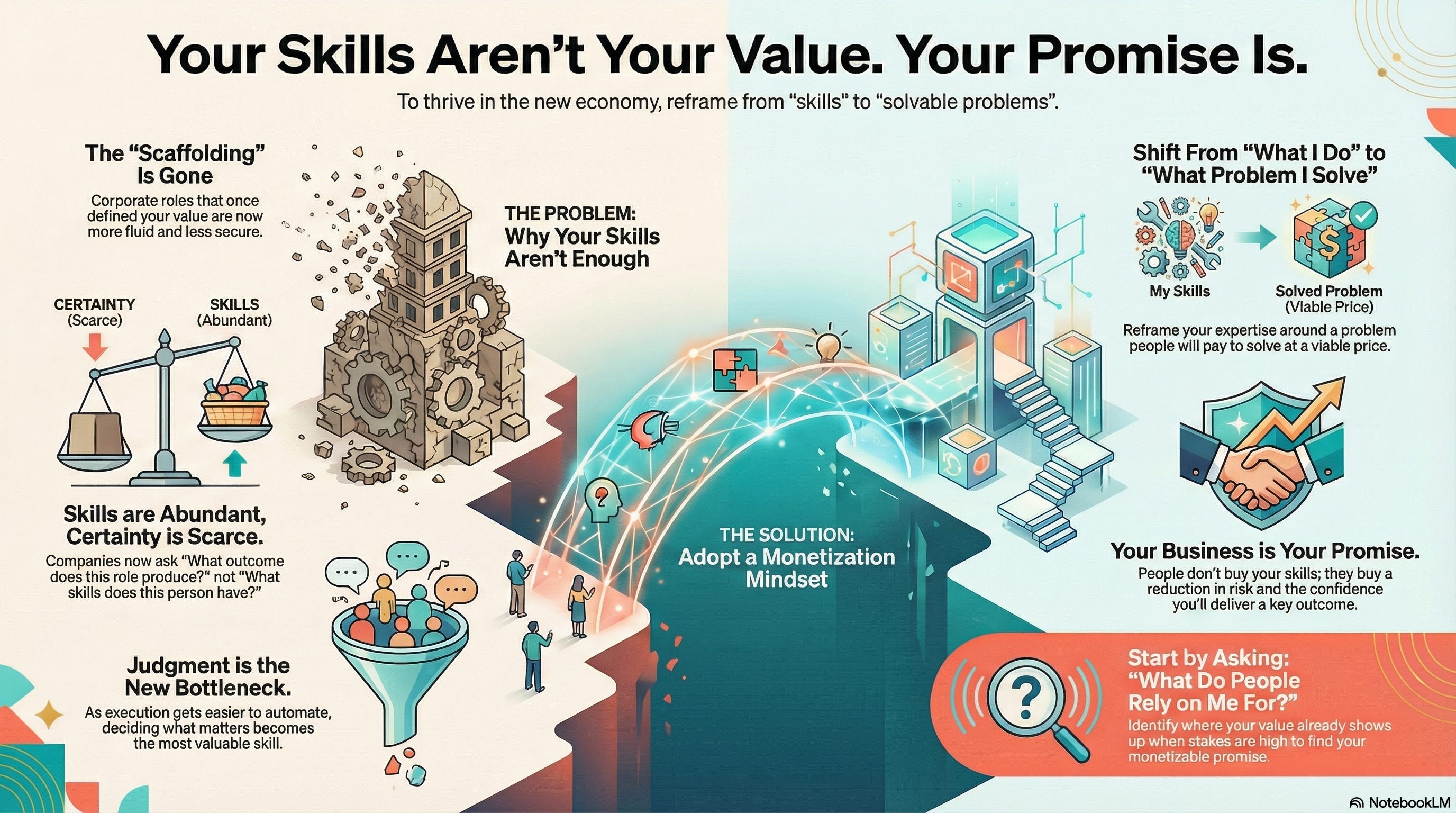
Skills are everywhere. Security isn’t.
Here’s the hard truth many people are running into right now:
Skills are abundant.
Tools are abundant.
Competence is assumed.
What’s scarce is certainty.
When budgets tighten or roles get redefined, organizations don’t ask:
What skills does this person have?
They ask:
What outcome does this role reliably produce? Could it be automated?
That’s why so many capable professionals feel exposed.
Not because they aren’t valuable, but because their value has been bundled inside roles and systems that no longer explain it as clearly.
As execution becomes faster and easier to generate, it stops being the bottleneck.
What’s harder to automate, and increasingly valuable, is judgment:
deciding what matters, choosing between tradeoffs, and knowing what not to do.
The constraint has shifted.
Many professionals feel it, even if they don’t yet have language for it.
The Independent Monetization Mindset
For work to be viable as an independent economic activity, it has to meet these conditions:
Some problem or tension is recognized
The buyer can imagine an improved state
The purchase reduces perceived risk or uncertainty
In other words, value is derived from a reduction or elimination of uncertainty
Inside a role, that work is mostly done for you.
The organization defines the problem, names the outcome, and absorbs much of the risk.
When you step outside that structure, even partially, those conditions don’t go away, they just become explicit.
Which is why having an independent monetization mindset often comes down to shifting from what I know how to do, to what problem I can solve in a way people will pay for at a price and scale that actually works.
This is not about becoming a different person or learning a new trade, it’s about learning how to translate what you already do into something that can stand on its own economically.
When people don’t make this shift, they default to listing skills, describing tasks, or offering help that’s useful but not viable. This is a framing problem, not a lack of ability.
Why this Feels Heavier than it Sounds
For many people, this work begins with discomfort, not excitement.
There’s a quiet grief in realizing:
the role you mastered may not protect you
the system you trusted is changing
competence alone isn’t enough to explain your value anymore
Most professionals were trained to:
avoid over-claiming
stay flexible
contribute broadly
let outcomes be shared
Those instincts make you a good employee.
They don’t automatically help you clarify independent economic value.
So people postpone.
They keep thinking.
They wait for certainty.
Until waiting starts to feel more dangerous than acting.
The Business is the Promise
When people pay for help, inside a company or outside it, they’re not paying for effort or intelligence. They’re paying because something becomes less uncertain or risky.
A decision feels clearer.
A mistake is avoided.
A situation stops spiraling.
Your skills are what allow you to do that.
But they’re not what someone is buying.
What they’re buying is the outcome they care about and the confidence that it will be handled well.
That’s what a promise really is. A clear statement of what someone can count on you for.
How to Make this Shift
If you’re thinking, “This makes sense, but I still don’t know what I would actually do next,” don’t rush to answers.
Start with a short exercise.
Set aside 15–20 quiet minutes.
The goal isn’t to decide what to do.
It’s to notice what’s already true.
Think of this as a way to surface how your value actually shows up without titles, roles, or résumés getting in the way.
Diagnostic
Experience & Credibility
How would you describe your current or most recent professional role?
How many years of experience do you have in this domain?
In your career so far, what types of problems have you most often been trusted to handle?
Where Value Already Shows Up
When stakes are high, what do people already rely on you for?
What do people say you’re especially good at, even if it feels obvious or “just part of the job” to you.
Describe a recent situation where your involvement materially improved an outcome.
Identity & Motivation
Which parts of your work give you the strongest sense of competence or confidence?
Which parts of your work feel increasingly undervalued, automated, or taken for granted?)
Monetization Readiness for Professionals
Turn your experience into a clear, paid direction without overbuilding or guesswork.
Clarity, Design and Validation
This program helps experienced professionals translate what they know into a problem worth paying to solve, at a price and scale that actually works. Through a structured diagnostic, guided clarity sessions, and disciplined design, we identify where your value already shows up, narrow it into a viable promise, and pressure-test it against real market patterns before you commit time, energy, or reputation.
What you get:
Clarity on what’s actually worth monetizing (and what to ignore)
A clearly defined promise rooted in real demand, not assumptions
A realistic path to build independent income capacity
For more information visit: juansalasromer.com/monetization
Up to this point, the questions have focused on how you see your experience and strengths.
The next section changes lenses
Here, we are not evaluating what you’re good at, we’re testing whether that value translates into a specific problem people would pay to solve, at a price and scale that works economically.
Value Translation & Monetization
From Skill to Problem
In the situations you described above, what problem are people actually trying to avoid or resolve?
(Think risk, delay, confusion, missed opportunity.)If you were not involved in those situations, what would most likely go wrong or take longer?
From Helpfulness to Willingness to Pay
If someone paid you specifically to solve that problem, what outcome would they be buying?
(Describe the result, not the activity.)Who is the specific person or role that would most likely pay for that outcome?
How frequently does this problem occur for people like them?
Economic Reality Check
What does it cost (in time, money, risk, or stress) when this problem is not solved well?
What range do you believe someone might reasonably pay to reduce or eliminate this problem?
Does solving this problem require your direct involvement every time, or could parts of it be systematized or repeated?
Constraints & Readiness
What constraints would limit your ability to monetize this right now?
(Time, energy, confidence, access, role obligations, etc.)What would make it meaningfully easier to test this in a low-risk way?
If there were a clear, contained way to test this without quitting your job or overexposing yourself, would you explore it?
You’re not trying to write an offer.
You’re testing whether you can name a problem, an outcome, and a reason it matters without leaning on a role or title.
If you can do this even roughly you’ve taken the first real step toward independent economic thinking.
Curious about Fractional Work?
This live series will help you understand what it takes to make the transition, grow a following, challenges and opportunities, and more. It also shows the fractional service from the business operator side and how to work with fractional service providers. Subscribe to Build to Thrive to get alerted when our new live gets scheduled.
Live Programs
The Case for going Fractional Series - The Fractional CFO
The Case for Going Fractional Series. The Fractional COO
Some reader favorites
AI Is Here. Let’s Get Your Business in the Game.
How I Scaled My Business Without Hiring: Building My First AI Agents for $0
The Science of Execution: Why Most Founders Stay Stuck (and How to Break Through in 90 Days)
How to Build Assets That Compound (Even When Life Forces You to Pivot)
Everyone’s Rushing to AI. Few See the Ceiling Ahead.
Scaling Smart: 5 Systems Every Solopreneur Needs to Grow Without Burning Out
Built to Blaze: How Ooni Turned Backyard Pizza into a $200M Global Movement
This article really gets to the heart of an issue that many of us are starting to recognize: just being good at your job doesn’t guarantee financial stability anymore.
As a Career Professional, I see this problem only affecting more and more people. It's exactly the “quiet grief” that you so eloquently name, Juan and it's the same feeling that professionals the world over are experiencing.
We’ve worked to get here, paid good money for education, developed our skills, and built careers we thought would last and guarantee the futures we deserved… but the rules that once protected that effort are shifting beneath our feet.
To turn this around, we need to move away from simply listing our skills and start focusing on the specific problems we can solve, discover the outcomes people value, and learn how we personally can translate that into economic leverage beyond a job title.