


I’ve been in enough cycles to know the difference between a market making noise and a market changing structure.
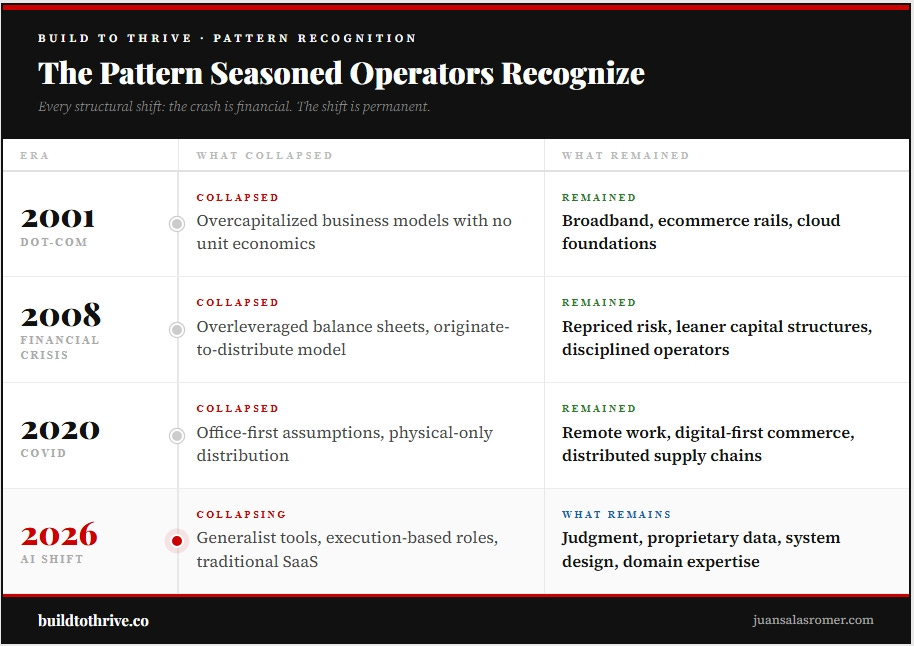
Dot-com was structural. The bubble popped, the bad business models got flushed, and the obituaries called it a correction. What they missed is that the infrastructure underneath didn’t go back. Broadband expanded. Ecommerce rails got built. Amazon nearly died in 2001 and the underlying shift it was riding did not. The crash was financial. The shift was permanent.
2008 was structural. The financial crisis didn’t just wipe out overleveraged balance sheets. It permanently repriced risk, collapsed the originate-to-distribute model, and forced every operator in real estate, banking, and development to rebuild their assumptions from the foundation up. The players who came back weren’t the ones who waited for the market to return to what it was. It never did.
COVID was structural. Not because of the disruption. Disruptions happen. But because of what it permanently relocated. Remote work, digital-first commerce, distributed supply chains. The office didn’t come all the way back. Neither did the assumptions built around it.
That’s the pattern a seasoned operator carries that a first-cycle observer doesn’t. The bubble popping doesn’t mean the structure changed back. It means the overcapitalized, underdisciplined version of the idea got flushed and what remained rewrote the rules for the next twenty years.
What Gartner’s 2026 forecast is describing, quietly, in the language of percentages and timelines, is the same kind of moment. The AI hype will correct. Some version of it already is. But the operators asking the right question aren’t watching the valuation multiples. They’re asking what’s underneath. What infrastructure, what shift in how work gets executed, what reallocation of where value lives, doesn’t go back when the noise clears.
That’s what this forecast is actually mapping. Here’s what it’s telling us.
1. Your next teammate isn’t human
The biggest shift in Gartner’s forecast isn’t about tools. It’s about how work gets executed.
Think about the best back-office you ever built. The one that ran without you having to touch it every day, where the right people knew their roles, handed off cleanly, and caught problems before they became yours. Now imagine that system never clocks out, never miscommunicates, and scales without adding headcount.
That’s what Multiagent Systems are becoming. Not a better chatbot. An autonomous operation. Specialized AI agents that collaborate to run complex workflows end to end. Execute the buy, negotiate terms, reconcile the ledger. No handoff required.
When the infrastructure of a market changes, the people who optimized for the old flow get squeezed. Not because they did anything wrong, but because the structure they built around no longer exists.
By 2028, Gartner projects $15 trillion in B2B transactions will flow through AI exchanges, with up to 90% of buying happening algorithm to algorithm. If the buyer is an agent operating on parameters, emotional resonance is irrelevant. Positioning clarity becomes everything.
Two weeks in February changed the frame entirely. I wrote about it in the Blueprint when Anthropic, OpenClaw, and RentAHuman all moved in the same direction at the same time. Not coincidence. Pattern. The cost of knowledge, execution, and coordination collapsed simultaneously, and the digital coworker stopped being a concept and became a product. That shift didn’t reverse when the news cycle moved on.
I also wrote about this when RentAHuman launched and 7,856 people signed up to work for AI agents in 48 hours. That wasn’t a novelty. It was a signal. The employer-employee relationship isn’t just being disrupted. It’s being inverted.
2. The competency paradox is real, and it’s already in your hiring process
I’ve hired enough people to know that credentials tell you what someone studied. They rarely tell you how someone thinks under pressure.
What’s coming is a version of that tension at scale. By 2027, over 75% of hiring processes will require AI certifications or standardized proficiency tests. That’s the new baseline, the same way spreadsheet literacy became table stakes in the 90s.
But here’s the other side Gartner is forecasting: 50% of global organizations will also require “AI-Free” skills assessments to verify that candidates can still reason without the machine.
The most valuable professional in 2027 won’t be the best prompter in the room. It’ll be the person whose judgment holds up with or without the assist.
Both things are true at once. You need people who can leverage AI at a high level and who still think clearly when the tool is taken away. The operators I respect most aren’t the ones who handed everything to AI and got fast. They’re the ones who stayed sharp underneath the automation, because they’ve seen enough cycles to know the machine doesn’t save you when the unexpected hits.
I’ve been watching this tension build across my readership. In the Blueprint last week I described it as identity lag. The tools moved fast. The narrative around AI natives moved even faster. And seasoned professionals with decades of hard-earned experience suddenly found themselves asking a quiet question: where does my experience fit in this new landscape? That’s the human version of the competency paradox Gartner is now forecasting at scale. The answer hasn’t changed. Deep experience doesn’t disappear in a structural shift. It gets disoriented first, then repositioned.
3. The $58 billion collapse of traditional SaaS
In development, I learned early that a general contractor is fine until something goes wrong. Then you need the specialist. The one who’s built that exact wall before, who knows where it fails and why.
Traditional software was built for human fingers and human eyes. Menus, dashboards, buttons. AI agents don’t need any of that. They work through APIs and code. And that architectural shift is triggering a $58 billion disruption in the productivity software market by 2027.
AI-native development platforms are replacing off-the-shelf tools by letting AI generate, test, and iterate on custom software directly. By 2030, Gartner projects 80% of organizations will operate with leaner engineering teams focused on oversight, not manual output.
If custom tooling is now accessible at low cost, the question is no longer whether you can build what your operation needs. It’s whether you’re still paying to bend your workflow around someone else’s product.
I covered what happened on February 3rd when Anthropic’s Cowork plugins wiped $285 billion in market value in a single session. Thomson Reuters dropped 18% with no earnings miss, no regulation, no macro surprise. Just a product release. That was the market pricing the structural pressure, not the rollout. And in the Blueprint I took it further: plugins now let anyone build what previously required a SaaS company, a dev team, and millions in funding. The disruption of traditional software didn’t start with Gartner’s forecast. It started that Tuesday morning.
For operators, two questions are worth sitting with right now. Which of your current software subscriptions exist because they solve a real problem, and which ones exist because switching felt like too much friction? The caveat is real. When AI writes the code, security, reliability, and IP ownership get complicated. That’s not a reason to wait. It’s a reason to build with oversight as a load-bearing wall, not an afterthought.
4. Generalist AI is losing ground to domain specialists
The generalist LLM had its moment. That moment is passing.
A seasoned operator has seen this pattern before. The generalist who can do everything adequately gets hired when budgets are tight and speed matters. The moment precision becomes the only currency that counts, in a negotiation, in a compliance filing, in a high-stakes diagnosis, the generalist gets outcompeted by the specialist every time.
The ceiling is already visible. I wrote about it when everyone was rushing to AI and few were asking what happens when speed outpaces trust, policy, and performance. In regulated industries, that ceiling isn’t a performance issue. It’s a liability. Hallucinations in a legal brief or a financial model don’t get you a lower score. They get you sued.
Gartner’s forecast reflects a clear shift toward Domain-Specific Language Models built on narrow, high-quality datasets that deliver precision where general models fall short.
In the generalist era, Big Tech held the leverage. In the specialist era, the leverage belongs to whoever owns the best proprietary data. And most experienced operators are sitting on more of it than they’ve priced.
The capital markets were already pricing this in February. In the Blueprint I noted that investors were rotating away from what AI can do toward how it changes pricing, cost structure, and market structure. The control layer, the governance, the auditability, the precision that survives scrutiny in regulated environments, was moving from policy deck to budget line. Domain specialists own that pricing power. Generalists don’t. A hospital’s outcomes data. A law firm’s case history. A bank’s transaction patterns. Fine-tuned into a specialized model, that data becomes a moat an external provider can’t replicate. If you’ve been operating in one industry long enough to accumulate it, you may be sitting on an asset you haven’t valued yet.
The question that ties all of this together
I’ve been knocked down enough times to know that pattern recognition is an asset with a real liability attached to it. The same experience that helps you spot a structural shift early can make you overconfident right before a new cycle breaks the old rules entirely.
What Gartner is describing isn’t just another technology wave to ride or survive. It’s a fundamental repricing of where value lives. Away from execution, toward judgment. Away from generalist tools, toward specialized systems. Away from doing the work, toward designing the system that does.
The February fracture I wrote about wasn’t hype. It was the moment the floor shifted under a familiar-looking surface. This Gartner forecast is the structural map of what replaced it.
Dot-com didn’t end the internet. 2008 didn’t end real estate. COVID didn’t end business. They ended the version of each that was built on assumptions that were never as solid as they felt.
AI will do the same. The question isn’t whether you’ll survive the correction. It’s whether you’re building on the infrastructure that remains after it.
The machine is getting better at executing. Which means the value you bring has to live somewhere the machine can’t reach. Problem definition, judgment under ambiguity, and the wisdom to know when the output is wrong even when it looks right.
AI is a multiplier. But it only multiplies what’s already clear.
That’s the gap only a seasoned operator can close.
If you only have 1 minute, here’s what matters
AI is moving from assistant to autonomous operator. By 2028, $15 trillion in B2B transactions will flow between algorithms. If your growth strategy depends on reaching a human decision-maker, the window to adapt is now.
The most valuable professional in 2027 sits at the intersection of two things: the ability to leverage AI at a high level and the judgment to think clearly without it. One without the other is a liability.
Traditional SaaS is being disrupted by $58 billion in market shift toward AI-native platforms. The question for every operator is whether your current software stack is solving real problems or just surviving on switching friction.
Proprietary data is becoming the most underpriced asset in business. As generalist AI gives way to domain specialists, the operators who’ve spent years accumulating deep industry data hold a moat that Big Tech can’t replicate.
Every structural shift leaves behind operators who optimized for what came before. The ones who came back from dot-com, 2008, and COVID didn’t wait for the market to return. They built on what remained. The same move applies here.
—🔴—🔴—🔴—🔴—🔴—🔴—🔴—🔴—🔴—🔴—🔴—🔴—🔴—🔴—🔴—🔴
Build to Thrive caters to professionals and founders seeking clarity, leverage, and income in the new AI economy. It is built for people navigating real transitions and applying what they know to new opportunities as the rules of business change.

A Quick Story
I was recently on a call with someone who attended one of my webinars about unbundling the value of your experience.
He’s an operations expert who helps nonprofits improve their internal systems.
But he told me he struggles with one thing:
Explaining the value of what he does.
When I asked how he introduces himself to clients, he said something like:
“I run operational audits, identify bottlenecks, and implement systems that save time and money.”
Technically correct.
But hard to relate to.
So I asked him a different question.
“Tell me about a time you helped a client.”
His whole energy changed.
He told me about a nonprofit leader who had to make 50+ phone calls every time they organized an event. The process was chaotic and exhausting.
He designed a simple system that organized the outreach and documented the workflow.
The result?
The client saved about eight hours every time they ran an event.
When he finished, I told him:
Start with the transformation, not the title.
Because you are not telling me what tasks you do.
You’re telling me the story of a transformation.
A person who solves a problem worth paying for.
So, we went onto refining his value statement to this:
“I help nonprofit teams turn messy operations into clear systems so they save time and focus on their mission.”
We then worked on a 90-day plan to help him take his business to the next level.
If you like to give me more the 30 seconds…continue reading
If This Sounds Familiar
Many professionals and business owners have valuable experience but struggle to translate it into something clients or employers can clearly understand.
Next Wednesday I’m hosting a free webinar with my colleague Sherry Prescott-Willis where we’ll show you how to unbundle the value of your experience and apply AI to create leverage in your career or business.
👉 Register for the Webinar: learn.buildtothrive.co/webinar
And on April 3rd, we’ll run a deeper hands-on workshop where we’ll help you turn your experience into something you can clearly communicate and sell.
For Those Who Want Help Applying This
Some people prefer to work through this one-on-one.
So, here is what I decided to do, as I am building this expertise. I am taking 100 hours of my time to coach 50 professionals or business leaders at a fraction of my cost.
Normally these sessions are $250/hour, but for a limited time I’m offering them at $50/hour (for up to two hours).
My goal is that by the end of our conversation we’ve made real progress on a concrete issue you’re facing. If we need a little extra time to get there, I’m happy to continue the discussion.
In these sessions I typically work on:
• Clarifying the real value of your experience
• Identifying new income opportunities
• Applying AI to create leverage in your work or business
• Mapping your next strategic move
• Building a 90-day execution plan with weekly or bi-weekly follow-ups
👉 Reserve a Session
Once the 100 hours are booked, the offer closes.
buildtothrive.co/subscribe - click on the Private Coaching Option
Thank you, and see you in the next edition.
JS
Great article. New times, new strategies, new world. 🔥
One of my companions "only has one leader who only hires humans" 🤯 all the others hire humans and build & deploy agents 🤖