TL;DR
A competitor can now reproduce work that once took you years to learn how to deliver. That doesn’t mean your business has lost its value. It means you need to understand where that value actually lives.
I found six advantages worth examining: trust, customer routines, proprietary know-how, owned audiences, scarce assets, and referral networks.
But having one isn’t enough. A moat only matters if it gives customers a reason to stay, makes competitors harder to choose, or helps you maintain your prices.
This article shows you how to identify your strongest advantage, test whether it really protects your business, and spend the next 30 days making it stronger.
Here’s what you’ll learn
Why AI threatens some established businesses more than others.
Four competing answers to what still makes a business defensible.
Six potential moats, with examples of how they work.
How to find the advantage your customers already value.
A seven-step framework and 30-day plan for strengthening it.
Your competitor just got a lot cheaper
Imagine you’ve spent 15 years building an accounting practice.
You know your clients, understand their businesses, and have developed a reliable way of handling their books, payroll, and taxes.
Then a competitor arrives with AI software that can do much of the routine work at a fraction of your cost.
Their reports look professional. Their turnaround is faster. Their prices are lower.
What do you do?
You could lower your prices. You could buy the same tools. You could explain that your experience makes you different.
But there’s a more important question:
What would your best customer actually lose by switching?
Would they lose access to your judgment? Someone who understands ten years of financial decisions? A relationship they trust when something goes wrong?
Or would they simply lose a service that someone else can now deliver for less?
The answer tells you a great deal about the future of your business.
And it’s a question more owners will have to answer.
What happened to Chegg could happen elsewhere
For years, Chegg built a business around helping students find answers to academic questions.
It had a recognizable brand, a large collection of educational material, and millions of students who knew where to go when they needed help.
Then students gained access to AI tools that could answer many of those questions directly.
In October 2025, Chegg announced it was cutting approximately 45% of its workforce. The company pointed to AI and declining traffic from Google as major reasons for its falling revenue.
Think about that.
Chegg still had its brand, its content, its technology, and years of experience. What changed was the customer’s ability to get a satisfactory answer somewhere else.
Its business hadn’t become worthless overnight. But an important part of what customers had paid for became easier to obtain.
That distinction matters.
AI doesn’t have to copy your entire company to damage your business. It only has to make enough of what customers pay for available elsewhere.
An accounting firm might experience that through automated bookkeeping. A marketing agency through AI-generated content. A consultant through research and analysis that clients can increasingly do themselves.
The danger isn’t identical across these businesses. But the question is.
What are customers really paying you for, and how much of that can now be reproduced?
The surprising part: the product may not be your most valuable asset
I’ve spent much of my career in finance, real estate, and hotels, rather than technology.
That background shapes how I look at this question.
Consider two hotels on the same street.
Both can buy the same reservation software, use the same AI pricing tools, and hire designers to create attractive websites.
But one has a location visitors specifically want, relationships with repeat guests, an excellent reputation, and a team that knows how to deliver an experience people return for.
The other has beautiful rooms and competitive prices.
Which would you rather own?
The rooms matter. But the lasting advantage may be everything built around them.
The same principle applies to a neighborhood restaurant, an accounting firm, or a professional who has spent years earning the trust of clients.
And it explains why I think we need to be careful with a popular idea: that AI has made traditional competitive advantages obsolete.
Some have weakened considerably. Others may become more valuable.
To understand the difference, I looked at four arguments about what still protects a business.
Four answers to the moat question
Answer 1: If the product can be copied, the moat is gone
Investor Chamath Palihapitiya made a forceful argument in his 2025 annual letter.
If a competitor can replicate your core product in weeks, he argues, you may no longer have the lasting advantage that justified your company’s future value.
It’s a serious warning.
For a business owner, the practical version is straightforward: how much of your revenue depends on something competitors can now reproduce cheaply?
Chegg is a useful example because it shows how quickly the economics can change when customers find an alternative.
But I don’t think this argument tells the whole story.
A competitor might reproduce the product without reproducing the business that delivers it.
Answer 2: The strongest moats are structural
Dan Hockenmaier, writing in Lenny’s Newsletter, identifies four traditional advantages that can compound over time:
Switching costs: leaving your business creates meaningful effort, expense, or risk.
Network effects: your product becomes more valuable as more people use it.
Scale economies: your costs improve as your business grows.
Data effects: information gathered through use makes the service better.
This is a useful distinction because it separates something customers like from something competitors genuinely struggle to overcome.
A great brand may attract customers. But attraction alone doesn’t guarantee they’ll stay.
An accountant whose work is deeply integrated into a client’s financial operations may have a stronger position, provided the client continues receiving real value from that relationship.
Answer 3: The relationship inside the customer is the advantage
Consider Palantir, which has built part of its business around working closely with customers to understand and solve complicated operational problems.
The software matters. But so does the knowledge gained from working inside those organizations.
A competitor may offer similar technology. Reproducing the customer-specific understanding, relationships, and implementation work can be much harder.
For small businesses, there’s a familiar version of this.
It’s the consultant who knows why a company made a decision three years ago.
The accountant who understands the owner’s priorities.
The supplier who knows what the restaurant needs before Friday’s rush.
That knowledge can create a powerful advantage.
But only if the business captures it, uses it, and keeps delivering better outcomes because of it.
Answer 4: AI will weaken some of those advantages too
The skeptics have a point.
AI can make it easier for competitors to understand an industry, build software, organize information, and deliver sophisticated services.
Some of the knowledge that once took years to assemble can now be developed much faster.
Even customer relationships aren’t automatically safe. People will reconsider long-standing providers when the savings or improvements become compelling enough.
Which brings us to the conclusion I draw from these four perspectives.
The question isn’t whether an advantage is difficult to copy today. It’s whether that advantage becomes stronger as your business serves more customers, learns more, and earns more trust.
That’s where I would focus.
Six places your moat may already exist
In my earlier article, The Only Businesses Left to Build in the Agentic Era, I examined 13 business categories and the advantages that could help protect them.
Six kept appearing.
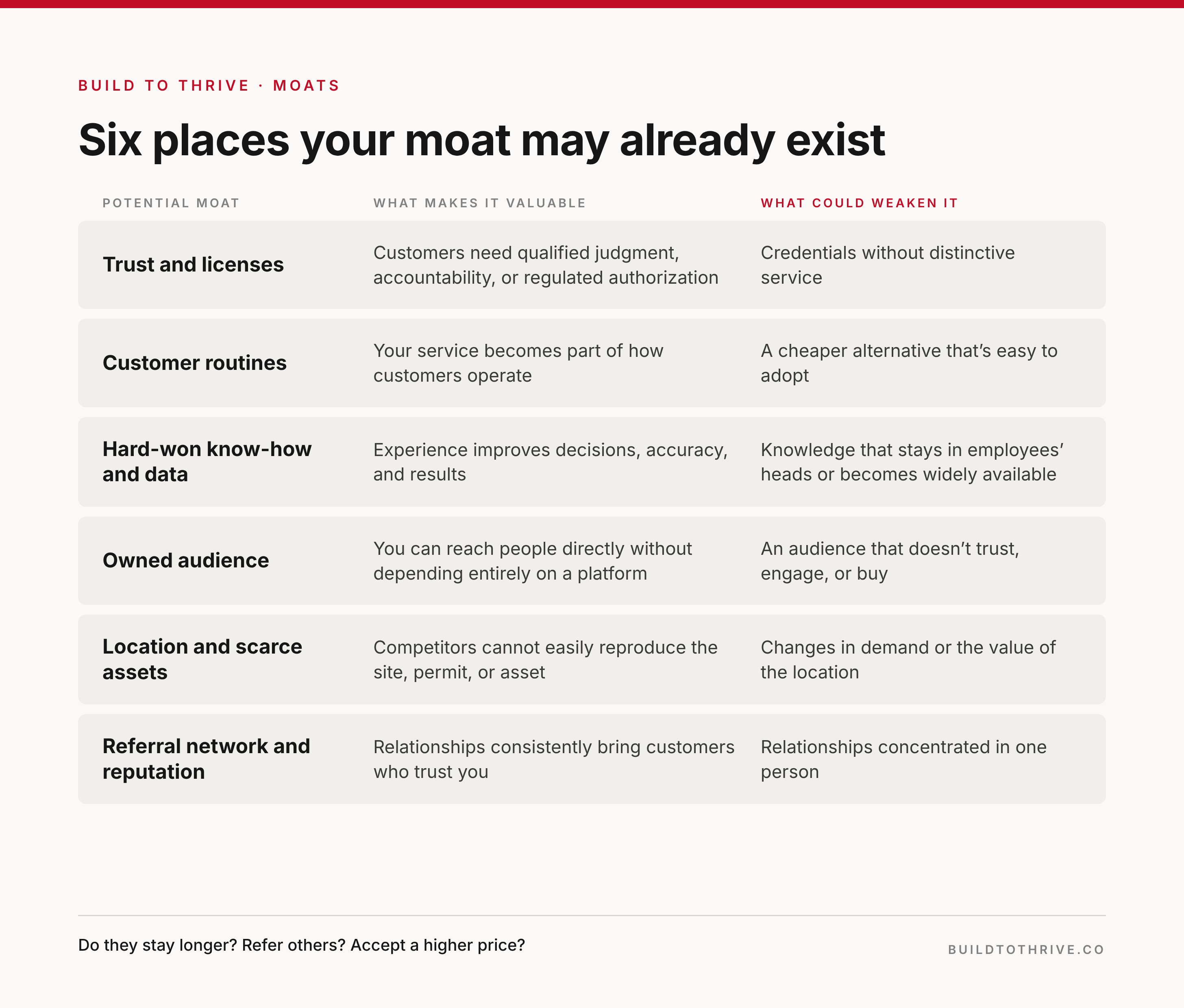
These aren’t six guarantees of success.
They’re six places to investigate.
A restaurant might have a valuable location but weak customer loyalty. A consultant might have excellent expertise but no way to retain the knowledge developed across engagements.
A newsletter might own its email list but still need to give readers a reason to open it.
The important question is not whether you can claim one of these advantages.
It’s whether customers behave differently because of it.
Do they stay longer? Refer others? Accept a higher price? Depend on something that would take time and effort to replace?
Those are the signs worth looking for.
Some reader favorites
How a $379 Bill Survived the AI That Should Have Killed It (Aug 13, 2026) is a real case of a business keeping its price when AI should have undercut it, so it fits next to the “maintain your prices” test.
AI Made Building Easy. It Did Not Make Choosing Easy. (Sep 17, 2026) argues the advantage moves away from technical skill once anyone can build, which supports your opening about the cheaper competitor.
How Anthropic Set Off a Trillion-Dollar Software Repricing (Feb 6, 2026) covers software losing its value when it gets easy to copy, so it sits naturally near the Chamath and Chegg section.
Stop Renting Labor: Why “Owning the AI Loop” Is the New Solo Competitive Advantage (Feb 12, 2026) fits your know-how and customer-routines moats.
Built to Last: The Story Behind YETI’s Unbreakable Brand (Apr 25, 2025) is a brand and audience case study for the owned-audience moat.
Let’s follow one business through the process
Go back to our accounting practice.
Imagine the owner has 60 small-business clients and has spent years providing bookkeeping, payroll, and tax services.
The practice is profitable, but the owner is concerned that AI will put downward pressure on prices.
A competitor could probably automate much of the routine bookkeeping. So defending the business on bookkeeping alone would be risky.
But the owner notices something.
The longest-standing clients rarely call to ask whether their books are complete.
They call when they’re thinking about hiring someone, buying equipment, or wondering why there’s less cash in the bank than expected.
They’re paying for bookkeeping, but what they particularly value is having someone who understands their financial situation.
That’s the opening.
Instead of selling bookkeeping as the main promise, the practice could develop a more valuable ongoing relationship.
Imagine a service that combines accurate financial records with a monthly review of the decisions the owner needs to make.
AI prepares the information. The accountant checks it, interprets it, and helps the client decide what to do.
Over time, the practice builds a useful history of decisions, financial patterns, and outcomes.
The customer receives something more valuable than a set of reports.
And the accounting practice develops something harder to reproduce than a bookkeeping workflow.
This is a hypothetical example, not a guarantee that every client would pay more. The owner would still need to test the offer.
But it illustrates the shift I want you to consider:
Use AI to make the work cheaper. Use what you learn from that work to make the business more valuable.
Seven steps to build around your strongest advantage
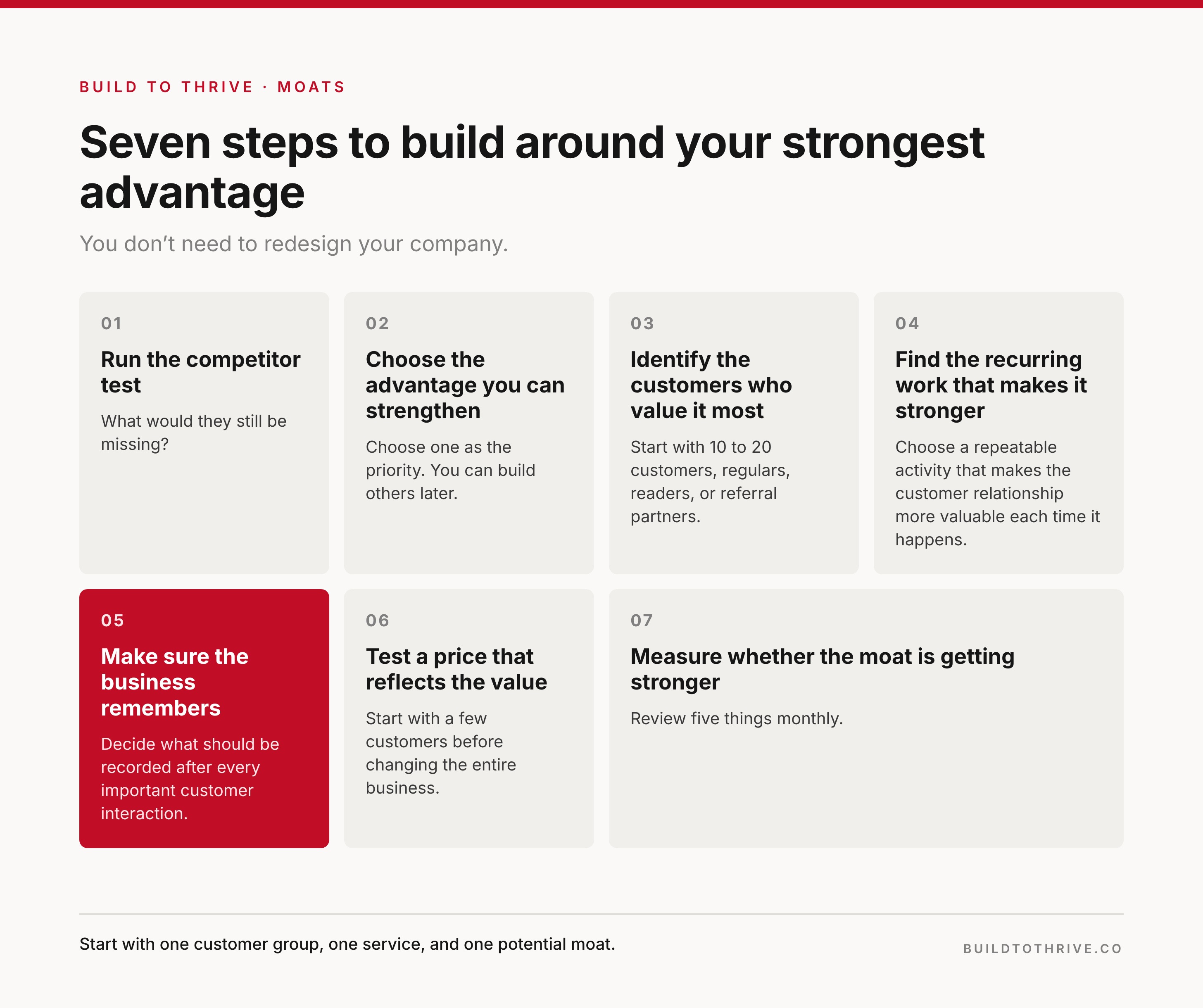
You don’t need to redesign your company.
Start with one customer group, one service, and one potential moat.
1. Run the competitor test
Imagine a competitor has your software, your AI tools, and enough money to match your prices.
What would they still be missing?
Now imagine your best customer has access to those same tools.
What would they still need from you?
Write down the answers. Avoid generalities like quality or great service. Look for something specific you can demonstrate.
2. Choose the advantage you can strengthen
Look at the six moats.
Which one is already producing evidence that customers value it?
For our accounting practice, it might be customer routines combined with historical knowledge.
Choose one as the priority. You can build others later.
3. Identify the customers who value it most
Start with 10 to 20 customers, regulars, readers, or referral partners.
Look for patterns.
Who stays longest? Who refers others? Who asks for more help? Who seems least sensitive to price?
These people may tell you more about your competitive advantage than a broad market survey.
4. Find the recurring work that makes it stronger
For the accounting practice, that might be the monthly financial review.
For a restaurant, remembering regular customers’ preferences.
For a consultant, documenting what worked across previous engagements.
Choose a repeatable activity that makes the customer relationship more valuable each time it happens.
5. Make sure the business remembers
This is the step I would pay particular attention to.
If your advantage depends entirely on what you remember, it becomes vulnerable when you’re unavailable, hire someone, or eventually sell the company.
Decide what should be recorded after every important customer interaction.
For example:
What problem did the customer face?
What did we recommend or deliver?
What was unusual?
What happened afterward?
What should we remember next time?
AI can help organize those records and prepare useful summaries.
But the business needs clear rules about accuracy, access, privacy, and who reviews the information.
The goal is to turn experience into an asset the company can continue using.
6. Test a price that reflects the value
Don’t automatically lower prices because AI reduces your costs.
Ask whether the improved service solves a more valuable problem.
Our accounting practice could test an annual arrangement that includes bookkeeping, payroll, taxes, and regular financial reviews.
A restaurant with a scarce location and loyal regulars might test a membership.
A specialist might offer a fixed-price engagement around a clearly defined outcome.
The pricing model isn’t the moat. It is a way of capturing the value the moat helps create.
Start with a few customers before changing the entire business.
7. Measure whether the moat is getting stronger
You don’t need a complicated dashboard.
Review five things monthly:
How many of your priority customers stayed?
How much revenue came from the service built around your moat?
Did customers accept your proposed pricing?
Did the team consistently capture and use what it learned?
What customer decision or business outcome improved because of that knowledge?
These won’t prove you have an unassailable moat.
But they’ll tell you whether you’re making progress.
And that’s far more useful than simply declaring your business defensible.
Your first 30 days
Here’s how I would put the framework to work.
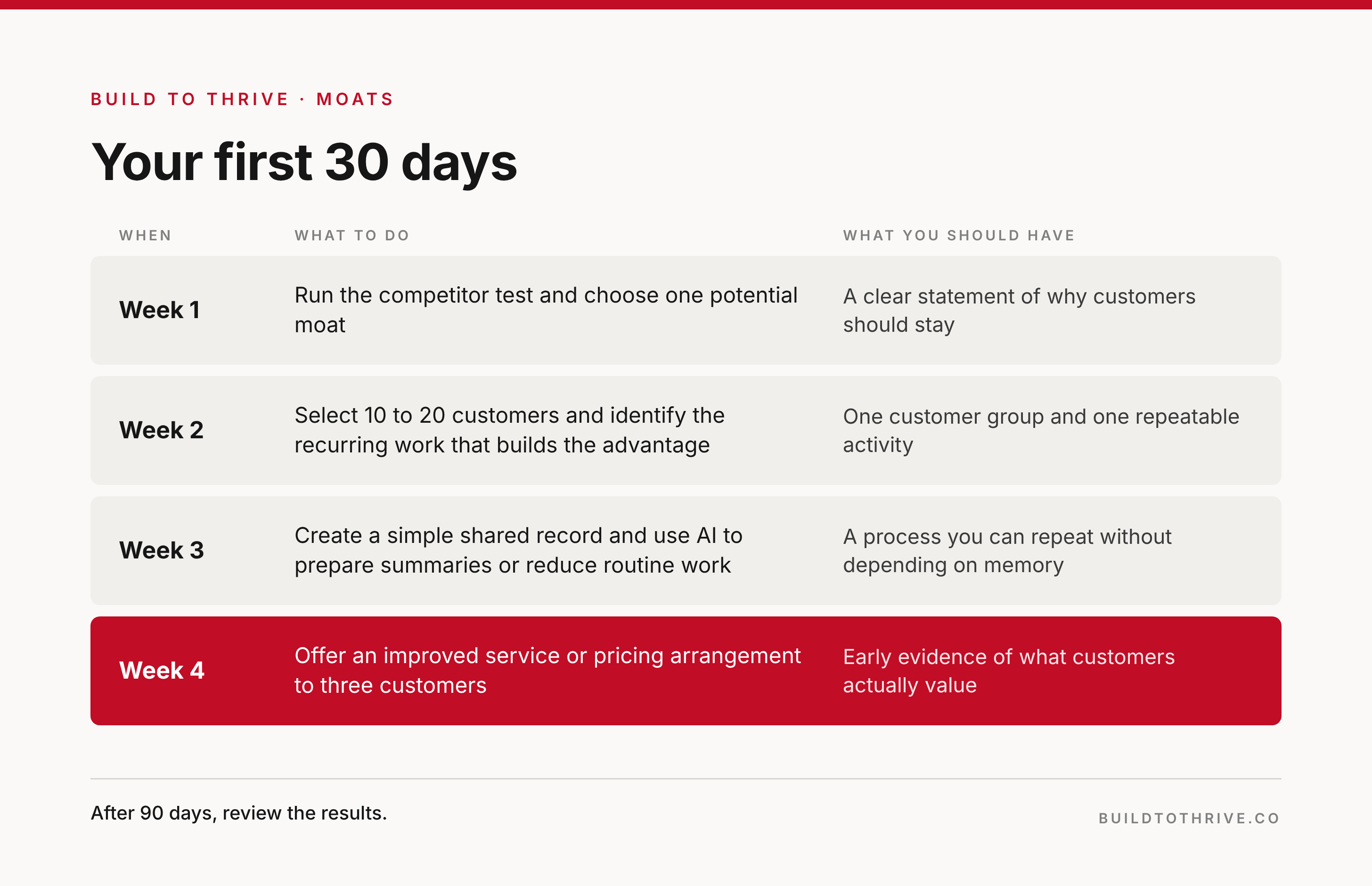
Don’t expect to create a lasting competitive advantage in 30 days.
That’s not the point.
The goal is to stop treating your existing business as a collection of products and services, and start strengthening the reasons customers choose you.
After 90 days, review the results. If the advantage isn’t showing up in retention, referrals, pricing, or customer outcomes, revisit your assumptions.
The question I’d leave you with
I’ve been building companies long enough to know how much work goes into developing a product, a service, or a way of operating.
And I understand why it’s uncomfortable to watch AI reproduce parts of that work in minutes.
But there’s another way to look at it.
If competitors can use the same tools, the tools themselves won’t be enough to distinguish your business.
What matters is what you’ve built around them, and what you continue building every time you serve a customer.
The trust you’ve earned. The knowledge you’ve accumulated. The relationships you’ve developed. The place you’ve earned in someone’s daily routine.
Some of those advantages may be more fragile than you think. Others may be much stronger.
The opportunity is to find out which is which before a competitor does.
So here’s the question I’d encourage you to ask this week:
If a competitor could copy everything you deliver, what would your customers still be unwilling to give up?
That’s where I’d begin.
Want to find out where your business stands?
Start with the Better Business Reflection, a structured way to examine how your business operates and where its strongest opportunities may be.