


TL;DR
AI has dramatically reduced the time and money required to turn an idea into something you can use.
A business owner can now create a workflow, internal tool, client portal, research system, or first version of an app without assembling a traditional software team.
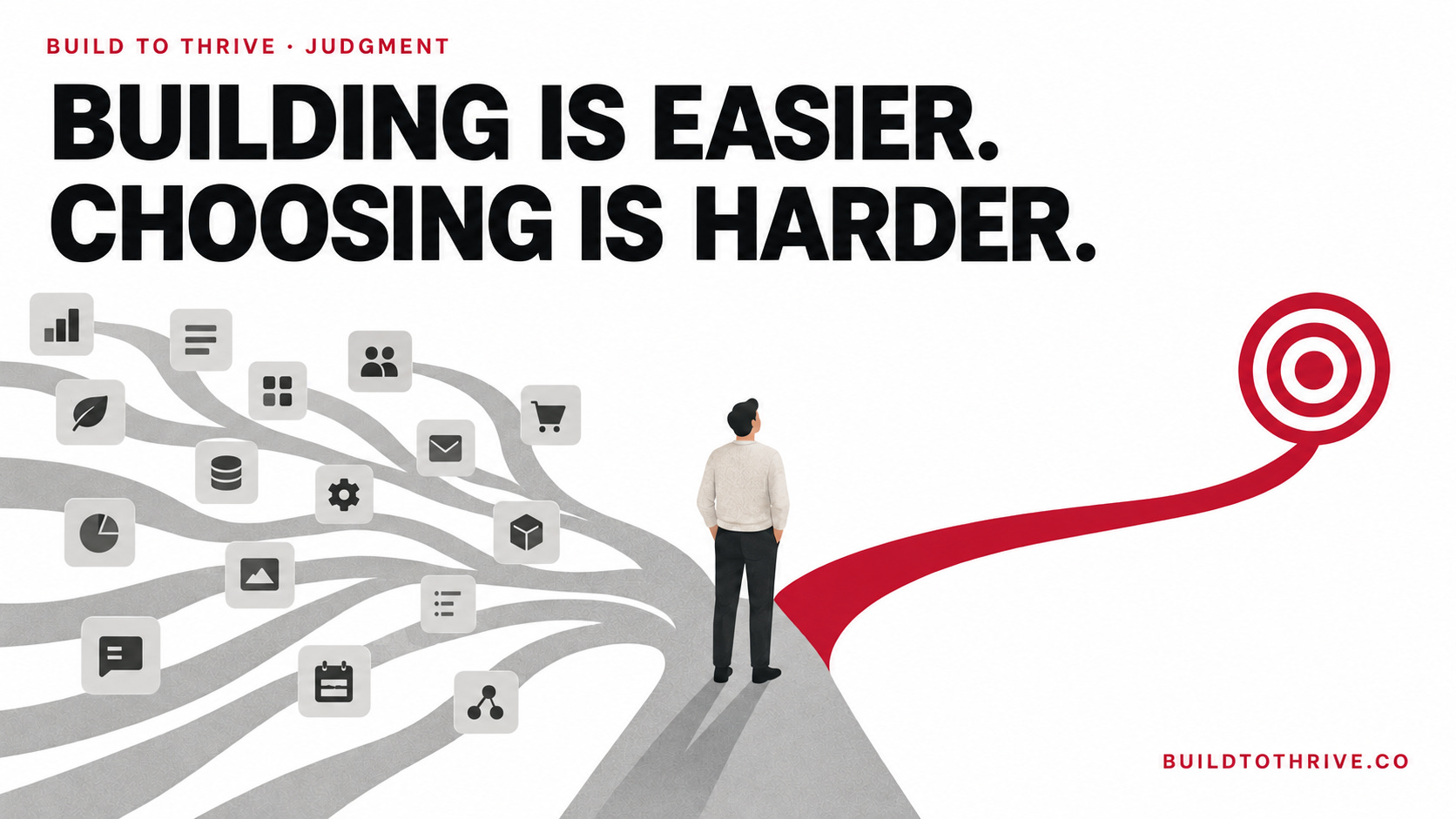
But easier building creates a new problem. When almost anything can be built, it becomes easier to spend time building things that do not matter.
The question is no longer only, “Can we build this?”
It is, “If we build this, what becomes meaningfully better?”
A few years ago, most business owners could identify problems they wanted software to solve but could not build the solution themselves.
They needed someone to translate the problem into technical requirements. Then they needed a designer, developer, budget, and enough confidence in the idea to justify the cost.
That cost created a filter. Many ideas never made it past a notebook because testing them was too expensive.
AI is removing much of that barrier.
You can now describe a problem, create a rough version of a solution, try it on real work, and improve it as you learn. You do not need to begin with a large software project. You can begin with something that frustrated you on Tuesday afternoon.
That is a major shift for business owners.
It is also an invitation to build the wrong things faster.
Here’s what you’ll learn
Why the old cost of building acted as a filter
* How AI changes the order in which we develop ideas
* Why cheaper building makes judgment more important
* How to decide whether an idea deserves to be built
* The five questions to answer before choosing the tool
The old cost was building
For most of the software era, turning an idea into something usable required a long sequence of decisions.
You identified the problem. Someone wrote a specification. The project was scoped and priced. A designer worked through the experience. Developers built it. The team tested it, revised it, and eventually released it.
The process was slow because engineering time was expensive. Companies created planning rituals to protect that limited resource.
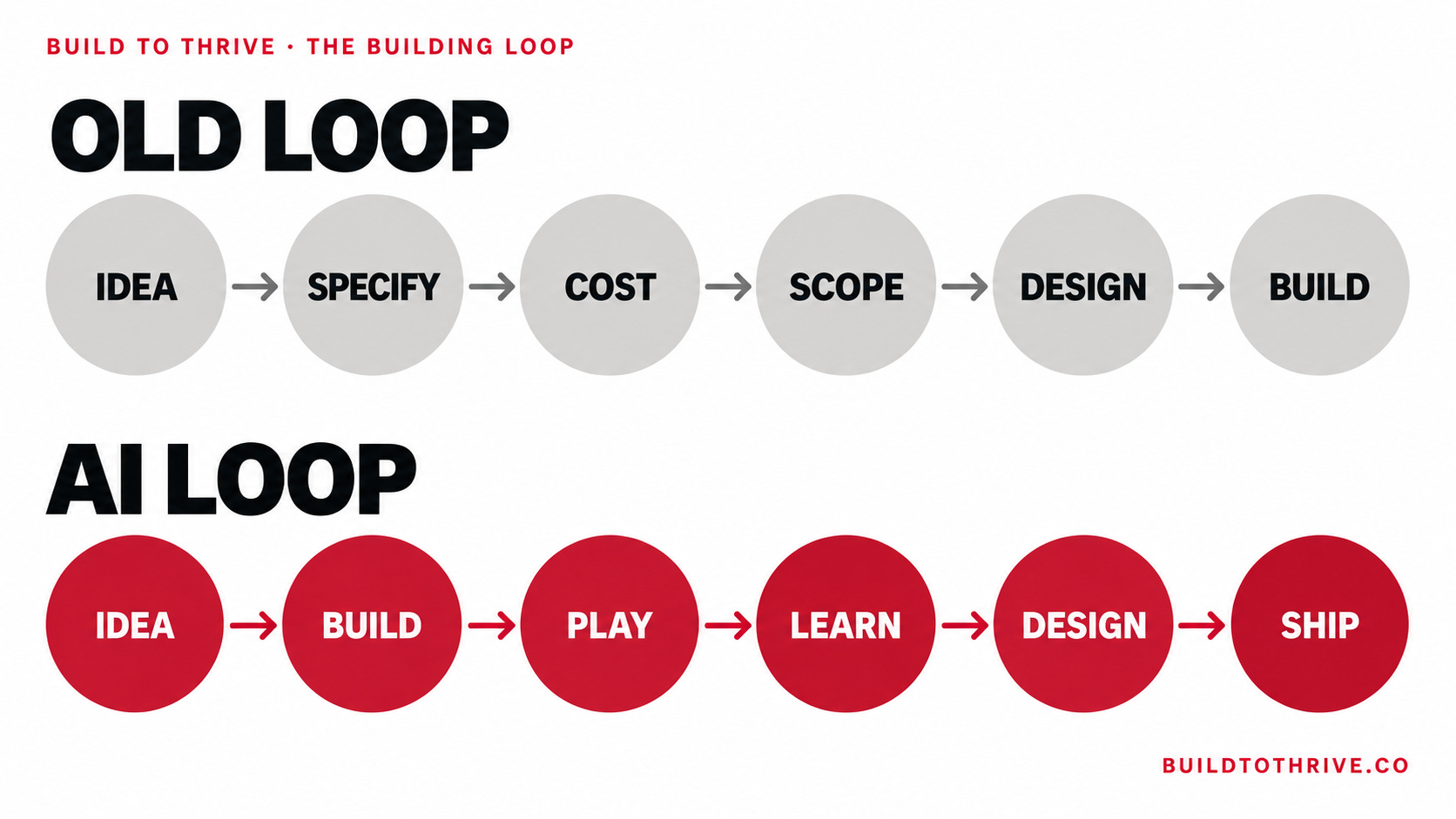
Josh Elman, a former product leader at LinkedIn, Twitter, and Robinhood, describes the old development loop as beginning with the idea and moving through specification, costing, scoping, design, and finally building.
AI changes the order.
Instead of fully describing the system before anything exists, you can build a rough version first. Then you play with it, learn what feels useful, see what is missing, and decide whether it deserves further investment.
The new loop looks more like this:
Idea → Build → Play → Learn → Design → Ship
Elman describes this shift in his article, “Product Management Is Still All About Telling Stories.”
A prototype gives you something a written specification cannot. It lets you experience the idea.
For a small-business owner, that prototype does not have to be software sold to thousands of people. It could be a system that prepares a proposal, reviews purchase receipts, organizes research, or shows which client relationships need attention.
The economics have changed
The cost of using AI has fallen with unusual speed.
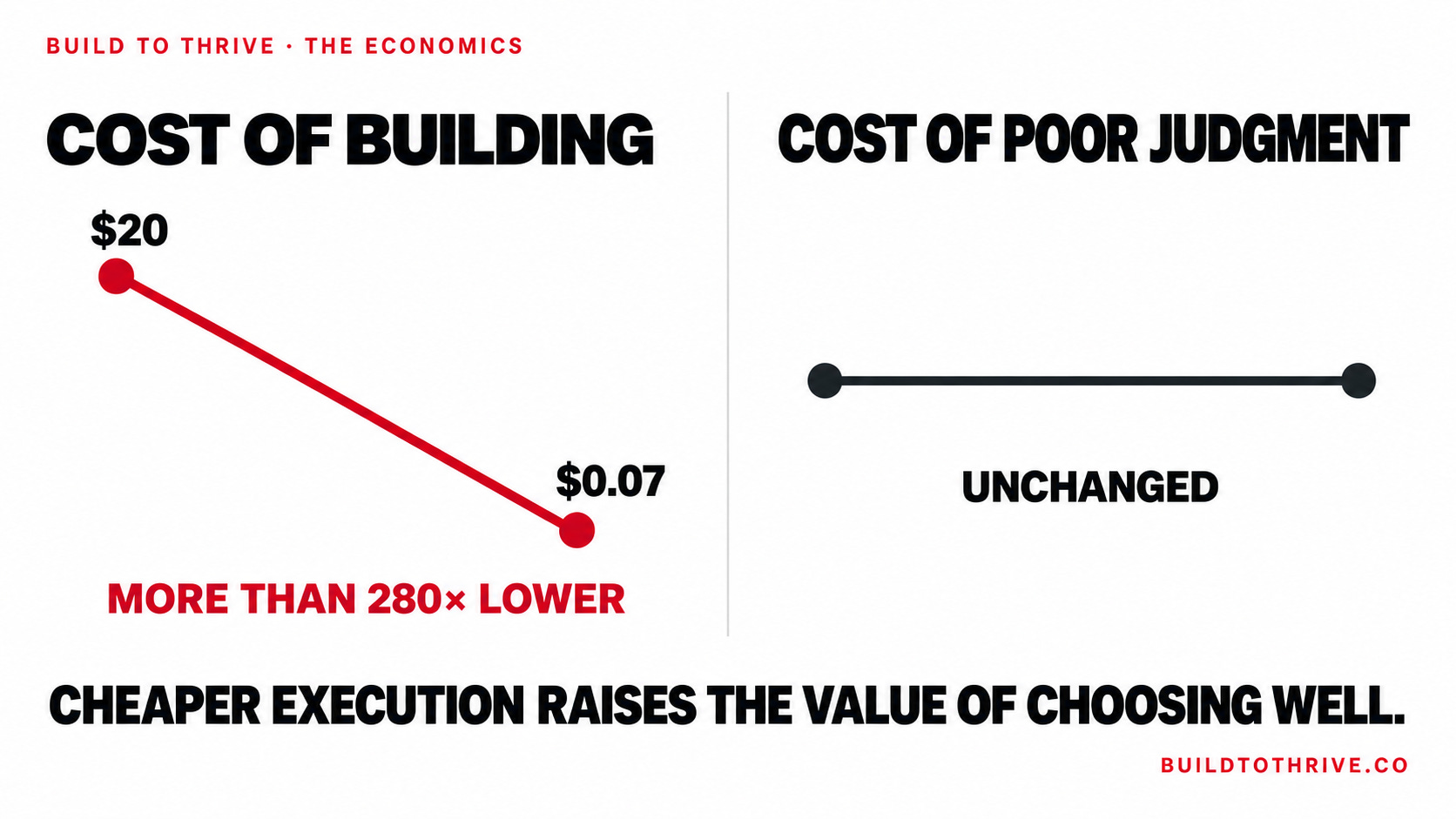
The Stanford AI Index found that the cost of querying a model performing at approximately GPT-3.5 level fell from $20 per million tokens in November 2022 to $0.07 by October 2024.
That is a reduction of more than 280 times in about 18 months.
The figures explain why capabilities that once required a software company are appearing inside ordinary businesses.
A consultant can build a research system around past work. A restaurant owner can turn purchase receipts into information for the accountant, inventory, food-cost decisions, and tomorrow’s purchasing. An agency can prepare client updates before the weekly meeting. A real estate operator can organize property information and identify what needs attention.
The technical barrier keeps getting lower.
The cost of a bad decision has not fallen at the same rate.
You can still spend days building something nobody uses. You can automate a process that should have been eliminated. You can create a dashboard that displays information without improving a single decision.
The system may work exactly as designed and still have little value.
The new cost is distraction
When building was expensive, the obstacle was access.
When building becomes cheap, the obstacle is focus.
You can create an app for a task that takes ten minutes each month. You can build an agent to produce a report nobody reads. You can connect five tools when a shared checklist would solve the problem.
The app works. That does not mean it was worth building.
This is where many AI projects go wrong. They begin with a capability instead of a business problem.
Someone sees that AI can summarize calls, create dashboards, generate proposals, or coordinate agents. The conversation begins with what the technology can do. Nobody stops to ask which part of the business is actually costing time, margin, revenue, or customer trust.
A working prototype can create false confidence. Because the system runs, everyone assumes the project has moved forward.
But activity is not the same as progress.
The better question is:
If we build this, what becomes meaningfully better?
Can we name the hours that come back?
The delay that disappears? The decision that improves?
The customer who receives a better experience?
The margin that is protected?
If the answer is unclear, the idea is not ready.
Experience becomes part of the technology
AI gives business owners a new ability to act on what they already know.
The owner knows which part of the process breaks when the restaurant is busy. The owner knows why two clients who appear similar need different recommendations. The owner knows when an invoice is normal, when it requires attention, and when the supplier needs a call.
That information rarely appears in the official process.
It lives in experience.
A developer may understand how to build the system. AI may be able to produce the first version. A consultant may recognize patterns from other companies.
The owner understands what happens when the clean process meets the real day.
That knowledge helps answer questions the technology cannot settle on its own:
Which problem is worth solving?
* Which exception matters?
* What can be standardized?
* What must remain specific to the customer?
* Which decisions involve money, trust, or accountability?
* What should the system prepare?
* What should a person still decide?
AI can help execute the answer. It cannot decide what matters to the business without being taught.
Five questions before you build
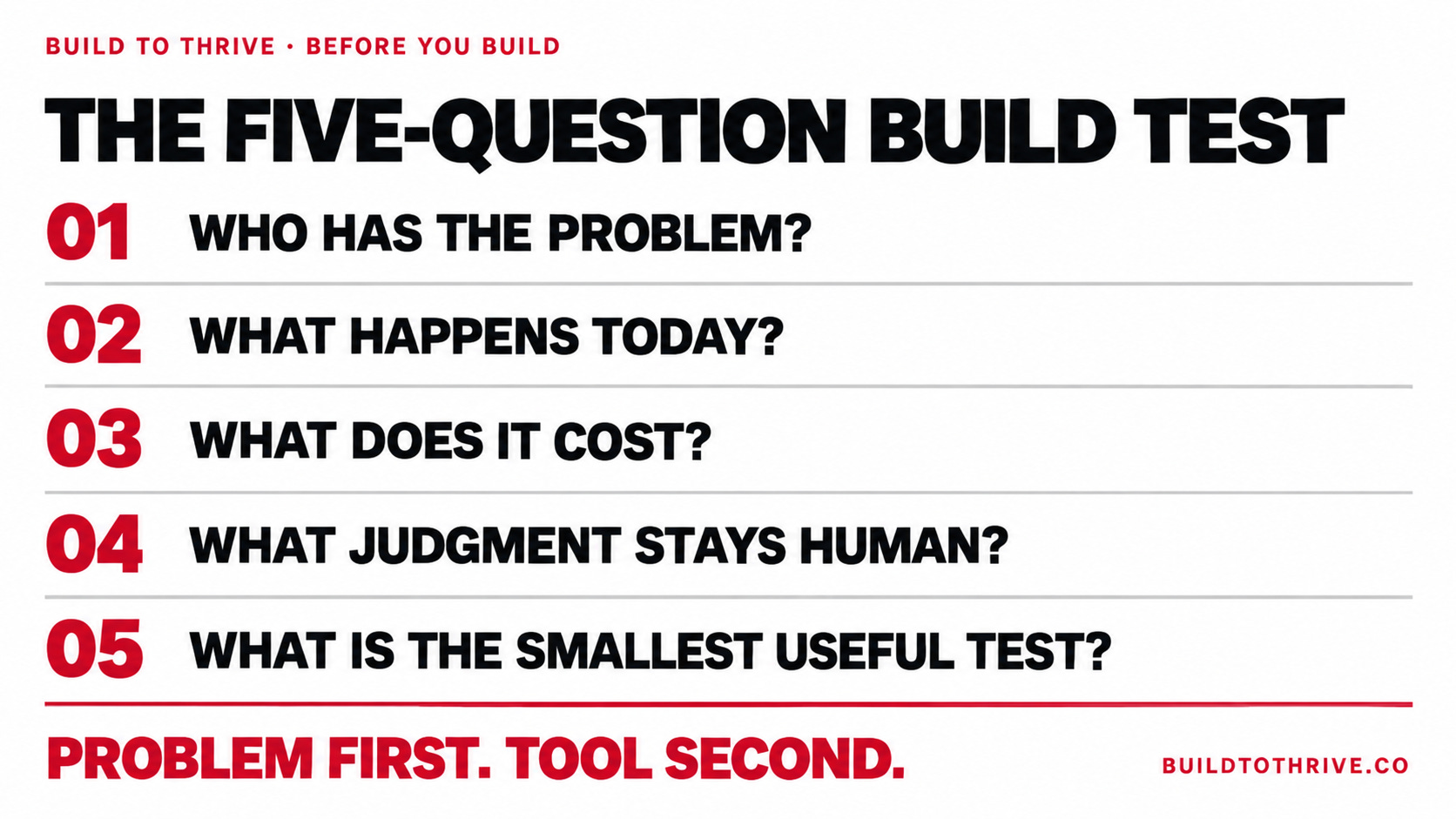
Before choosing a tool, writing a prompt, or connecting two systems, answer five questions.
Who is experiencing the problem?
“The business” is too broad.
Is the problem affecting the owner, an employee, a customer, the accountant, or a supplier? Different people may experience different parts of the same process.
What happens today?
Describe the work as it actually happens.
Where does the information begin? Who touches it? What gets copied? What is reconstructed from memory? Where does the process wait?
What does the problem cost?
The cost may be time, lost revenue, lower margin, a poor customer experience, or a decision made without current information.
If the cost cannot be described, it will be difficult to know whether the solution helped.
What judgment must remain human?
AI can collect, organize, compare, calculate, summarize, and draft.
A person should remain responsible for decisions involving fit, price, promises, relationships, risk, and accountability.
Define that boundary before automating the process.
What is the smallest version that could teach you something?
Do not begin by building the final system.
Run one invoice through it. Prepare one client meeting. Draft one proposal. Use one real piece of work and observe what happens.
A prototype is useful because of what it teaches you, not because it exists.
Start with work that already exists
You do not need to invent an AI strategy for the entire company.
Look at the work already happening.
Find one repeated process that consumes meaningful time or money. Choose something with recognizable inputs, a visible output, and a decision that can remain with a person.
Then test the smallest useful version on live work.
If it is a proposal process, prepare one proposal.
If it is purchasing, process one set of receipts.
If it is client preparation, use it before one meeting.
You will learn more from one real run than from another week of discussing tools.
If you only remember one thing
AI has lowered the cost of turning an idea into something that works.
It has not lowered the cost of choosing the wrong idea.
The advantage will not belong to the business that builds the most systems. It will belong to the business that knows which problem deserves attention, what outcome matters, and where human judgment belongs.
This is why my work with business owners begins before we choose a tool. We identify the real constraint, define what should change, and build the smallest, useful version around the work that already exists.
The technology comes after the problem is clear.
Build assets. Create freedom. Thrive on your terms
Juan

That's the biggest challenge now, not can we build but should we build.
A working prototype creating false confidence is such an easy trap to fall into.