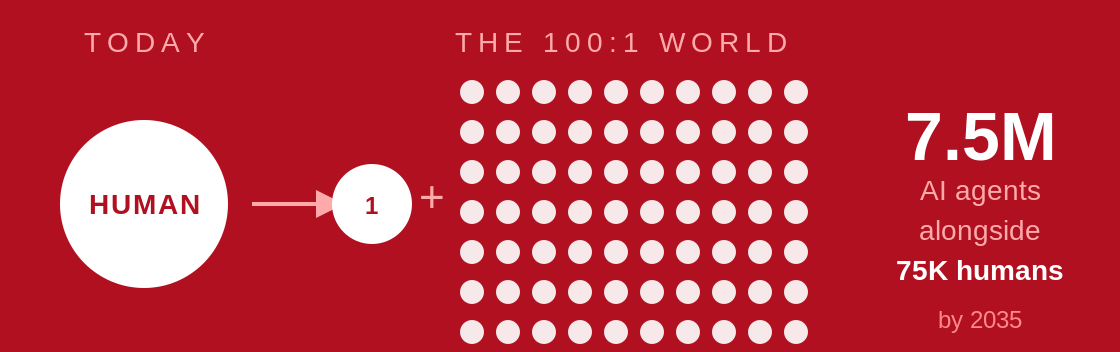
Not a percentage. Not a projection. A ratio. One human. One hundred AI agents. Working alongside each other, every day, on the same team.
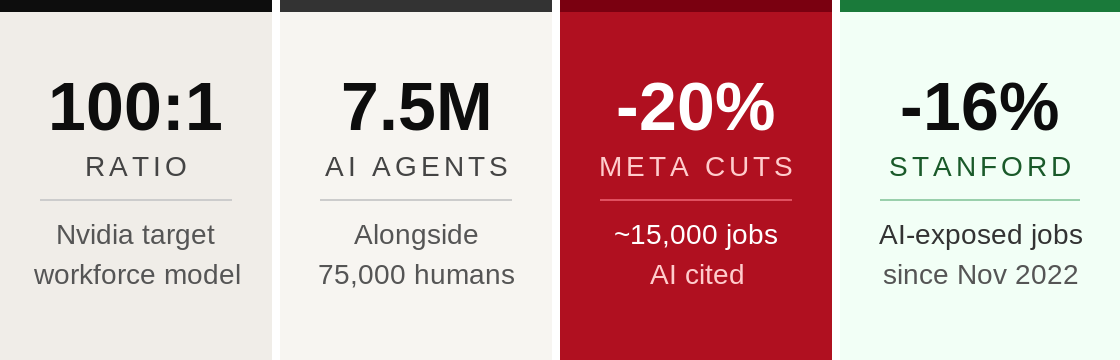
Jensen Huang said it out loud Thursday at Nvidia’s GTC conference in San Jose. In ten years, Nvidia plans to employ 75,000 people — nearly double its current workforce. And working alongside them: 7.5 million AI agents. His exact words: “as small as possible, as big as necessary.”
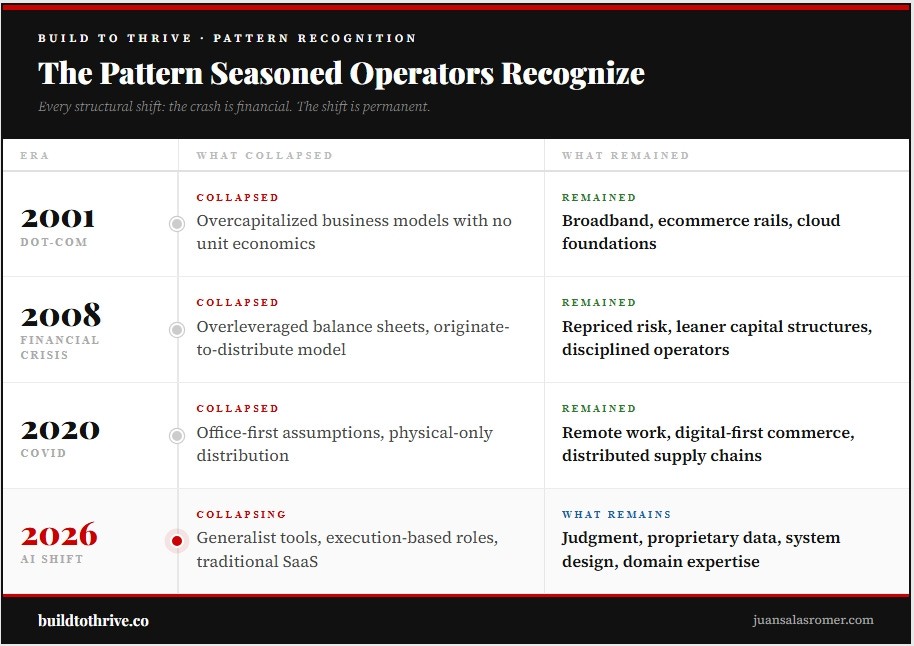
I’ve been in enough cycles to know the difference between a market making noise and a market changing structure. Dot-com was structural. 2008 was structural. COVID was structural. Not because of the disruption, disruptions happen, but because of what each one permanently relocated. The bubble popping doesn’t mean the structure changed back. It means the overcapitalized, underdisciplined version of the idea got flushed, and what remained rewrote the rules for the next twenty years. The AI hype will correct. Some version of it already is. But what’s underneath, the shift in how work gets executed, the reallocation of where value lives, that doesn’t go back when the noise clears.
I spent fifteen years watching industries reorganize themselves around a new cost structure. When the mortgage crisis hit in 2008, it wasn’t just banks failing — it was an entire ecosystem of roles evaporating almost overnight. Loan processors, appraisers, the mid-level deal managers who made the machine run. The work didn’t disappear. The headcount did. Whoever was left had to operate more of the system with far fewer people around them. (More on this: Gartner’s 2026 Forecast: 5 Shifts That Will Define Who Wins and Who Gets Left Behind)
What Huang described this week is not a dystopia. It is a structural announcement. The kind that gets filed under “bold prediction” in March and quietly becomes the baseline by December.
If you’re a professional with ten or twenty years behind you, this week’s issue is not about whether AI will take your job. It’s about understanding what 100:1 actually means for someone who has already built something — and what the smart professionals are doing right now.
JS
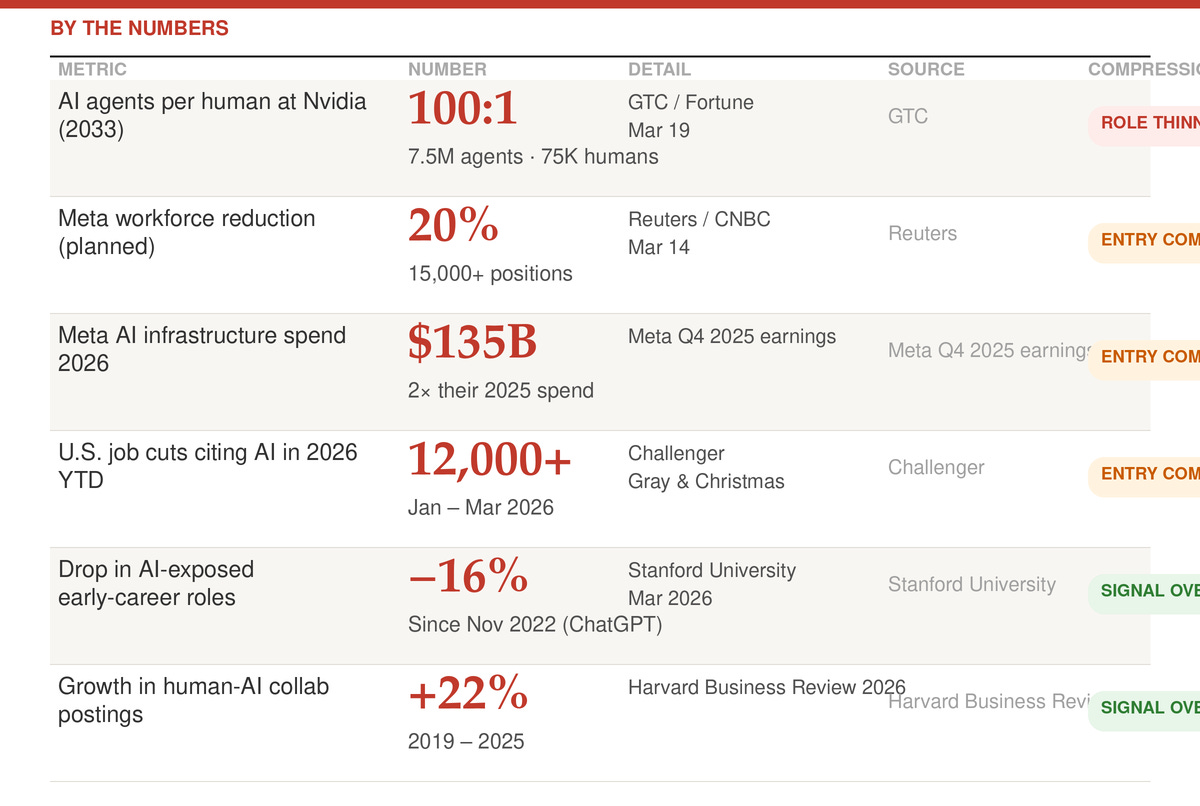
WHAT HAPPENED Speaking at Nvidia’s GTC on March 19, 2026, CEO Jensen Huang said Nvidia expects to employ 75,000 people within a decade — nearly double its current 42,000 — working alongside 7.5 million AI agents, a 100-to-1 ratio. He also proposed an “AI token budget” on top of base salary, paying engineers to deploy agents as productivity multipliers. Source: Fortune, March 19 · CNBC, March 20, 2026.
WHAT IT MEANS FOR PROFESSIONALS & BUSINESS OWNERS Huang is not a futurist. He runs the company building the infrastructure that makes AI agents possible. When he describes his own workforce at 100:1, he is telling you what the new organizational unit looks like — one person operating a portfolio of agents. The professionals who thrive are those with judgment, relationships, and domain expertise. The ones at risk: volume, coordination, execution.
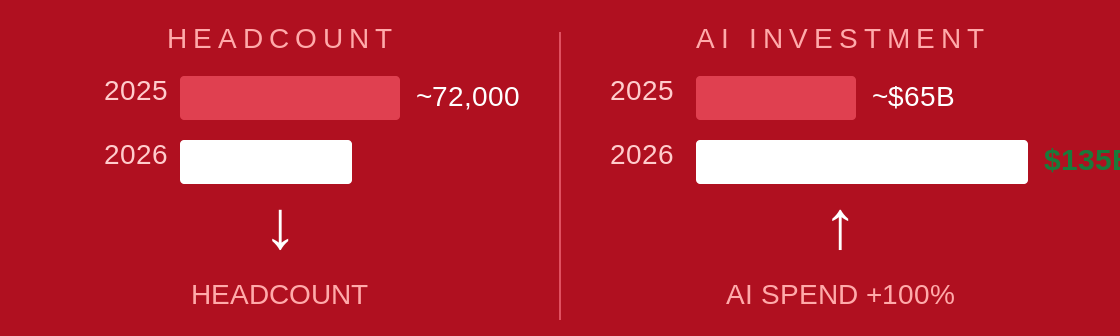
WHAT HAPPENED Meta is reportedly planning layoffs affecting at least 20% of its workforce — potentially 15,000+ positions — as AI spend hits $115–135B in 2026, double 2025. Jack Dorsey’s Block cut 4,000 in February citing AI. AI has been cited in 12,000+ U.S. job cuts in 2026 so far. Source: Reuters/CNBC, March 14 · TechCrunch, March 14, 2026.
WHAT IT MEANS FOR PROFESSIONALS & BUSINESS OWNERS Companies are simultaneously investing heavily in AI and eliminating the human roles it can absorb. For the solopreneur or founder, this signals what your corporate clients are doing. Their budgets are moving toward AI, not toward the coordinating and execution roles you may currently fill. The question is not whether your clients will change — it is whether you have already repositioned.
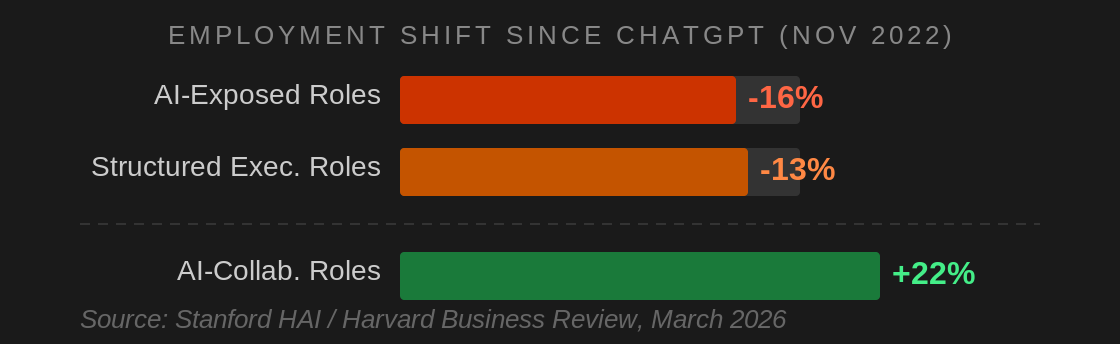
WHAT HAPPENED Stanford found employment in AI-exposed early-career occupations has fallen 16% since ChatGPT launched in November 2022 — concentrated in financial analysis, paralegal work, data processing, software testing. HBR found postings for structured roles fell 13% while human-AI collaboration roles grew 22%. Source: Stanford University / Harvard Business Review, March 2026.
WHAT IT MEANS FOR PROFESSIONALS & BUSINESS OWNERS The 16% number is about early-career workers, but the mechanism applies to anyone whose value is created through volume, not judgment. The 22% growth in collaboration roles tells the other side: when you bring AI in as a co-worker, demand for your judgment increases. If you are still packaging your expertise as execution capacity, you are pricing yourself into the category that is disappearing.
The 100:1 world is not coming. It arrived Thursday, in San Jose, in front of thousands of engineers and every major tech publication on earth.
WHAT IT IS Manus is an autonomous AI agent that operates your computer end to end — without you watching it. Give it a task and it figures out the steps, opens the apps, browses the web, writes the files, and delivers the output. No permission requests. It just runs. Meta acquired Manus for $2 billion after it hit $100M in revenue in 8 months.
WHO IT’S FOR Professionals and founders with high-value work requiring hours of low-judgment execution — research, prospecting, content production, competitive analysis, document drafting. If you’ve ever said “I know what needs to be done, I just don’t have time to do it,” this is built for you.
HOW TO START RIGHT NOW Download at manus.im (Mac + Windows, launched March 18 — two days ago). Give it your first real task: “Summarize the top 5 competitors in [your market] and tell me where each one is weakest.” Let it run. See what comes back.
WHY IT MATTERS THIS WEEK This is Jensen Huang’s 100:1 world made tangible for a non-technical professional. No code. No waitlist. Start today.
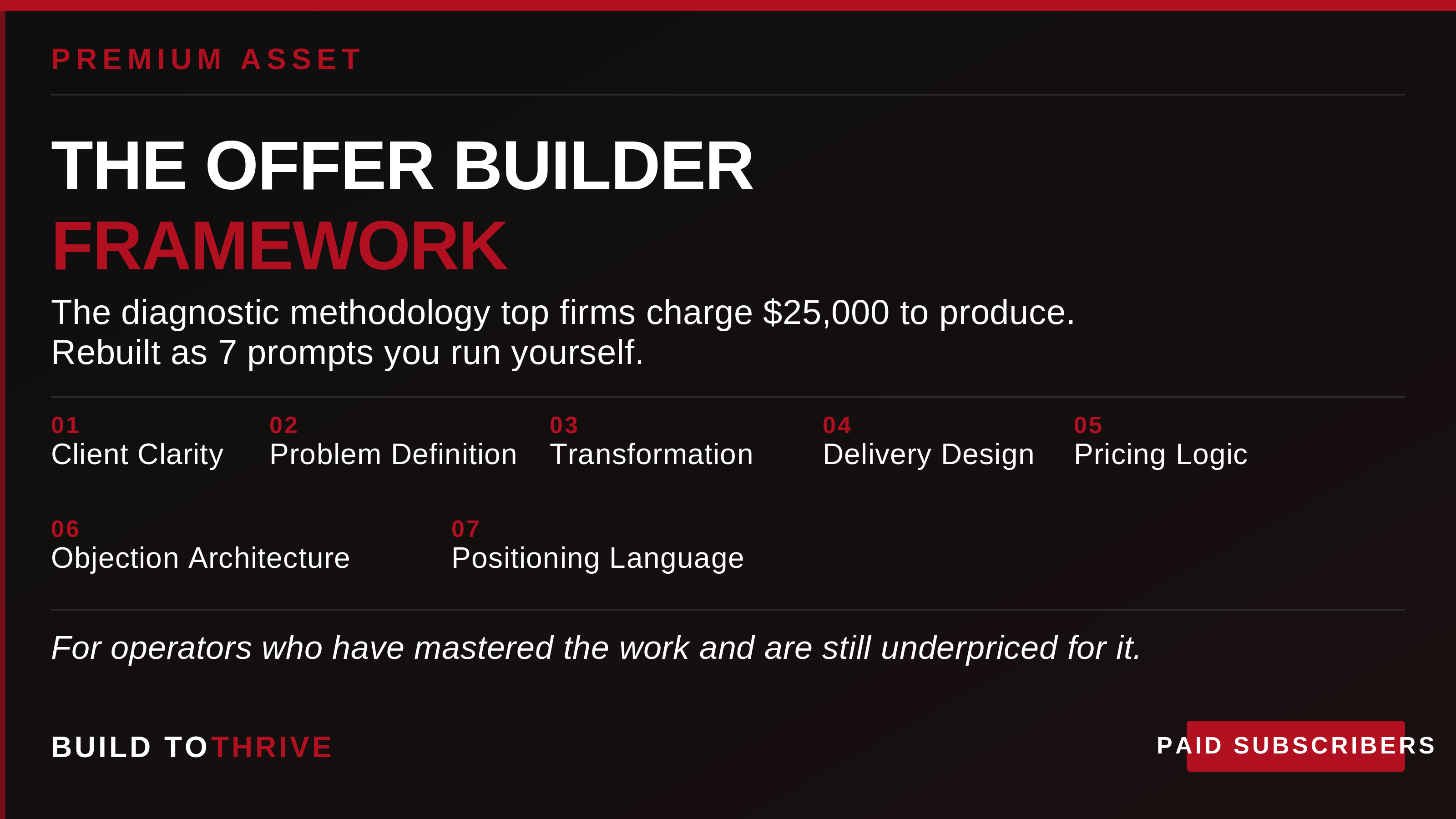
The top strategy firms — McKinsey, Bain, BCG — do not sell time. They sell a structured diagnostic that produces a defensible output. Their engagements command premium fees not because their people are smarter, but because their methodology is systematic, sequenced, and outcome specific.
The Offer Builder Framework applies that same diagnostic architecture to the solo operator’s most expensive problem: the undefined offer.
The transformation: You enter the framework with a vague service and exit with a positioned, priced, and pitch-ready offer. Complete with a client definition, a problem statement in the buyer’s language, a before/after transformation, a repeatable delivery structure, a value-anchored price, pre-built objection responses, and one sentence that closes.
The same diagnostic work a retained strategy firm would bill $25,000 to produce. Rebuilt as seven prompts you run yourself.
Continue reading this post for free, courtesy of Juan Salas-Romer.