


Editorial
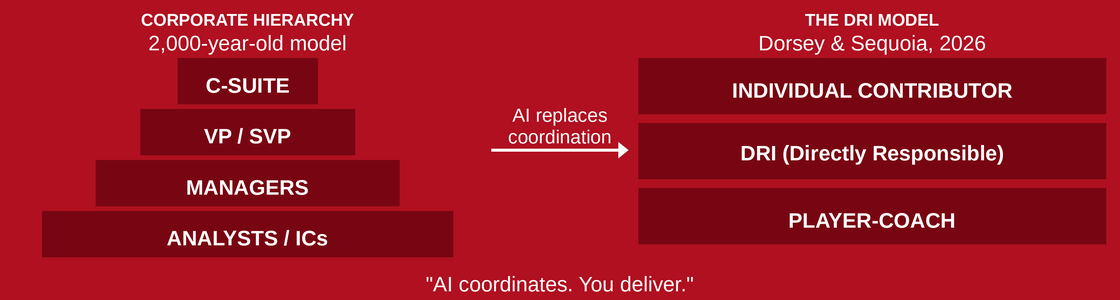
Jack Dorsey (founder of tweeter) and Sequoia published a piece yesterday called "From Hierarchy to Intelligence.”
The argument: corporate hierarchy is a 2,000-year-old information routing protocol.
AI makes it redundant. Three roles replace it:
Individual Contributor: owns a deep technical layer, the actual craft. Value is specific domain skill, not coordination.
DRI (Directly Responsible Individual): owns a specific outcome for a defined period. Accountable, empowered to decide, expected to deliver and move on.
Player-Coach: builds the work and develops the people around them simultaneously. Senior enough to have judgment, embedded enough to have context.
None of them coordinate. That's the job AI took.
Fractional operators have been running this model for years.
The DRI is exactly what every fractional CMO, CFO, and COO does, except across four companies at once.
The difference: Dorsey's DRI is assigned by a company. The fractional operator is hired for it, on their own terms, with the leverage to walk away.
This new vision will welcome a growing number of fractional operators. The question is whether you've built your practice to look like the future or the past.
Check out the podcast here

The commoditization clock just moved.
Three data points landed this week that every operator in advisory, strategy, or consulting needs to process together.
PwC launched PwC One on March 19.
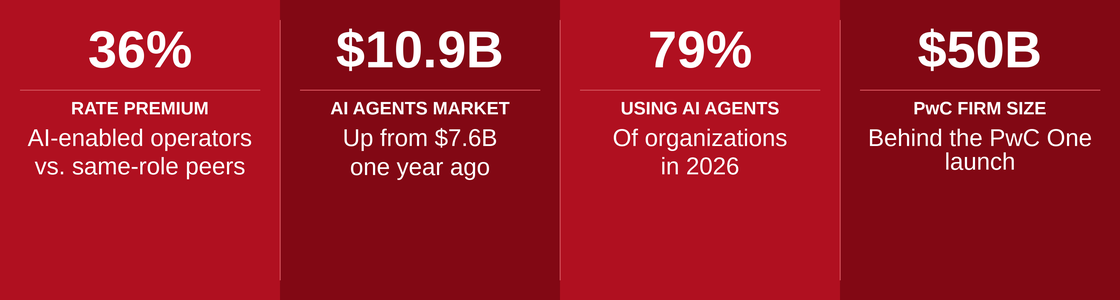
They describe it as an AI-enabled professional services platform that gives clients "continuous insight" and "earlier visibility into risk and opportunity" -- replacing episodic project engagements with an always-on AI layer. For a $50B firm, this is not a pilot. It is the new delivery model.
AI Orchestrators are commanding a 36% rate premium.
Operators who combine domain expertise with AI agent coordination are now billing 36% higher than peers with equivalent experience who are not using AI systematically. The data is from Upwork's most recent earnings period and reflects what companies are willing to pay for human-plus-AI delivery vs. human-only delivery.
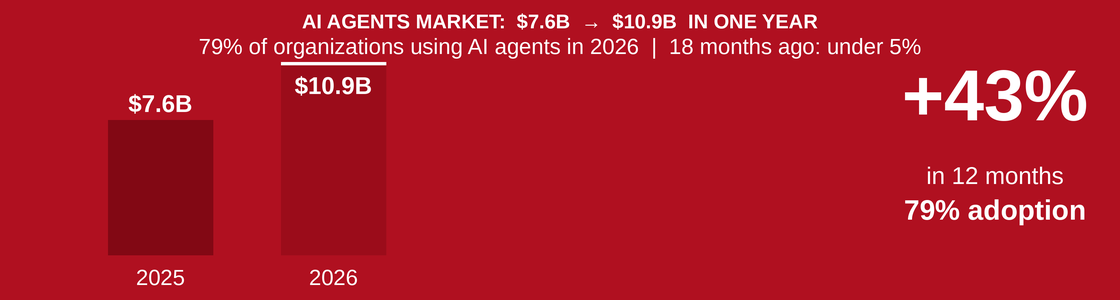
The AI agents market hit $10.9B in 2026, up from $7.6B last year. 79% of organizations report using AI agents in some capacity.
Eighteen months ago, that number was under 5%. The infrastructure has moved faster than most operators have.
What this means
PwC just committed the organizational weight of a $50B firm to build, at scale, what you already do -- direct, accountable delivery with no coordination layer between the judgment and the client. That is not a threat. That is market validation.
The 36% rate premium is what happens when buyers realize that a solo operator with AI delivery beats a team without it on speed, cost, and output quality. Enterprises are paying to replicate your model. The operators billing at premium rates have made that model explicit to buyers -- not assumed it.
If you read The Death of the High Performer when I published it, you know where this is going. The generalist identity is the most expensive comfort zone in professional life right now. And if you caught How Anthropic Set Off a Trillion-Dollar Chain Reaction, you already saw the mechanism behind this compression before it showed up in PwC’s product roadmap.
The business model archetypes emerging from this infrastructure shift are mapped in my most recent piece: 8 AI Business Models That Didn't Exist Two Years Ago. They're Hiring Now.
Three prompts for this week. All three are designed to force a decision, not generate more analysis. Run them in order.
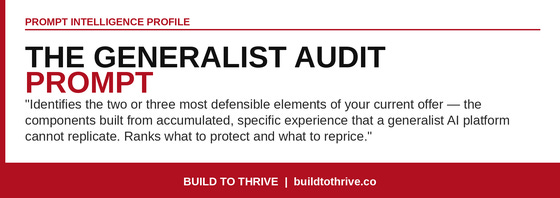
Use this to identify what is actually defensible in your current offer.
"I work with [target client type] on [current service description]. Which elements of my positioning reflect judgment that comes from accumulated, specific experience -- the kind that a generalist AI platform cannot replicate? Identify the two or three elements most defensible for this reason. Then identify the one element most likely to be systematized in the next 18 months. Give me a concrete recommendation: where should I narrow or deepen to make my highest-value positioning more visible and more explicit to buyers?"
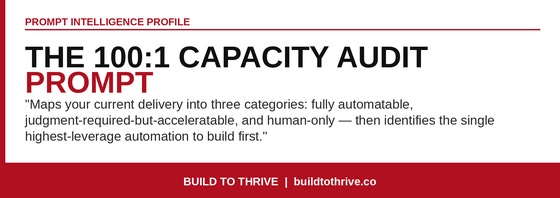
Use this to map where your hours are going and where AI can absorb them.
"I currently deliver [service] to [client type]. My current capacity is approximately [X] clients or [Y] hours per month. What would need to be true for me to serve 3x the clients without 3x the hours? Break my delivery into three categories: (1) tasks that can be fully automated with current AI tools, (2) tasks that require my direct judgment but can be accelerated with AI support, and (3) tasks only I can do. Then identify the single highest-leverage automation I should build first."
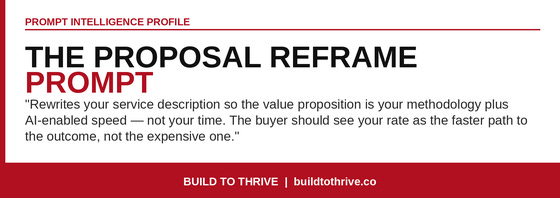
Use this before your next proposal goes out.
"Here is my current service description: [paste your current language]. Rewrite it so the value proposition is my methodology plus AI-enabled speed -- not my time. The buyer should come away thinking: I could hire two junior consultants for this, or hire this person and get better output faster. Adjust the framing for a buyer who already uses some AI tools internally and values an operator who can out-think and out-execute their own tools."

Three moves for this week. Each one is concrete. Each one takes under two hours.

Think about the thing you assess in the first hour with every new client. The three questions you always ask. The pattern you recognize that takes them months to see on their own. That's a diagnostic. It just doesn't have a name yet.
Give it one. Write it down: "The [Your Name] Growth Readiness Assessment. Five dimensions. Delivered in a week." That one sentence turns a repeating conversation into a sellable asset. PwC One competes on breadth across thousands of clients. You compete on the specific pattern recognition you've built over 10 years. A named diagnostic is how you make that visible before the proposal.
If you haven't done this yet, it's the move -- ahead of content, ahead of marketing, ahead of anything else on your list. I laid out the foundation in the February 9 Operator's Leverage Diagnostic issue. If you haven't run that yet, this week is the right time.

Here's a sentence worth adding to your next proposal:
"Using AI-enhanced research and analysis, I deliver [outcome] in [timeframe] -- typically two to three times faster than a traditional engagement at the same depth."
You don't need a new service. You just need to say the thing that's already true. If a competitive landscape that used to take you three days now takes six hours, that's the number. Put it in the proposal. Your clients are comparing you to firms that still do this the slow way -- they just don't know you're different unless you tell them. Where AI Agents End and Human Judgment Begins has the framework for figuring out where this applies in your specific work.

Run a 30-minute leverage audit on your active engagements.
Pick one active engagement. Then ask yourself honestly: could PwC One do what I just did for $200 a month?
If yes -- even for part of it -- that's your signal. Either build the automation yourself and get that time back, or phase that piece out and replace it with work that actually needs your judgment in the room.
Here's what that looks like: if you're writing the same meeting recap for a client every week, that is a $200/month job. The n8n workflow in the TOOL section above does it on a schedule, without you. Once you've automated it, the question becomes: what do I do with those three hours? That's the upgrade.
Don't wait for your client to run the same audit on your work. They will. Get there first.
TOOL
n8n -- n8n.io
Wyndo at The AI Maker ran a direct comparison between Claude Code and n8n this week. The piece is worth reading. What it surfaces for operators: n8n is not a developer tool. It is scheduling infrastructure. Here is what to do with it.
WHAT IT IS
Open-source visual workflow automation. You connect apps, APIs, and AI models into triggered sequences -- no code required. Unlike Zapier or Make, n8n gives you full control over logic branching, loop handling, and native AI model calls within a single canvas. Run it free on your own server or pay $24/month for the cloud version.
WHO IT'S FOR
Operators running recurring client work who want autonomous delivery systems instead of manual weekly prep. If you have ever thought "I do the same research and summary every week for three different clients" -- this is built for that. The 36% rate premium documented this week goes to operators who have a systematic delivery layer in place. n8n is that layer.
YOUR FIRST BUILD THIS WEEK
A client briefing workflow. Trigger: every Sunday at 6pm. Steps: pull RSS feeds from three client-relevant sources, call Claude API to summarize the top three signals, format as a memo, send via email before Monday morning. Total build time: under 90 minutes. Once running, it removes two to three hours of weekly prep and makes your delivery look like you never stop watching.
Cost: Free tier available. Paid starts at $19/month.

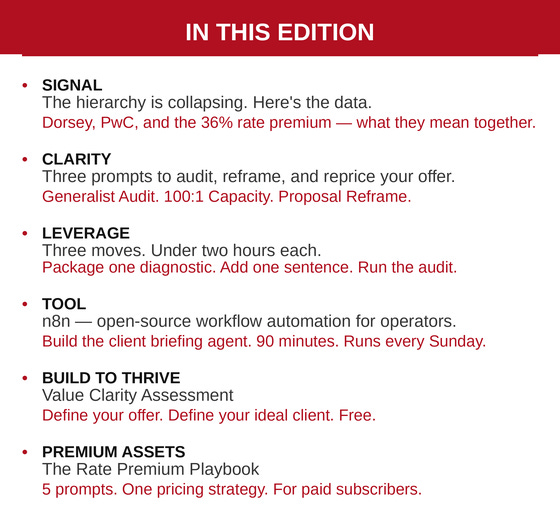
Define what you offer and to whom.
Roles are being reviewed and repriced. Hierarchies are flattening. The traditional employee contract is being renegotiated. If your value is still tied to a title, that is a risk.
Your skills, insights, relationships, and problem-solving are assets. The question is whether you have packaged them yet.
The Value Clarity Assessment helps you diagnose the real value of your experience, define the problem you solve, and identify the ideal client who needs it most. 12 questions across 5 dimensions. AI-powered and personalized to your answers.
Free. No credit card required.
Take the assessment at learn.buildtothrive.co/valueoffer
PREMIUM PROMPT
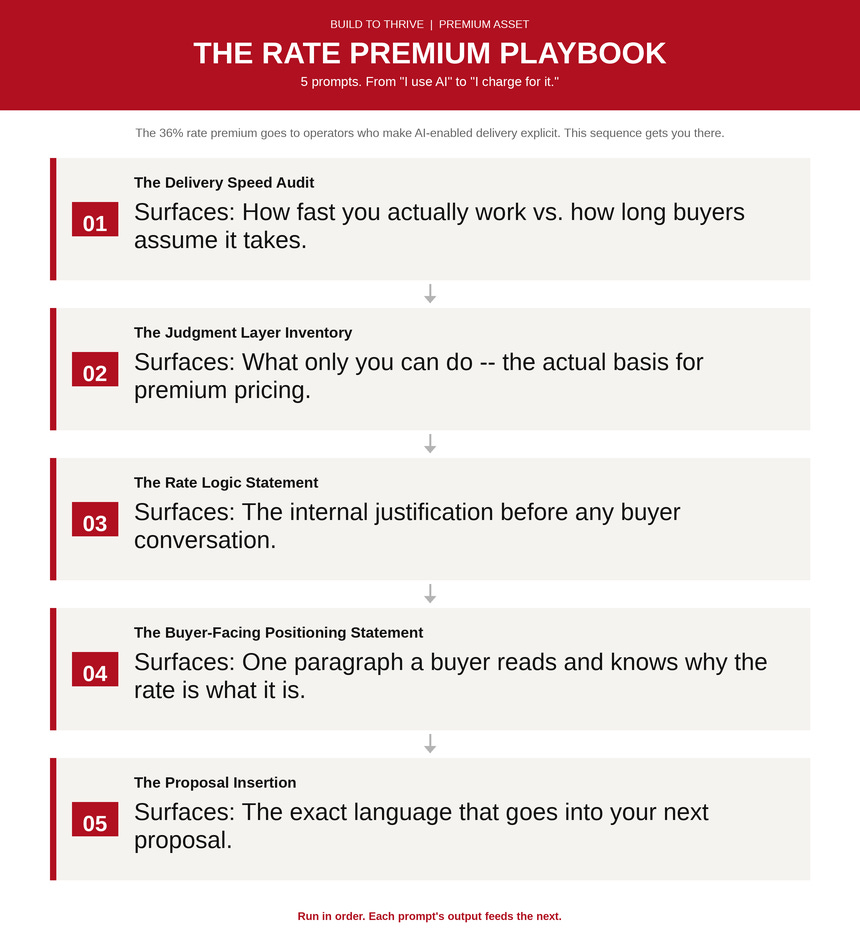
5 prompts. Position for the 36% rate premium.
The data from this week's SIGNAL section is actionable: operators who combine domain expertise with AI agent coordination are billing 36% higher than peers with equivalent experience. That gap does not close on its own. It requires explicit positioning.
This playbook is five structured prompts built around that gap. They help you audit your current offer language, identify where AI coordination creates visible leverage in your delivery, and rewrite your positioning so buyers can see the difference before the first conversation.
Not theory. A sequenced build process for operators who already have the experience and need to make it legible to buyers.
Here are the links to access the 5 premium prompts
