


Hey. Juan here.
October was soccer, soccer and more soccer. I played even twice a week, and my older kid joined me. Of my two younger ones, one plays premier and the other got recruited to play MLS Next Pro. I don’t know where he got those genes!

Business news first. This is me celebrating Pan247, my new AI Operations Manager for Restaurants.
Just joking. What I’m really celebrating is my first payment from one of the restaurants, after saving the owner $14,400 a year.
Here’s how Pan247 works. Every morning, the owner asks for a report and sees what changed, what needs attention and what’s worth a second look. It pulls from the restaurant’s invoices, recipes, register and delivery apps, so the cost of a dish, the margin and the shift schedule are in one place instead of in the owner’s head. The owner decides. The system prepares.
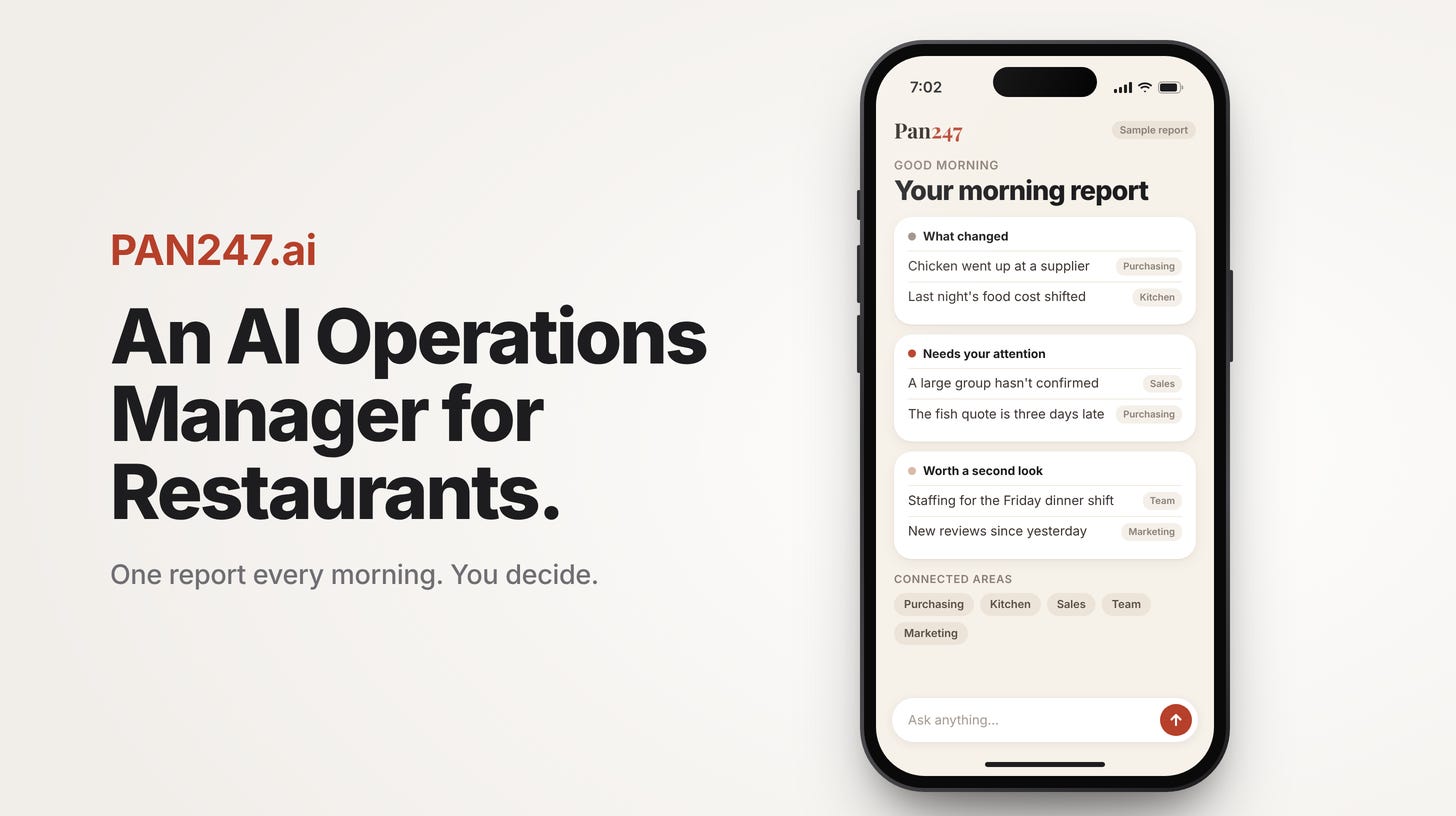
If you run a restaurant, or know someone who does, take a look here: Pan247.
The other new initiative this month is AI in 20 Minutes, a 20-minute live AI class on Zoom I am doing about every two weeks, on Thursdays at noon ET. One AI topic, no jargon, and I build something useful while you watch.
This is a 20-minute class I taught recently. I opened it with a short video about Sarah.

Sarah’s story. Click to watch.
Sarah asked her friend Steve where to start with AI. Steve went into geek mode: MCP servers, cron jobs, vector embeddings. Somewhere around vector embeddings, Sarah started wondering if she’d left the stove on. She didn’t learn a thing.
Then it’s Thursday evening. Her boss, Mike, has a pitch tomorrow at three and needs a briefing by ten. It pulls from five places, and two of them won’t exist until the middle of the night. Done the usual way, that’s about eight hours of pulling it all together and checking all night for the last files. Sarah says, “Let me try something.”
In the class, I showed how she gets there in Claude, one step at a time. She writes a prompt that tells Claude what a good brief looks like and asks it to question her before it writes anything. She saves that as a skill, so next time it’s one command. She connects Claude to the files in her Google Drive. Then she schedules it, so the brief gets built overnight and is waiting for her to review at 7 AM, before Mike sees it at ten. AI does the gathering. Sarah does the judging.
Watch the replay here: AI in 20 Minutes replays.
Here are the pieces I wrote in October.
November 5: How to Find 5 Hours Hiding in Your Business. You list the work that keeps coming back, see which jobs are worth handing to AI, and leave with a prompt to start on the best one that same afternoon. By the time you read this, it has run. The replay will be on the same page: AI in 20 Minutes replays.
November 19: Posts That Build Your Name. Turn one idea into a week of posts that sound like you. You leave with the prompts and your first week started.
December 10: Start With What You Have, End With an Offer. I run my 7-prompt Offer Builder live, and you leave with your offer in one sentence.
January 14, 2027: Grant Writing for Nonprofit Staff. For nonprofit staff who write their own grants. Tell your story once, and every grant answer starts from it.
Every class, replay and date lives on one page, including the rest of January: AI in 20 Minutes.
If you want the material behind the classes, paid subscribers get it for $117 a year, about $9.75 a month. That brings you the Vault, every class replay and a 1-on-1 with me.
Here’s what the month taught me. Every piece this month landed on the same split. The tools got cheaper for everyone at once, so the tools are not what makes you hard to replace. What makes you hard to replace is what you learn doing the work, and only if the business writes it down. Keep the judgment. Build the repeat work once.
Here are the October articles:
How a Prompt Becomes a Machine
October 8
What is about: How one annoying recurring job, a Friday client update, grows from a single prompt into a working system, one step at a time, and why you stop the moment it’s good enough.
The nuggets: Start with a prompt. When you catch yourself repeating the same directions, save them as reusable instructions. When finding the notes takes longer than writing, connect one source. When you keep forgetting, add a reminder before you reach for an agent. Each step has to earn its place, and review time counts.
The transformation/benefit: You stop guessing which AI tool to buy and start fixing the actual bottleneck in one job. You also get a four-part test (the job, the baseline, the review rule, the test) so you know whether the time saved is real.
Tools: Any AI chat tool you’re approved to use. The copy-paste client update prompt is in the free issue, along with a link to OpenAI’s guide to workspace agents.
The Only Businesses Left to Build in the Agentic Era
October 13 · Paid
What is about: Greg Isenberg’s 13 categories of businesses still worth building as AI agents spread, with real companies in each, how one sale is priced, and what may protect them.
The nuggets: I went through all 13 and kept seeing six things that protect a business: trust and licenses, being built into the customer’s routine, hard-won know-how and data, an audience you own, scarce places and permits, and a referral network. The surprise is who’s closest. Established owners often already hold more of these than founders starting from scratch.
The transformation/benefit: You can see which category you’re already near and which advantage would make your business harder to copy, instead of chasing the newest AI business idea.
Tools: This one is for paid subscribers. It ends with the scorecard I use to rate each business against your own skills.
Who Still Has a Moat? And How to Build One That Lasts

October 20
What is about: What your best customer would actually lose by switching, now that a competitor can reproduce in weeks what took you years to learn.
The nuggets: Chegg kept its brand and content and still lost ground, because students could get a good enough answer elsewhere. Having an advantage isn’t enough. It only counts if customers stay longer, refer others, or accept your price because of it. Use AI to make the work cheaper. Use what you learn from that work to make the business more valuable.
The transformation/benefit: You walk away with one advantage to strengthen, a seven-step way to build around it, and a 30-day plan, starting with one customer group and one service.
Tools: The competitor test, the seven steps and the 30-day plan are all in the free issue. If you want a structured look at your own business, the Better Business Reflection is free.
My 8-Step AI Workflow After Writing 100+ Substack Articles
October 27 · Guest piece by Timo Mason
What is about: Timo Mason of Write Your Way To Wealth walks through how he takes an article from idea to published with AI, and the one step he never hands over: deciding what to write.
The nuggets: Timo picks every idea and writes from his own experience. Then the repeat work goes to setups he built once: a tool that links each new article to his older ones, tracked links that show which article sent which sale, and saved setups for thumbnails, titles and Notes. Swap “article” for “proposal” and it reads like a small business.
The transformation/benefit: You see the split in action. The owner keeps the judgment, and the follow-up work runs the same way every time. My notes in the piece show where a team can borrow it.
Tools: Claude for long-form writing, ChatGPT for thumbnails and Notes, Notion as the list of past articles, and tracking links. Article Architect and Headline Hero are Timo’s own paid tools.
October in AI
Four things from October worth an owner’s attention.
Google put a small business hub inside Gemini. On October 20, Google announced a business page in the Gemini app where owners can work on branding, finances and customer insights, connected to tools like Google Business Profile, Shopify, Canva and Xero. If you already run on Google, you can upload your brand kit once and stop re-explaining your style every time you need a graphic. Google
Anthropic opened a waitlist for Claude Duet. In late October, Anthropic started a research preview of Claude Duet, an app where Claude sends you a morning brief from your connected apps, keeps working while you’re away, and asks before it sends, pays for or signs anything. Anthropic says it built it for professionals and small business owners, so the assistant is moving from answering your questions to watching your inbox and calendar with you. Anthropic
Shopify let merchants run their store from AI chats. On October 28, Shopify’s Fall ‘26 Edition connected stores to AI assistants like ChatGPT, Claude and Gemini for managing products, inventory and orders, and added a page where you approve the facts AI shopping agents get about your store. If you sell online, check your return and shipping facts there, because agents that ask Shopify about your store only get what you’ve published. Shopify
LegalZoom launched a free AI assistant for owners. On October 29, LegalZoom launched an AI Assistant that answers questions like “Am I in good standing?” from your own business record and connects you to a licensed attorney when judgment is needed. It’s the split I keep writing about: AI handles the lookup, a person handles the judgment. LegalZoom
Thank you for reading and I hope you are really enjoying it. What do you think I should write about next?
Juan