


Hey! Juan here. Thank you for reading Build to Thrive, the newsletter for operators and professionals turning hard-won experience into leverage, income, and opportunity in the AI economy. More than 5000 of you read along each week.
A word on why I write it. I have started four companies, and I am building my fifth: this one, a media company I run almost entirely solo, on a fleet of about thirty AI agents that draft this newsletter, scan my inboxes, prep my client work, and write my morning brief. I am not reporting on this shift from the sidelines. I am living it, and I share what works and what breaks, openly, as I go.
If you want the right AI solution for your business, not just another list? Book a 15-minute call. I will assess your bottleneck and point you to the right system or app that fits. If it needs more digging, I will come back with the answer on a follow-up call.
TL;DR
Collecting AI tools won’t change your business. Building systems will. This piece shows you what an AI-powered business actually does that a pile of apps can’t: it remembers so you stop starting from zero, turns one-off prompts into loops that run without you, prepares your decisions so you spend judgment only where it counts, mines your content for what buyers actually want, and stops revenue from leaking in forgotten follow-up. The move is simple: find the one place your business is losing time, money, or momentum, and fix that first instead of buying another tool.
It comes with 8 tools built in, one for each way a business leaks leverage, so you can go from reading to fixing the same day
How to Build you AI-Powered Business
You have ChatGPT open in a tab right now. Maybe Claude too.
You use it to write emails, summarize the occasional document, or brainstorm a post when you get stuck. All of that is useful, but it may not change how the business operates. At the end of the week, the same work is still piling up, the same opportunities are slipping through, and ChatGPT has become a faster assistant sitting on top of an unchanged business.
If that sounds like you, you are not doing it wrong. You are just early. And you are asking the question almost everyone asks first: “What tools should I use?”
Natural question. Also a small one.
An AI-powered business uses technology to improve how the company remembers information, follows through on commitments, prepares decisions, and learns from its work. Writing an occasional email with ChatGPT may save a few minutes, but the larger benefit comes when AI becomes part of the way the business operates.
1. Stop chasing tools, start looking for leverage
A better place to begin is the part of the business that repeatedly wastes time, loses money, delays decisions, or allows opportunities to stall. Adding AI before understanding that problem may only accelerate an ineffective process. Identify what is breaking first, then decide what kind of system could improve it.
2. Build a memory your business can query
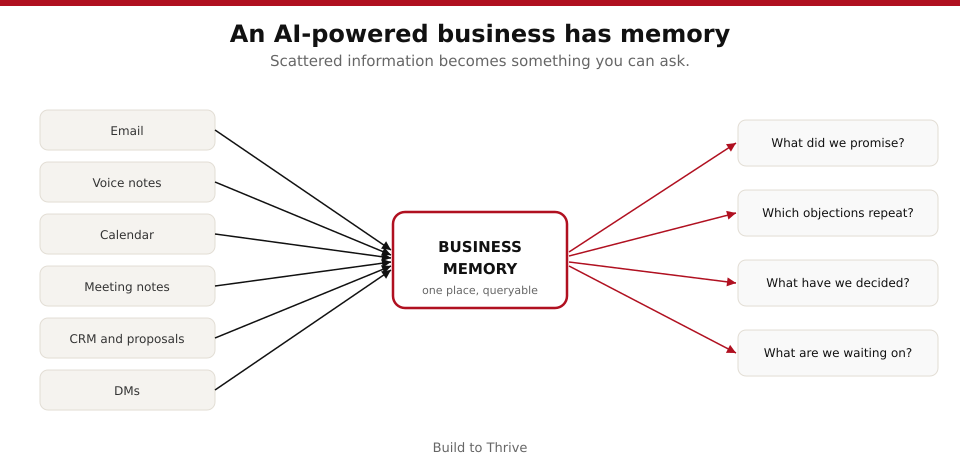
Most small operations have a memory problem. Important information is scattered across email, voice notes, calendar events, meeting notes, CRM fields, proposals, documents, DMs, and the operator’s head.
The consequences appear throughout the business. Important details from a prospect may be buried in an old email, a client request may never make it out of the meeting notes, and a useful audience question may disappear in the comments. Even strategic decisions can resurface months later when nobody records why they were made.
This is not an organization problem. It is a growth problem. A business without memory keeps starting from zero.
A useful business memory should make it easy to retrieve what a client cared about, what the company promised, which objections keep appearing, and which decisions have already been made. It should also show what is still unresolved and who is responsible for the next step.
This does not mean AI makes the decisions. It means the business remembers enough for you to make better ones.
3. Stop feeding the vending machine
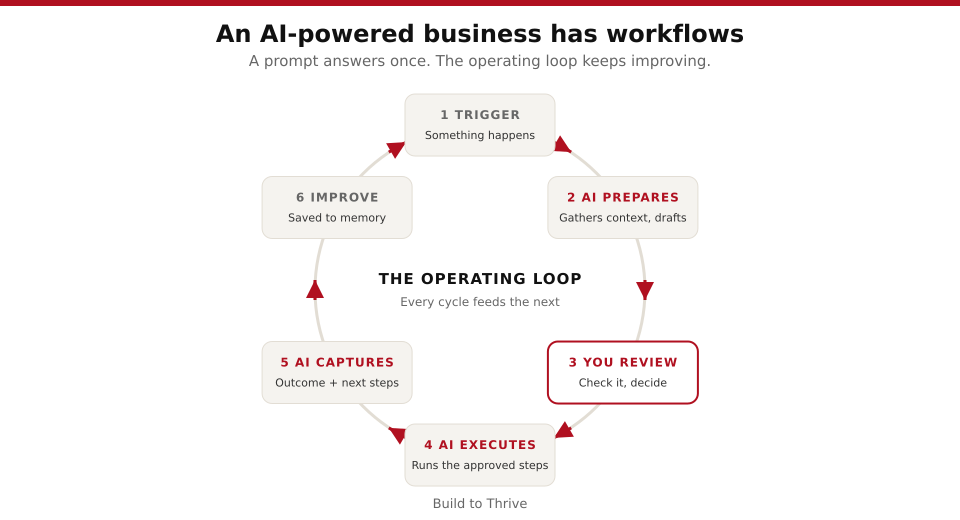
Many people use AI like a vending machine: enter a prompt, collect the answer, and move on. That can save time, but the process disappears as soon as the task is finished.
There are three useful levels to understand.
A prompt handles a single request. You define the goal, evaluate the answer, and continue working. It is appropriate for one-time tasks such as drafting an email or summarizing a call, but it does not create a repeatable process.
A skill preserves the instructions behind a useful prompt so the same type of work can be completed consistently. Instead of explaining the task again each time, you solve the process once and improve it as you use it.
A loop, or workflow,, connects that skill to a trigger and a follow-through process. An event occurs, the skill prepares the work, the system tracks what should happen next, and you step in when the task requires judgment.
These levels build on one another. A useful prompt can become a skill, and that skill can later operate inside a loop. The prompt is not discarded. It becomes part of a more dependable system.
Consider a simple sales loop. A prospect completes an assessment, AI summarizes the responses and identifies the likely bottleneck, and a call brief is prepared for review. You lead the conversation, while the system captures the next steps and tracks the follow-up afterward.
The value comes from the full loop, not from any single prompt.
Our paid subscribers gain access to our full library of prompts, skills and loops you can
4. Protect your judgment, do not delegate it
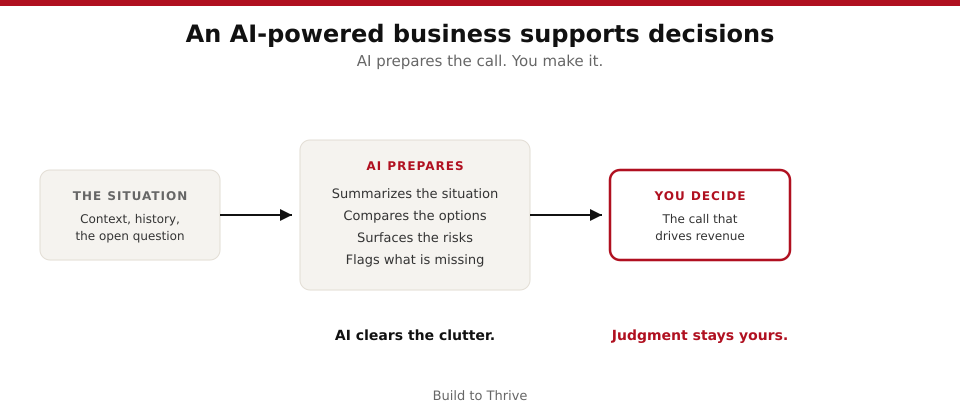
Many operators already have enough information. The harder problem is deciding what to do with it.
A prospect may deserve another follow-up, but the previous conversations need to be reviewed first. A new product idea may sound promising, but it still has to be compared with existing priorities. Pricing changes, workshops, client engagements, and automation decisions all require context.
AI can prepare these decisions by summarizing the situation, comparing options, retrieving previous decisions, identifying missing information, and surfacing potential risks.
Some decisions should not be delegated. The final decision still belongs to the operator.
Pricing, positioning, client diagnosis, product promises, offer strategy, and major tradeoffs carry consequences that should not be delegated automatically. AI is most useful when it handles the preparation, allowing you to spend your judgment where it matters
5. Turn content into a learning loop
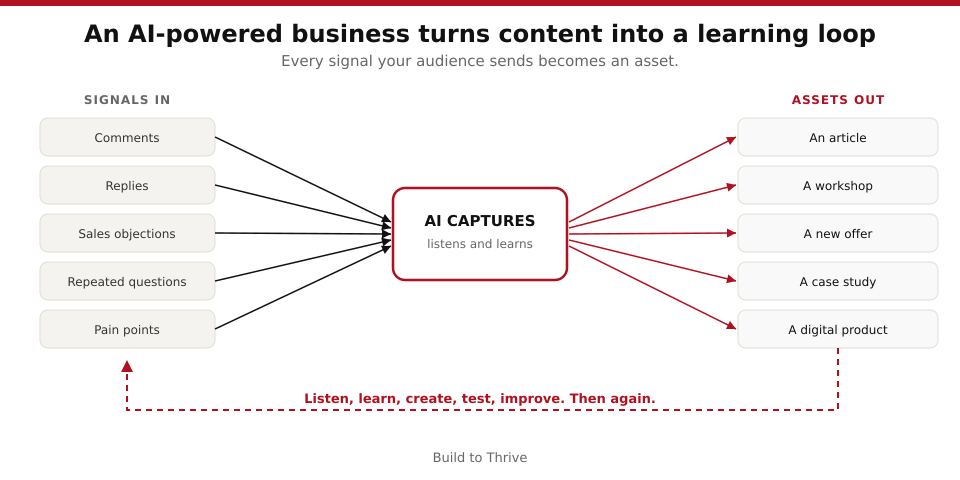
Content is usually treated as a marketing activity. Publish the post, send the email, look at the results, and start again.
An AI-powered business can use content as a source of market intelligence. Comments, replies, workshop questions, email responses, and sales objections reveal where people are confused, which problems keep appearing, what they want to learn, and how they describe those problems in their own words.
Most of these signals disappear because nobody captures them consistently.
AI can help collect and organize that information before it is lost. A useful comment may suggest an article, while several related questions may point toward a workshop. Recurring objections can improve an existing offer, and patterns from client work can support a case study, service, or digital product.
Once those signals are captured and reviewed, content becomes part of the learning loop. The business listens to the market, creates something in response, observes the reaction, and uses what it learns in the next cycle.
6. Plug the revenue leak in your open loops
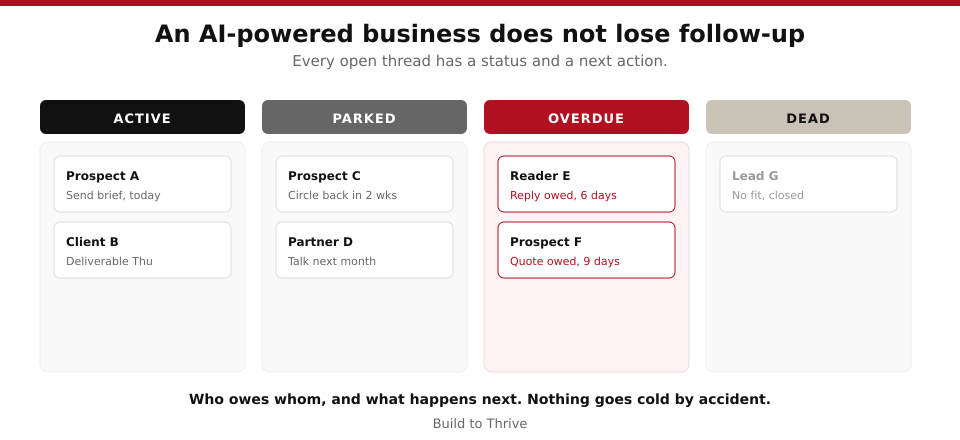
A considerable amount of potential revenue disappears during follow-up. The problem is usually not a lack of interest or effort. It is the absence of a reliable system for managing open loops.
A prospect asks you to circle back in two weeks. A client requests something after a call. A partner suggests reconnecting the following month, or a reader asks a question that could lead to a useful conversation. Once the day becomes busy, those commitments are easy to forget.
An AI-powered business tracks its open loops. The system should show who is waiting for a response, what was promised, when the last contact occurred, and who owns the next action. It should also distinguish an active opportunity from one that has been parked, abandoned, or left overdue.
Many viable opportunities are lost because the next step depends on someone remembering it at the right moment. The prospect may still be interested and the relationship may still be developing, but the conversation stops because the open loop has no clear owner.
7. Make every engagement compound
Client delivery has consequences beyond the work completed during a single meeting. It affects trust, future decisions, and what the business learns from the engagement.
AI can support delivery by preparing for calls, summarizing sessions, recording action items, tracking progress, and identifying patterns across the work.
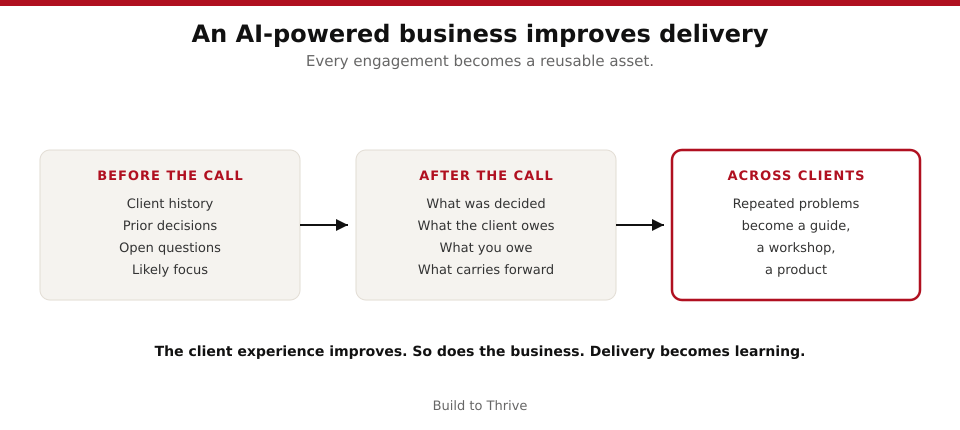
Before a coaching or advisory call, the system can assemble the client’s history, previous decisions, unresolved questions, and likely priorities. Afterward, it can record what was decided, what each person agreed to do, and which issues need to carry into the next conversation.
Patterns may also emerge across several clients. A problem that appears repeatedly could lead to a guide, workshop, productized service, or digital product.
The client benefits because fewer details and commitments are lost. The business benefits because each engagement contributes to future frameworks, offers, products, and content.
An AI-powered business compounds when delivery becomes part of a learning loop rather than an isolated transaction.
8. Add a Chief of Staff layer
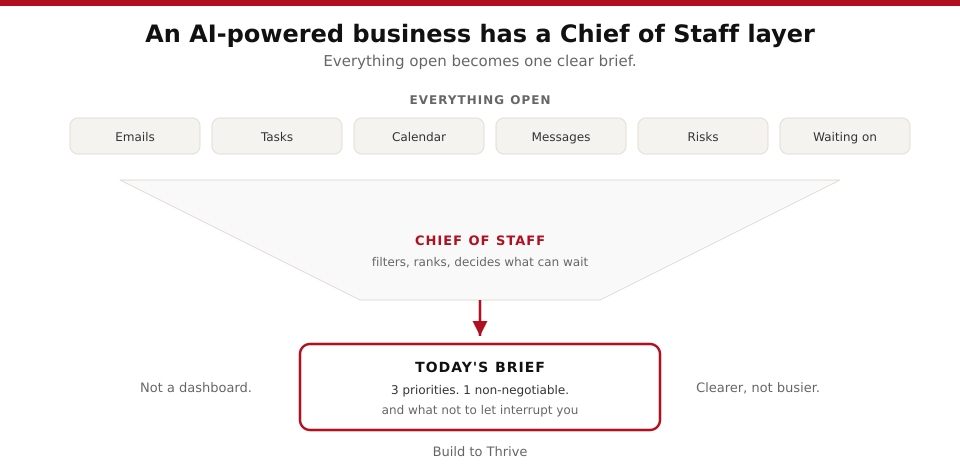
As the amount of information grows, another report is unlikely to solve the problem. What the operator needs is a concise daily operating brief.
A useful AI Chief of Staff should identify what deserves attention, what may be at risk, and which commitments are waiting for a response. It should separate urgent work from tasks that can wait and highlight the one to three priorities that should not be displaced.
A dashboard presents data. A Chief of Staff brief interprets that information in the context of the workday and helps the operator decide where to focus.
The purpose is not to create more activity. It is to reduce the time spent sorting through information before meaningful work can begin.
9. Find your bottleneck
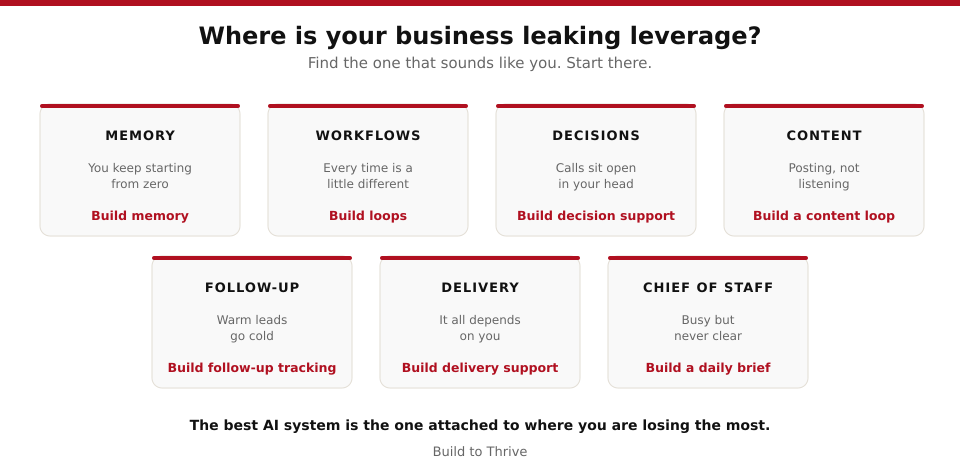
One part of your business probably felt more familiar than the others.
Perhaps important information is difficult to retrieve, or follow-up still depends on memory. Your content may be disconnected from your offers, while client delivery continues to depend too heavily on you. Decisions may stall because the necessary context is scattered, or the business may keep building from internal ideas without learning enough from customer signals.
Start with the problem that creates the greatest recurring loss of time, money, or momentum. Here is a tool I give clients to help them diagnose bottlenecks AI Leverage Assessment.
Instead of asking which AI tool to adopt next, identify the part of the business that needs to become easier to manage, more consistent, or less dependent on manual effort.
Once the bottleneck is clear, select the resource that addresses that specific problem. Some resources are available to all readers, while others are included with a paid subscription.
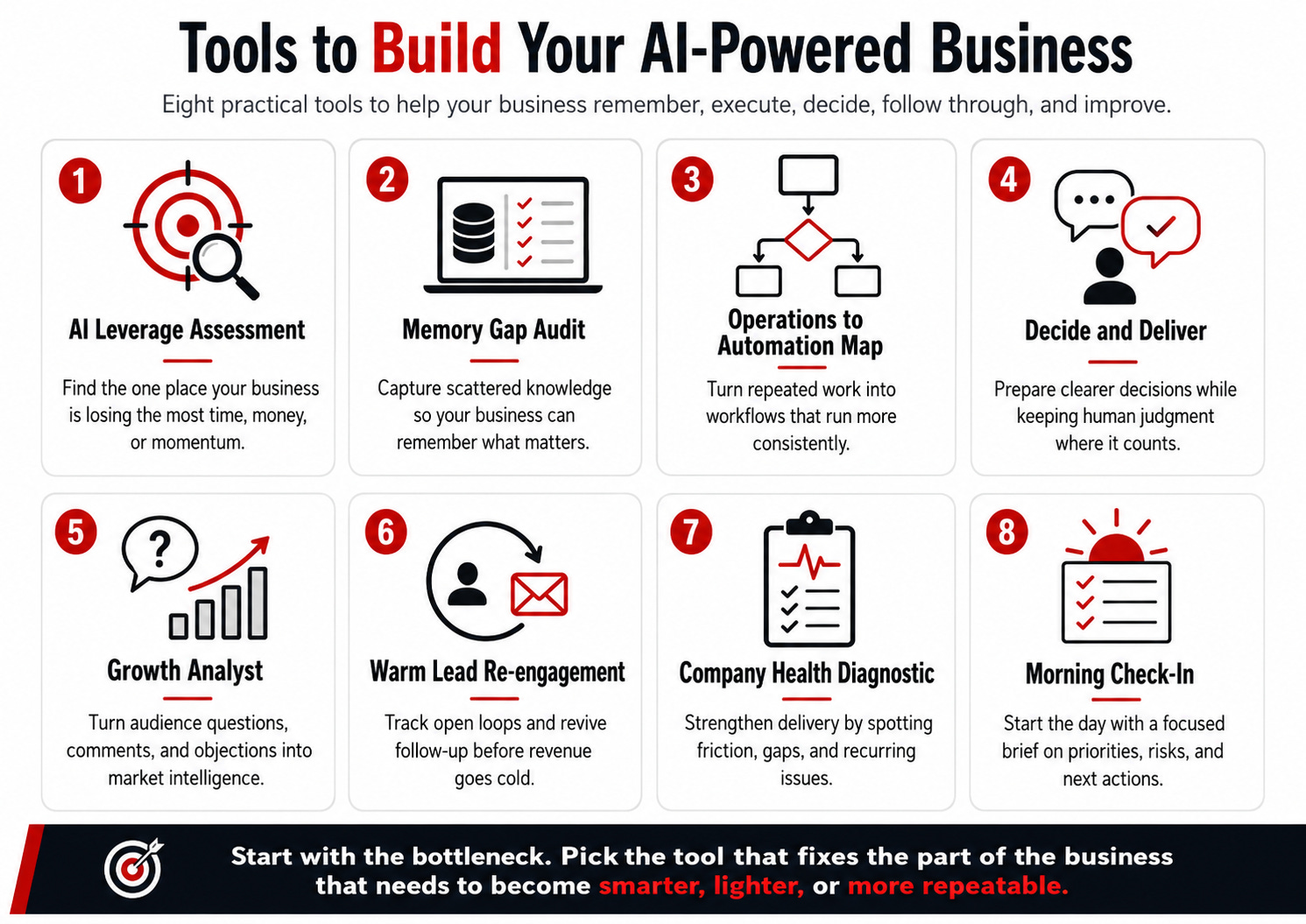
Scattered knowledge? Build memory. Start with the Memory Gap Audit.
Inconsistent execution? Build workflows. Start with the Operations to Automation Map. 🔒Get it →
Stalled decisions? Build decision support. Start with the Decide and Deliver prompt. Get it →
Weak marketing? Build an authority flywheel. Start with the Authority Flywheel Audit. 🔒 Get it →
Lost revenue? Build follow-up tracking. Start with the Warm Lead Re-engagement prompt. Get it →
Inconsistent delivery? Build delivery support. Start with the Company Health Diagnostic. Get it →
Founder dependency? Build a Chief of Staff layer. Start with the Morning Checkin 🔒. Get it →
To unluck the rest of the resources and access our full library of more than 200 prompts, skills and loops
Want the right tool for your business, not just another list? Book a 15-minute call. I will assess your bottleneck and point you to the tool or system that fits. If it needs more digging, I will come back with the answer on a follow-up call
This is the work behind Build to Thrive
This is why I do not start with AI tools when I work with a business. I start by finding the bottleneck.
AI is not the strategy. AI multiplies the way the business already works. If the process is unclear, AI produces unclear output faster. If follow-up is broken, AI sends more messages without building trust. If the offer is weak, AI writes better copy for a weak offer. If the business has no memory, AI keeps starting from zero.
But give it clear loops, clear decisions, clear ownership, and useful memory, and AI becomes leverage.
That is the work I am building at Build to Thrive: helping operators build AI-powered businesses that create more revenue, profit, and time.
Where to start
You do not fix this with another tool. You fix it at the bottleneck. The AI Leverage Assessment tells you which part of your business is losing the most time, money, or momentum, and which one to redesign first.
Take it here: Find your bottleneck
Let me know what you think of this content, I would love your feedback in the comments section.
Thank you reading. Feel free to share it!
Oh…I almost forgot.
Want more free resources? Fifty operators shared the prompts behind the first six months of our AIBlueprint Edition. 50 Creators share their rockstar prompts →
Liked, downloaded and shared by more than 1000 people…you can’t go wrong!
Thirty AI agents sounds impressive. I’d settle for one that remembers what I promised people last Tuesday.
Spot your bottleneck and fix that first before adding another tool. Great advice!