


Build to Thrive caters to professionals and founders seeking clarity, leverage, and income in the new AI economy. It is built for people navigating real transitions and applying what they know to new opportunities as the rules of business change. As a subscriber, you get thoughtful deep dives, timely insights, and practical operating systems you can use to build and adapt in real time. As a paid subscriber, you unlock full access to every article, premium prompts, and our growing library of tools, while joining a community of more than 4,000 founders and aspiring entrepreneurs navigating this path together.
Editorial Note
Hello folks,
Before we dive in, I want to flag something that’s been bothering me all week.
Nothing headline-worthy happened. No dramatic release. No moment you could screenshot and point to later. But sometime over the last few days, a line was crossed and if you’ve been watching features instead of workflows, you probably missed it.
The work moved.
AI isn’t sitting on the sidelines advising anymore. It’s inside the files. Inside the handoffs. Inside the coordination work that used to require someone paying attention. Drafts get written. Summaries get passed along. First-pass analysis happens without anyone asking for it.
What quietly disappeared was the bottleneck.
That sounds like progress, and it is, but it also changes where things break. Output is no longer the constraint. The risk has shifted upstream. It now lives in decision quality: what gets worked on, in what order, and why.
As you read through this edition, that’s the pattern to watch for. Tools that don’t feel flashy because they’re embedded where real work happens. Automation approaches that prioritize orchestration over clever one-off agents, and a growing tension in the market between big productivity claims and the uneven way leverage is actually concentrating.
This doesn’t just change how companies operate. It changes what’s demanded of the person in the seat.
When execution becomes cheap and abundant, advantage collapses to judgment. To sequencing. To the ability to design systems instead of feeding them.
This isn’t a call to adopt more tools or automate everything in sight. It’s an attempt to name what’s already been commoditized, which assumptions no longer hold, and where quiet misallocation starts compounding into real risk.
Use this as a map, not a prescription.
-JS
—🔴—🔴—🔴—
Table of Contents
Clarity Prompts
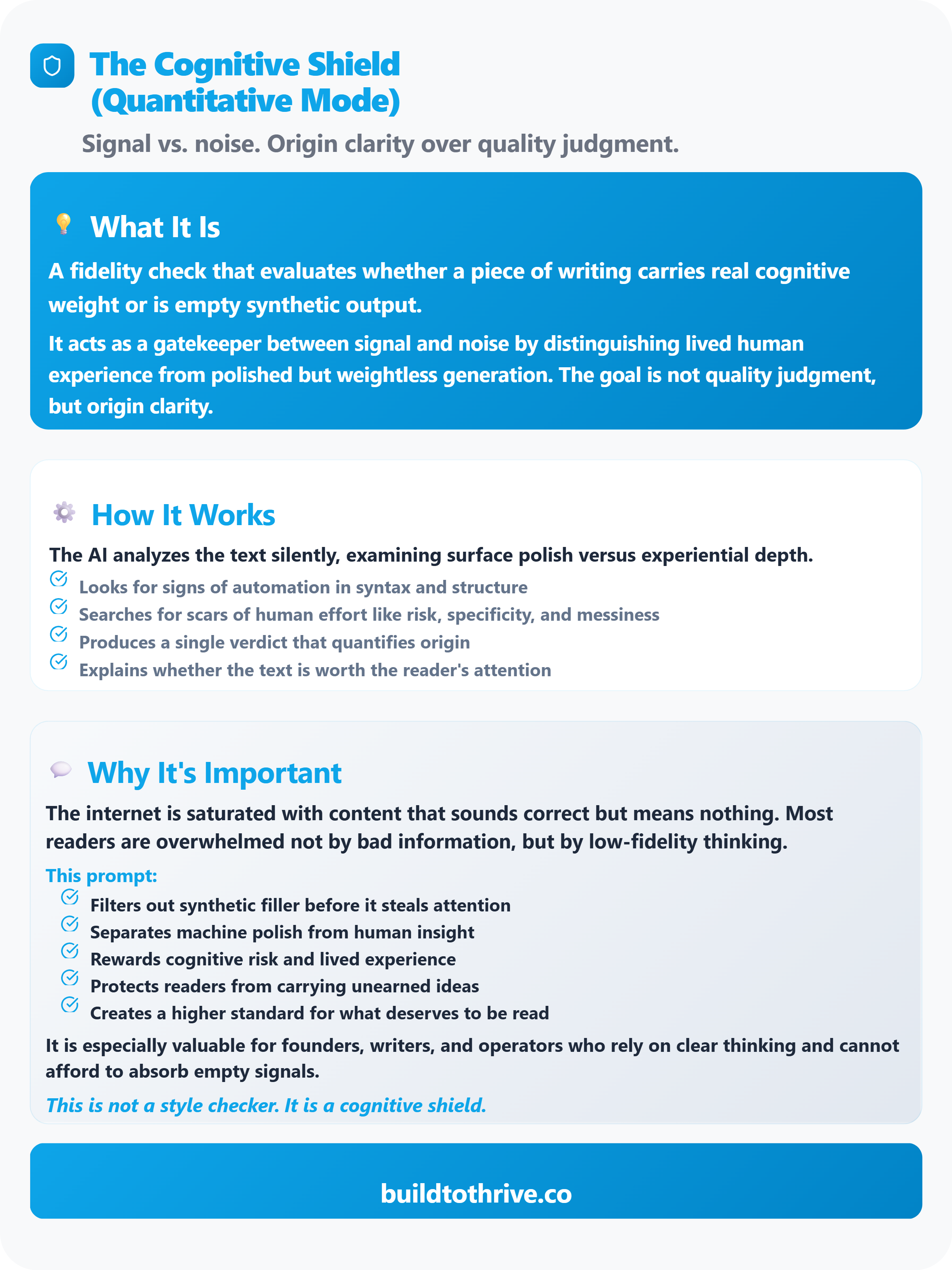
The Cognitive Shield (Quantitative Mode)
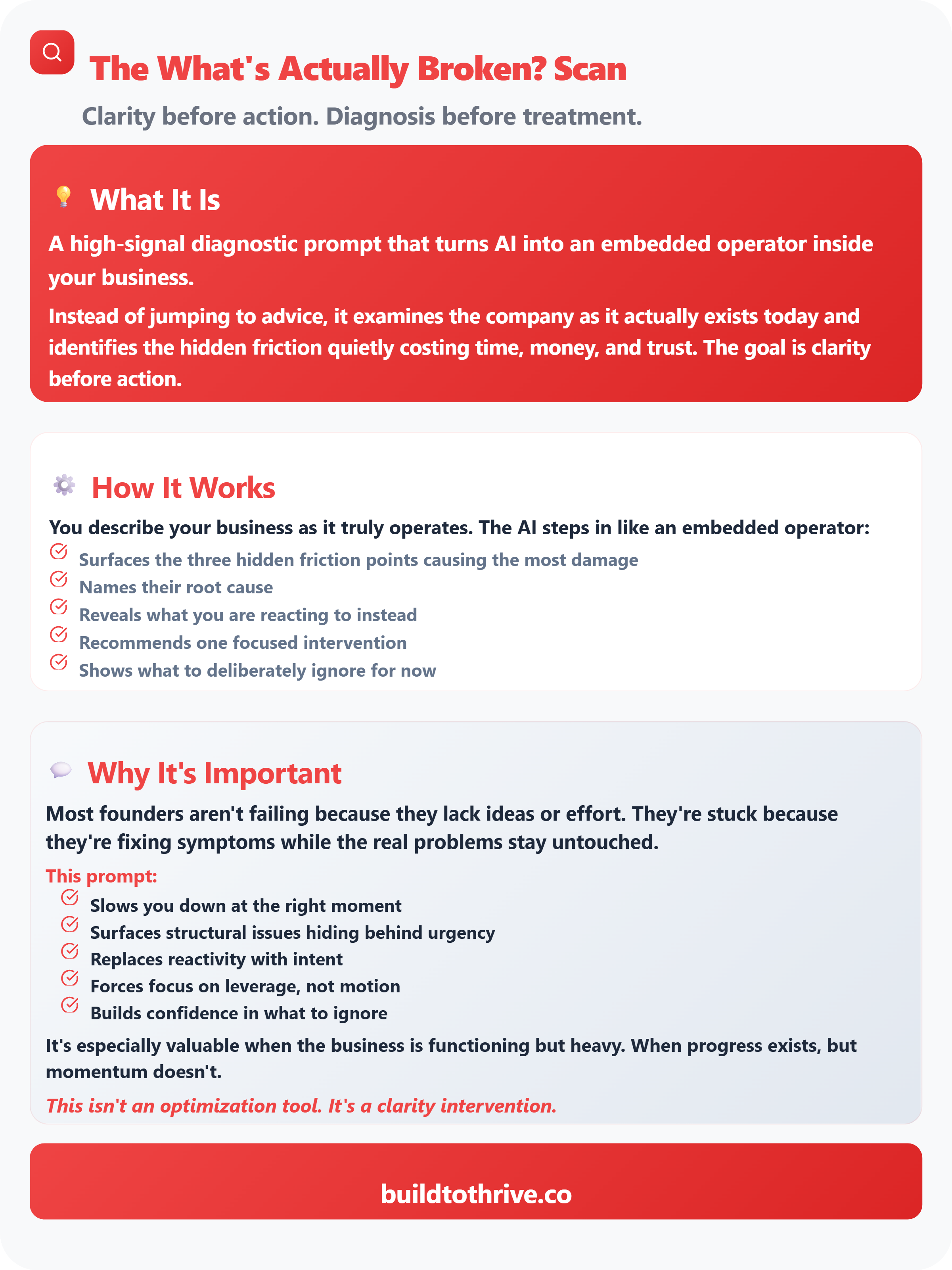
The What’s Actually Broken? Scan
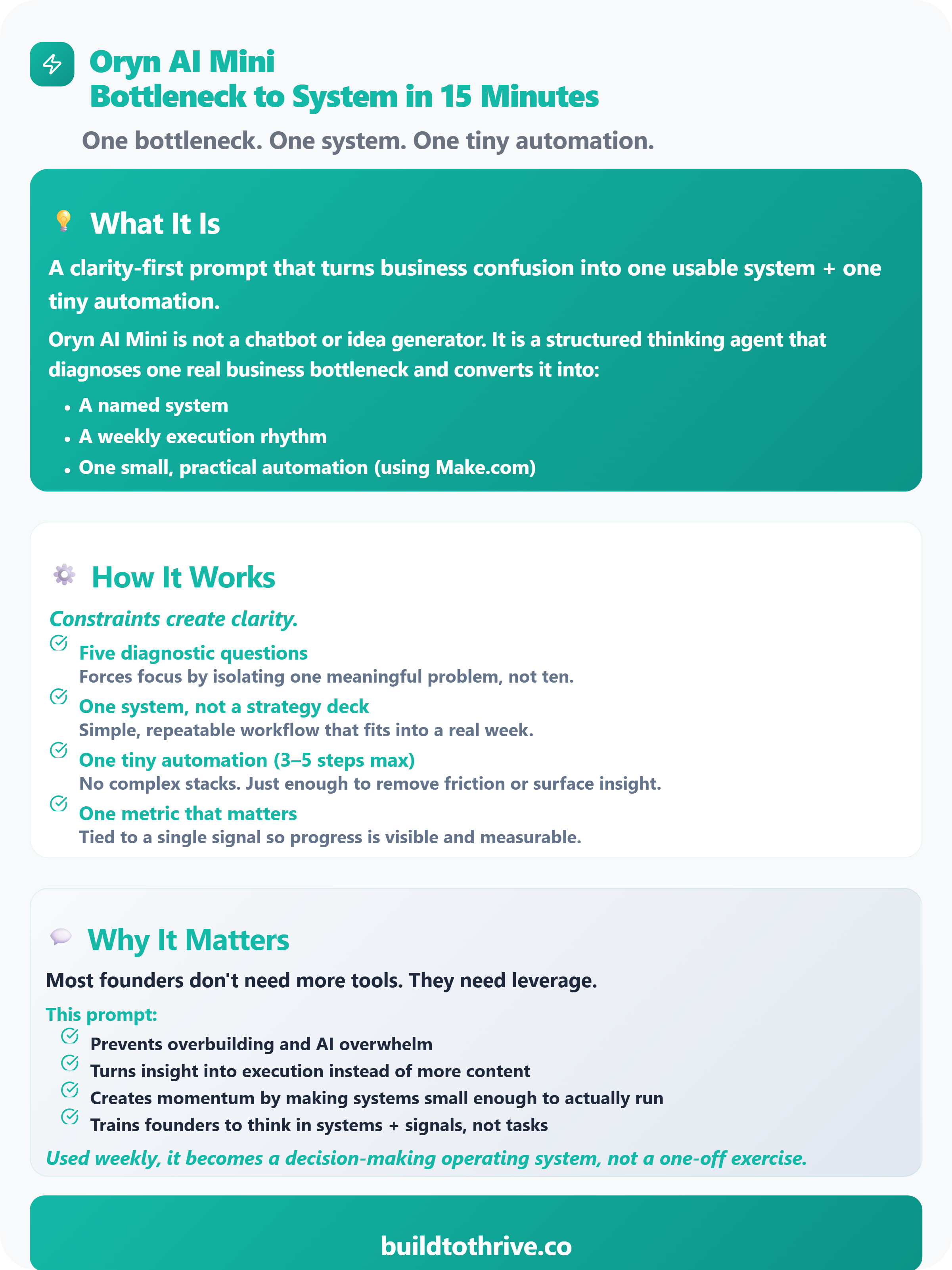
Oryn AI Mini - Bottleneck to System in 15 minutes
Featured Article: How I Reclaimed My Attention by Making One Decision Stick
AI Automation Leverage
Practical automations that increase output without adding headcount
Strategic Terrain
How AI is reshaping operating models and competitive advantage
AI Capital Market Narratives
The stories shaping risk, margins, and valuation
—🔴—🔴—🔴—
Clarity Prompts
These prompts are designed to cut through noise, narrative bias, and surface-level problem solving. Each one acts as a cognitive instrument—a way to slow thinking down, interrogate assumptions, and surface what’s actually happening beneath complexity.
They draw from different domains—macro strategy, operations, and applied AI—but share a common goal: restore signal where intuition, hype, or urgency have distorted judgment.
The Cognitive Shield (Quantitative Mode)
By Peter Jansen
The Airlock | Macro Strategy, Sovereignty, and Exit Paths is a newsletter about geopolitical fracture, algorithmic governance, and personal infrastructure, focused on how power, capital, and control are reorganizing as legacy institutions weaken.
Written for operators, founders, and leaders who sense the ground shifting beneath existing assumptions, The Airlock blends macro-forensics with practical frameworks to examine what’s changing, why the old maps no longer work, and how individuals can reduce dependency and increase resilience without relying on speculation or hype.
—🔴—
The What’s Actually Broken? Scan
By Katie Barnes
Systems and Sideyes Operations, Process, and the Human Side of Scale is a newsletter about what actually happens between founder vision and scalable reality, focused on the messy, human work of building systems that teams can follow without burning out.
It translates day-to-day operational chaos into clear patterns and frameworks: where revenue leaks hide, why handoffs break, how tool sprawl creeps in, and what structure looks like when it supports people instead of suffocating them. A central lens is the lived experience of founders and operators navigating growth, burnout, and the tension between speed and sustainability. It’s part playbook, part therapy, and part behind-the-scenes look at scaling without chaos.
If you want a grounded, humane take on operations, one that values clarity over heroics and systems over fire drills Systems & Side Eyes is a good place to start.
—🔴—
Oryn AI Mini - Bottleneck to System in 15 minutes
Cove Connect | Build. Automate. Deliver. Weekly is a newsletter about moving from writing code to shipping automation, focused on how developers and builders turn AI tools into reliable, real-world systems.
It translates hands-on experimentation into applied guidance: building AI workflows, testing tools in production-like environments, and assembling web and automation stacks that actually deliver value. A central lens is build-in-public learning, sharing what works, what breaks, and what improves through iteration.
If you want a practical, delivery-first view of AI and automation, grounded in real builds rather than theory, Cove Connect is worth subscribing to.
—🔴—🔴—🔴—
—🔴—🔴—🔴—
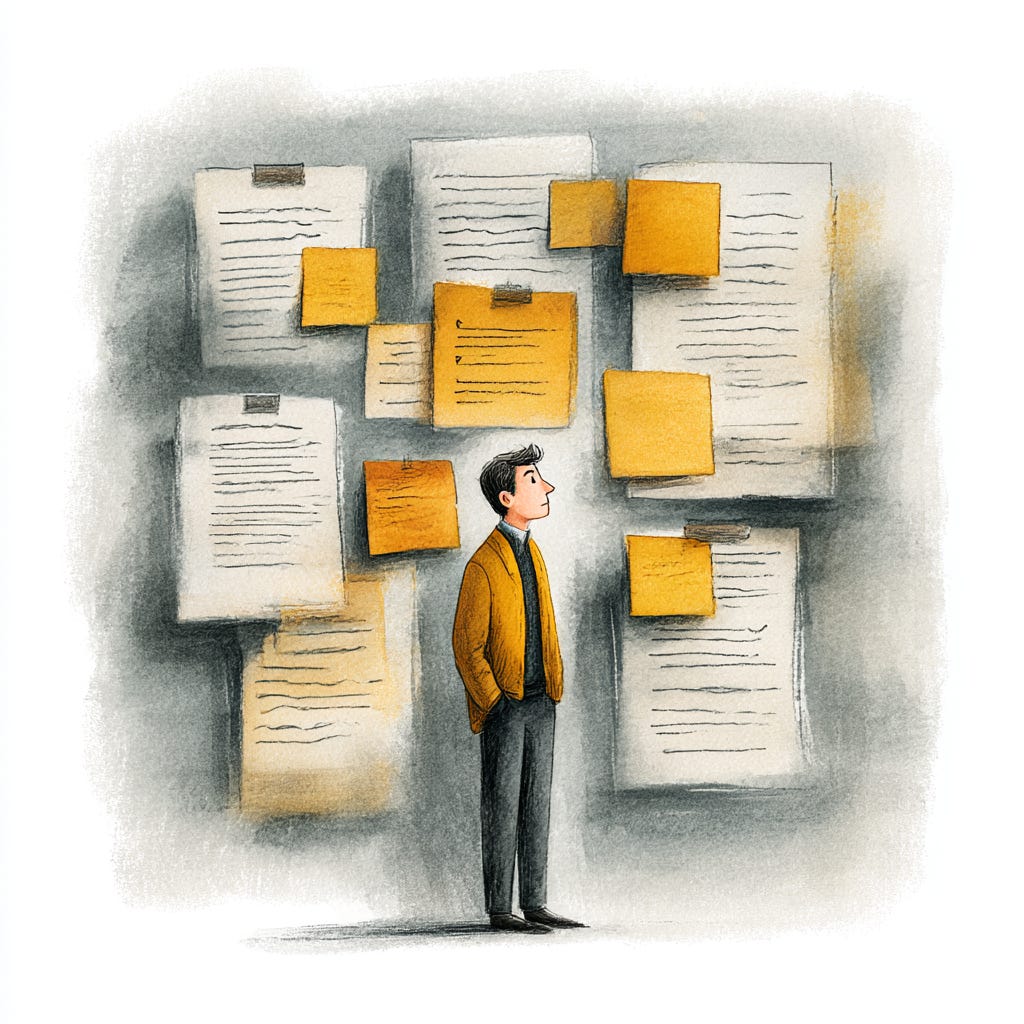
Featured Article: How I Reclaimed My Attention by Making One Decision Stick By Juan Salas-Romer
—🔴—🔴—🔴—
AI Automation Leverage - Grow Margins
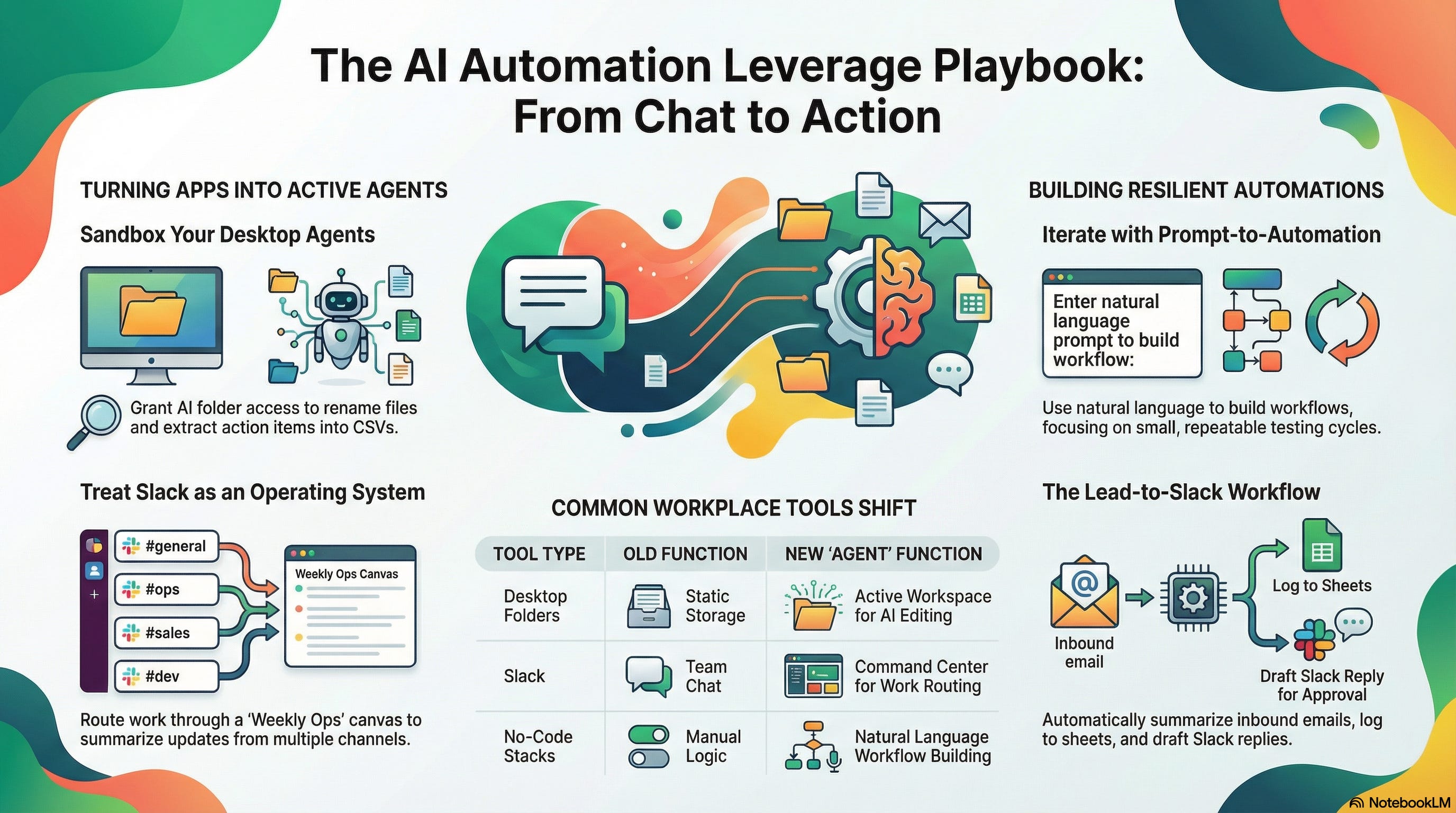
This week, AI agents moved closer to “actually useful”: desktop agents that can safely work inside your files, and Slack turning into a do-work command center. On the build side, tools are making prompt-to-automation more realistic, but only if you adopt simple orchestration patterns instead of random one-off agents, while commerce is getting “agent-ready,” with new incentives and pricing risks you should plan around now.
Trend 1 – Desktop agents that touch real work
Anthropic’s new Cowork tool offers Claude Code without the code
Summary: Cowork turns Claude into a practical desktop teammate: you grant access to a specific folder, then it can read, edit, organize, and produce outputs through chat. It’s powerful, but the “files can change” part means you need guardrails.
Check out this article from Joel Salinas Claude Cowork: What It Is, Why It Matters, How to Use It
Practical Takeaway: Create a “Cowork Sandbox” folder with copies of 20 real files (docs, CSVs, screenshots). Ask Cowork to: rename consistently, extract action items into one CSV, and draft a weekly summary. Keep it sandboxed until you trust the pattern.
Trend 2 – Slack becomes an operating system for your team
Summary: Slackbot is shifting from reminders to an agent that can search, analyze files, draft content, and help run meetings, with admin controls and staged rollout by plan. The winning move is treating Slack as the place work gets routed, not just discussed.
Practical Takeaway: Create one “Weekly Ops” canvas (pipeline, blockers, priorities). Enable Slackbot canvas editing, then schedule a recurring prompt: “Pull updates from #sales, #support, and #product, summarize, and propose next actions.”
Trend 3 – Prompt-to-automation gets real in no-code stacks
Summary: n8n’s AI Workflow Builder turns natural language into working automations, but the main unlock is iterative prompting: small builds, test, refine, repeat. This lowers the barrier for non-engineers to ship automations that stick.
Practical Takeaway: Build one workflow this week: Typeform (or inbound email) → summarize with AI → route to the right owner → log to Google Sheets → post a Slack update with the drafted reply for approval.
—🔴—🔴—🔴—
Strategic Terrain - Design Smarter
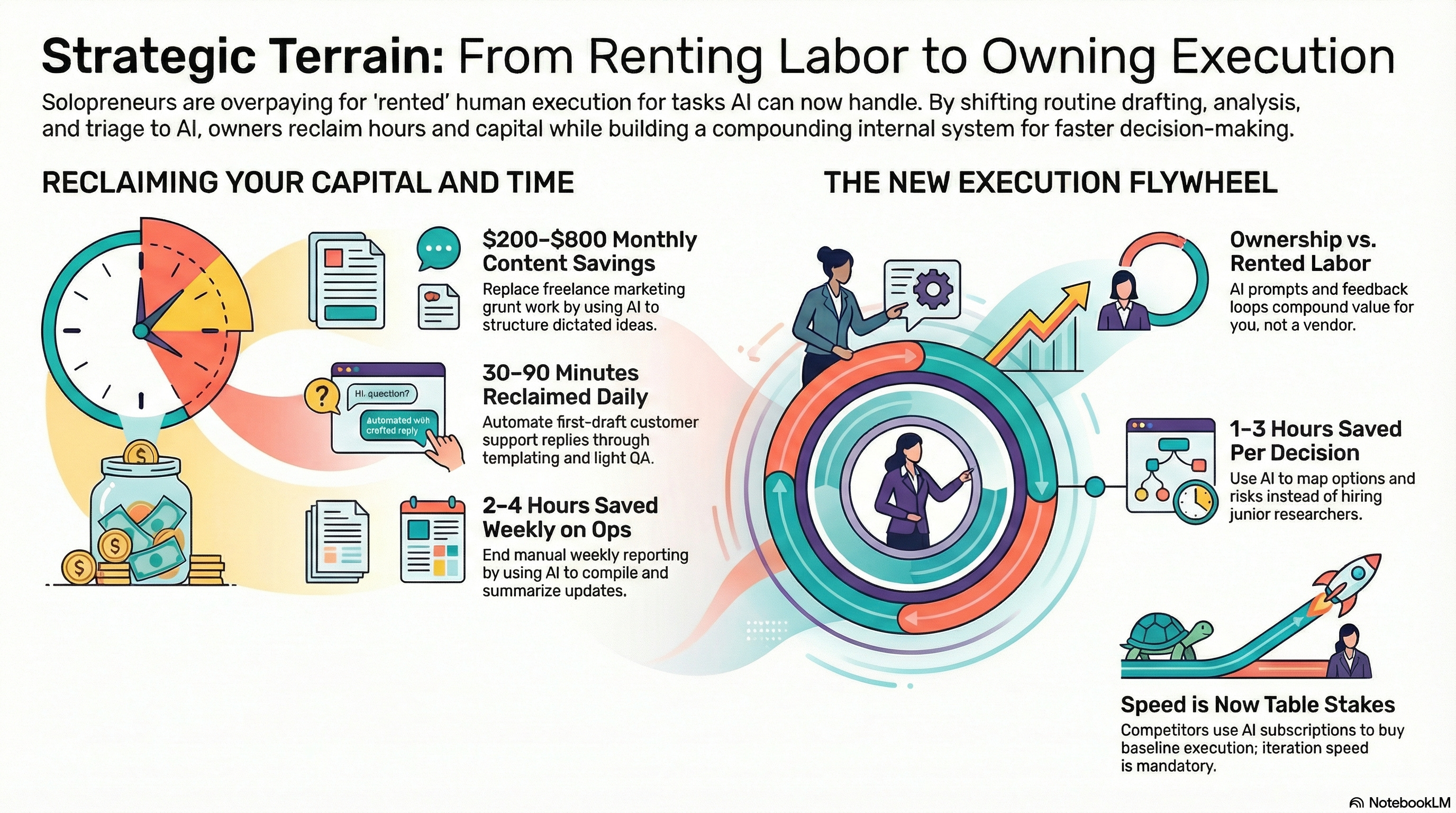
This week’s shift: AI it’s reliably acting like your analyst + drafter + triage desk, if you run it with a tight feedback loop. Solopreneurs are still overpaying humans for first drafts, basic analysis, inbox cleanup, and routine customer replies, the exact work AI can now do cleanly with light review. Delay compounds because every week you keep renting execution; you fall behind on the only thing that matters; shipping decisions + outputs faster than your market.
Strategic Signals:
• Weekly ops reporting is now unnecessary; replaced task: “virtual assistant compiling updates” → typical save: 2–4 hours/week you can redirect into sales calls or fulfillment.
• First-draft customer support is now unnecessary; replaced task: “support rep writing replies” → typical save: 30–90 minutes/day once you template + QA.
• Marketing repurposing grunt work is now unnecessary; replaced task: “freelancer turning ideas into assets” → typical save: $200–$800/month in recurring content labor if you dictate and let AI structure.
• “Starter research + option mapping” is now unnecessary; replaced task: “junior researcher/assistant” → typical save: 1–3 hours per decision (and fewer wrong turns) when you force AI to generate alternatives, risks, and next actions.
• Spreadsheet sense-making is now unnecessary; replaced task: “analyst cleaning and summarizing” → typical save: 1–2 hours/week on basic performance readouts once you standardize inputs and prompts.
Why It Matters:
At solo scale, “AI competence” is becoming assumed, not optional, because competitors can buy baseline execution for the price of a subscription. Execution baselines rose: speed, iteration, and the ability to think in alternatives is now table stakes. Renting labor is structurally inferior to owning execution, because the flywheel (prompts → outputs → feedback → reuse) compounds for you, not your vendor.
How It Affects Solopreneurs:
Your leverage expanded most in the messy middle: turning raw inputs (notes, calls, data, emails) into usable outputs (drafts, decisions, playbooks, follow-ups). Quality now compounds faster solo because you can standardize your voice, your checklists, and your “definition of done” — then reuse them endlessly. Continuing to outsource the repeatable parts quietly taxes your margin and slows your learning loop, which is the real moat.
—🔴—🔴—🔴—
AI Capital Market Narratives - Move early
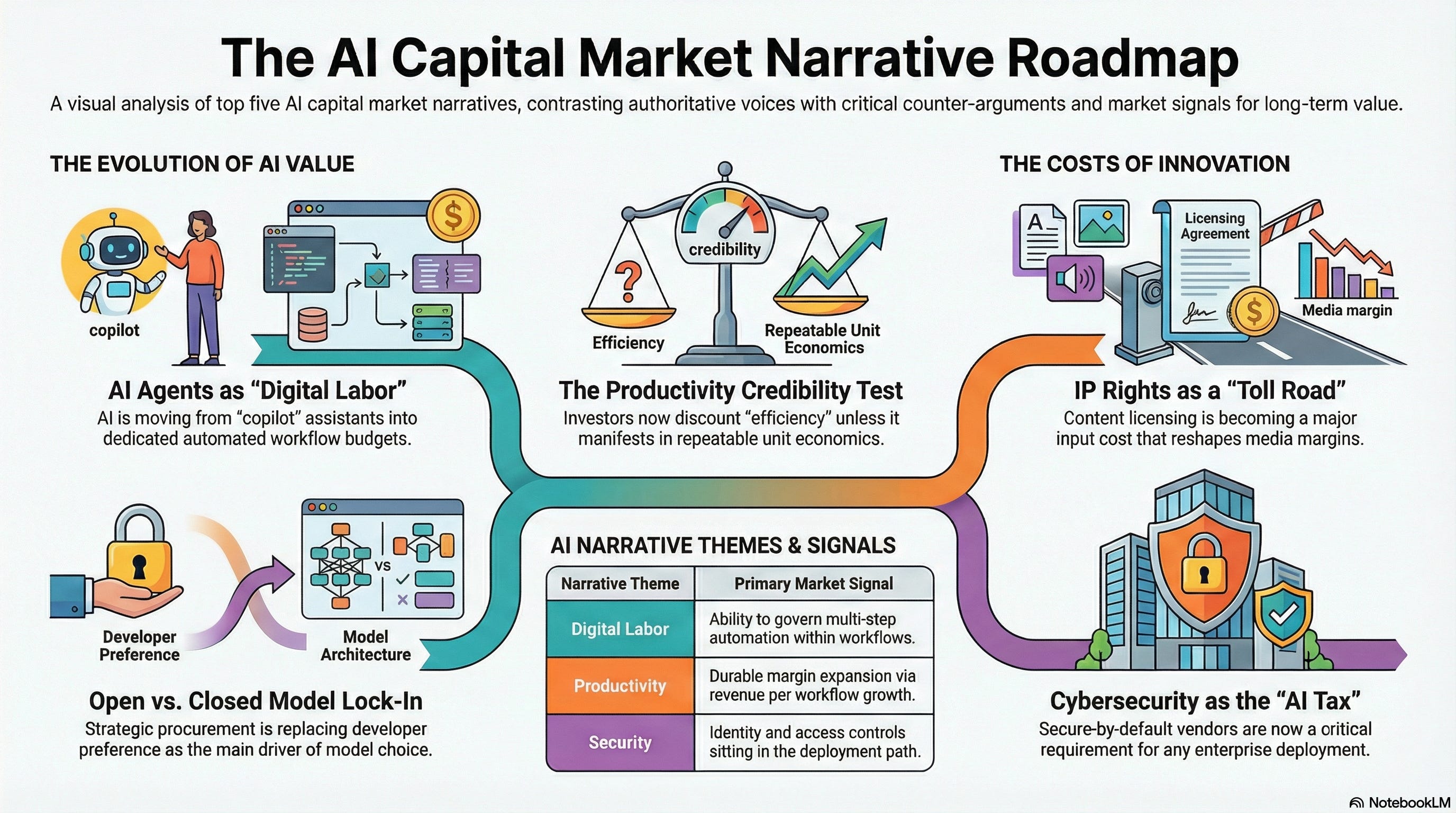
1. Agents Move From “Copilot” to “Digital Labor” Budgets
What authoritative voices are saying: Investors and CIOs are framing “AI agents” as the next spend bucket—automation that sits inside workflows, not a chat UI.
What critics are arguing: Most “agent” roadmaps are brittle without clean data, guardrails, and ownership, so pilots scale slower than the narrative.
Signal: Track who can sell (and govern) multi-step automation inside enterprises, not who demoed the best bot.
2. AI Productivity Claims Turn Into a Credibility Test
What authoritative voices are saying: Management teams are selling AI as operating leverage, with “output per employee” style metrics moving from HR talk to investor talk.
What critics are arguing: Cutting headcount isn’t the same as durable margin expansion if revenue per workflow doesn’t rise.
Signal: Discount “AI = efficiency” unless it shows up in repeatable unit economics, not one-off cost actions.
3. IP Holders Try to Turn AI Into a Toll Road
What authoritative voices are saying: Big media and entertainment are choosing licensing + equity-style alignment to monetize (and control) model outputs.
What critics are arguing: Pricing power is unclear, and licensing can accelerate the shift of attention away from the original publisher.
Signal: Content rights are becoming an input cost (or revenue line) that can reshape margins across media, platforms, and consumer brands.
4. Cybersecurity Becomes the “AI Tax” on Enterprise Adoption
What authoritative voices are saying: CISOs are leaning into AI/agentic tools to keep up with alert volume—while attackers also weaponize AI.
What critics are arguing: More automation raises blast radius if identity, access, and oversight aren’t airtight.
Signal: “Secure-by-default” vendors and identity controls sit directly in the AI deployment critical path.
5. Open vs. Closed Models Reframe Vendor Lock-In
What authoritative voices are saying: The market debate is shifting to whether open models commoditize capability or whether closed stacks keep pricing power and distribution.
What critics are arguing: Open isn’t “free” once you price infrastructure, security, and integration and closed isn’t “safe” once you price dependency.
Signal: Watch who controls the interface + data plane; model choice is becoming a strategic procurement decision, not a developer preference.
—🔴—🔴—🔴—
YOU KNOW MORE THAN YOU ADMIT
YOU HAVE MORE THAN YOU GIVE YOURSELF CREDIT FOR
THE ONLY THING MISSING IS A SYSTEM THAT LETS YOUR EXPERIENCE COMPOUND
BUILD IT AND YOUR GROWTH BECOME INEVITABLE
YOUR NEXT CHAPTER IS WAITING
Some reader favorites
Build to Thrive | The Blueprint | Week of January 12, 2026
How I Reclaimed My Attention by Making One Decision Stick
AI Is Here. Let’s Get Your Business in the Game.
How I Scaled My Business Without Hiring: Building My First AI Agents for $0
The Science of Execution: Why Most Founders Stay Stuck (and How to Break Through in 90 Days)
How to Build Assets That Compound (Even When Life Forces You to Pivot)
Everyone’s Rushing to AI. Few See the Ceiling Ahead.
Scaling Smart: 5 Systems Every Solopreneur Needs to Grow Without Burning Out
Built to Blaze: How Ooni Turned Backyard Pizza into a $200M Global Movement
For years, the market sold "Execution" as the asset. You are one of the few voices lucid enough to call it what it has become: Commodity. When the cost of production drops to zero, the value of Selection goes to infinity.
Thank you for deploying "The Cognitive Shield" in this week’s Blueprint. It is properly placed. Your analysis of the "Strategic Terrain" provides the necessary context for why such a shield is required in the first place.
To your readers:
Juan has handed you the map. I have handed you the shield.
But understand this: A "Cognitive Shield" is not a passive wall. It is an active filter. It requires the calorie-expenditure of saying "No" to 99% of the noise that feels like work but is actually just friction.
You have the tools. The bottleneck is no longer the software.
The bottleneck is you.
Build accordingly.
Thank you Juan for this amazing opportunity to rank amongst the best in the industry 🙏