


Build to Thrive caters to experienced professionals stepping into entrepreneurship and founders looking for clarity, leverage and income in the new AI economy. As a subscriber you get deep dives, timely insights, and operating systems that shape tomorrow’s business. As a paid subscriber you unlock all articles, premium prompts, access to our library of tools and become part of our active community of more than 4000 aspiring entrepreneurs and founders.
If you’re a solopreneur, chances are you feel overextended.
Your days are full, you probably have a decent set of tools to conduct work, and you’ve even tried using AI to speed things up, yet nothing really feels lighter.
That was me until recently.
A few weeks ago, I was reading a piece about decision fatigue; the idea that judgment degrades when it’s used repeatedly on low-stakes or low-leverage choices. One line stuck with me more than it should have:
“When people feel overwhelmed, it’s often not because the work is hard, it’s because too many decisions were never resolved.”
I didn’t think much of it at first. It sounded abstract. Academic.
But later that week, out of curiosity more than intention, I ran a simple diagnostic prompt on my own task list. I assumed I’d get a cleaner to-do list or a few efficiency suggestions.
Instead, it surfaced something uncomfortable:
Most of my work existed because I had never made a clear decision.
This article is about that shift; from managing tasks to designing decisions, and why it matters more than another productivity system.
Life in the Messy Middle
The “messy middle” of solopreneurship is a strange place.
You’re past the beginner phase; you know how to execute and shipped real work. People depend on you.
But you’re not big enough to hide behind layers of process or delegation.
So what happens?
You review things “just in case”
You stay involved longer than necessary
You keep tasks alive because stopping them feels risky
You optimize workflows instead of questioning why they exist
Over time, the work doesn’t just grow; the decisions you keep remaking implicitly do too.
Research backs this up. Studies on decision fatigue show that humans have limited cognitive bandwidth for high-quality judgment, and that repeated low-value decisions degrade performance over time (Baumeister et al., Journal of Personality and Social Psychology).
In other words, it’s not that you’re bad at deciding.
It’s that you’re deciding too much, too often, in the wrong places.
Table of Contents
Signs You’re Spending Judgment Where It Doesn’t Belong
A Simple Decision Audit (Using AI as a Mirror)
The Diagnostic Prompt
What the Output Revealed
What I Do With the Rest of the Output
What I Do After the Diagnostic
Closing Reflection
Signs You’re Spending Judgment Where It Doesn’t Belong
If this resonates, you’ll probably recognize at least a few of these:
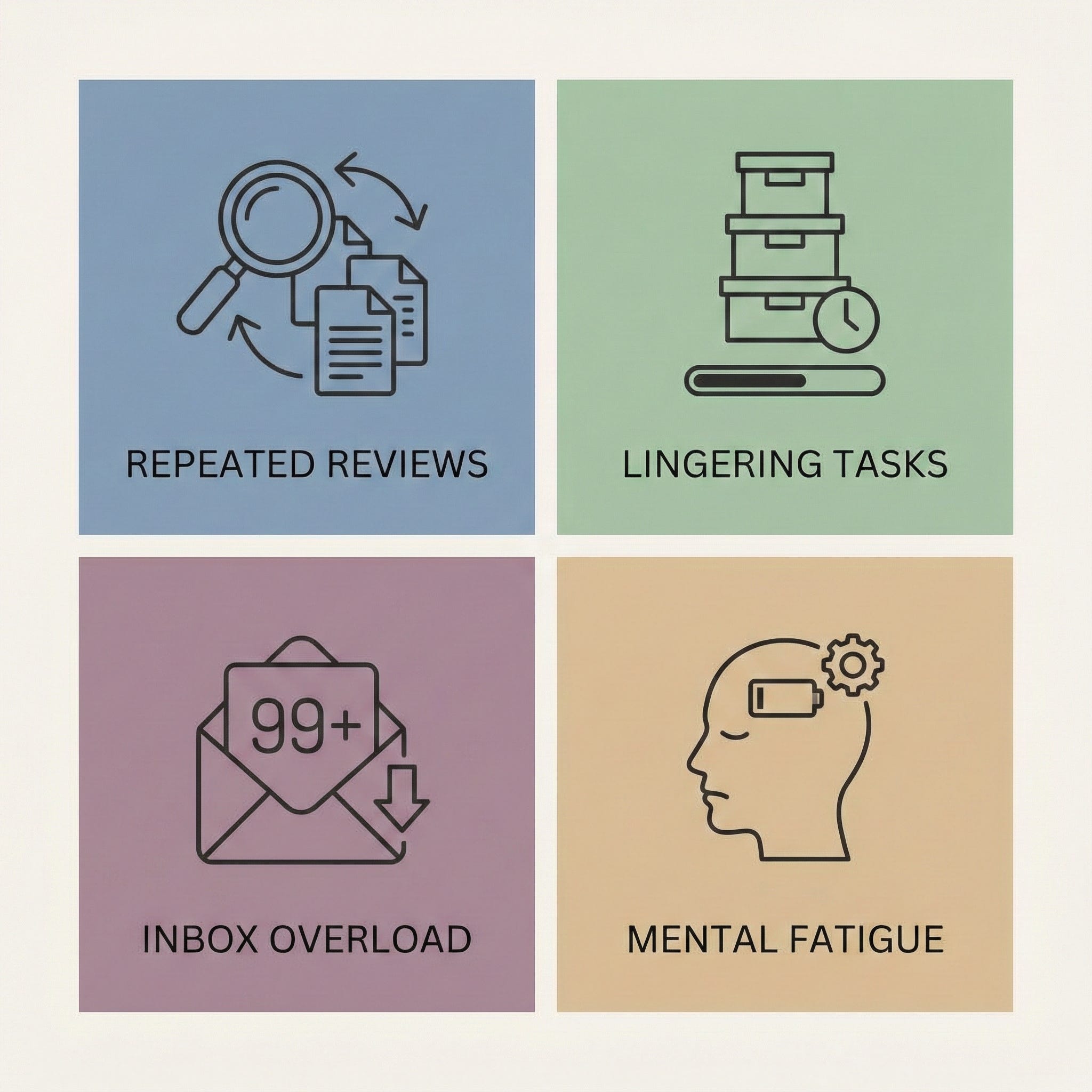
You’re constantly checking work that should already be done, not because it’s bad, but because you don’t fully trust the system producing it.
Your task list never really shrinks. Items repeat weekly. They survive by inertia.
You feel busy but not strategically satisfied. Days are full, but impact feels fuzzy.
AI helps, but also creates new oversight work instead of relief.
These aren’t personal failures.
They’re design failures.
A Simple Decision Audit (Using AI as a Mirror)
What changed for me wasn’t a new system.
It was a different way of looking at my work.
Here’s the exact process.
Step 1: Paste your task list exactly as written
No cleanup. No organizing. Messy is the point.
Step 2: Normalize each task into verb + object
For example:
Review newsletter draft
Coordinate contributor inputs
Verify sources
This strips away ambiguity and makes the work visible.
Step 3: Classify each task
Ask what kind of work it really is:
Judgment-critical — requires context, taste, or tradeoffs
Rule-based — should be handled by standards or checklists
Legacy — exists mostly because it always has
Judgment is scarce. Treat it that way.
Step 4: Ask why the task exists
Most answers fall into a few buckets:
A decision was never made
Success was never clearly defined
An old assumption no longer holds
This is where insight starts to appear.
Step 5: Identify one leverage point
Not ten. Just one.
The task that, if stopped or redesigned, would free the most attention.
In my case, it wasn’t the busiest task.
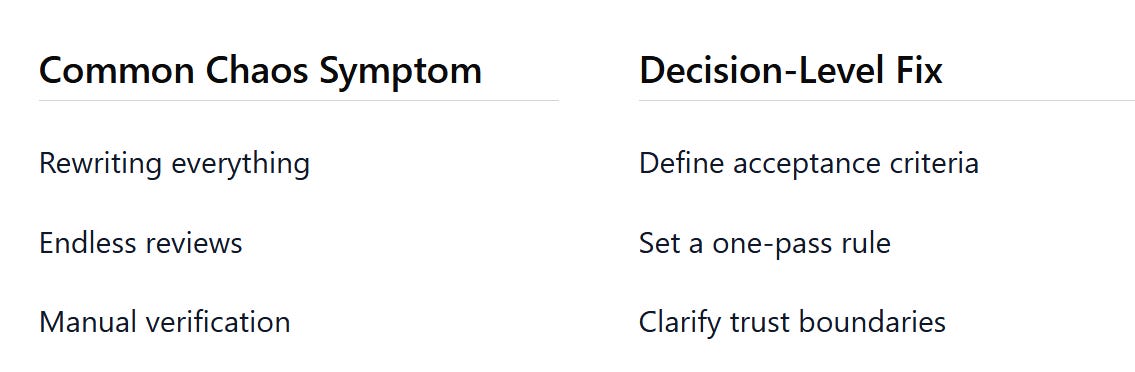
It was coordinating and rewriting contributor content, not because it was hard, but because the quality bar lived only in my head.
The Diagnostic Prompt
This is the exact prompt I used. It’s not designed to optimize your workflow.
Its only job is to surface where judgment is compensating for missing decisions.
Paste this into your AI tool of choice:
Act like an operations strategist and systems designer who specializes in eliminating low-leverage work through clearer decisions, better rules, and smarter automation.

Your objective: analyze my recurring daily/weekly task list and identify the single highest-leverage change that would reclaim the most time, attention, or strategic impact.

Task (do not skip steps):
1) Ingest the task list exactly as written. If the list is blank or still says “[PASTE YOUR LIST]”, respond with a short message asking me to paste the real list, and include an example format I can copy.
2) Normalize each task into a clear verb + object (keep original wording in parentheses).
3) Classify each task into exactly one category:
   - Judgment critical: requires human judgment, tradeoffs, prioritization, or contextual nuance.
   - Rule based: can be executed reliably via a checklist, SOP, automation, or clear decision tree.
   - Legacy: exists mainly due to outdated assumptions, historical baggage, or inertia; low value relative to effort.
4) For each task, explain the root cause that makes it exist today. Choose the best fit:
   - Missing decision: a decision not made (owner, priority, definition of done, escalation rule).
   - Unclear outcome: success criteria ambiguous (no metric, no deadline, no acceptance test).
   - Outdated assumption: a past constraint no longer true (tooling, process, stakeholder needs, frequency).

Output format (Markdown):
A) Table with columns: Task (original), Normalized task, Category, Root cause type, Root-cause explanation, Quick fix (one sentence).
B) “Highest leverage task” section: name 1 task only, then explain why it matters more than the others using: impact (time/quality/risk), frequency, downstream effects, and ease of redesign.
C) Minimal “Next action” checklist (3–5 bullets) to change how that task is handled.

Constraints:
- Be specific and concrete; no generic advice.
- If details are missing, state reasonable assumptions explicitly instead of asking questions.
- Keep it scannable: short paragraphs, crisp bullets, no fluff.

Take a deep breath and work on this problem step-by-step.
What the Output Revealed
The output didn’t give me more tasks.
It showed me where my judgment was quietly being taxed everywhere else.
The highest-leverage task wasn’t the one taking the most time.
It was the one that existed because I had never decided otherwise.
Once I saw that, the week already felt different even before I changed anything.
Clarity came first.
Relief followed.
What the Prompt Gives You
The prompt
Turns overwhelm into a diagnosis
Shows where judgment is being misused
Separates essential work from inertia
Forces one clear decision
That’s enough to create clarity.
But clarity isn’t the same as safety.
The prompt does not tell you:
Whether to stop, redesign, or automate the task
Where automation would quietly introduce risk
What must stay human to protect trust and credibility
That boundary is intentional.
Because once you see the real problem, the wrong next move can make things worse.
If this prompt worked for you, you now know what the problem is.
The next question is how to change it without breaking things.
That’s what the paid prompts are for.
Turn Clarity Into a Decision That Sticks
The diagnostic shows you where judgment is leaking, the task that exists because a decision was never made.
That insight is powerful. What I do next is decide how much of myself that task deserves going forward.
The prompts beyond this point help me:
Decide what stays human
Set boundaries so I don’t re-solve the same problem next week
Redesign work without introducing new failure modes
This isn’t about doing more.
It’s about making one decision stick.
Here is the prompt: