Editorial
The Tension
AI agents promise to replace your $5k/month assistant and turn every solopreneur into a one-person empire in 2026. Yet most still hallucinate, demand constant babysitting, and quietly create more management debt than freedom. The real anxiety? You’re either racing to build your agent army before it commoditizes you or pretending the hype will pass.
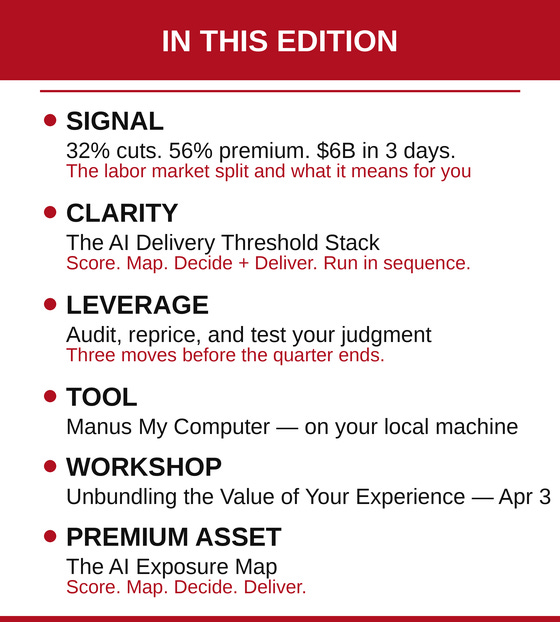
This edition is built around one question: what does it actually take to be on the right side of a labor market that is splitting in real time and how operators can have an edge.
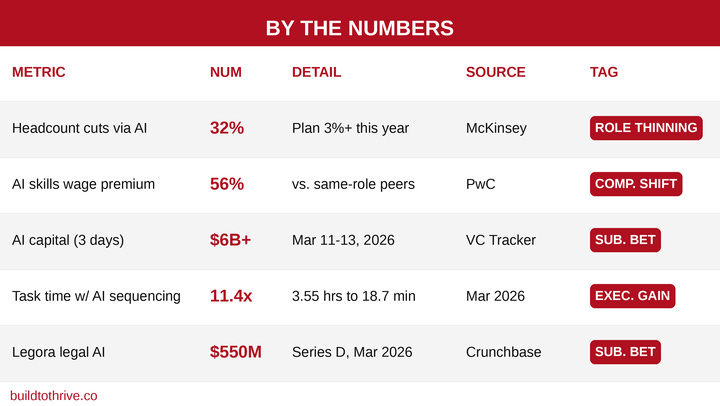
The SIGNAL section this week covers three data points that arrived in the same week and point at the same thing. McKinsey reports that 32% of companies plan to reduce headcount by at least 3% in the next year due to AI. PwC’s AI Jobs Barometer found that workers with demonstrated AI skills command wage premiums up to 56% higher than peers in identical roles. And between March 11 and 13, over $6 billion in AI investment was deployed in three days -- concentrated not in productivity tools but in substitution plays: legal AI, agent architecture, robotics, infrastructure. Those are not three separate stories. They describe the same event from three angles.
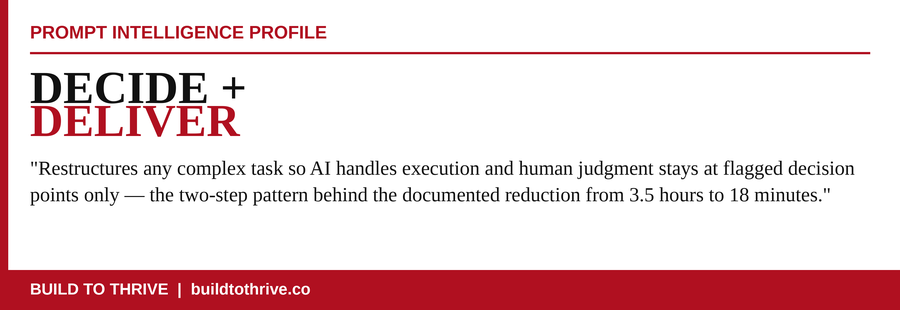
The mechanism that connects them is a research finding that received less attention than it deserved. A March 2026 study measured how long humans take to complete complex tasks working solo versus with structured AI task sequencing. Solo: 3.55 hours. With AI as the primary executor of a sequenced workflow: 18.7 minutes. That is an 11.4x reduction. The finding that matters is not the time difference. It is the explanation for it: the people capturing the largest gains had restructured the task before starting. They treated AI as the executor of a defined sequence rather than asking it questions at each step. That structural decision -- not the model, not the tool -- is what separates 1.5x gains from 11x. That finding is the spine of this edition.

STORY 01
GPT-5.4 ships with computer-use. The unit of AI output just changed.
EXECUTION SHIFT
WHAT HAPPENED
OpenAI released GPT-5.4 on March 5, 2026 with native computer-use capability. The model scores 75% on OSWorld-V — a benchmark for real desktop task completion — up from roughly 50% on prior models. It navigates software interfaces, pulls data, and completes multi-step workflows without instruction at each stage. The unit of AI output is no longer a response. It is a completed workflow. Source: OpenAI, March 5, 2026 · OSWorld-V benchmark.
WHAT IT MEANS FOR PROFESSIONALS & BUSINESS OWNERS
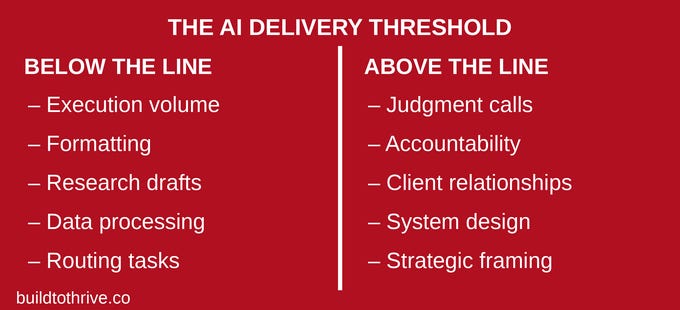
When a model can see your screen, navigate your tools, and deliver a finished output, the economic question stops being "how do I use this?" It becomes: what specifically am I being paid to do that this cannot do? Professionals whose value lives in execution volume are the first to feel this. The ones who retain leverage are those whose work requires judgment, client relationships, or accountability that cannot be delegated to a system.
Companion read: One Useful Thing by Ethan Mollick
STORY 02
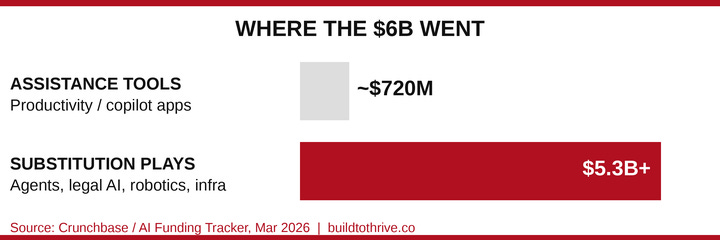
$6B deployed in three days — and none of it is going to assistance tools
SUBSTITUTION BET
WHAT HAPPENED
Between March 11 and March 13, 2026, over $6 billion in AI capital was deployed. AMI Labs raised $1.03B seed for agent architecture. Legora raised $550M for legal AI. Four robotics companies raised a combined $1.2B. Nvidia committed $2B to AI factory infrastructure. Seventeen US AI startups have raised $100M+ in early 2026 alone. Source: Crunchbase, March 2026 · AI Funding Tracker, March 2026.
WHAT IT MEANS FOR PROFESSIONALS & BUSINESS OWNERS
The categories receiving capital are not productivity tools. They are substitution plays. Legal AI at $550M is not helping lawyers work faster — it is building a parallel delivery system for legal output. Robotics at $1.2B is not assisting workers — it is replacing the role. For solo operators: identify which of your service categories sit inside the investment thesis of companies that just raised $500M. That timeline is shorter than most operators are planning for.
Companion read: The Pragmatic Engineer by Gergely Orosz
STORY 03
McKinsey and PwC released the same finding the same week — from opposite directions
COMPENSATION SHIFT
WHAT HAPPENED
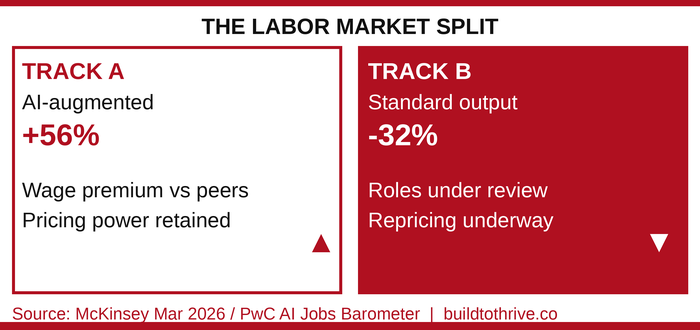
McKinsey reports 32% of companies plan to reduce their workforce by at least 3% in the next year, specifically citing AI capability as the driver. PwC's AI Jobs Barometer found workers with demonstrated AI skills command wage premiums up to 56% higher than peers in identical roles. Both published the same week. Source: McKinsey Global Institute, March 2026 · PwC AI Jobs Barometer, March 2026.
WHAT IT MEANS FOR PROFESSIONALS & BUSINESS OWNERS
These two findings don't contradict each other. They describe the same bifurcation. The labor market is splitting into a track where AI-augmented output is the new baseline, and a track where current output falls below that baseline and roles are being restructured. For professionals inside companies: the 56% premium is not a bonus — it is the new floor for knowledge workers who want to retain pricing power. For solo operators: if your offer is priced on output volume, the repricing has already started.
Companion read: What the Best AI Users Do Differently — HBR, March 2026
Reader Favorites
How Anthropic Set Off a Trillion-Dollar Software Repricing
AI Agents Are Now Hiring Humans: The Rise of RentAHuman and the Agent Economy
How I Scaled My Business Without Hiring: Building My First AI Agents for $0
4 Ways NotebookLM Will Supercharge Your Research
Everyone's Rushing to AI. Few See the Ceiling Ahead.
CLARITY
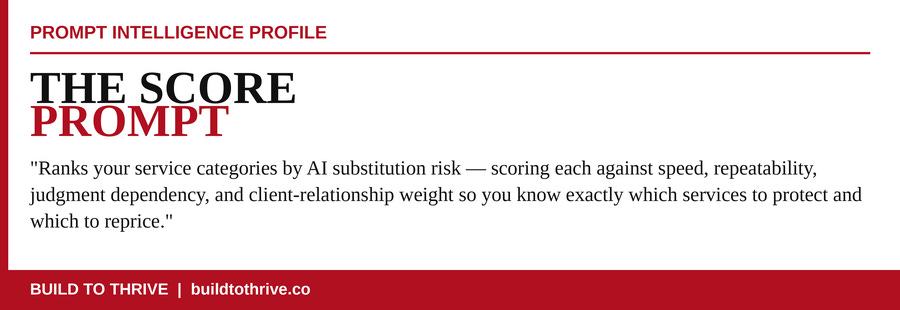
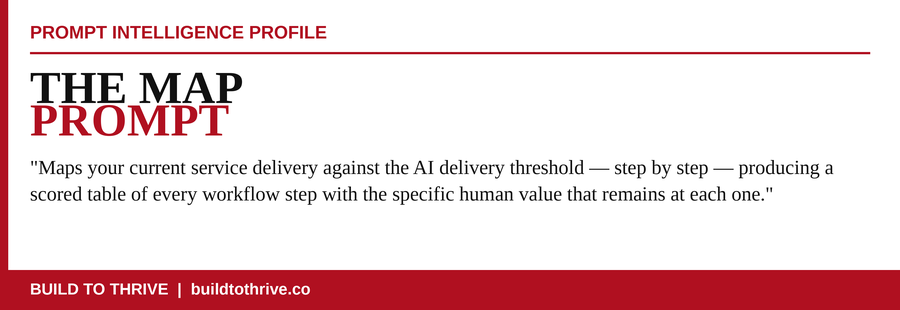
This week’s prompts are the AI Delivery Threshold Stack — three prompts, three levels, one question.
The Score Prompt — macro level. Which of your services are inside the AI investment thesis? Tells you where the risk is.
The Map Prompt — service level. Which steps in your delivery are AI-replaceable? Tells you where your margin is defensible.
The Decide + Deliver Prompt — execution level. How do you restructure the work so AI executes and your judgment stays at decision points? Tells you how to capture the gain.
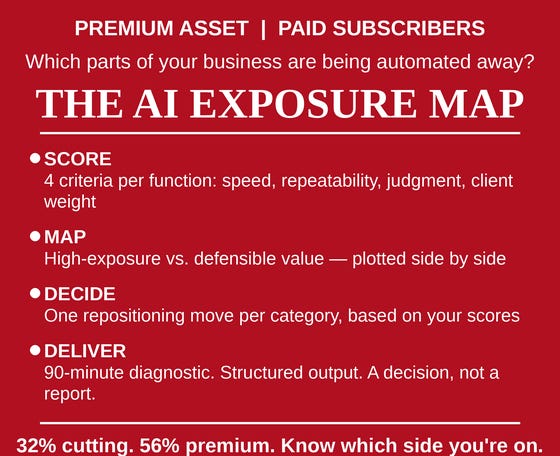
Run them in sequence. Each one inputs into the next. You end up with a complete picture: which services to protect, which workflow steps to reprice, and how to operate at 11x on the ones you keep.

Your deliverables are not your value. Your judgment about which deliverables to produce, for whom, and under what constraints — that is what you are actually selling. This week, act like it.
SMART MOVE 01
Run the Workflow Audit on your highest-margin service
Take your most profitable service and map it step by step: what information is needed at each stage, what output each stage produces, and what decision requires your judgment before proceeding. Then ask Claude or GPT-5.4: "Given this workflow, which steps can you execute autonomously and which require my input?" The output tells you where your margin is actually defensible. Most operators who run this are surprised by what is above the line. Some are surprised by what is not. Either way, you need to know before your next proposal conversation.
SMART MOVE 02
Price one engagement on judgment, not output
Pick one upcoming proposal or renewal. Instead of describing what you will produce, describe the three decisions your client faces in the next 90 days where getting it wrong would be expensive — and position yourself as the person who guides those decisions. Do not mention deliverables unless asked. This is not a pricing trick. It is a structural repositioning that becomes more valuable as AI output becomes cheaper. One sentence in your bio or your next proposal. Do it this week.
Smart Move 3
Run one real task through Manus this week
Download Manus My Computer (manus.ai, Mac and PC). Pick one task you repeat every week that involves moving information between your own files and tools. Run the setup prompt from the TOOL section. Let Manus execute it from start to finish with decision-point stops. You are not testing the tool -- you are testing whether your workflow is structured well enough for an agent to run it. If Manus gets stuck, that is your diagnostic. The stuck points are the ones you have not defined clearly enough to delegate, human or AI.

What it is: Desktop app launched March 17. Runs on your local machine -- files, apps, workflows -- not a browser. Mac and PC. Integrates with Calendar, Gmail, and third-party platforms.
Why it matters: Every other agent works in a browser or a single app. Manus works inside the file systems and tools you have spent years building. That is a different capability category.
The key mechanic: Requires explicit approval before executing tasks -- keeps your judgment at decision points while the agent handles execution. Same pattern as the 11x gain.
Setup prompt included: Instructs Manus to document each action, stop at client data or contractual decisions, and proceed independently on everything else.
Operator advantage: Browser agents cannot see your CRM notes or client files. Manus can. First agent built for a solo operator’s actual workflow, not alongside it.

Space is limited. → learn.buildtothrive.co