


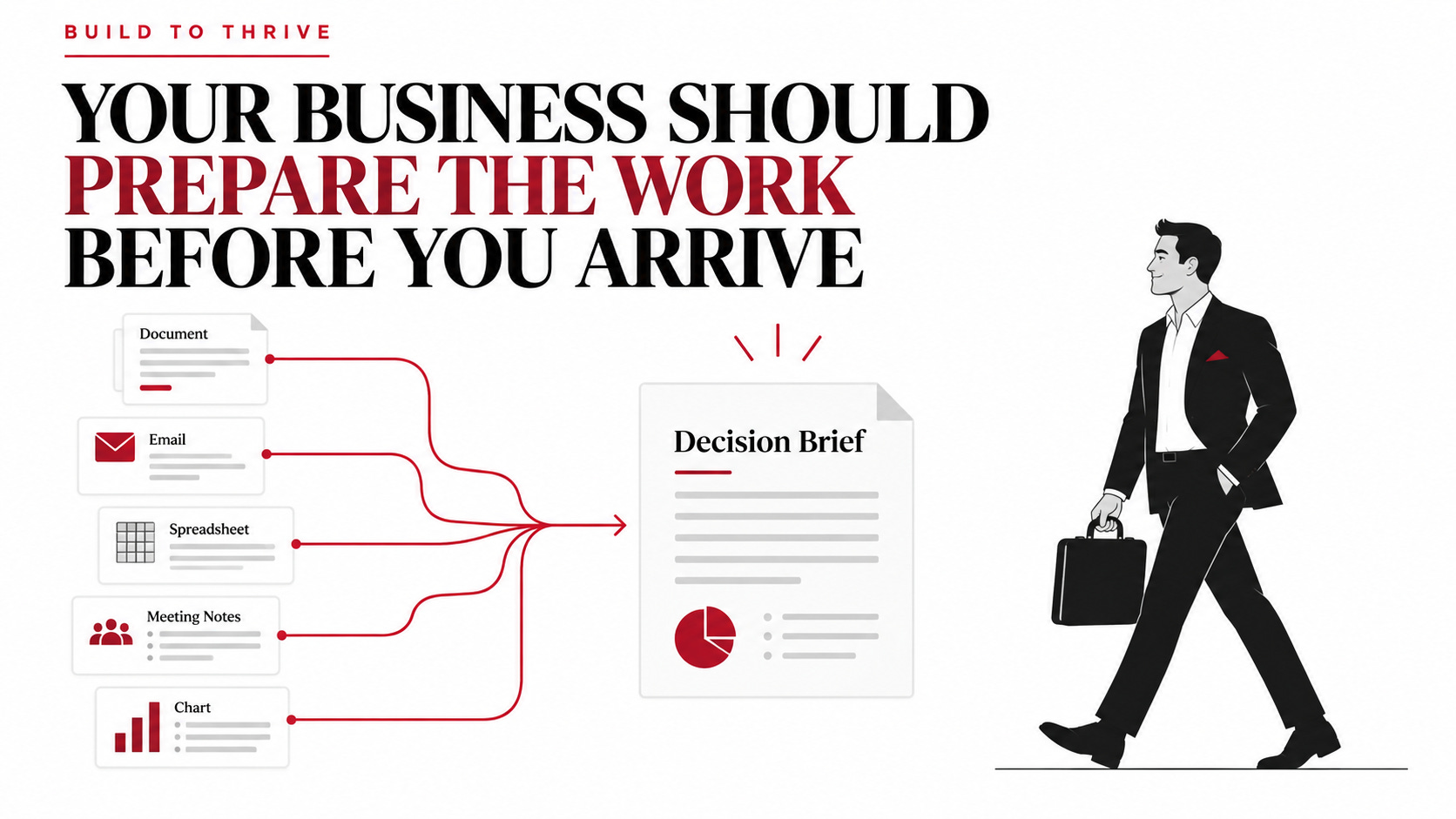
TL;DR
Many owners are not overwhelmed because they have too many decisions.
They are overwhelmed because every decision arrives unfinished.
The information is scattered. The history has to be reconstructed. Someone needs to find the email, compare the numbers, review the notes, and explain what changed.
Only then can the owner think.
AI can prepare that work before the owner arrives.
The goal is not to remove human judgment. It is to make sure human judgment is used where it matters.
Here is what you will learn
Why owners become the hidden queue inside a growing business
The difference between preparing work and making decisions
What a decision-ready business looks like
Five questions for finding work that should stop waiting for you
Examples of work AI can prepare without taking control
How to identify the first machine worth building
Most work does not arrive ready for a decision
A proposal lands in your inbox.
Before approving it, you need to remember what the client requested, check the last conversation, compare the price with similar projects, and confirm what the team can deliver.
A purchasing question arrives.
Before answering, you need to see what was ordered last time, whether the price changed, what is already in inventory, and what the next few weeks of demand might look like.
Someone asks what the business should publish this week.
Before choosing, you need to know what customers are talking about, what competitors are covering, what performed previously, and what the business is trying to sell.
None of these decisions is necessarily difficult.
The preparation is what makes them heavy.
And that preparation often waits for the owner.
The owner becomes the hidden queue
Michael Gerber wrote about the difference between working in the business and working on the business.
Cal Newport has written extensively about the damage caused by fragmented attention.
Research from companies such as Asana and Microsoft continues to show how much work disappears into coordination, searching, switching, and communication.
Different writers use different language, but the pattern is familiar:
The owner is not only making decisions.
The owner is also gathering the material required to make them.
That creates a hidden queue.
Projects wait because the owner has not reviewed the notes.
Proposals wait because the owner needs to reconstruct the client conversation.
Content waits because the owner has not chosen the angle.
Follow-up waits because the relationship history lives in the owner’s head.
The business appears to be waiting for a decision.
In reality, it is often waiting for preparation.
New to Build to Thrive? See the different subscription plans here
What should be waiting for you?
This is the question I would ask:
What work is waiting for you that could be waiting for your decision instead?
Consider two versions of the same Monday morning.
Version one: the work waits for the owner
You open your laptop and find:
Twenty-seven unread emails
Three proposals requiring review
Notes from four customer calls
A spreadsheet that needs interpretation
Five possible topics for the newsletter
A message asking which lead should receive attention first
Before making progress, you have to reconstruct the week.
Version two: the work waits for a decision
You open your laptop and find:
Three emails that actually require your response
A proposal with the client’s goals, scope changes, price comparison, and open questions
A summary of repeated customer concerns
A short explanation of what changed in the spreadsheet
Three newsletter opportunities ranked by relevance
A lead brief showing the relationship history and recommended next step
The decisions are still yours.
But the work arrives prepared.
That is a very different business.
Preparation is not judgment
This is where many conversations about artificial intelligence go wrong. Preparing a decision is often treated as if it were the same as making the decision.
A capable system can gather information, organize notes, compare versions, identify repeated themes, expose contradictions, and draft a recommendation. Those activities reduce the distance between information and judgment.
The owner still determines which outcome matters and which constraint cannot be ignored. Decisions involving fit, price, promises, relationships, exceptions, and risk continue to require human responsibility.
This is the division of work Build to Thrive is built around. The machine finds and prepares, human judgment chooses, and the market proves whether the choice worked.
I have written about my AI Chief of Staff and how helpful it has been for me.
If you like to meet for 15-min and see what would make more sense to you, click on the link below. I’ll be happy to help you find the best approach to this. Believe me, it is night and day, your productivity will 10x.
What a decision-ready brief should answer
What happened? The relevant facts.
What changed? The difference from the previous situation.
Why does it matter? The likely consequence.
What remains uncertain? Missing or conflicting information.
What is recommended? A proposed next step and the reasoning behind it.
What decision is needed? The exact choice the owner must make.
A useful brief makes the facts visible without burying the owner in detail. It also separates what is known from what is inferred, recommended, or still not established.
The machine does not bury the owner in information.
It reduces the distance between information and judgment.
Six examples of work that can arrive prepared
1. Market intelligence
Instead of sending the owner twenty links, the system can:
Monitor selected sources
Remove duplicates
Group developments by topic
Explain why each development may matter
Identify three opportunities worth reviewing
The owner decides which opportunity fits the business.
2. Content
Instead of beginning with an empty page, the system can:
Review customer questions
Find themes in recent conversations
Compare them with past content
Suggest several angles
Prepare an outline using the business’s voice and offers
The owner chooses what is worth saying.
3. Repurposing
After an article is approved, the system can prepare:
A LinkedIn post
A Substack Note
An email introduction
Several short excerpts
Suggested visual concepts
The owner approves what represents the brand.
4. Proposals
Before the owner reviews a proposal, the system can assemble:
The client’s stated problem
Desired outcome
Relevant meeting notes
Open questions
Proposed scope
Similar past work
Pricing considerations
Risks or unclear promises
The owner decides what to offer and what not to promise.
5. Follow-up
The system can prepare:
The relationship history
The last commitment made
What has happened since
A suggested message
The appropriate next step
The owner decides when the relationship requires a personal touch.
6. Purchasing
Before approving a purchase, the system can show:
Previous prices
Current price changes
Supplier history
Quantities purchased
Inventory information
Expected demand
Unusual cost movements
The owner decides whether to buy, wait, substitute, or renegotiate.
If you like to know more about my Chief of Staff click on this link it guides you through the plug-in I install for others after a short consultation.
The founder-wait test
Choose one piece of work currently waiting for you.
Then ask five questions.
1. What decision actually requires me?
Name the specific judgment.
If you cannot identify it, the work may be reaching you because of habit rather than necessity.
2. What information do I gather before making that decision?
List the emails, documents, numbers, history, and context you normally reconstruct.
This is the preparation layer.
3. Which parts follow a repeatable pattern?
Look for work that happens in a similar way each time:
Searching
Sorting
Comparing
Summarizing
Drafting
Checking for missing information
These are strong candidates for a machine.
4. Which parts require my judgment?
Protect the decisions involving:
Fit
Price
Promises
Relationships
Exceptions
Risk
The objective is not to remove the owner from the business.
It is to stop wasting the owner on preparation.
5. What would a decision-ready package contain?
Describe what you would want to receive.
Not “summarize the emails.”
Something more useful:
Show me the customer’s objective, what changed since our last discussion, the relevant commitments, the financial implications, the unresolved questions, and the recommended next step.
That is the beginning of a real machine specification.
Start with one recurring decision
Do not begin by asking:
How can we automate the business?
That question is too broad.
Start with:
Which recurring decision keeps arriving unfinished?
Then build the smallest system that can prepare it.
For example:
Before: The owner searches through emails, notes, and spreadsheets before every proposal review.
Machine: The system collects the client context, summarizes the request, compares it with previous work, identifies missing information, and drafts the proposal.
Owner’s decision: Scope, price, promises, and whether the opportunity fits.
Scoreboard: Preparation time, proposal turnaround, corrections required, and conversion rate.
That is a machine with a purpose.
The first machine teaches you about the business
Building the first machine is not only about saving time.
It reveals how the business actually works.
You discover:
Which decisions have never been documented
Where essential context lives
Which exceptions occur repeatedly
What employees cannot access
Where information becomes unreliable
Which steps require experience
Which decisions should never be delegated
This is why owners should participate in building their first AI machine.
Not because they need to become technical.
Because the first build forces the business to explain itself.
If you only remember one thing
AI should not replace the moment when your judgment matters.
It should prepare that moment.
The best machine may not make a single important decision.
It may simply make sure that when the decision reaches you, the facts are organized, the history is visible, the uncertainty is clear, and the next move is ready for consideration.
The work no longer waits for you.
It waits for your decision.
Where is your business waiting?
If work keeps stopping because it needs your memory, preparation, or rescue, that is usually not a personal productivity problem.
It may be the first machine your business needs.
I offer four free 30-minute diagnostic calls each month.
We will identify the work that keeps waiting for you, separate preparation from judgment, and find the first practical move.
A few days later, I will send you a two- or three-page report with what we uncovered and my recommended first step.
It is yours to keep, whether or not we ever work together.
Juan

AI becomes far more valuable when it removes the investigative burden while keeping judgment, accountability, and context firmly with the owner.
The proposal example makes the preparation problem very concrete.