


I have been tracking who is actually starting businesses this year, and a number landed last week that I keep turning over. Alibaba.com runs a global pitch competition called CoCreate Pitch. This year it drew more than 15,000 applicants from 132 countries. When they looked at who applied, 71 percent were one-person businesses. A year ago that figure was 40 percent. And 89 percent of those solo founders said AI tools were essential to getting started (WWD coverage of the Alibaba.com analysis).
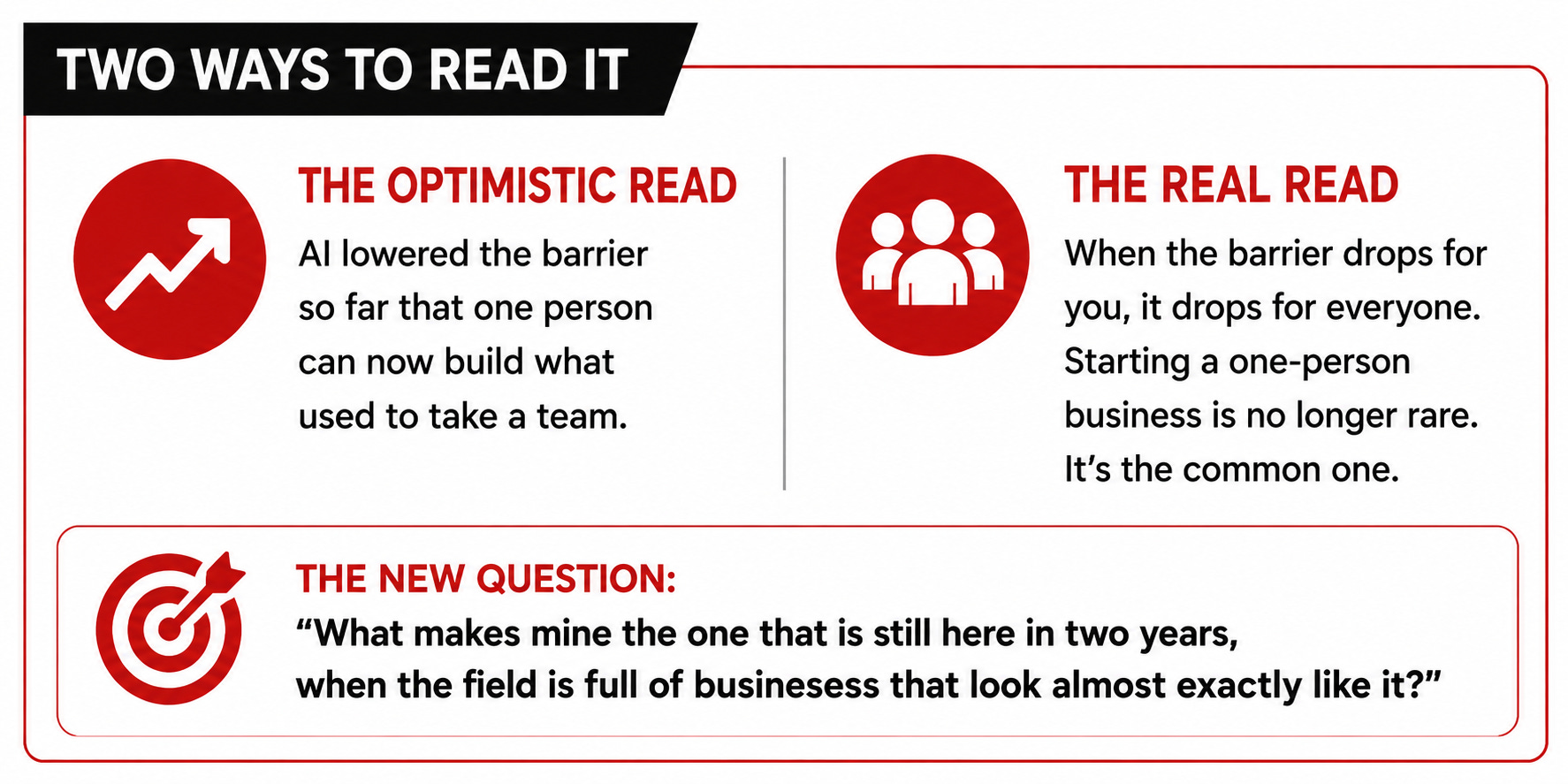
Read that the way Alibaba framed it and you get the optimistic headline: AI lowered the barrier so far that one person can now build what used to take a team (Alibaba.com via PR Newswire). That is real, and if you have been waiting for permission to turn your experience into your own thing, this is the clearest sign yet that the market moved in your direction.
But there is a second read, and it is the one that matters more if you are the one building. When the barrier drops for you, it drops for everyone. If 71 percent of the people in the room are solo and 89 percent are leaning on the same handful of plug-and-play AI tools, then starting a one-person business is no longer the rare move. It is the common one. The thing that used to set you apart, that you started at all, is now table stakes.
So the question quietly changed. It is not “can I start a one-person business with AI.” Thousands of people just answered that for you. The question is “what makes mine the one that is still here in two years, when the field is full of businesses that look almost exactly like it.”
The part the tool cannot give you
Here is the mechanism underneath the surge. A plug-and-play AI tool is, by design, the same for everyone who buys it. That is the whole point of plug-and-play. It hands a first-time founder the same industrial design, the same marketing copy, and the same workflow it hands the founder next to them. The tool is the great equalizer, which is exactly why it cannot be your edge. Anything the tool gives everyone cannot be the reason a buyer picks you.
What the tool cannot supply is the part you already have and most people do not: the specific judgment that comes from years in your seat. The pattern you recognize on a sales call that a generic model would miss. The thing you know not to do because you watched it fail once. The way you frame a problem that makes a buyer feel understood in the first five minutes.
This rule comes from two pieces I have written, and they are two halves of the same point. In How Anthropic Set Off a Trillion-Dollar Chain Reaction I traced how fast the AI model itself is turning into a cheap commodity, the same one anyone can rent for a few dollars. In The Death of the High Performer I made the other half of the case: once the tool does the task, being good at the task stops being the thing you get paid for, and your judgment becomes the scarce part. Put them together and you get the rule for this moment. The tool races toward commodity, so the value moves to the judgment you wrap around it, the part a competitor cannot rent. In a one-person business, that wrapper is you, made specific.
The economics, in plain terms
Think about what happens to price in a crowd of lookalikes. When a hundred solo operators offer the same AI-built service with the same tool, the only lever any of them has left to compete on is price. So price falls. That is not a moral failing, it is just what happens when buyers cannot tell two offers apart. The technical word is commoditization. The plain version is that sameness pushes price toward the floor.
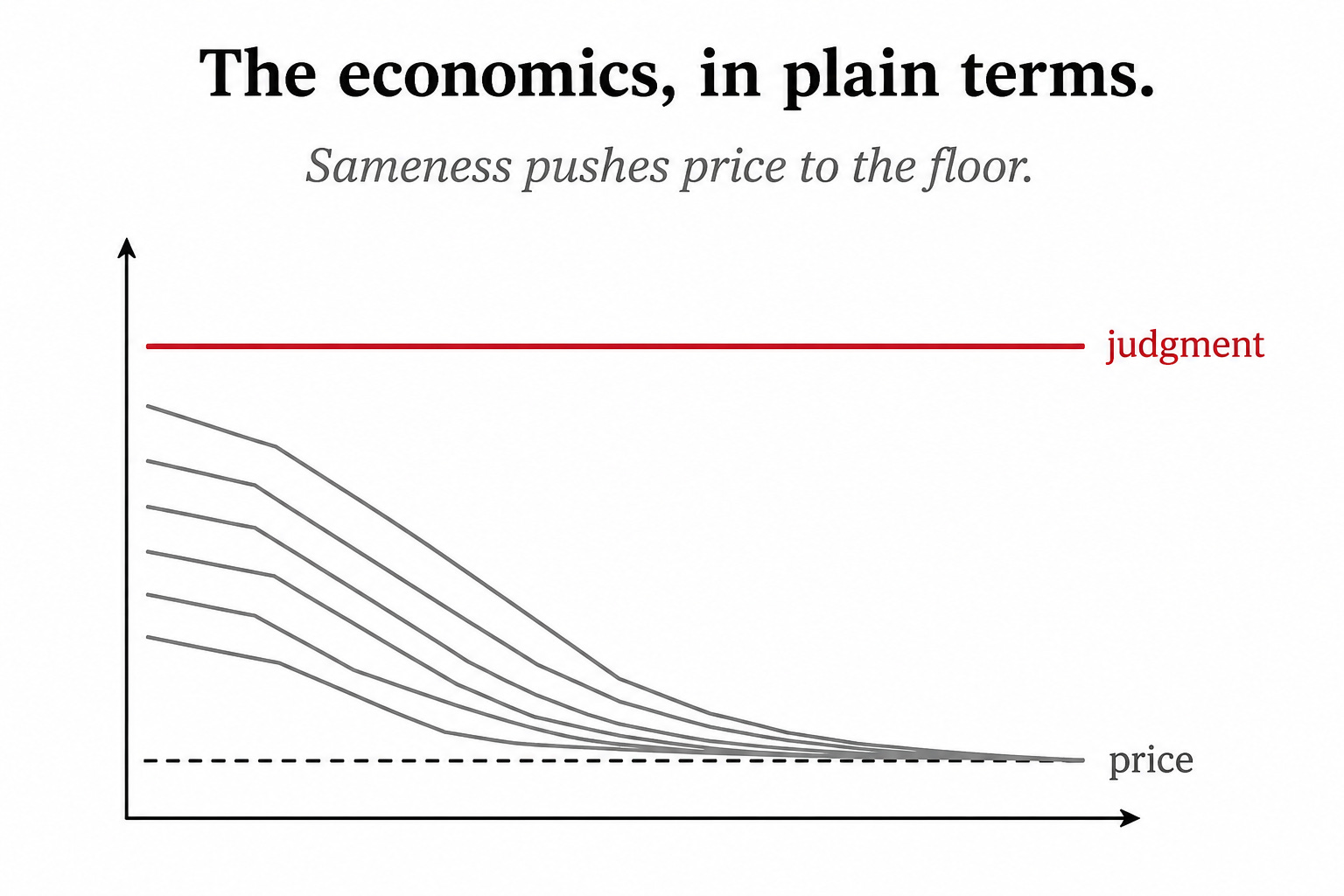
Now picture the operator whose offer carries something the tool did not supply. A buyer who can name why they want that specific person is not comparing on price anymore, they are comparing on fit. That operator holds their number while the lookalikes race each other down. Same tool underneath, completely different economics on top. The difference is entirely in the layer the buyer can see that did not come out of the box.
A move you can make this week, free
You do not need a new tool for this. You need to get specific on the one thing the tool cannot copy, and put it where a buyer can see it.
Try this. Write down the last three times someone paid you, or paid a company you worked at, for a judgment call rather than a deliverable. Not the report, the call. The moment where your read on the situation changed what happened next. For each one, finish this sentence: “Most people in my field would have done X, I did Y, and here is why it worked.” Those three answers are the raw material of an offer a competitor running your same tool cannot reproduce, because they did not live the thing that taught you Y.
That is the difference between “I use AI to build marketing campaigns” and “I have run growth for two consumer brands, I know which of these AI-built campaigns will quietly burn budget, and I build the ones that do not.” Same tool. One of those sentences competes on price. The other one does not.
When you want the structured version
The free move above gets you started. Turning those three sentences into a one-sentence offer you can actually sell, with a price and a shape, is the work I do inside Founder 100. If you are an experienced operator stepping into your own thing, the Positioning path is built for exactly this: I help you take your raw experience and shape it into a one-sentence offer, a priced engagement, and the language to put it on your profile and in a proposal. Session two turns that into a 30-day plan with three moves that put it in front of buyers. In case you like to drive solo, you can also explore this yourself with a 7-sequence prompt that takes your there. Offer Builder
If you are reading this as one of the 71 percent, or about to be, the tool already did its job. It got you in the room. What keeps you in the room is the part of you the tool could never supply. Pick the one judgment call you are proudest of and start there.
Juan

This is exactly why the "anyone can build a business now" narrative is a double-edged sword. When you lower the barrier to entry to zero, you flood the room with identical offers.
"The tool races toward commodity, so the value moves to the judgment you wrap around it." That's the cleanest version of the argument I've been making from the creative side. I've spent 25 years watching this play out in advertising. The agencies that survive aren't the ones with the best tools, they're the ones with the sharpest point of view about what to do with them. The 71% stat reframes that entirely. It's not a creative problem anymore. It's an economic one.