


You’ve been using Claude to draft your follow-up emails after customer meetings. It feels faster. If someone asked how much time it saves you, you’d probably say “a lot” and move on.
But think about what actually happens now. The draft shows up in seconds. Then you read it. You fix the line where it guessed a date you never promised. You check that the price matches what you discussed. You soften the opening because it doesn’t sound like you. Then you send it.
How long did that take? Most people have no idea. And that’s the number that decides whether AI is giving you time back or just moving the work to a different part of your afternoon.
TL;DR: Before you decide AI saves you time, time it. Pick one task, measure it for two weeks without AI, then track it for 60 to 90 days with AI, and count your own review minutes as a cost. The answer might still be good. It just won’t be a guess.
What the numbers say, and what they don’t
A recent Forbes piece by Rahul Dogra, How To Measure AI ROI In A Small Business, opened with the Federal Reserve’s numbers on small businesses and AI. The number that tends to get repeated is that only 31% of firms saw higher sales from AI. The 31% is real, but it’s 31% of the firms already using AI, and it sits next to a much bigger number.
The Fed’s own report, the 2025 Small Business Credit Survey of small employer firms (published in 2026), says 46% of employer firms had a business or employees using AI. Among the firms using it, 71% said AI increased their productivity. Only 31% reported higher sales. And 77% said their labor costs didn’t change.
That gap is what caught my attention. 71% feel more productive. 31% can point to it in their sales.
The survey doesn’t say why. It’s what owners reported about themselves, not a measurement of their businesses. It doesn’t prove that AI isn’t working. But it does tell me that “it feels faster” and “it changed something in my business” are two different claims, and a lot of owners are living in the space between them.
What it costs you to skip the measuring
When you don’t measure, a few things go wrong, and they go wrong quietly.
The review time disappears from the math. You remember the 45 minutes you used to spend writing. You don’t notice the 20 minutes you now spend checking. So you count the whole 45 as saved when the real number is much smaller.
You expand on a feeling. One task seems to work, so you add AI to a second and a third. If the first one was only breaking even, you’ve just copied a break-even setup three times, and you’re now reviewing three streams of drafts.
The tool bills keep coming. Small monthly charges sit on different cards, and nobody asks whether each one is earning its place.
The saved time goes nowhere. Dogra makes this point well: if the hours saved “dissolve into slower afternoons,” the gain never reaches the business. Time back only counts if you can say what it went to.
None of these is dramatic. That’s the problem. You can spend a year paying for AI and checking its work without ever knowing whether you came out ahead.
A simple way to measure one task
The method in the Forbes piece is simple enough to do with a notepad. I’ve adapted it slightly for a business where the owner is often the one doing the work.
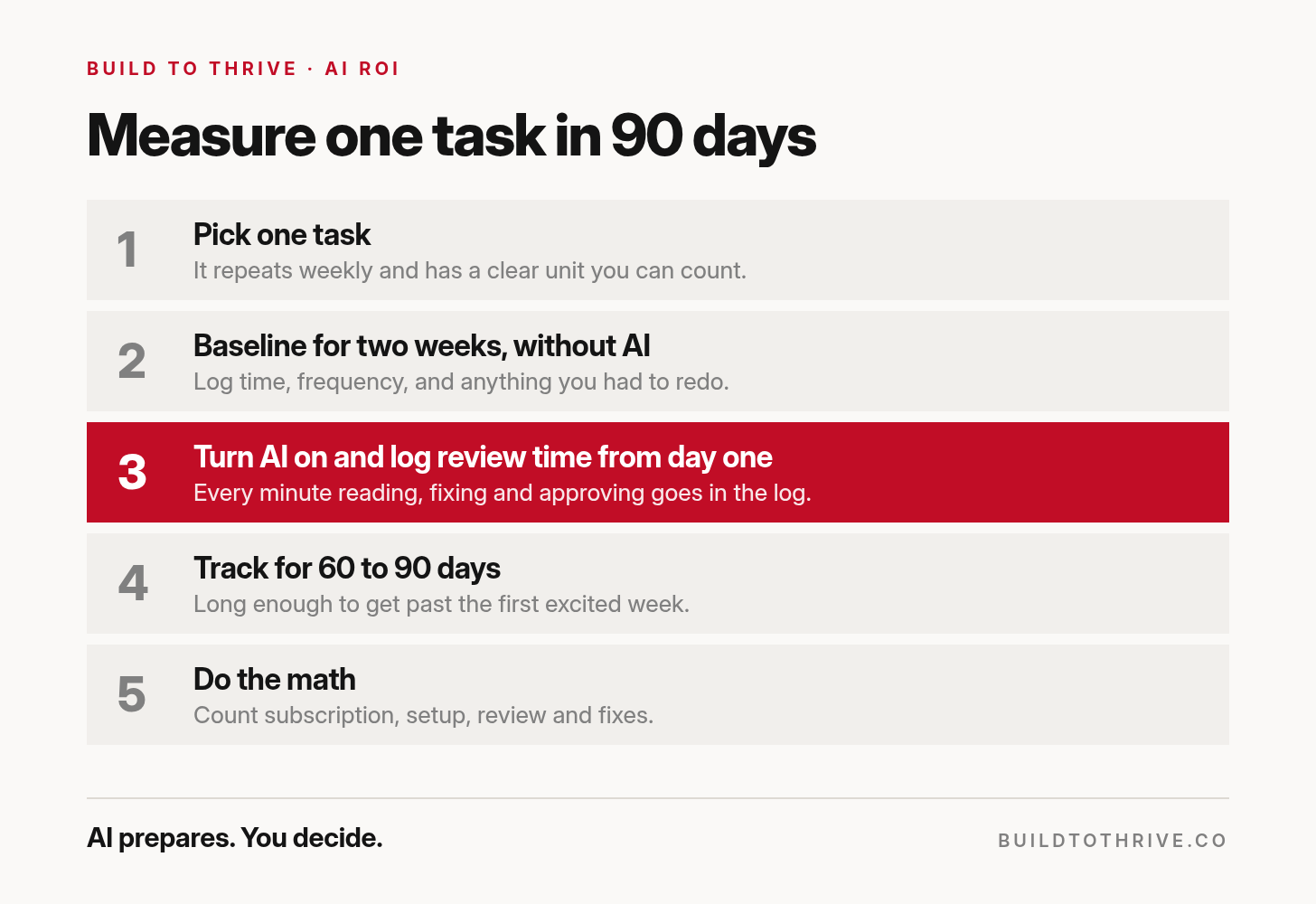
1. Pick one task. Something that repeats every week and has a clear unit you can count: a follow-up email, a quote, a weekly report. One task only. If you test three at once, you won’t know which one did what. (I wrote about why one recurring job is the right place to start in How a Prompt Becomes a Machine.)
2. Take a baseline for two weeks, without AI. Write down three things each time you do it: how long it took, how often it came up that week, and whether anything had to be redone or corrected afterward.
3. Turn AI on for that task, and log your review time from day one. Every minute you spend reading, fixing and approving the draft goes in the log. So does the time you spend setting it up and writing the instructions.
4. Track the same numbers for 60 to 90 days. Long enough to get past the first excited week and see what it’s like as a normal part of your routine.
5. Do the math. Take the value of the time you saved, subtract the full cost, and divide by the full cost. Full cost means the subscription, the setup time, your review time, and any time spent fixing mistakes that got out the door.
A worked example (hypothetical)
This is a made-up example to show the math, not a real result. The $60 an hour, the $25 a month and the 3 hours of setup are example numbers. Swap in your own.
Say the task is the follow-up after a customer meeting. Your baseline shows it takes 45 minutes, three times a week. That’s 135 minutes a week.
With AI, the draft is ready almost instantly, but you spend 20 minutes reviewing and fixing each one. That’s 60 minutes a week of review.
You run the test for 12 weeks. For this example, you value your own time at $60 an hour (use whatever number you’d defend for your own business).
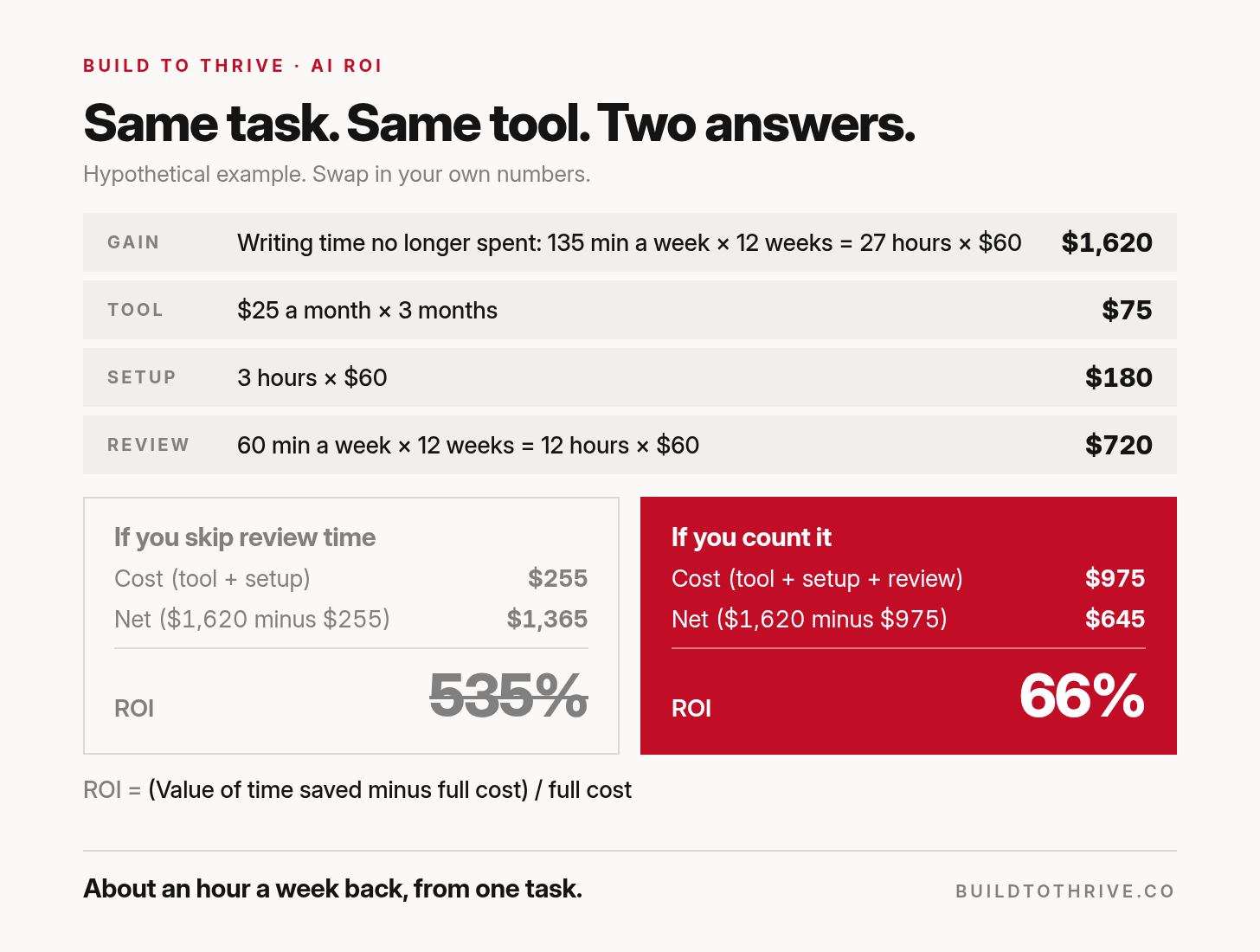
Writing time you no longer spend: 135 minutes a week for 12 weeks is 27 hours, or $1,620.
Tool (example price): $25 a month for three months, $75.
Setup (example): 3 hours writing instructions and testing, $180.
Review: 60 minutes a week for 12 weeks is 12 hours, $720.
Total cost: $975. Net gain: $1,620 minus $975 is $645. Divide by the cost and you get about 66%.
Now run the same math and leave out the review time. Cost drops to $255, the net gain jumps to $1,365, and the return looks like 535%.
Same task. Same tool. The only difference is whether you counted the minutes you spent checking the work. That’s how easy it is to fool yourself.
In time, the honest version comes out like this: 27 hours of writing gone, minus 12 hours of review and 3 hours of setup, leaves 12 hours over 12 weeks. About an hour a week, from one task.
An hour a week from one task is a good result. It’s also why five hours rarely comes from one place. It comes from finding several tasks like this, measuring each one, and keeping the ones that actually give time back.
And those tasks don’t all have to be emails. One recent how-to guide for small businesses suggests writing your business down on one page first (your services, prices, area, policies, the tone you use and the things you never say) and giving that page to a saved helper in Claude for one job, like turning your price list into a quote. Before you trust it, you test it with a request you already know the answer to, a quote you’ve priced yourself, and you keep that as your check. That check is review time too, so it goes in the log.
What the math won’t tell you
Two things to keep in mind before you treat the number as the final word.
First, the hour only matters if it goes somewhere. Before the test starts, write down what you’d do with the time if you got it back. If you can’t answer that, the measuring will tell you AI works and your week will feel exactly the same.
Second, some value is hard to count. A follow-up that goes out the same day instead of two days later might win you a job. That doesn’t show up in minutes saved. Don’t ignore it, but don’t use it as a reason to skip the baseline either. Measure what you can, and note the rest honestly.
And the review time isn’t something to eliminate. Reading the draft before it goes out is where your judgment lives. AI prepares the follow-up. You decide what gets promised. The point of counting review time isn’t to cut it to zero. It’s to know what you’re really trading.
Where to start
The hardest part of this method is step one. Most owners don’t know which of their tasks are worth measuring, because they’ve never added up where their week goes.
Take this example: Meet Frank. He’s made up, and so is his business, but his week might look a lot like yours.

If you want to know how AI can save you five hours of your time or more, I’m teaching a 20-minute class on exactly that this Thursday, Nov 5, at noon ET on Zoom. You’ll list the work that keeps coming back, see which jobs are worth handing to AI, and leave with a prompt to start on the best one that same afternoon. That gives you the task to run this test on.

If you’d like access to all my AI in 20 Minutes classes, with their study guides, plus a 30-minute diagnostic and design session with me to save you time and money, become a paid member of Build to Thrive. It’s an annual membership, $117 a year, which comes out to $9.75 a month.
Rather talk it through than type? Sage, my AI voice agent, will walk you through finding the task worth measuring first.

Which task in your week would you measure first? Hit reply or leave a comment and tell me.
Juan
Faster generation doesn't automatically mean greater productivity
The real productivity gain only becomes clear when you include verification, corrections, and human review in the measurement.