


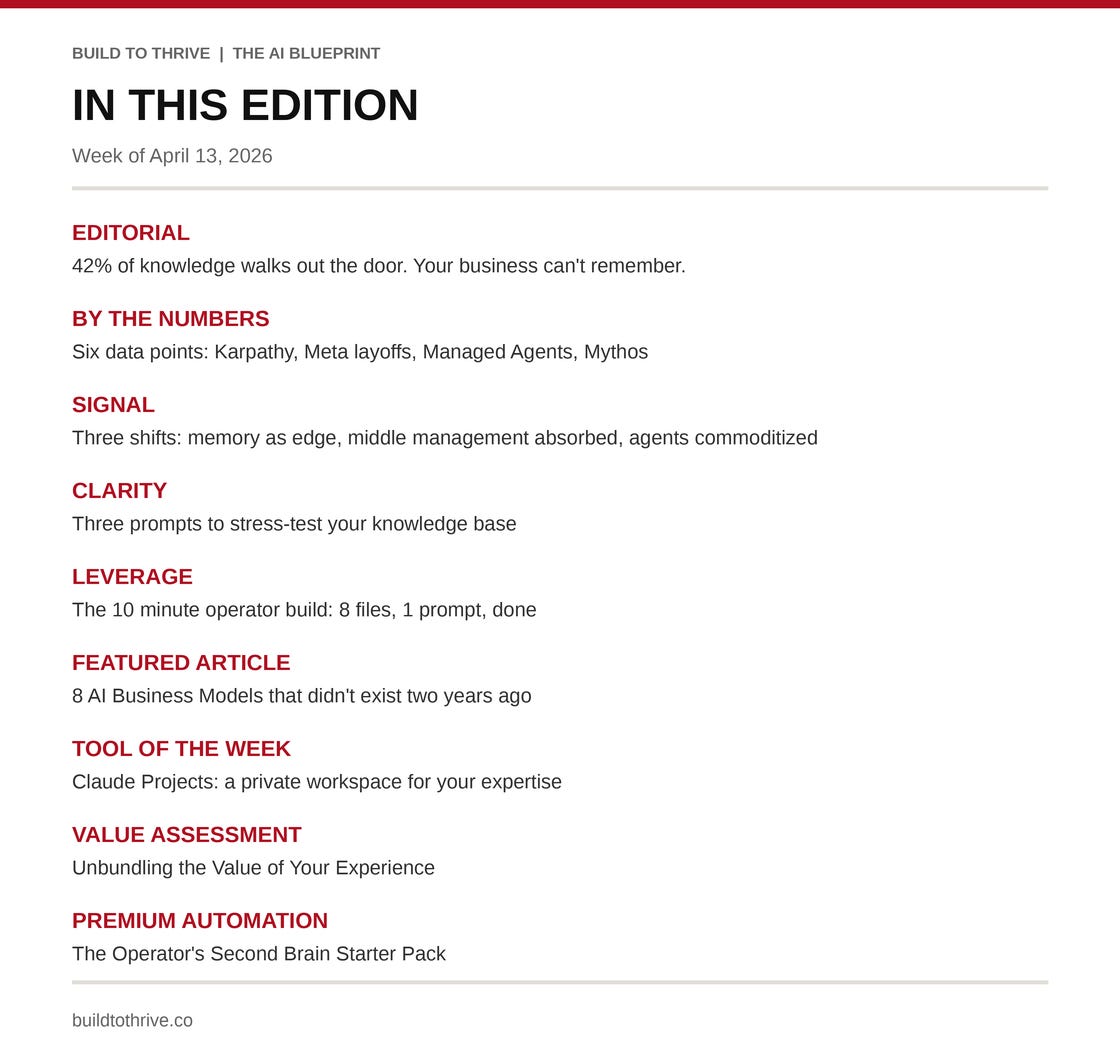
EDITORIAL
Around 42% of institutional knowledge resides in individual employees. Most operators I work with have the same problem at the individual level. Years of client work in their heads. Patterns they have spotted and never written down. Frameworks they rebuild from scratch on every engagement. Methodology they cannot hand to anyone, including themselves six months from now.
Last week, Andrej Karpathy -- ex-Open AI and one of the people who built modern AI posted what he actually uses it for now. It is not writing code. It is not generating content. He uses AI to remember everything he learns: 400,000 words, 100 articles, one knowledge base he rarely opens because he does not need to. AI reads it, organizes it, writes the summaries, builds the connections. He does not touch any of it.
This is not a productivity hack. That is an operating advantage. The company that can retrieve its own judgment on demand stops rebuilding from scratch. The company that cannot is paying a tax on every engagement, every proposal, every handoff. Most of them do not even know it.
Now apply that to your business. You have the Google Drive folders, the proposal templates, the client notes from three years ago buried somewhere you will find if you look hard enough. The problem is not that your business has no memory. The problem is that your memory does not work for you. It sits in twelve places, in formats only you understand, organized by whatever made sense the week you saved it.
This issue fixes that. Not with a concept. With an actual 10-minute setup using 8 files, one morning prompt, and a workspace inside Claude or ChatGPT. Want to know how? Read this edition, and apply is, so your business stops losing what you already know, and its memory compounds.
Here is what is changed for me. My morning starts with AI reading my own work history back to me and telling me what to do with it. My proposals pull from every engagement you have ever run. My positioning sharpens because the patterns across my client work are visible for the first time. I stop being the person who has the expertise and start being the person whose business can deploy it on demand.
This edition is a single build. Signal names the three shifts that happened this week -- Karpathy’s knowledge base, Meta’s management cuts, and Anthropic’s new agent platform , and what each one means for how you hold and deliver your expertise. I also share three prompts to stress-test your own knowledge gaps. The leverage section is dedicated to building the second brain. And Tool of the Week is the workspace that runs it all.
-- Juan

The scaffolding protecting careers is coming down and what survives is the promise you can stand behind.
This assessment helps you unbundle the value of your experience, understand your ideal customer profile and design a buyer facing offer.
LAST WEEK’S NUMBERS
400,000
words in Andrej Karpathy's personal knowledge base. He rarely opens it. AI pulls from it on demand. (Karpathy, April 3, 2026)
70%
share of routine coding and administrative work Meta says its internal agents Metamate and DevMate now handle. Approximately 700 April layoffs target middle management, QA, customer support, and internal IT. (Storyboard18, April 2026)
10x
time-to-ship improvement Anthropic claims for customers building on Claude Managed Agents, the new cloud service launched April 8. Early adopters include Notion, Asana, and Rakuten. Pricing: $0.08 per session-hour plus token rates. (SiliconANGLE, April 8, 2026)
244
pages in the system card Anthropic published for Claude Mythos Preview on April 7, simultaneously announcing the model is too dangerous to release publicly because of its cybersecurity capabilities. Limited access is going to roughly 40 critical infrastructure organizations under Project Glasswing. (Gizmodo, April 7, 2026)
52,050
U.S. tech layoffs in Q1 2026. A 40 percent year-over-year jump. 20.4 percent of tech cuts through early March were explicitly AI-linked, up from 8 percent in 2025. (Challenger, March 2026 Report)
400%
growth in LinkedIn fractional job postings since 2022. Gartner forecasts 30 percent of midsize enterprises will have a fractional executive on retainer by 2027. (LinkedIn Economic Graph, Gartner, April 2026)

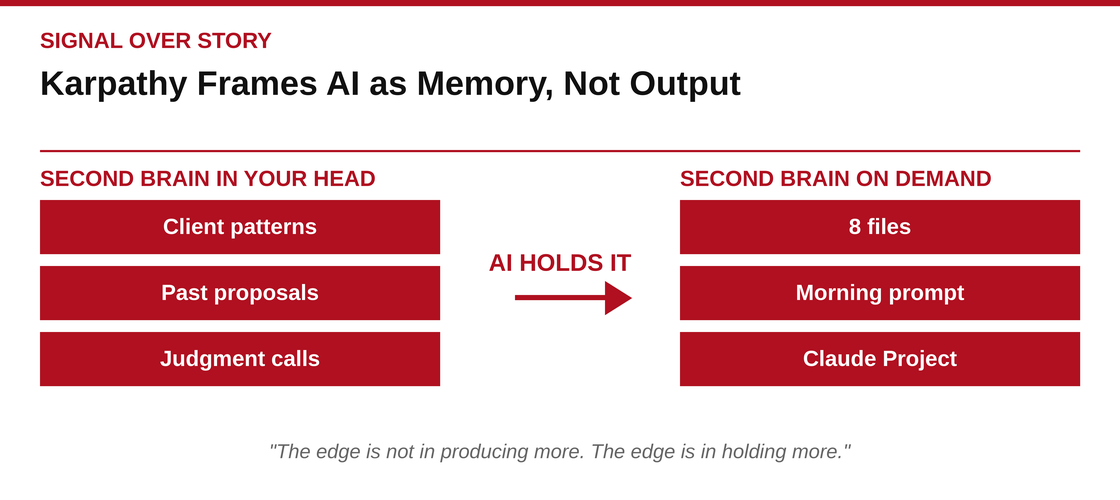
What happened: On April 3, Andrej Karpathy posted publicly that his day-to-day AI use is now centered on personal knowledge management, not code generation. He described a setup where AI ingests his notes, articles, and ideas, organizes them, writes summaries, and surfaces connections. His base is 100 articles and roughly 400,000 words. He rarely opens it directly. When he needs something, AI pulls it. Source: Andrej Karpathy, public post, April 3, 2026.
What it means for professionals and business owners: When the person who built modern AI is using it for memory instead of output, the edge is not in producing more. The edge is in holding more. The generalist advisory offer is being compressed from above by enterprise AI platforms and from below by the premium going to operators who deliver human-plus-AI work. Neither of those moves matters if the operator cannot recall their own methodology on command. Portable judgment is the asset. A memory system is how you make judgment portable.
What is the smart move: Before you write another proposal, stop and build the infrastructure to never rebuild one from scratch again. The Leverage section below walks through the setup. Thirty minutes once. Then ten minutes every morning.
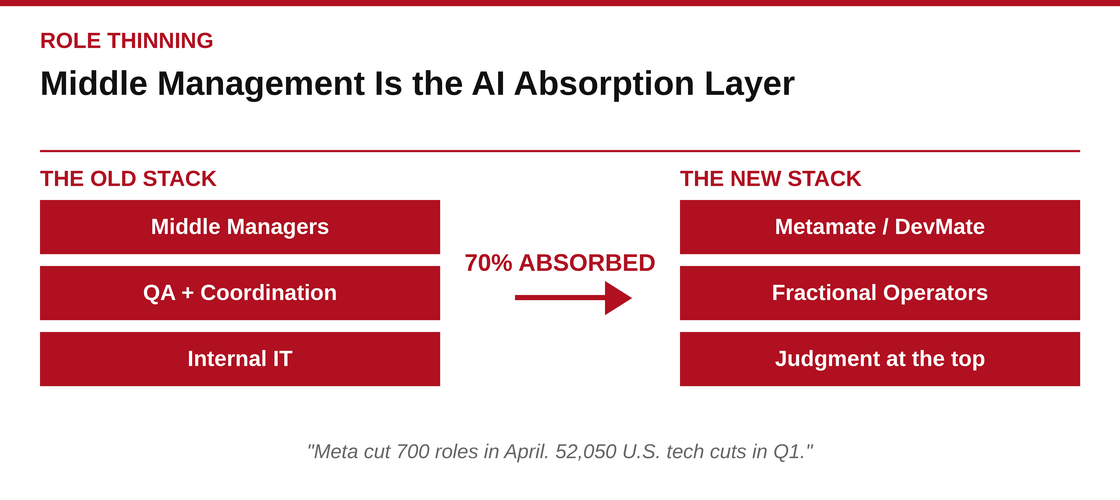
What happened: Meta confirmed approximately 700 April layoffs targeting middle management, QA, customer support, and internal IT, and disclosed that its proprietary agents Metamate and DevMate now handle 70 percent of routine coding and administrative work. Microsoft set an internal target of a 10:1 engineer-to-manager ratio. Q1 2026 tech layoffs hit 52,050, a 40 percent jump year over year, with 20.4 percent of tech cuts explicitly AI-linked, up from 8 percent in 2025. Source: Storyboard18, NewsPress India, Challenger March 2026 Report, April 2026.
What it means for professionals and business owners: The layer being removed is the layer that did coordination, synthesis, and translation between strategy and execution. That is judgment work. Judgment work only survives when it can be named, reused, and delivered repeatedly. The people being cut are not losing because their judgment is worthless. They are losing because their judgment lives in their head, inside an org chart that is being rewritten. The people replacing them will be fractional, will charge more, and will have their own memory system.
What is the smart move: Look at the three kinds of work you did this week that required your judgment. Write them down in a file you will still be able to find in six months. That file is the seed of your second brain.
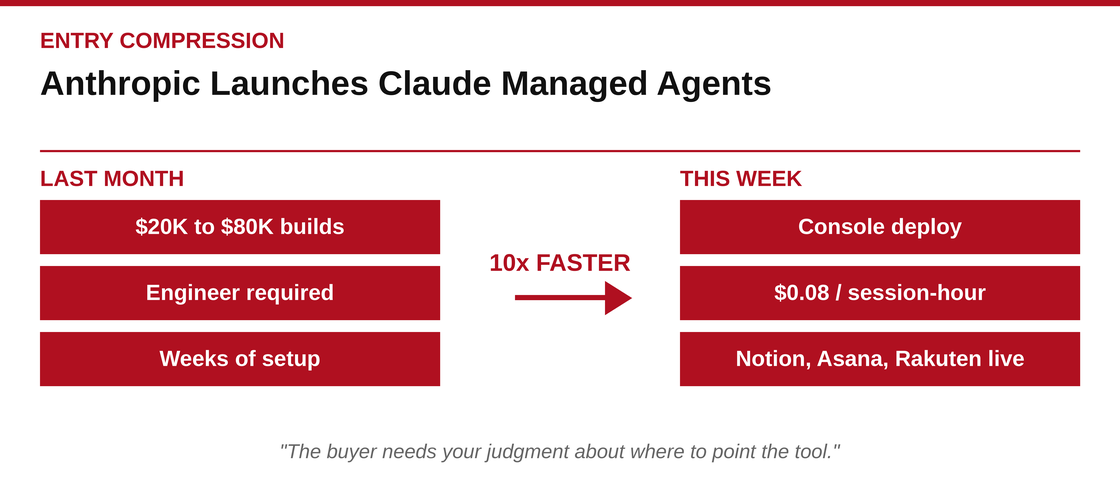
What happened: On April 8, Anthropic launched Claude Managed Agents, a cloud service that builds, runs, and scales AI agents on top of Claude. It ships with a tuned agent harness, sandboxed code execution, authentication, checkpointing, scoped permissions, and persistent long-running sessions. Developers define tasks, tools, and guardrails. Anthropic handles the orchestration. Pricing is consumption-based: standard Claude token rates plus $0.08 per session-hour of active runtime. Early adopters include Notion, Asana, and Rakuten, and Anthropic is reporting 10x improvements in time to ship. Source: SiliconANGLE, TechRadar, April 8, 2026.
What it means for professionals and business owners: The agent build layer just got commoditized. A month ago, standing up a production AI agent was a technical engagement worth $20,000 to $80,000. This week, a product manager with a credit card can do it through a console. The front door for junior "AI agent developer" roles is closing the same way the front door for junior software engineers closed two years ago. For experienced operators, the lesson is different. Your moat is not "I can build an agent." Your moat is "I know which specific workflow inside your business an agent earns its keep in, and I have the methodology to prove it before you spend a dollar." The buyer no longer needs your hands. They need your judgment about where to point the tool.
What is the smart move: Pick one workflow inside a past client's business where you have watched an agent fail or succeed. Write a one-page memo naming the workflow, the failure mode, the success mode, and the measurable outcome. Send it to that client this week. The memo is the new proposal.
Also last week
Claude Mythos Preview -- the model Anthropic will not release. On April 7, Anthropic published a 244-page system card for its most powerful frontier model and simultaneously announced it would not be made publicly available. The stated reason is that the model's cybersecurity capabilities are too dangerous. Anthropic disclosed that Mythos has already found thousands of high-severity vulnerabilities, including ones in every major operating system and web browser. Access is limited to roughly 40 critical infrastructure organizations through a controlled preview called Project Glasswing. Why it matters for operators: the gap between frontier capability and what you can legally deploy just widened. The lesson is not "wait for the better model." The lesson is that the operators who win this cycle are the ones who extract full value from the models that are already shipping. Your advantage is not access. It is usage. Source: Gizmodo, Geeky Gadgets, April 7, 2026.

Three prompts you can paste directly into Claude or ChatGPT to stress-test your own knowledge base against this week's thesis. Each one links to its full page in the Prompt Library.
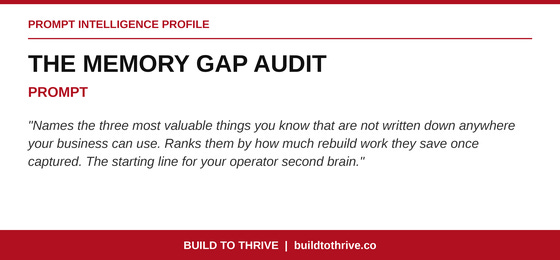
What valuable thinking patterns did I use in my recent work that I haven’t documented yet, and which ones should I capture first so I don’t have to figure them out again?
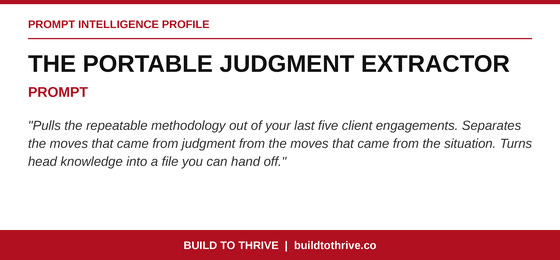
Look across five client projects, separate what was just context from what was actually my repeatable judgment, and turn the recurring parts into a practical step-by-step method I can reuse
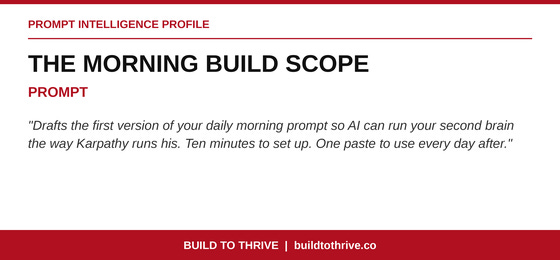
Write me a short daily AI briefing prompt that reviews my system, reminds me what’s unfinished, and tells me the most important thing to do today.

If you do one thing this week, build your operator second brain. Ten minutes of setup. Ten minutes every morning after that. By next Friday your business stops forgetting.
Here is the exact system I run. It is eight files, one morning prompt, and a workspace inside Claude or ChatGPT that reads all of them every time you start a session.

Create a plain markdown file for each of these eight. No tools to learn. No database to configure. Just text.
Goals and Priorities. What you are building this quarter, the three things that matter most, and the one thing that must happen regardless.
Daily Work Log. One paragraph a day. What you did, what moved, what stalled. Searchable later.
Session Log. A record of every working session with AI or with yourself. The question you were trying to answer and the answer you landed on.
Pending Actions. The live list of open loops. Not a to-do list. A decision queue.
Revenue Log. Every dollar in and every dollar out, tagged by source. The single fastest way to see what is working.
Function Architecture. The eight functions of your business (delivery, marketing, sales, ops, finance, product, people, self), each with current status. Tells you where the weakest link is without guessing.
Brand Voice. What you sound like and what you do not. The file that keeps AI writing in your voice instead of generic advisor voice.
Working Memory. The short-term scratchpad for the week. Everything that is live but not yet filed.

Open your workspace. Paste this as your first instruction:
"Read the eight files in this workspace. Tell me what I worked on yesterday, what is open, what the single most important thing to do today is, and one thing I am likely to miss. Keep it under 300 words. Direct, operator voice, no motivation language."
Save it. That is your morning prompt.

Go to claude.ai, create a Project called "Operator Second Brain," drag the eight files in, and run the morning prompt. Update the Daily Work Log and the Pending Actions file before you close the session. By day five, the prompt is reading your own history back to you and telling you what to do with it.
The reason this matters more than anything else you could do this week: every other move depends on this one. The repositioning conversation, the fractional offer, the proposal rewrite, the LinkedIn headline change. All of them assume you can retrieve your own work on demand. If you cannot, every next move rebuilds from scratch. Updating what you do is easier than updating who you believe you are. Updating what your business can remember is how you start closing the lag.
8 AI Business Models That Didn't Exist Two Years Ago.

Two years ago, if you described a company that charges per task completed instead of per employee hired, replaces an entire department with a software workflow, and reaches $250 million in annual revenue with fewer than 50 people, you would have been writing science fiction.

Claude Projects -- A private workspace for your expertise
What it is: Claude Projects is a feature inside Claude.ai that lets you create a persistent workspace where you upload your own documents, templates, past proposals, and frameworks. Claude reads that material as context for every conversation inside the project. You get answers built on your own history instead of generic advice.
How to use it: Go to claude.ai, click "Projects" in the left sidebar, and create a new project called "Operator Second Brain." Drop in the eight files from the Leverage section (or download the starter pack in the Premium section below). Save the morning prompt as the project's custom instructions. Run the prompt once. Then run it again tomorrow.
Why it matters this week: This is the workspace the whole Leverage build runs on. Free tier is enough to start. Paid tier raises the file limit when you outgrow it. The second brain you build inside it travels with you to every client engagement from here forward. And with Anthropic launching Managed Agents on top of the same platform this week, anything you build inside Projects is already sitting on the runway the rest of the market is about to land on.

You just read the system. Eight files, one morning prompt, a workspace that reads your history back to you every morning. You know what to build.
Here is what takes most people out: the blank page.
They open a new file called “Goals and Priorities” and stare at it. They write something vague. They move to “Function Architecture” and realize they don’t know what the eight functions are or how to fill them in. By file four they close the tab and tell themselves they’ll come back to it this weekend. They don’t.
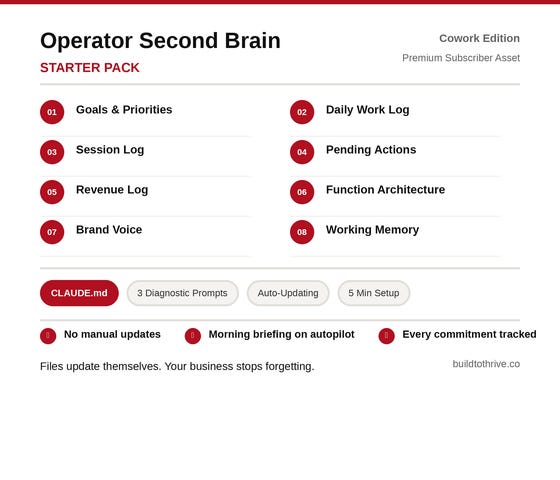
The Operator Second Brain Starter Pack removes the blank page. Every file has the headers, the structure, the example entries, and the format already built. You open it, replace the examples with your own lines, and you’re running. Ten minutes, not ten days.
What’s inside: 8 pre-built memory files with headers, structure, and real example entries. The morning prompt, ready to paste. A README walkthrough that takes you from download to first morning briefing in under ten minutes. And for Cowork users, the CLAUDE.md orchestration file that makes the whole system automatic.
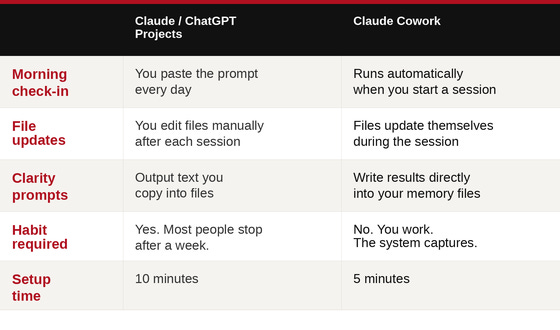
Both versions are included in the Starter Pack. Start with Projects if that’s what you have. Move to Cowork when you’re ready for the system to run itself.
This is the system I run to operate Build to Thrive. Same files, same structure, same morning prompt. The only difference is yours will have your business inside it instead of mine.