


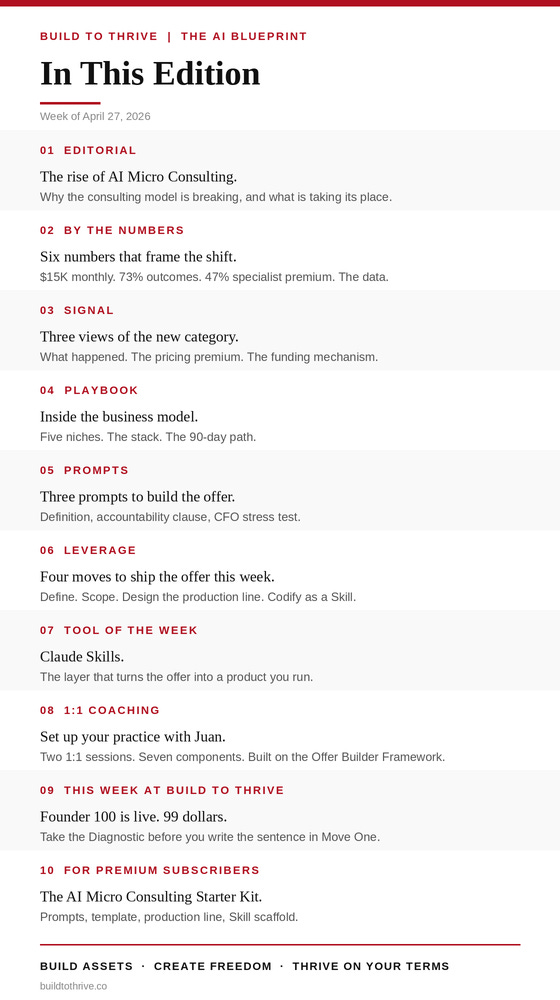
EDITORIAL
The rise of AI Micro Consulting
For years, a consultant’s price was measured in hours. The rate card said ten days of discovery, three weeks of analysis, a deliverable at the end. But what the client actually bought was time. The invoice was time. The scope doc was time. The risk conversation with procurement was time. And the way a consultant scaled was by selling more of it, either by raising the rate or by hiring bodies to bill at a margin.
That model is breaking. A new one is taking its place, and it has a name.
AI Micro Consulting. Bounded engagement. Forty-eight hours from yes to delivery. Priced between $750 and $1,500 per engagement. Scaling to $8,000 to $15,000 a month on fifteen to twenty hours of work a week. Seventy-three percent of clients in this category now prefer outcome-based pricing over hourly rates.
The market has the name, the pricing floor, and the delivery structure all at the same time. That almost never happens.
Read against everything else moving this month, the signals converge.
Meta’s April layoffs named middle management as the target layer, with proprietary agents now handling 70 percent of routine coding and administrative work. The AI skills premium has shifted from technical (a 10 to 12 percent generalist premium that is compressing) to judgment (a 35 to 47 percent specialist premium that is holding). General Counsel just became an AI buyer with a December deadline. And the macro labor environment is what the St. Louis Fed now calls low-fire, low-hire, which means a CFO cannot approve a permanent hire but can approve a project expense.
Every one of those signals points to the same offer shape. Small. Bounded. Outcome-accountable. Priced as judgment. Repeatable.
AI Micro Consulting is the operator’s answer to all of it.
I covered this in last week’s piece on AI business models, alongside seven others worth knowing. If you missed it, the full list is here.
Naming the shift is the easy part. Building the offer is where most operators get stuck. So this edition is structured to take you from concept to construction, in that order. We will dive into this business so you can launch or improve this business model.
Enjoy it!
Juan

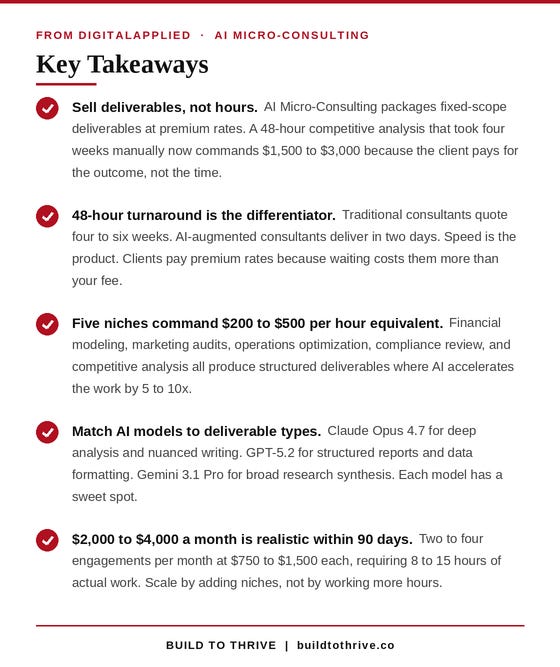

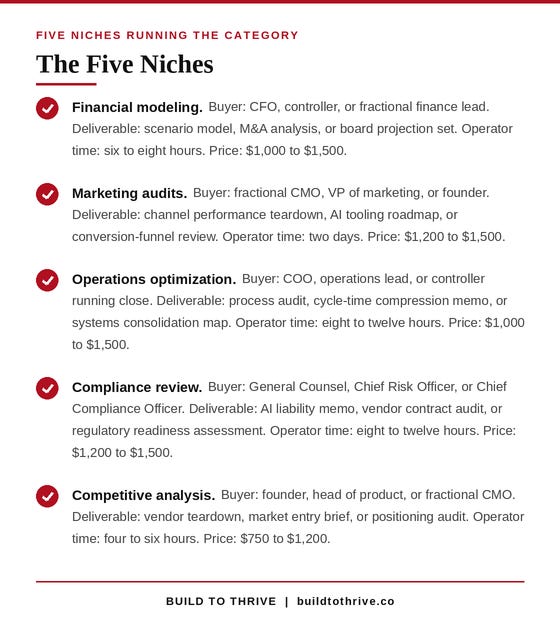
AI micro-consulting are short, high-value engagements where one operator pairs domain expertise with AI tools to deliver in 48 hours what previously required a team working two weeks. A competitive analysis that took three analysts two weeks can now be completed in four to six hours by one person using current AI tools. Income benchmarks named for the first time in a single piece: 750 to 1,500 dollars per engagement, two to four engagements per month realistic within ninety days, 8,000 to 15,000 per month within eighteen to twenty-four months working fifteen to twenty hours per week. The model scales through better templates, higher prices, and repeat clients. Not more hours.
Five niches commanding 200 to 500 dollar per hour equivalent: financial modeling, marketing audits, operations optimization, compliance review, and competitive analysis. 73 percent of clients now prefer measurable outcomes over hourly rates. Source: DigitalApplied, “AI Micro-Consulting: Premium Rates, Solo Practice,” April 2026.
What it means for professionals and business owners: The category now has a name, a pricing floor, and a delivery structure at the same time. That almost never happens in a new service market, and when it does, the window to establish yourself inside it closes faster than most people notice. The 48-hour engagement is not a smaller version of a consulting project. It is a product. Which means the unit economics change completely. You are not pricing eight hours of prompting. You are pricing the fact that the deliverable is judged, not drafted. You are not scoping a discovery phase, a development phase, and a handoff. You are scoping a single bounded outcome with a regulatory or commercial deadline, and your production method is what compresses the work from two weeks to two days. This is the first offer format since the subscription software bundle where the operator’s margin comes from how good the template is, not how many hours they can put on the invoice. Most of my audience has the expertise for three to five of these offers already sitting in their past work. What they do not have is the one-page product definition, the pricing clause, and the outcome language that turns expertise into something a client can say yes to in one email.

The 2026 compensation surveys from Ravio and Korn Ferry show the generalist AI salary premium compressing to 10 to 12 percent, while the specialist premium (custom LLM, governance, implementation advisory) holds at 35 to 47 percent. The same bifurcation shows up across independent markets. Consulting pricing: generalist AI advisors at 120 to 250 dollars per hour, senior specialists at 200 to 500-plus. Fractional Chief AI Officer retainers now cataloged at 15,000 to 40,000 dollars per month. And a widely-quoted WEF Workforce Transformation and Gloat AI Workforce Trends 2026 framing this month states it directly: “The premium has decisively shifted from technical AI skills toward orchestration, integration, and judgment. Companies are not struggling to find people who can use AI tools. They are struggling to find people who can direct AI systems, evaluate their outputs, and make decisions the AI cannot.” Source: Ravio 2026, Korn Ferry, Curominds/Lightcast, WEF/Gloat 2026, Groovyweb, Hyperion Consulting, April 2026.
What it means for professionals and business owners: The 48-hour offer only works because the underlying pricing is bifurcating. If the market still paid a flat 150 dollars per hour for “AI help,” you could not deliver a bounded engagement for 750 to 1,500 dollars and run a business. The math works because the market pays a five-times premium for outcomes over time, and the operator who packages a 48-hour deliverable is effectively converting one hour of judgment into five hours of billable equivalent. This is why the five named micro-consulting niches (financial modeling, marketing audits, ops optimization, compliance review, competitive analysis) all live at the specialist end of the bifurcation. They are not “generic AI.” They are “domain expertise applied through AI tools to produce a decision the client cannot make without you.” The premium is holding because the judgment is holding. Your job is not to compete at the generalist end. Your job is to name the judgment you sell, price it at the specialist floor, and run the offer against one client this month to prove the math works in your own practice.

The mechanism that turns AI-driven restructuring into fractional demand is now named. Federal Reserve Vice Chair Philip Jefferson, in an April 7 speech, described the labor market as a sustained “low-firing, low-hiring” environment. The St. Louis Fed published a March analysis confirming the pattern. The Dallas Fed’s data shows the breakeven rate of employment growth turned negative last summer, meaning the economy can shed jobs without lifting unemployment. Meanwhile Meta confirmed roughly 700 April layoffs targeting middle management, QA, customer support, and internal IT. Microsoft set an internal 10 to 1 engineer-to-manager target. Q1 2026 tech layoffs hit 52,050, up 40 percent year over year, with 20.4 percent of cuts explicitly AI-linked. LinkedIn fractional job postings are up more than 400 percent since 2022. Gartner forecasts 30 percent of midsize enterprises will retain at least one fractional executive by 2027. Source: Federal Reserve Board, St. Louis Fed, Dallas Fed, Storyboard18, Challenger March 2026 Report, LinkedIn Economic Graph, Gartner, April 2026.
What it means for professionals and business owners: The 48-hour offer is the exact shape of work a CFO can approve in this environment. In a low-fire, low-hire labor market, the permanent senior hire is off the table. The committee that would have signed off on a 180,000 dollar full-time role cannot reconvene for six months. But the same CFO can approve a four-week project expense without touching headcount. That is the mechanism. And the 48-hour engagement is the lightest possible version of it, which means it is also the easiest to approve. Your offer is not competing against other consultants. Your offer is competing against the empty chair. It wins because it costs less than a week of the salary that chair would have carried, it delivers an outcome the company cannot get internally because the middle-management role that used to hold that judgment is either gone or about to be, and it reads on the P&L as a project line item instead of a personnel line item. The pricing works because the market pays a premium for judgment. The category works because the money is already sitting in the operating-expense budget. The only missing piece is the operator who has written the offer down and sent it.

Three prompts you can paste directly into Claude or ChatGPT to build your 48-hour offer this week. Each one links to its full page in the Prompt Library.

The 48-Hour Offer Definition Prompt Takes your work history and one past client you know well, and returns a one-sentence offer definition that names the specific deliverable, the specific buyer, the specific outcome, and the specific judgment they are paying for. Rewrites the sentence five ways until it is tight enough to put on a product page. The starting point for every offer component below.

The Outcome Accountability Clause Generates the clause you put at the bottom of your one-page offer that names what you stand behind in writing. Turns “we will deliver a report” into “you will leave this engagement able to make the following three decisions you cannot make today.” The language that justifies 1,500 dollars for 48 hours instead of 150 dollars for an hour.

The Offer Stress Test Walks through your one-page offer as a CFO would read it. Returns the three questions the buyer will have that are not yet answered, the two lines that read like consulting jargon, and the one sentence that must be rewritten before you send it. A final pass before the offer leaves your desk.

Build the 48-hour offer this week. Four moves. Each one in a single working block. By Friday you have a product page, a pricing clause, an intake-to-delivery sequence, and a repeatable version of the whole thing that you can run again next week without rebuilding it from scratch.

Thirty minutes. Pick one past client or one past employer whose business you know the way you know your own. Write a single sentence that names the 48-hour deliverable you could produce for them. Not a service category. Not a phase. The deliverable. “A forty-eight-hour competitive teardown of their top three vendor proposals that ends with a priced recommendation memo.” “A forty-eight-hour operational audit of their quarter-close process that names the three cycle-time compressions their controller can ship before May.” “A forty-eight-hour AI liability memo that maps their exposure under the December EU deadline and names the first three vendor contracts to audit.” Specific deliverable, specific buyer, specific outcome. If you cannot get it into one sentence in thirty minutes, the expertise is still diffuse. Keep rewriting until a CFO who has never met you could read the sentence once and know whether it fits their next quarter.

Forty-five minutes. One page. No bullet lists. Four paragraphs. Paragraph one is the sentence from Move One, expanded into three sentences that name the client’s problem, the deliverable they walk away with, and the decision the deliverable enables. Paragraph two is your method: the three or four things you will do in the 48 hours, named at the level of outcome, not process. Paragraph three is the timeline and price: kickoff Monday morning, delivery Wednesday end of day, 1,500 dollars invoiced on signature, payable against Stripe or wire. Paragraph four is the outcome accountability clause from Clarity prompt two, in your voice, in writing. That is the product page. It goes on your website, in a PDF attachment, and in the second email after someone replies to your cold message.

Forty-five minutes. Now design the production side of the offer. Five components. The intake questionnaire the client fills out before you start (ten questions, takes them fifteen minutes, gives you eighty percent of what you need). The hour-zero kickoff call script (thirty minutes, confirms the scope, names the decision the deliverable will enable). The production template for the deliverable itself (the document skeleton, the analysis steps, the review checklist). The delivery call script (thirty minutes, walks the client through the deliverable, names the three decisions they can now make). The follow-up email template sent seven days later that converts the engagement into either a second 48-hour project or a four-week retainer. Those five components are the production line. They are what make the margin work. Without them you are selling time. With them you are selling a product.

Sixty minutes. This is where most operators stop, because they finish Move Three and treat the offer as a set of Google Docs to open every time a new engagement starts. That is the generalist model. The specialist model is to turn the offer into a Skill you run. See Tool of the Week below for the mechanics. In short: take the five components from Move Three, turn them into a single Skill file Claude can read, and install the Skill so that typing /run-offer-name inside Claude Cowork or Claude Code triggers the intake, sets up the production template, schedules the kickoff questions, and starts the first analysis step. From that point forward, every new engagement starts at five minutes in, not two hours in. That is how the 8,000 to 15,000 dollar per month math actually works. Not more hours. Better templates. The Skill is the template in executable form.
By Friday you have a product page, a pricing clause, a production line, and a repeatable version of the whole thing. The first time you run the offer, it takes 48 hours because that is the scope. The tenth time you run it, it still takes 48 hours for the client, but your side is compressed to twelve, because the Skill does the first pass. That is the gap between a consultant and an operator. Consultants sell hours. Operators sell products.

Claude Skills
The layer that turns your offer into a product you run instead of a document you rewrite.
What it is: Claude Skills are reusable capabilities you build once and deploy across every Project, Cowork session, or agentic run. A Skill is a folder containing instructions, examples, reference files, and optionally scripts. Claude loads the Skill when a relevant trigger fires (a /command, a project type, a matching task), reads the instructions the same way a new team member reads an onboarding document, and produces output aligned with your methodology instead of generic defaults. Ruben Hassid’s April 1st primer on How to AI walked the end-to-end setup for non-technical operators using the skill-creator feature inside Claude Cowork. The whole thing takes thirty minutes the first time and five minutes every time after.
Who it is for: The operator who just finished Move Three above and has five Google Docs defining their production line. The consultant who runs the same three or four engagement types repeatedly and rebuilds the scaffolding every time. The fractional executive who wants the intake-to-delivery sequence to run the same way whether the client is a financial services firm on Tuesday or a healthcare provider on Thursday. The advisor whose margin on the 48-hour offer depends on the second engagement taking half as long as the first.
How to use it right now: Open Claude Cowork. Type /create-skill. Point it at the folder where your Move Three components live: the intake questionnaire, the kickoff script, the production template, the delivery script, the follow-up email. Name the skill after the offer (competitive-teardown, ops-audit-48, ai-liability-memo). Add a description that names when to trigger it (”when the user wants to run a 48-hour competitive teardown”). Save. The Skill is now callable from any Claude session with a single command. The first engagement you run with it, you will feel the friction of the Skill learning your actual workflow. The second engagement, you will feel the friction drop. By the fifth engagement, the Skill is running the production line and you are doing the judgment work.
Why it matters: Every other move in this issue assumes you treat the offer as a product. Skills are how the offer actually behaves like a product. Without this step, you have designed a better version of consulting. With this step, you have the first repeatable 48-hour engagement in your practice, which is the exact threshold that separates the 750-dollar-per-engagement operator from the 15,000-dollar-per-month operator. The math is not in the rate. The math is in the repetition. Skills are how repetition stops costing you hours.
FEATURED ARTICLE

How I Build my AI Chief of Staff that runs on $20.mont

1:1 coaching to setup your Micro-Consulting practice.

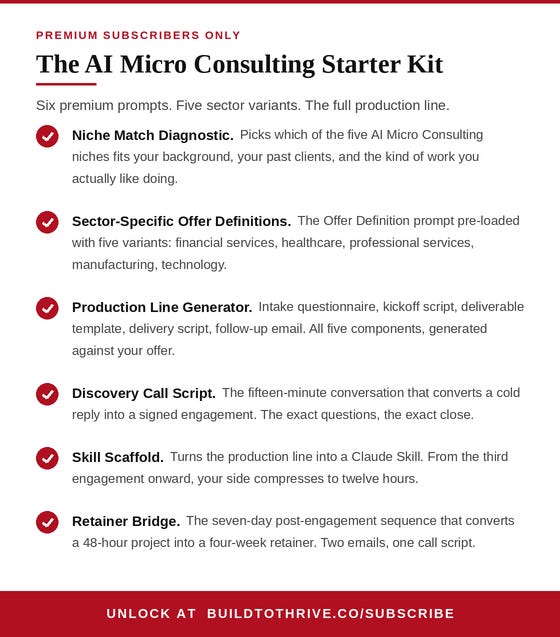
Here is your premium Micro-Consulting Kit