


Editorial note
Hello folks,
I’ve had a quiet realization this week.
A lot of capable solo operators are still building their businesses like it’s 2022.
They hire freelancers for first drafts. They pay someone to clean up decks. They outsource research summaries. They forward notes to a VA to “turn into something.” It feels responsible. Delegation equals growth. That’s what we were taught.
But the ground shifted.
The kind of work we used to rent is no longer scarce. It’s infrastructure. Fast copy. Decent analysis. Clean formatting. Basic follow-ups. That’s table stakes now. Anyone with a halfway decent system can produce it on demand.
So when you keep renting that layer, two things happen.
First, your margins thin for work that no longer differentiates you.
Second, and more dangerously, you give away the repetition that teaches you. The small loops. The translation from messy notes to clear action. The refinement from version one to version five. That’s where judgment sharpens. That’s where edge compounds.
What changed isn’t that AI can “help.”
What changed is that execution can be internalized.
If you design your work so inputs turn into outputs through a repeatable loop, with simple checks for quality, you stop babysitting tasks. You start supervising systems. And every cycle improves the next one because you own it.
This doesn’t mean internalize everything. Judgment, relationships, liability, taste, those still matter. But repeatable glue work? That used to require payroll.
Now it requires architecture.
The solo advantage isn’t working more hours.
It’s closing more loops per week.
And the person who owns the loop keeps the compounding.
JS
—🔴—🔴—🔴
Build to Thrive Launches First Workshop
Turning your Experience into Income
Build to Thrive presents a 90-minute live workshop hosted by Juan Salas-Romer and led by Fractional COO Katie Barnes to help experienced professionals navigate AI-driven shifts in work. As fractional roles surge and job security erodes, this session helps you clarify your value beyond titles and translate your experience into a clear, buyer-facing problem-and-outcome statement.
—🔴—🔴—🔴
Table of Contents
Clarity Prompts
AI Verification Coach
SpaceTech Intelligence and Investor Lens
Strategic Sparring Partner
Featured Articles
Stop Renting Labor: Why “Owning the AI Loop” Is the New Solo Competitive Advantage
Where AI Agents End and Human Judgment Begins: The Future of Work in an Agent-Driven World
Build to Thrive Live
The Case for Going Fractional Series - The Fractional CFO
AI Strategic Terrain (30 day edition)
A practical, operator-focused take on how AI is reshaping operating models and competitive advantage.
Paid Subscribers Prompt:
Innovation Industry Intelligence and Investor Lens
—🔴—🔴—🔴
CLARITY PROMPTS
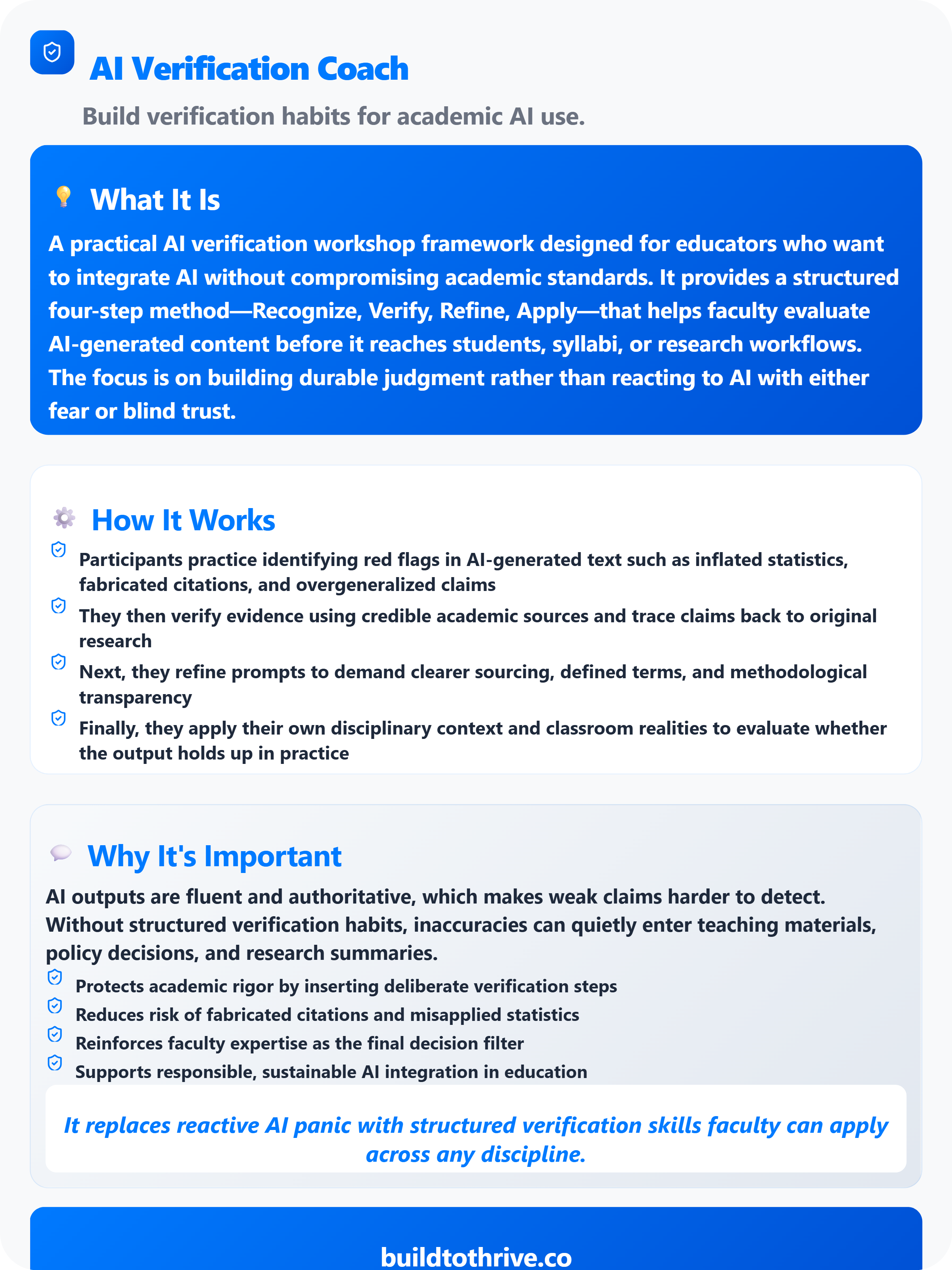
AI VERIFICATION COACH
By Tawnya Means
The Collaboration Chronicle: Human+AI in Education is a signal-driven newsletter focused on how artificial intelligence and human creativity intersect inside real classrooms and institutions. It cuts through AI hype and fear-based reactions to examine how educators can integrate intelligent tools thoughtfully, strategically, and without losing the human heart of teaching.
In an education landscape facing its most significant shift since the printing press, The Collaboration Chronicle stands out by treating AI adoption as a leadership challenge, not just a technology trend. If you care about shaping how AI transforms learning, preserving core educational values, and building institutions where human+AI collaboration strengthens rather than replaces human wisdom, this is a perspective worth following.
—🔴
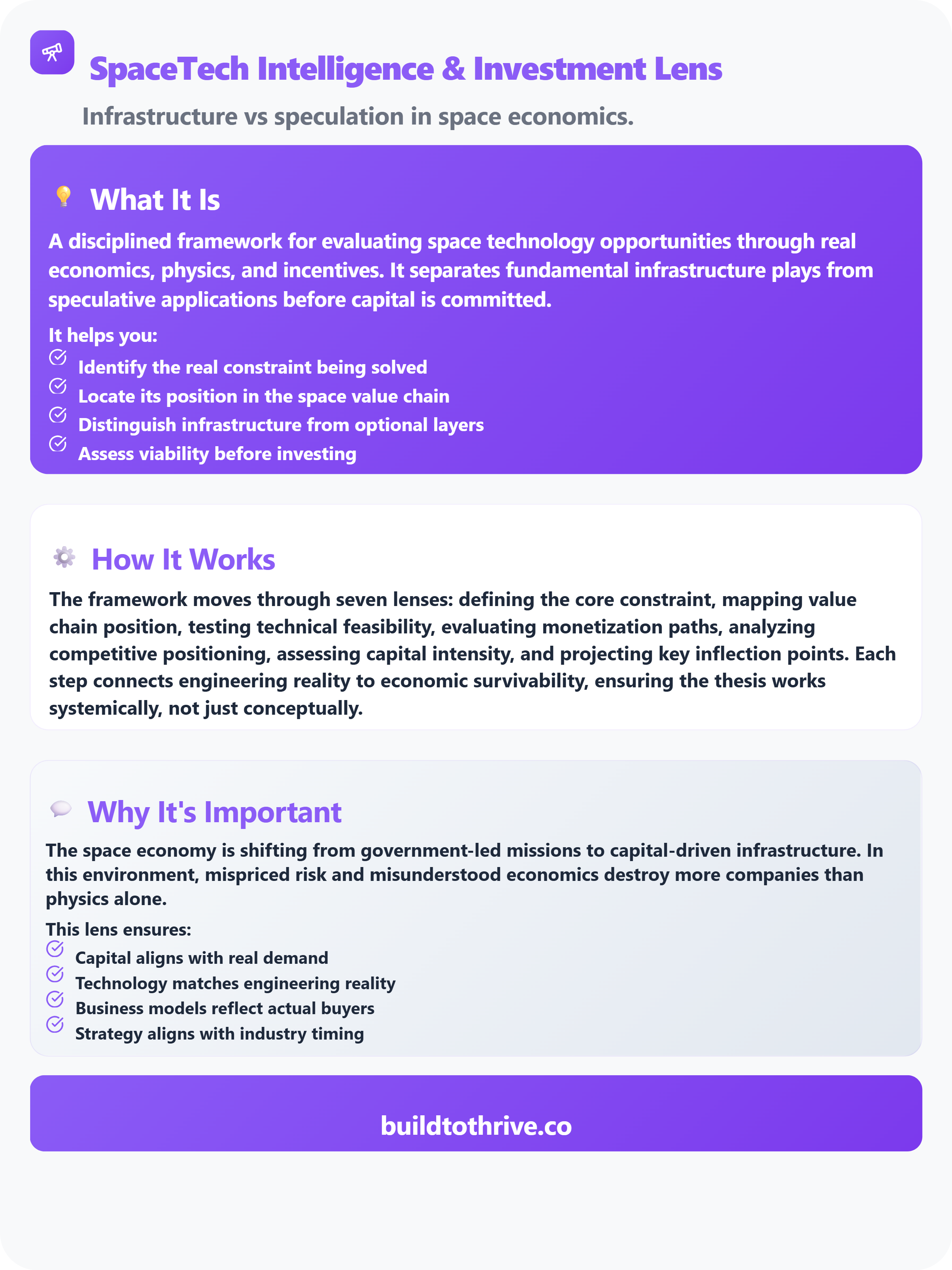
SPACE TECH INTELLIGENCE AND INVESTMENT LENS
Cyclop SpaceTech is a signal-driven newsletter focused on the technologies, companies, markets, and capital flows shaping the future of the space economy. It cuts through speculative headlines and surface-level excitement to deliver structured analysis of space infrastructure, satellite ecosystems, launch economics, emerging commercial markets, and the real numbers behind both public and private players.
In a sector often dominated by hype cycles and visionary narratives, Cyclop SpaceTech stands out for its balanced, research-backed perspective across the entire ecosystem, from early-stage startups to publicly traded giants. If you care about where space technology is actually heading, how new markets are forming, and which companies and trends will define the next era of orbital infrastructure and commercialization, this is a perspective worth following
—🔴
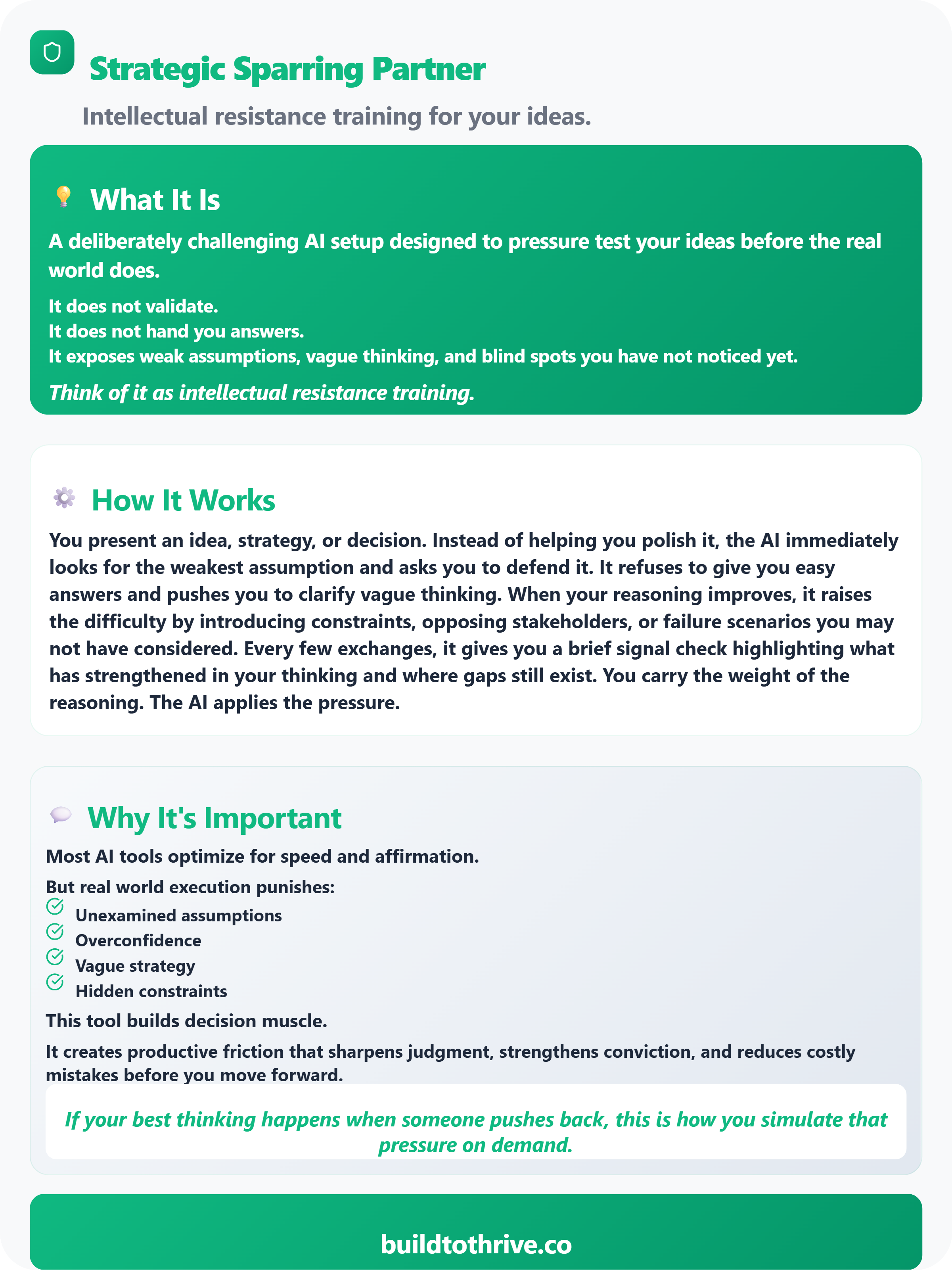
STRATEGIC SPARRING PARTNER
By Mike Kentz
How We Frame Machines is a signal-driven newsletter focused on how education systems can adapt thoughtfully and effectively in an AI-dominated world. It cuts through panic-driven reactions and shallow tech enthusiasm to explore practical strategies, classroom experimentation, and forward-looking ideas that help teachers and institutions integrate artificial intelligence without losing educational purpose.
In a moment when both education and AI are reshaping society simultaneously, How We Frame Machines stands out by treating AI integration as a pedagogical and human challenge, not just a technological one. If you care about preparing students for a world of human+AI collaboration and want grounded insight into how schools can evolve without abandoning their core mission, this is a perspective worth following.
—🔴—🔴—🔴
Build to Thrive Live: The Case for Going Fractional - The Fractional CFO
The Case for going Fractional Series - The Fractional CFO
In this session from “The Case for Going Fractional” series, Katie and I were joined by Ryan Gaines (Fractional CFO, N6 Finance). Together, we explored the rapid rise of fractional work, how professionals can transition into fractional roles, and how founders can strategically hire and integrate fractional talent in an AI-driven economy.

—🔴—🔴—🔴
Featured Articles
Where AI Agents End and Human Judgment Begins: The Future of Work in an Agent-Driven World
Stop Renting Labor: Why “Owning the AI Loop” Is the New Solo Competitive Advantage


—🔴—🔴—🔴
Strategic Terrain
A practical, operator-focused take on how AI is reshaping operating models and competitive advantage.
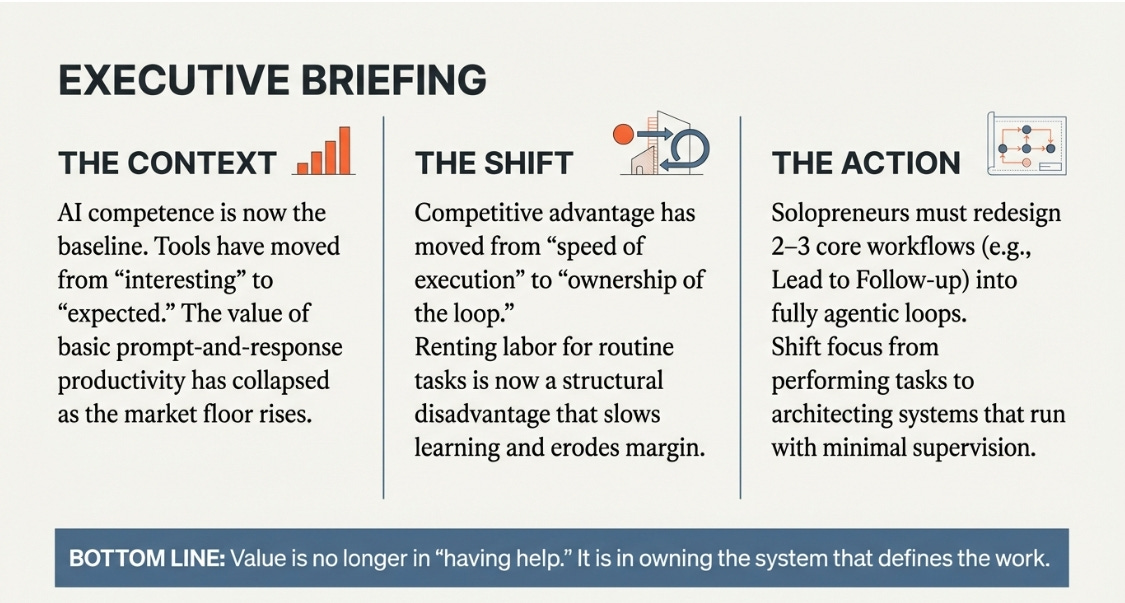
In the last 30 days, the big change is this: AI agents moved from “interesting” to “expected,” not because the tools got cute, but because the winning move is now to rebuild your workflow so AI can run multi-step loops end to end.
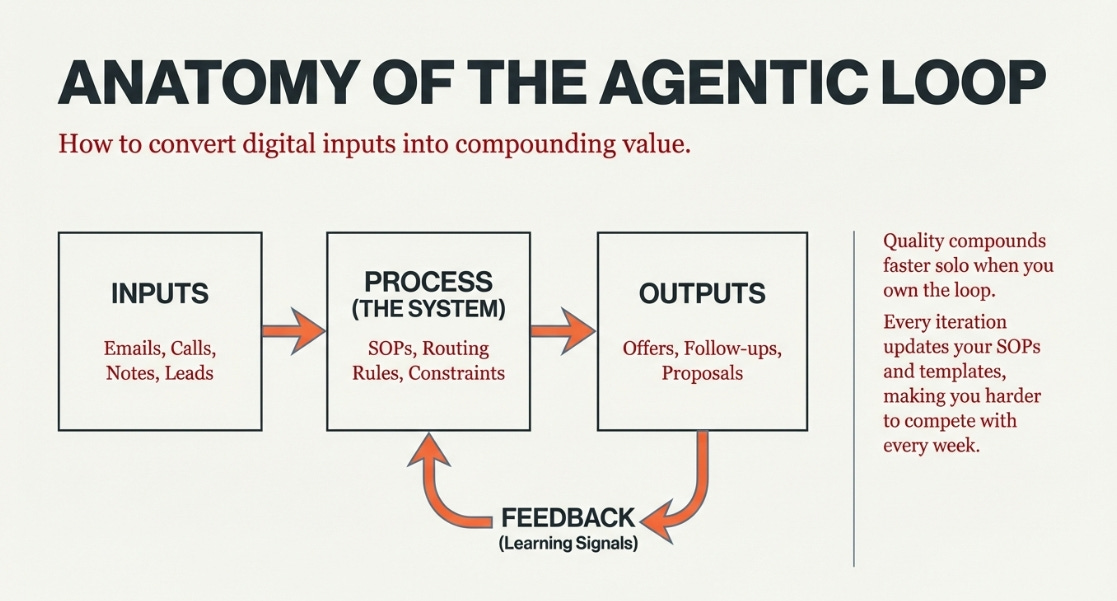
Table stakes now are fast, cheap first drafts, summaries, and basic analysis. The new edge is owning the loop: tight feedback, reusable SOPs, and a small set of always-on automations that turn raw inputs (calls, emails, notes, leads) into outputs (offers, follow-ups, content, proposals) without you touching every step.
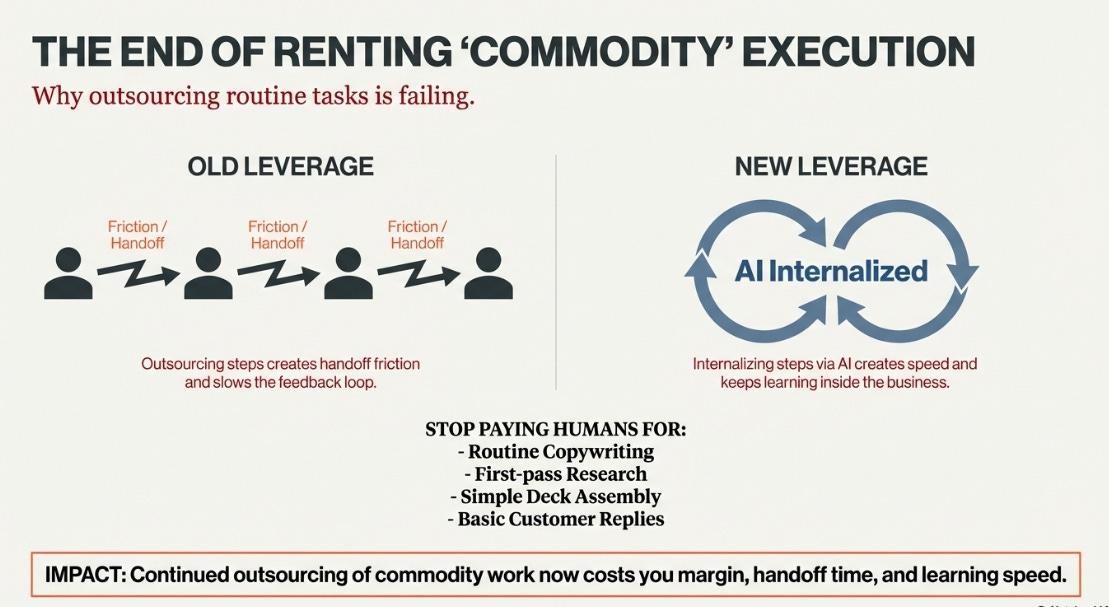
What solopreneurs are still overpaying humans to do, and no longer getting advantage from: routine copywriting, first-pass research, simple deck assembly, basic customer replies, and “keeping the queue moving.” Those are collapsing into commodity work. Delay costs you because it slows your learning loop while the execution baseline rises.
Strategic Signals
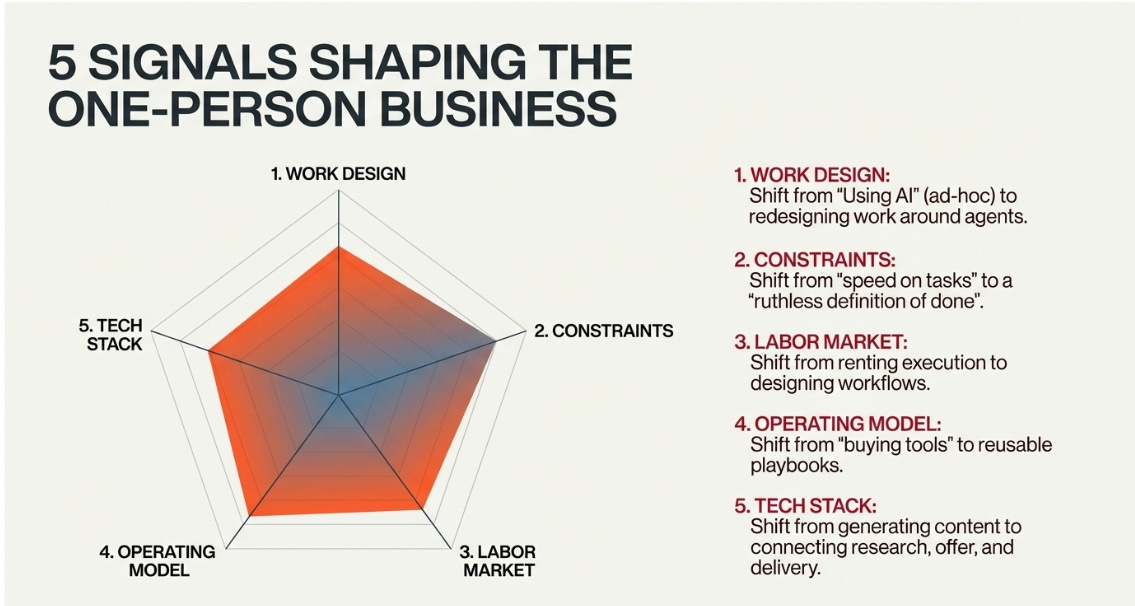
Shift: “Using AI” is not the differentiator anymore. Redesigning your work around agents is. What got commoditized is prompt-and-response productivity. What is scarce now is workflows that let AI initiate, route, check, and ship with minimal supervision. Solo impact: fewer paid hours to keep things moving, more finished output per week.
Shift: AI does not automatically free time. It intensifies work unless you set constraints. What got commoditized is speed on tasks. What is scarce now is boundaries and a ruthless definition of “done” so you do not generate infinite options. Solo impact: more shipped deliverables and fewer half-finished branches.
Shift: The labor market is reacting to AI expectations, even when ROI is uneven. What got commoditized is entry-level execution and basic queue-handling. What is scarce now is the operator who can design and supervise AI-assisted workflows with measurement. Solo impact: you can stop renting basic execution and reallocate budget to distribution and acquisition.
Shift: Most AI efforts miss value unless the operating model changes. What got commoditized is buying tools and hoping. What is scarce now is disciplined experimentation and reusable playbooks. Solo impact: fewer tool rabbit holes, more compounding systems you reuse weekly.
Shift: The one-person business stack is more complete, and more punishing if you treat it like a toy. What got commoditized is “I can generate content.” What is scarce now is connecting research to offer to follow-up to delivery into one loop that runs daily. Solo impact: faster response to demand signals and fewer dropped leads.
Why It Matters
AI competence is now assumed at solo scale. Nobody cares that you used a tool. They care that you respond faster, personalize better, and ship reliably. The baseline rose. Advantage moved from “having help” to owning the loop: inputs to decisions to outputs to feedback, so every week you get harder to compete with.
Renting labor is structurally inferior to owning execution when the work is repeatable. If you keep outsourcing commodity steps, you lose margin and you lose learning signals that train your system and your judgment. Meanwhile, AI tends to intensify work unless you intentionally design limits, which punishes operators who “add AI” without redesigning how they operate.
Competitive Advantage Shifts
Commoditized: first drafts, summaries, basic research, routine customer responses, simple analysis, and assembly work like decks and cleanup.
Scarce: clean reusable workflows agents can run, tight feedback loops that improve outputs weekly, and decision rules that prevent option-sprawl.
Winner behavior over the next 30 to 90 days: stop “using AI sometimes” and install two or three always-on loops (lead to follow-up, content to distribution, delivery to retention) with measurement. Loser behavior: keep paying people to push commodity tasks through a pipeline AI can already handle, then fall behind on speed and learning.
How It Affects Solopreneurs
Your leverage expanded most where the inputs are already digital: emails, calls, notes, proposals, FAQs, lead lists, and content. But compounding only happens if you convert that work into a repeatable loop. Otherwise you just generate more “stuff.”
Quality compounds faster solo when you own the loop because every iteration updates your SOPs, templates, routing rules, and evaluation criteria. Continued outsourcing now costs you margin, handoff time, and learning speed. Keep paying humans where judgment, taste, relationships, or liability dominate. Internalize the repeatable parts into your system.
Top Terrain Reads of the Last 30 Days
AI Doesn’t Reduce Work, It Intensifies It
Source: Harvard Business ReviewIs Your Workplace Set Up for AI Agents?
Source: Harvard Business ReviewCompanies Are Laying Off Workers Because of AI’s Potential, Not Its Performance
Source: Harvard Business Review9 Trends Shaping Work in 2026 and Beyond
Source: Harvard Business Review7 AI Tools That Run a One-Person Business in 2026
Source: Entrepreneur
Pause and Reflect
What are you paying a human to do each week that an agent loop could do at 80 to 90 percent quality, and what would you ship if that work ran daily instead of “when someone gets to it”?
If your workload is intensifying, what is your definition of done and your stop rule so AI creates finished outputs instead of infinite options?
—🔴—🔴—🔴
PAID SUBSCRIBERS PROMPT
INNOVATION INDUSTRY INTELLIGENCE & INVESTOR LENS
Adapted for Build to Thrive with the consent and review of Matej Pretković
This is a innovation industry prompt that forces you to think like an investor. The prompt makes you slow down and ask the uncomfortable questions. What real bottleneck is being solved? Who actually pays for this? Where does it sit in the value chain? How capital-intensive is it? What has to go right for this to scale?
The benefit is clarity.
You stop confusing innovation with viability.
You start seeing where risk actually lives.
You understand timing, incentives, and structural constraints.
Whether you’re a founder testing your own idea or an investor evaluating someone else’s, it helps you separate signal from noise and make decisions grounded in reality, not momentum.
Click below to access the prompt.
