


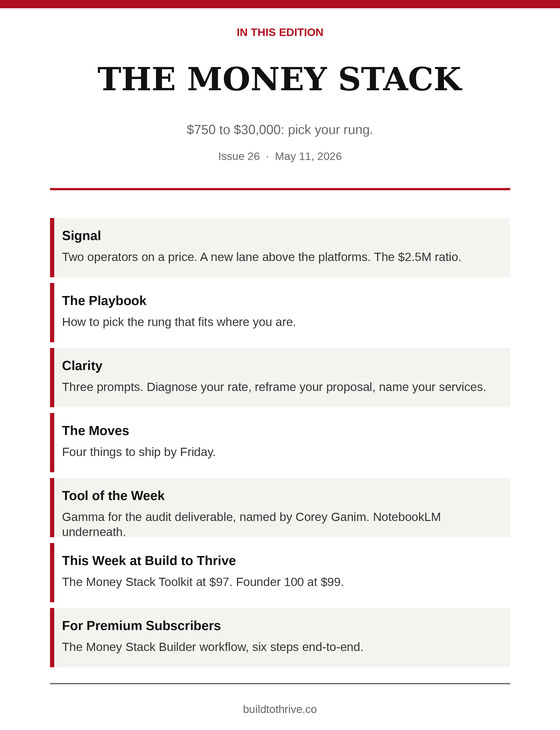
Editorial
The Money Stack
I have been researching the new AI business models — practices that did not exist two years ago and now have real revenue, real buyers, and real operator demand. The broader exploration is here. Last week’s piece on AI Micro Consulting was one rung of it. This issue walks the full ladder: three rungs operators are charging for AI services in May 2026.
If you are running your own engagements, this issue names the rung you grow into next. If you are starting to package your expertise as a fractional or independent professional, the ladder is your menu. If you are inside a corporate role watching AI shift the work around you, the same ladder maps what your experience would price at on the outside.
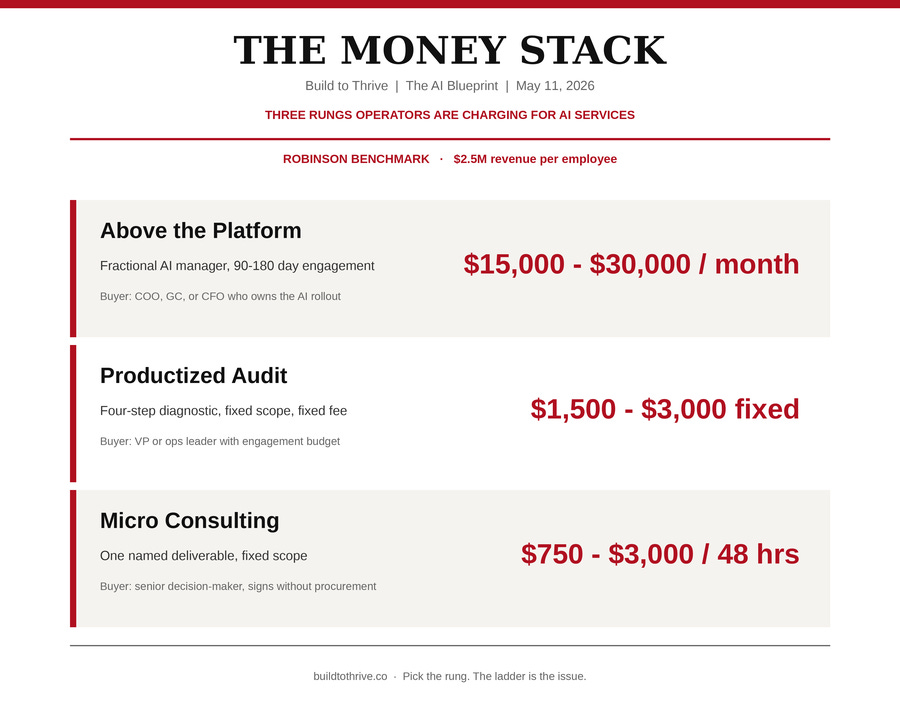
Rung One: The AI Micro Consultant. Ten-plus years of expertise in one function. 48-hour engagements at $750 to $3,000, one named deliverable, signed without procurement. Niches running hot: financial modeling, marketing audits, ops optimization, compliance review, competitive analysis.
Rung Two: The AI Audit. The diagnostic productized. Buyer is the operations leader at a mid-sized company six months into AI deployment, asking what is working. Four-step delivery, $1,500 to $3,000 fixed-fee. Two operators are running this format at the same band this month. The tier is forming.
Rung Three: Above the Platform. Companies signing AI agent platform contracts realize the contract covers the software, not the human who runs it. The operator steps in: 90 to 180 days at $15,000 to $30,000 a month, monitoring the agents, writing the governance, owning what breaks. HBR and Gartner are calling the role the AI Agent Manager or Owner. We will name the practice once the operator voices are clearer to point at.
Pick the rung that fits where you are this week.
Juan
750 to 3,000 dollars. Per-engagement price band for AI Micro Consulting (48-hour, fixed-scope, single-deliverable), per the May 4 Build to Thrive piece on the category. Five named niches at the high end: financial modeling, marketing audits, ops optimization, compliance review, competitive analysis. The entry rung on the stack.
1,500 to 3,000 dollars. Productized AI Audit fixed-fee band. Corey Ganim’s public $1,000 audit ladders to this price tier with the four-step delivery (transcripts to AI analysis to Gamma report to review call). Zephyr named the same band the same week. The middle rung. Operating-stage piece for the operator who has shipped Micro Consulting and is sizing up a recurring engagement.
15,000 to 30,000 dollars per month. The Above the Platform retainer band. The fractional AI manager who runs the agents after the platform ships them, on a 90 to 180 day engagement, plus a 7,500 to 12,500 dollar one-time setup audit before the engagement starts. Backed by Gartner and IDC’s Q2 2026 data showing 56 percent of companies now formally name a person to own their AI agents, up from 11 percent in 2024.
15.8 billion dollars. Sierra’s May 4 fundraise, with 150 million dollars in yearly recurring revenue and roughly half the Fortune 50 already running its AI agents. The platform companies are getting funded like infrastructure. The operator’s lane sits one step above the contract.
1.5 billion dollars. Anthropic’s services partnership with Goldman Sachs and Blackstone, announced May 4 to bring Claude into mid-sized companies in healthcare, finance, manufacturing, retail, real estate, and infrastructure. AI labs are now building consulting arms. Operators outside those six areas have a 12 to 18 month head start in their own domain.
28 million dollars / 11 people. Adam Robinson’s combined yearly revenue across Retention.com and RB2B, against the size of his team. Roughly 2.5 million dollars per employee. Not a target to chase. A benchmark to measure your own work against, so you know how high the ladder actually goes.
SIGNAL

What happened. Two independent operator-tier voices named the productized AI audit tier at the same price band in the same week. Corey Ganim walked his $1,000 audit pitch publicly on the Niche Pursuits podcast with host Chris Koerner: the four-step delivery template, the live demo of his AI voice interviewer “Annie” (built with Retell), the real assessment walkthrough in Gamma, the pricing journey from free to $1,000, and the full upsell menu. He also ships a free audit template on Kit and the open audittemplate.ai reference. The product itself is open source. The judgment around it is the moat. Zephyr named the same productized audit category at 1,500 to 3,000 dollars per engagement that same week, then walked the upsell path: charge for the audit, fix the broken workflows for an additional fee. Two operators, two different formats, same price band, same month.
What it means. Productized Audits are the rung above Micro Consulting on the money stack. The Micro Consulting deliverable is one document, scoped to 48 hours, designed to demonstrate competence on a single named problem. The Productized Audit is a structured diagnostic: pull the buyer’s source material, run a defined analysis, produce a multi-section report, deliver on a review call. Same operator. Bigger ticket. The operator who has shipped two or three Micro Consulting engagements has the credibility to walk into the audit conversation. The audit is the bridge from project work to recurring revenue, because the audit ends with a recommendation the buyer pays you to implement.
What I am observing. The pattern showing up in operator pipelines this month is the transition from Micro Consulting to the Productized Audit. Operators with two or three Micro Consulting engagements under their belt are productizing the audit version of the same work (four-step delivery, fixed scope, fixed fee at 1,500 to 3,000 dollars, Gamma report as the deliverable) and sending it to existing clients as the renewal. Corey Ganim has walked this exact pattern publicly. The transition from project to retainer starts at the renewal conversation, not at a cold outreach.

What happened. On May 4, Sierra closed 950 million dollars at a 15.8 billion valuation, with 150 million in yearly recurring revenue and roughly half the Fortune 50 already using its AI agents for customer support, payments, and personalization. The same day, Anthropic announced a 1.5 billion-dollar services joint venture with Goldman Sachs and Blackstone to bring Claude into mid-sized companies in healthcare, finance, manufacturing, retail, real estate, and infrastructure. Two big bets in one week, both pointing at the same thing: enterprise buyers are now signing contracts to put AI agents into their operations.
What it means. When a buyer signs one of these contracts, the contract does not include the human who runs the agent after it is deployed. The SaaS bill covers the software. It does not cover the person who watches what the agent does, fixes what it gets wrong, writes the documentation, and is on the hook when something breaks. That gap is the rung. Operator price band: 15,000 to 30,000 dollars per month for a fractional AI manager on a 90 to 180 day engagement, plus 7,500 to 12,500 dollars for a one-time setup audit before the engagement starts. The pattern showing up across operator pipelines this month is buyers asking for the role explicitly once they have signed the platform contract.
What I am observing. Operators in this lane are pitching the role of running the agents the platform contract does not cover. The language working in real conversations: “The platform ships your agents. I run them, document them, and own the failure modes the contract does not cover.” The Anthropic and Blackstone partnership named six verticals as targets through 2027 (healthcare, financial services, manufacturing, retail, real estate, infrastructure) — operators in those verticals are now running into the JV as a direct competitor and re-positioning around specialist depth. Operators in domains outside the six have a 12 to 18 month structural runway before the lab-services arms reach their lane, per the supply-side signals tracked in the May 5 Content Creator Radar.

What happened. Adam Robinson grew Retention.com to twenty-two million dollars in revenue with six employees. He then built RB2B from zero to five and a half million in yearly recurring revenue in forty weeks, distributing entirely through his LinkedIn feed. The combined number is now public at twenty-eight million dollars across both companies with roughly eleven people on the team. Two and a half million dollars of revenue per employee. Most operators measure themselves against agency growth curves and feel behind. The Robinson ratio is the better benchmark.
What it means. Every rung on the money stack is a rented version of what Robinson is running at scale. The Micro Consulting client is paying for forty-eight hours of judgment they could not produce themselves. The Productized Audit client is paying for a structured analysis they cannot run at the speed you can. The Above the Platform client is paying for the human who owns the AI when something goes wrong. Each rung is a slice of operator-leveraged economics. If your $1,500 audit is taking two full work weeks, the price is not the problem. The delivery is. Robinson did not get to two and a half million per employee by raising prices. He got there by compressing what each delivery takes.
What I am observing. The benchmarks operators running each rung are landing on, based on the case studies tracked in the May 5 Content Creator Radar: Micro Consulting at 1,500 dollars a day or higher. Productized Audit at 750 dollars an hour or higher. Above the Platform retainer is per-month math, but the question is the same: hours in versus dollars out. Robinson did not get to two and a half million per employee by raising prices. He got there by compressing what each delivery takes. The operators clearing the benchmarks are running tighter deliveries, not higher fees.

The three tiers are not progressive. They are not steps you have to climb in order. They are three different delivery models with three different buyer profiles, and the right rung for you depends on where you are this week.
Pick Micro Consulting if you do not yet have a public proof point. The 48-hour engagement is fast, fixed, and visible. You ship it, you write the case study, you walk into the next conversation with named outcomes. The buyer is the senior decision-maker who can authorize a 1,500 to 3,000 dollar invoice on personal authority without going through procurement. The friction is low. The cycle is short. The point of this rung is signal generation, not revenue.
Pick Productized Audit if you have shipped two or three Micro Consulting engagements and you are sizing up a recurring relationship. The audit is the bridge. You walk in as the diagnostic, you walk out with a recommendation the buyer is paying you to implement. The buyer is the operations leader or the VP of a function who has a budget for engagement work but cannot yet justify a retainer line. The deliverable is the Gamma report. The conversion is the upsell from audit to implementation.
Pick Above the Platform retainer if your buyer has already signed an agent-platform contract (Sierra, comparable) and is now realizing the contract does not cover the failure modes. The buyer is the GC, the COO, or the CFO whose name is on the AI rollout. The retainer is 90 to 180 days. The deliverable is the named-owner role plus the audit trail. The handoff at the end is a playbook the internal team takes over. The point of this rung is recurring revenue at a defended margin.
For the in-house operator: the same three rungs are the benchmark for what your company should be paying for AI work, and what you would charge for if you went independent. If your internal team is delivering at less than 750 dollars per hour of equivalent value, your value capture is wrong. The fix is the same as for the consultant: tighter delivery, sharper scope, productized format.
The other lane on the money stack is digital products. That gets its own treatment in next week’s AI Blueprint. The consulting ladder is what this issue walks.

Three prompts. Each produces a deliverable you can use the same day. Run them in order. By the end, you have a rate diagnosis, a proposal reframe, and a list of three services you can monetize from what you already have.

From the Build to Thrive Vault. Audits your current service offer against the AI delivery threshold. Identifies what is defensible at a premium rate, what is exposed to commoditization, and where your rate premium is actually earned. Run before any rate conversation, any new proposal, or any time a buyer pushes back on your number.
The 36 percent rate premium is not earned by having AI tools. It is earned by making AI-enabled delivery visible and explicit to buyers. This prompt finds what to make explicit. Use the output to identify your floor (what to protect) and your premium lever (what justifies the higher number).

The Proposal Reframe. From the same Vault cluster. Rewrites your service description so the value proposition is your methodology plus AI-enabled speed, not your time. The operators billing at a 36 percent premium have not built different delivery models. They have made their existing model explicit to buyers in writing.
Run this before any proposal at the Productized Audit tier or above. The reframe is what stops the buyer from comparing you to a cheaper alternative on the same line.

The Money-Making System Prompt. By Nitin Sharma, an AI builder who publishes practical monetization frameworks on Substack. Featured in the Build to Thrive Blueprint Week of December 1, 2025. Designs a practical monetization engine using AI as leverage. Seven outputs: hidden monetizable assets you have but do not realize, an AI leverage map, three monetizable services or products you can launch in under ten hours, a seven-day validation sprint, conversion copy ready to paste, five free distribution channels, and a failure radar. The output is a list of three services you could ship this quarter that fit one of the three rungs above.
The Rate Diagnostic tells you where you are priced wrong. The Proposal Reframe fixes how you describe what you do. Nitin’s system names three services you could launch this quarter that fit the rungs. Three prompts, one consulting stack.
The premium prompt below is the orchestration layer. It is the workflow that takes the outputs of all three prompts above and produces one integrated consulting plan you ship by Friday.
THE MOVES

Move 1: Diagnose your rate. Run Prompt 1 (Rate Diagnostic). Read the three answers it gives you (defensible, commoditized, single most defensible thing). Compare against the three rungs in the Editorial. Most operators discover they have priced themselves one full rung below where their delivery actually warrants. The diagnostic closes that gap on paper before you close it on the invoice. The deliverable for this move is a one-paragraph diagnosis of your rate position.
Move 2: Reframe one proposal. Run Prompt 2 (Proposal Reframe) against your current service description. Rewrite it so the value is methodology plus AI-enabled speed, not time. Paste the reframed version into the next proposal you send. The deliverable for this move is one rewritten proposal opening, ready to send.
Move 3: Name three services. Run Prompt 3 (Nitin) against your current assets. The output is three services you could ship this quarter that map to one of the three rungs (Micro Consulting, Productized Audit, or Above the Platform). Pick one of the three and circle it. That is the rung you build this quarter.
Move 4: Send one calibration scope by Friday. Take the rung you picked in Move 3 plus the proposal language from Move 2 plus the rate position from Move 1. Send a one-page scope to one buyer. With a price. With a timeline. The point of this move is not the close. The point is the calibration. The response (interest, pushback, silence) tells you whether the rung is right and whether the price is right. Calibration data this week is worth more than a closed deal next week.
TOOL OF THE WEEK

Gamma is the audit deliverable tool this week, and the reason it is the named tool is Corey Ganim. Corey walked his thousand-dollar AI audit pitch publicly on the Niche Pursuits podcast with Chris Koerner: pull the buyer’s transcripts, run them through AI, ship the report in Gamma, schedule the review call. He is open-sourcing the entire delivery, including the free audit template he gives away on Kit and the public audittemplate.ai reference. Gamma is the report layer. The four-step structure is the rest.
The reason Gamma is the right tool for this rung is the format match. Gamma builds a multi-section deliverable that looks like a consulting deck in fifteen to thirty minutes from a prompt. 70 million users, 100 million dollars in ARR, 2.1 billion-dollar valuation as of 2026. The output matches what buyers in the 1,500 to 3,000 dollar productized audit band already expect to see. The product itself is open-source-adjacent. The judgment around it is the moat.
In this article Ruben Hassid walks you through the tool. Slides. - by Ruben Hassid - How to AI
Pair Gamma with NotebookLM for the buyer-research layer underneath the deliverable. Drop the buyer’s last earnings transcript, two press releases, and the most relevant analyst report into a notebook. NotebookLM grounds every answer in the source material with citations. The audit deliverable then comes back referenced to the buyer’s own sentences. That audit trail is what makes the recommendation defensible when you walk into the review call.
In this article Joel Salinas and I walked you through 4 ways Notebook LM will supercharge your research
4 Ways NotebookLM Will Supercharge Your Research

Build to Thrive delivers strategies, playbooks, trends and tools that help you build smarter, scale your business and stay ahead of the game.

Three ways to take what is in this issue and turn it into your move.
Subscribe to the paid version. The premium prompt sequence, the worked examples for each tier, and the weekly Friday Synthesis ships to paid subscribers first. Upgrade here and join 4500 plus subscribers.
The Money Stack Toolkit, 97 dollars. This issue’s digital asset. Headlined by The Money Stack Builder, a six-step sequenced workflow that takes the three free Clarity prompts and orchestrates them into one integrated consulting plan: revenue audit, rung selection, productized format, pricing logic, pitch architecture, calibration send. Each step takes the prior step’s output as context and runs as one Notion Project session. End output: a one-page consulting plan plus a calibrated outbound ready to send. Also includes the full Rate Premium Playbook (five-prompt sequence), the seven-component Offer Builder Framework, the four-step Audit Delivery Template, the Above the Platform retainer pitch architecture, the Tier-Selection Worksheet, the Delivery-Economics Calculator, and the post-engagement handoff playbook. Built in Notion. Yours forever once purchased. Available at juansalasromer.com/tools.
Join the Founder 100. The flagship Positioning bundle. Includes the Money Stack Toolkit, every digital asset Build to Thrive ships, the full premium prompt library, and two 1:1 sessions where the rung you picked, the productized format, and the delivery-economics audit get pressure-tested against your specific situation. Each rung maps to a Founder 100 path: Positioning if you are still building proof points, Fix if your delivery economics are off, Scale if you are sizing up the Above the Platform retainer. Join at learn.buildtothrive.co/founder-100.
For Premium Subscribers of B2T
The Money Stack Toolkit ships this week, headlined by The Money Stack Builder, a six-step sequenced workflow that orchestrates the three free Clarity prompts into one integrated consulting plan ready to ship by Friday. Run as one Notion Project session. End output: a one-page consulting plan plus a calibrated outbound ready to send. Also includes the five-prompt Rate Premium Playbook, the seven-component Offer Builder Framework, the four-step Audit Delivery Template, the Above the Platform retainer pitch architecture, the Tier-Selection Worksheet, the Delivery-Economics Calculator, and the post-engagement handoff playbook. Visit juansalasromer.com/tools for more information.

Most operators are priced one full rung below what their delivery actually warrants.
What a resource! So much gold here