


Build to Thrive caters to professionals stepping into entrepreneurship and founders who need clarity, leverage and ways to monetize in the new AI economy. As a subscriber you get deep dives, timely insights, and operating systems that shape tomorrow’s business. As a paid subscriber you unlock all articles, gain access to our library of tools and become part of our active community of more than 4000 aspiring entrepreneurs and founders.
Note from the Editor
The AI conversation keeps getting framed as a skills race. Learn faster. Add tools. Stay relevant.
That’s not where the real pressure is coming from.
What’s breaking down is the old exchange where competence translated cleanly into security. Titles used to do some of the explaining for you. Now they don’t. I address this topic in last week’s article Why Professionals Struggle to Monetize their Talent.
So I find myself asking Katharine Gallagher, who writes Learn Grow Monetize and works with professionals navigating this exact shift, what actually carries forward when roles stop protecting you?
Her answer isn’t more credentials. It’s adaptability, execution, and the ability to translate experience into value people will pay for.
That’s the throughline of her work. The newsletter isn’t about chasing trends or becoming an AI expert overnight. It’s about learning how to learn, apply, and monetize what you already know when the system around you change.
If your role disappeared tomorrow, what part of your experience would still work?
That’s the question sitting underneath all the noise right now.
Katharine, thank you so much for your contribution. Here she is. JS
The anxiety is palpable. Artificial intelligence is no longer a far-off concept; it’s a tool that is rapidly automating tasks once considered the exclusive domain of knowledge workers. Much of what we call “knowledge work”, analyzing data, writing reports, even coding is fundamentally about pattern recognition, a task at which AI now excels at a near-superhuman level. This reality is prompting many to question whether their qualifications and experience are becoming obsolete.
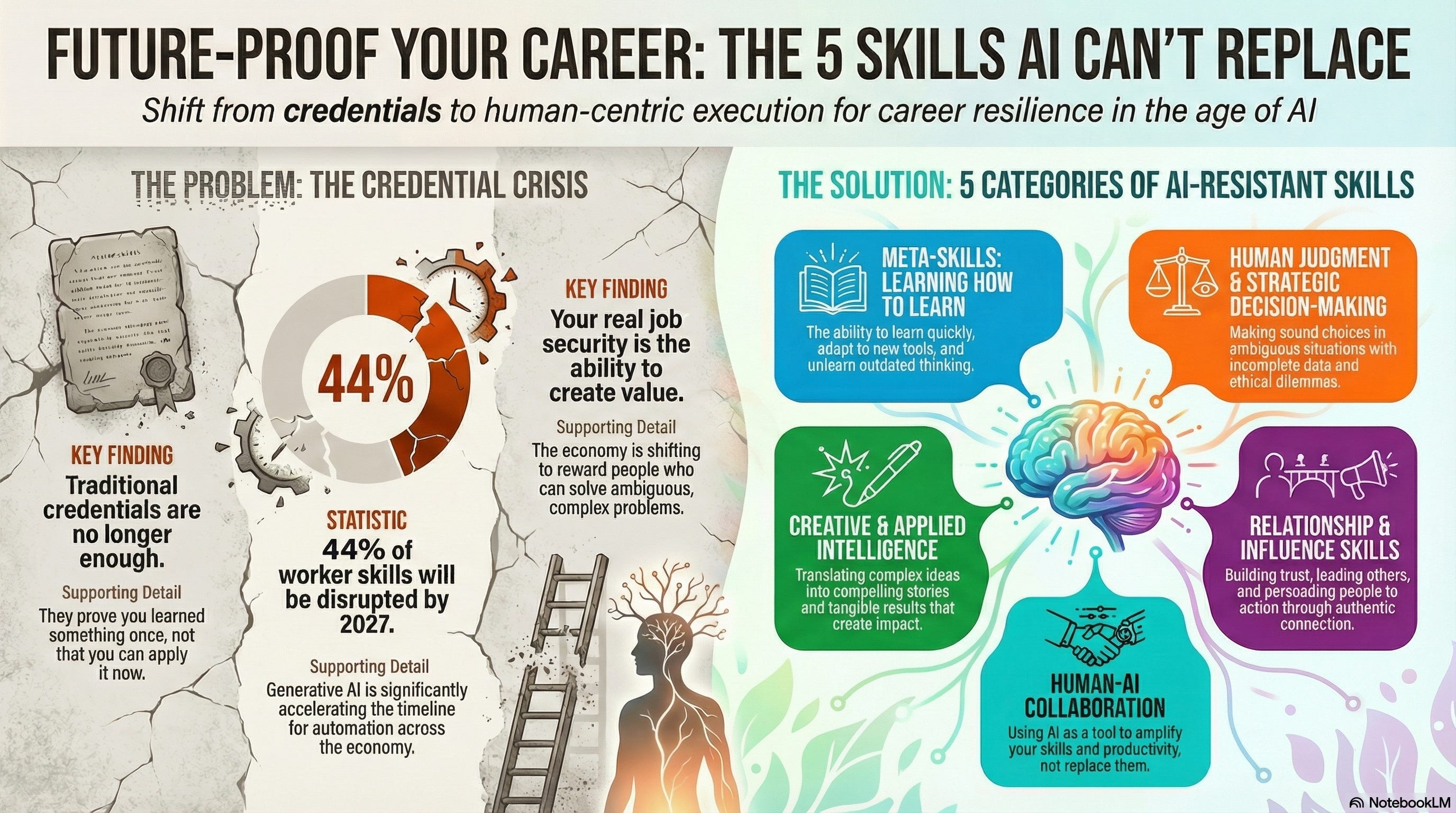
If you’re wondering how to stay relevant when automation is everywhere, this is your roadmap. The path forward isn’t about collecting more credentials; it’s about rethinking what ‘upskilling’ even means. Instead of competing with machines, the key is to cultivate the uniquely human capabilities that AI can’t replicate. This article reveals five counter-intuitive but essential truths that will help you build a durable and valuable career in the age of AI.
Your Credentials Won’t Protect You, Your Adaptability Will
Your credentials—the degrees and certificates you spent years collecting—prove you learned something in the past. But in an AI-driven economy, they offer little protection for the future. The economy is fundamentally shifting to reward professionals who can solve ambiguous problems and deliver results in constantly evolving contexts.
Knowledge is the baseline. Skills are the edge. It’s no longer about what you know; it’s about your capacity to learn, unlearn, and pivot based on what the current reality demands.
The people who survive career disruption won’t be the ones with the most knowledge. They’ll the ones who can learn new things quickly, can also (very importantly) unlearn outdated thinking, let go of the past status quo and adapt their approach based on what’s working now.
Knowledge is Cheap. Execution is Everything
Since AI has made information and data analysis abundant, accessible, and cheap, knowledge itself is no longer a differentiator. The only competitive advantage that remains is execution: the ability to transform ideas and information into tangible results, solutions, or products that genuinely benefit others.
This represents a critical shift in professional value. The new premium is on what you can do with what you know, a skill set fundamentally different from the one emphasized in traditional education. Applied problem-solving is the skill of moving from “here’s what the research says” to the far more valuable “here’s what we should do about it.”
The Most Powerful Skill Isn’t What You Learn, But How You Learn
The foundation for career resilience is built on “meta-skills”—the underlying abilities that govern how you acquire and apply all other skills. They are the operating system for your professional growth. The three most critical meta-skills are:
Learning Agility: The ability to pick up new concepts, tools, and frameworks quickly and effectively.
Adaptability: The capacity to pivot your approach when old methods stop working, without clinging to the familiar.
Systems Thinking: The skill of seeing how different parts of a complex problem connect and understanding second-order effects.
These are arguably the most valuable skills you can develop because they apply to everything, giving you the highest possible return on your upskilling investment. They allow you to stay relevant and effective as tools, industries, and opportunities constantly change around you.
Don’t Compete With AI, Make It Your Co-pilot
The most valuable professionals will be those who master the art of working with AI, not against it. Viewing AI as a competitor is a losing battle; viewing it as a powerful collaborator is a strategy for immense leverage. To do this effectively, you need to develop specific skills for human-AI collaboration.
AI literacy: Understanding its core capabilities, inherent limitations, and appropriate use cases.
Prompt engineering and tool fluency: Knowing how to ask the right questions to get high-quality results from AI tools.
Quality evaluation: Discerning when AI-generated output is sufficient and when it requires human refinement, context, or judgment.
Workflow design: Structuring processes to automate repetitive tasks, freeing up human focus for high-value strategic decisions.
I like to think of it like this: AI is a tool that makes skilled people more productive. It doesn’t replace skill. It amplifies it.
You Don’t Need More Courses. You Need More Practice
The common response to career anxiety is to passively consume more information by enrolling in another course. This is the least effective approach. The only way to develop skills that outlast AI is through active application in contexts where the outcome truly matters—a real project, a client’s problem, or a team you are leading.
It’s time to adopt a new directive: Measure Outcomes, Not Effort. Stop tracking the number of certificates you’ve collected and start tracking your tangible achievements. Success should be measured by landing a new client, launching a project, or solving a meaningful problem—not by course completion rates. This is how real, durable skills are forged.
Conclusion: What’s Your Next Move?
In an AI-driven world, your career resilience will not come from what you know, as knowledge is increasingly a commodity. It will come from uniquely human skills, judgment, adaptability, creativity, and influence that are developed through deliberate and active practice. Knowledge is replaceable, but your ability to apply it in valuable ways is your ultimate edge.
What skill are you focusing on first?
Katharine Gallager
Here are some popular articles
AI Is Here. Let’s Get Your Business in the Game.
How I Scaled My Business Without Hiring: Building My First AI Agents for $0
The Science of Execution: Why Most Founders Stay Stuck (and How to Break Through in 90 Days)
How to Build Assets That Compound (Even When Life Forces You to Pivot)
Everyone’s Rushing to AI. Few See the Ceiling Ahead.
Scaling Smart: 5 Systems Every Solopreneur Needs to Grow Without Burning Out
Built to Blaze: How Ooni Turned Backyard Pizza into a $200M Global Movement
Being able to adapt beats collecting more badges.
Thanks, Juan and Katharine. A fascinating read. For me, the skills that I'm going to continue to hone over the next 12 months are my judgement and networking, because these are things that I already feel pretty strong in. I believe these will give me a competitive edge over both my human and AI counterparts.