


Build to Thrive just hit #26 Rising in Business on Substack last week
Thank you for reading my newsletter and helping me grow at a pace of 600 subscribers per month. I started this newsletter in April of last year and it is now a resource to more than 5000 entrepreneurs. I would love for you to take the next step by offering a 25% discount over my paid subscription. By becoming a paid subscriber you have access to my library of prompts, workflows and timely content to help you gain your time back, improve your income and have happier customers and stakeholders. All for the price of a latte or capucchino. (Offer valid until July 31st)
TL;DR
Your business may feel broken because you are fixing symptoms instead of the real constraint. The Thrive Business System helps you find the weak point across 9 business levers grouped into Clarity, Opportunity, and Follow-Through. Traditional organizations add people, tools, and processes to manage complexity. AI-native businesses first redesign how workflows, then use AI to multiply what works. The goal is a business that earns more, runs smoother, and depends less on you.
Most founders do not wake up thinking, “My business model has a structural constraint.”
They wake up thinking:
Why am I still involved in everything?
Why are good opportunities not moving?
Why are clients happy with the work, but the delivery still feels messy?
Why did we buy another tool and still end up with the same problem?
That is usually how business problems show up.
Not as a clean diagnosis.
As friction.
A lead goes quiet. A proposal stalls. A client asks for an update that should have already been sent. A team member waits for the founder to make a decision. A new AI tool gets added, but the work does not really get better.
So the instinct is to fix what is loudest.
Work harder.
Hire someone.
Buy software.
Add automation.
Try another AI tool.
For a while, that feels like progress.
Then six months later, the same strain comes back in a different form.
That happens because the problem you noticed first was probably not the real problem. It was a symptom.
And this is the lesson I now lead with:
You cannot create leverage by speeding up a broken process.
Bolting speed onto chaos is not leverage
AI has made this problem more urgent.
A lot of businesses are not redesigning the work. They are just automating the work they already have.
That sounds efficient until you realize the process being automated should not exist in its current form.
If follow-up is scattered, AI can help you send messages faster. But the deeper issue may be that nobody owns the relationship pipeline.
If content feels generic, AI can help you publish more. But the deeper issue may be that the business has no clear point of view, no buyer language, and no visible proof.
If client delivery feels chaotic, AI can summarize meetings and draft updates. But the deeper issue may be that the client journey was never designed.
Speed helps only after the work is worth multiplying.
Otherwise, you do not get leverage. You get a faster mess.
The three questions I use to read a business
When I look at a business, I do not start with tools.
I start with three questions:
Clarity: Do we know what matters?
Opportunity: Can we create the right opportunities?
Follow-Through: Can we follow through consistently?
Every company is answering those questions all the time, whether the owner has named them or not.
When a business feels heavier than it should, one of those questions is usually weak.
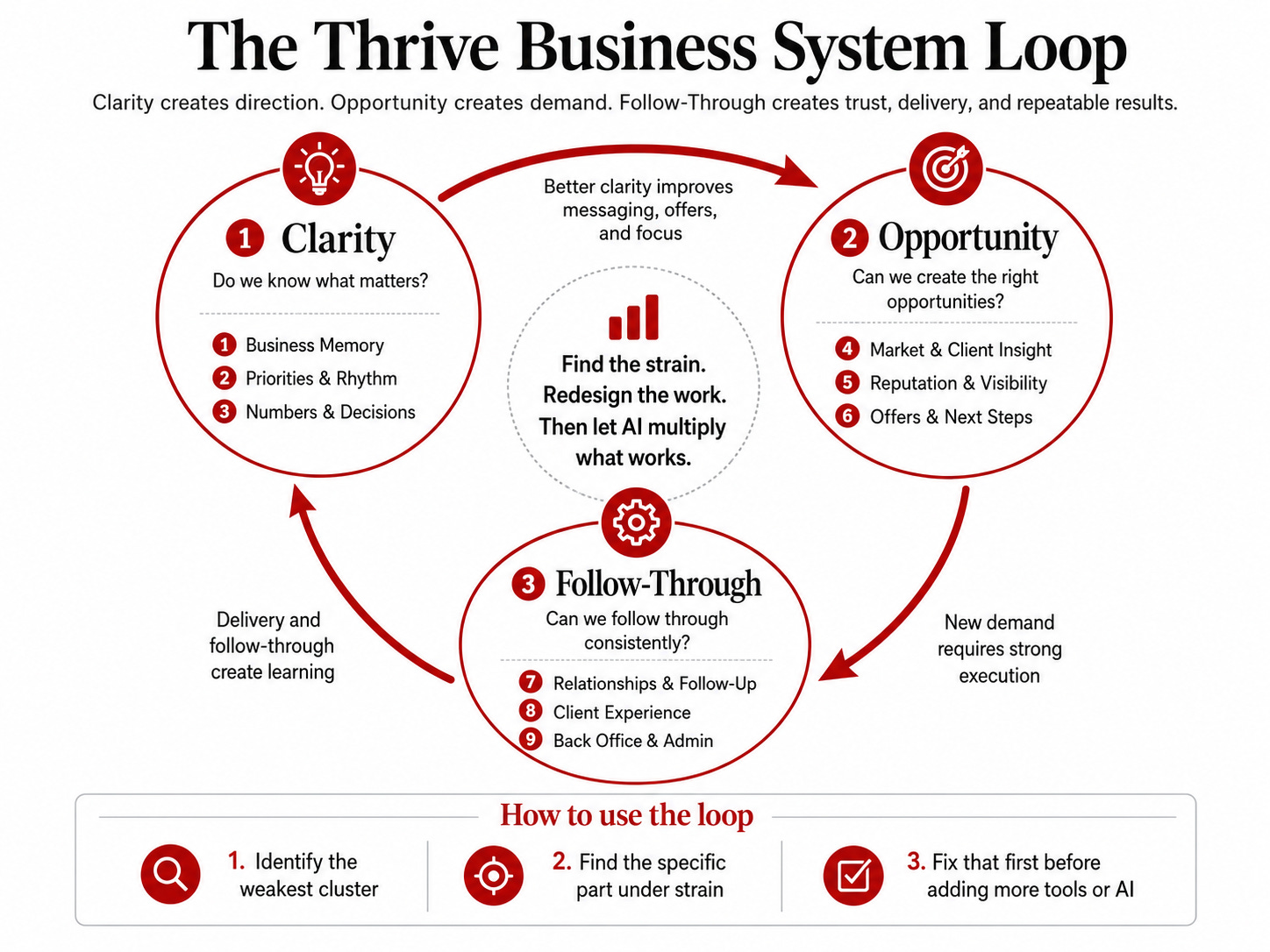
The Thrive Business System breaks those three questions into nine parts.
Not as a checklist.
As a diagnostic map.
The point is not to label the business. The point is to find where the real strain is coming from before you spend more time, money, or energy fixing the wrong thing.
Clarity: Do we know what matters?
Clarity is where the business remembers, focuses, and decides.
Without clarity, everything downstream gets harder.
1. Business Memory
Business Memory is the shared context your company runs on: positioning, offers, clients, decisions, voice, lessons, processes, and operating knowledge.
When this is weak, everything lives in the founder’s head.
The founder repeats the same explanations. Client context gets lost. Content sounds generic. Every new project starts from scratch.
This is also why AI often disappoints. If the business has no reliable memory layer, AI has nothing specific to draw from. It produces generic output because the business gave it generic inputs.
2. Priorities and Rhythm
Priorities and Rhythm is how the business decides what matters now and keeps it moving.
When this is weak, everything feels urgent. The founder becomes the traffic controller. Important work gets buried under reactive work. Projects start, stall, restart, and then get replaced by the next urgent thing.
This is where founder dependency often lives.
Not because the founder is bad at delegation, but because the business has no rhythm that allows the right work to move without constant intervention.
3. Numbers and Decisions
Numbers and Decisions is how the business sees what is working and what is slipping.
This does not need to be complicated.
For a solo operator, it might be a simple view of leads, sales, delivery load, time leaks, and cash. For a larger business, it may include margins, financing, capacity, client experience, and capital allocation.
When this is weak, the business runs on instinct.
Revenue may be growing while margin is shrinking. Clients may be satisfied while delivery is becoming too heavy. The founder may feel busy without knowing which activity is actually creating value.
Clarity creates direction.
Without it, you may be working hard in the wrong direction.

Opportunity: Can we create the right opportunities?
Opportunity is where the business understands the market, earns trust, and makes it easy for the right people to take the next step.
4. Market and Client Insight
Market and Client Insight is how the business listens.
When this is weak, messaging runs on assumptions. Offers are built from the inside out. Content does not connect. Sales calls reveal the same confusion over and over.
The business misses what buyers are actually saying because nobody is capturing the questions, objections, language, and signals already coming from the market.
A business grows stronger when it listens carefully.
5. Reputation and Visibility
Reputation and Visibility is how the market comes to see what you know and why you are credible.
A lot of operators have real expertise that the market never sees.
They are good at the work, but invisible to the people who would value it. Referrals depend too much on personal relationships. Content is inconsistent. Buyers do not understand why they should trust them before the first conversation.
Visibility is not just posting more.
It is turning experience, proof, ideas, and perspective into public assets that make trust easier to build.
6. Offers and Next Steps
Offers and Next Steps is how the business turns interest into action.
When this is weak, people may respect you but still not know how to work with you.
Calls end without a next step. Proposals are too custom. Pricing feels improvised. Content creates attention but does not create movement.
A good offer makes the next step feel obvious and valuable.
Opportunity creates demand.
But the order matters. Visibility without clarity just broadcasts a confused message more loudly.

Follow-Through: Can we follow through consistently?
Follow-Through is where the business keeps relationships moving, delivers well, and reduces the friction behind the scenes.
7. Relationships and Follow-Up
Relationships and Follow-Up is how the business keeps important conversations alive.
When this is weak, leads go quiet. Proposals stall. Past clients are forgotten. Referrals never get followed up. Good opportunities sit in inboxes, notes, or memory with no next step.
Most opportunities are not lost because of rejection.
They are lost because no one followed up.
A simple follow-up rhythm is often more valuable than a complicated CRM nobody uses.
8. Client Experience
Client Experience is how the business delivers in a way that feels clear, professional, and trustworthy.
When this is weak, the final work may still be good, but the process feels improvised.
Onboarding is unclear. Updates are inconsistent. The client has to ask what happens next. The founder keeps stepping in to rescue the experience.
Great delivery makes clients feel guided, not managed.
9. Back Office and Admin
Back Office and Admin is the invisible work that keeps the business running.
Documents. Handoffs. Inboxes. Calendars. Internal requests. Repeatable tasks. Small administrative steps that do not look strategic until they start consuming the capacity needed for growth.
When this is weak, tools pile up. Processes go undocumented. Work gets copied manually. The business feels heavier than it should.
Many “people problems” are actually design problems.
The issue is not always the team member. Sometimes the work was never structured for delegation.
Follow-Through creates trust, delivery, and results you can repeat.

The loop matters
These nine parts are not separate boxes.
They move in a loop.
Clarity creates direction.
Opportunity creates demand.
Follow-Through creates trust, delivery, and repeatable results.
Then the loop feeds itself.
Follow-Through produces learning.
Learning improves Clarity.
Better Clarity creates better Opportunity.
Better Opportunity requires stronger Follow-Through.
That is why fixing one visible problem often fails.
A business weak in Clarity cannot always be repaired with more marketing. A business drowning in delivery issues may be carrying a weak offer, unclear priorities, or missing business memory. A business struggling with sales may not need a louder funnel. It may need better follow-up, clearer proof, or a simpler next step.
The map helps you see not only where the strain is, but where it may be coming from.
Where AI actually fits
AI is not a tenth part.
It is not the strategy. It is not the operating system.
AI is what you apply after you understand the business, find the strain, and redesign the work underneath it.
The sequence matters:
Understand the business.
Find the part under the most strain.
Redesign the work so it is worth doing.
Then use AI to improve the outcome, speed, quality, or consistency.
Run that sequence backward and you get automation without leverage.
Leverage is the mechanism. A better business and a better life for the person running it are the outcomes.
A real example
I learned this the hard way.
I inherited a management-intensive Section 8 housing portfolio. It had high friction, high founder dependency, thin margins, and too many moving parts.
The instinct would have been to work it harder.
More oversight.
More chasing.
More people solving the same recurring issues.
But the real strain was not demand.
The strain was in the operating model itself: Priorities, Follow-Through, and the way the work was structured.
So we redesigned the work and repositioned the portfolio into scalable middle-market multifamily.
Over time, that led to 134 units and a 112-key hotel repositioned, more than $8 million in investor capital raised and leveraged 4x, and 20 percent plus IRR across the portfolio. The work was later recognized by the Greater New Haven Chamber of Commerce. More on this story
I did not have this map written down at the time.
I have spent the years since turning what worked into something repeatable, so the next operator does not have to learn it one expensive mistake at a time.
How to use this map this week
You do not need a consultant to start.
Ask yourself three questions:
Do we know what matters?
Can we create the right opportunities?
Can we follow through consistently?
One will feel shakier than the others.
That is your cluster.
Then ask: which part inside that cluster is carrying the most weight?
Not the loudest problem.
Not the easiest problem to fix.
The one everything else seems to be waiting on.
That is usually the first-place worth redesigning.
Where this goes next
The Thrive Business System Assessment is the main doorway into this map.
It is built for the founder or operator who can feel that something is off but does not yet know where the real constraint sits.
It asks nine plain questions, one for each part of the system, and shows what is strong, what needs work, what is at risk, and which area deserves attention first.
If you’re open to it, I’d be happy to offer you a complimentary 15-minute virtual coffee. We can talk through your results, and I’ll recommend an AI tool you can use right away to address your specific challenge.
My only ask is this: if you find that after you apply what I said in our conversation you gain back 5 hours of your time, consider recommending me to someone who could also benefit or schedule a follow-up conversation with me to explore how I may be able to help you further.
If you already know the issue is operational drag, time leaks, manual processes, workflow bottlenecks, customer friction, or AI leverage, the AI Leverage Assessment may be the better starting point.
If you already know the issue is authority, positioning, content, offer clarity, public assets, or turning expertise into trust, the Authority or Value Clarity path may be the better starting point.
And if you already know you want to talk, book the free 15-minute call.
The Thrive Business System Assessment is the central map, not the only entrance.
However you enter, the sequence is the same.
We look at the business.
We find the part under the most strain.
We identify one useful move.
Then we decide whether there is a larger system worth building.
You cannot create leverage by speeding up a broken process.
You redesign the work first. Then you let AI multiply what is worth multiplying.
That is how you build an AI-powered business part by part, without betting everything up front.
If one cluster stood out as you read this, start there.
Or take the Thrive Business System Assessment and see your whole map.
Either way, the goal is the same: find the part that is actually holding the business back before you spend more time, money, or energy fixing the wrong thing.
Thank you for reading,
Juan
Wait…I want to leave you with something extremely valuable. A post that has more than 15,000 views and over 1300 downloads.
50 Free Resources that can take your Business to the Next Level
50 brilliant creators contributed to this.
Broken down into 9 topics:
Leadership and Decision-Making: making the call you already have the information to make
Content and Storytelling: shaping a piece of writing that proves the point
Product and Building: shipping the minimum version of the thing
Growth and Marketing: finding and moving the next customer
Operations and Systems: turning a one-off into a repeatable process
Research and Synthesis: making sense of what you read
Career and Personal Brand: naming your value in a sentence a buyer can act on
Creativity and Craft: stress-testing your own thinking
Mindset and Operating: getting your head right to do the work at all
I really hope you can experience real progress and clarity out of these resources.
Build Leverage. Thrive on your terms.
Juan
Building systems that create more capacity is a valuable focus, especially when technology evolves quickly.
AI can amplify a strong business, but it can also magnify existing gaps if the underlying systems are unclear.