


Hey!— Juan here. This is a weekly read from Build to Thrive for operators and professionals turning hard-won experience into leverage, income, and opportunity in the AI economy. More than 5000 of you read along each week.
A word on why I write it. I have started four companies, and I am building my fifth: this one, a media company I run almost entirely solo, on a fleet of about thirty AI agents that draft this newsletter, scan my inboxes, prep my client work, and write my morning brief. I am not reporting on this shift from the sidelines. I am living it, and I share what works and what breaks, openly, as I go.
If you want to stop reading about it and build the system yourself, that is Founder 100. Two hours of one-to-one work with me plus twelve months of the Vault (more than 200 prompts, skills and workflows) and the premium Blueprint, where we turn your experience into a positioned, repeatable offer and a business that runs without you. No theory and no recycled frameworks. The same moves I run on my own fleet and with my clients, handed to you to use this week.

The “Deli Counter” Trap
At the start of this year, I decided to run my business with AI agents. I didn’t sketch a plan or write a manual; I simply opened my laptop and started ordering agents like a man at a deli counter. “I’ll take a research agent. Give me a newsletter writer. And let’s throw in a Chief of Staff to run the whole thing.”
By Tuesday, I had twelve of them. By Wednesday, I realized I hadn’t built a team—I had built a relay race where everyone runs at the same time and nobody is holding the baton. My writer was already halfway through a draft using research that hadn’t arrived yet. My Chief of Staff was confidently summarizing work that didn’t exist. My software bill was climbing, yet I was essentially paying for a smoke detector beeping in an empty house: reports were being generated every morning that no human had opened in months.
The realization was as beautiful as it was dumb: AI isn’t a tool you “buy”; it’s a worker you must “manage.” Hiring agents without a management framework doesn’t save time; it simply promotes you, unpaid, to a full-time micromanager of software.
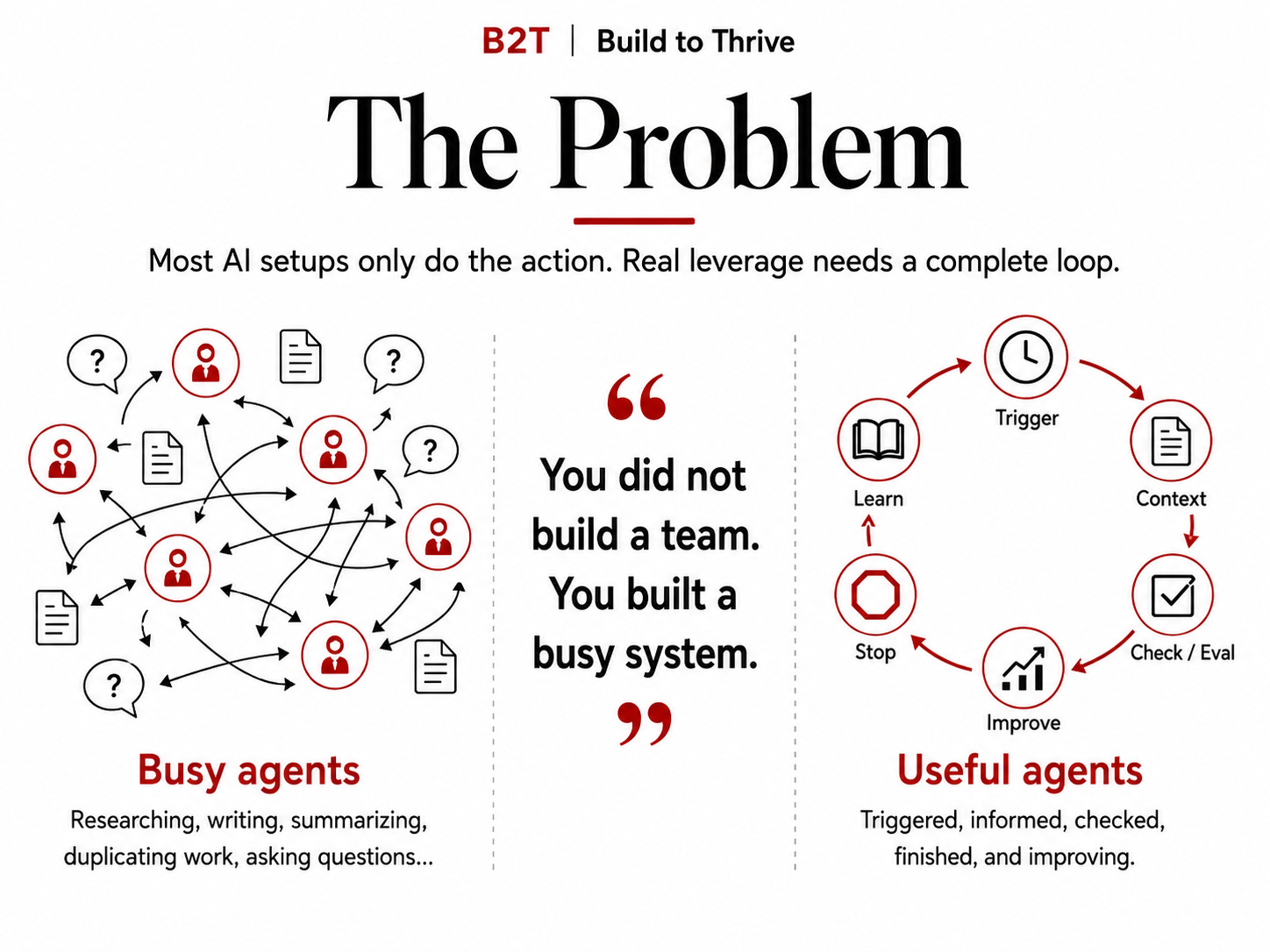
You Didn’t Hire a Team, You Built the “Worst Office in America”
The reason my twelve-agent “office” failed was that I skipped every fundamental of human management. In a traditional company, you’d never expect a new hire to succeed without infrastructure. With AI, we focus entirely on the Action (the hands moving) while ignoring the Infrastructure (the management of the work).
To move from firefighting to true leverage, you have to translate these twelve traditional management elements into your AI workflows:
Job Profile: I failed to define what each agent owned, leading to a “turf war” where two agents produced the same article in different voices.
Reporting Line: Because I didn’t establish who answered to whom, I became the answer to every question.
Order of Operations: I lacked a sequence, so agents started all at once instead of in a logical chain.
Trigger: I relied on a clock rather than a business event; one agent fired 11 out of 19 mornings when there was no work to do.
Inputs: I provided no “memory file,” forcing agents to start cold and improvise every time.
SOP: Without step-by-step instructions, the agents hallucinated their own processes.
Handoff: I had no clean way to pass data, so work frequently “hit the floor” between steps.
Definition of Done: I let “finished” be a matter of the agent’s opinion rather than my spec.
Quality Check: I lacked a review gate, allowing a made-up statistic to ship straight to the page.
Metrics: I didn’t check the logs to see if the agents were actually working or just being “busy.”
Escalation Path: My agents were programmed to guess rather than raise a hand when they got stuck.
Stopping Point: Without an “off switch,” one agent ran past a budget cap on a task with no end.
Stop Hiring “Staplers That Talk”
Most AI “failures” happen because we treat agents as tasks rather than loops. When you only focus on the middle of a job—the “doing”—you strip away the context and quality control that makes a human employee valuable.
“It is like hiring that great employee and keeping only the part where her hands move. That is not an employee. That is a stapler that talks.”
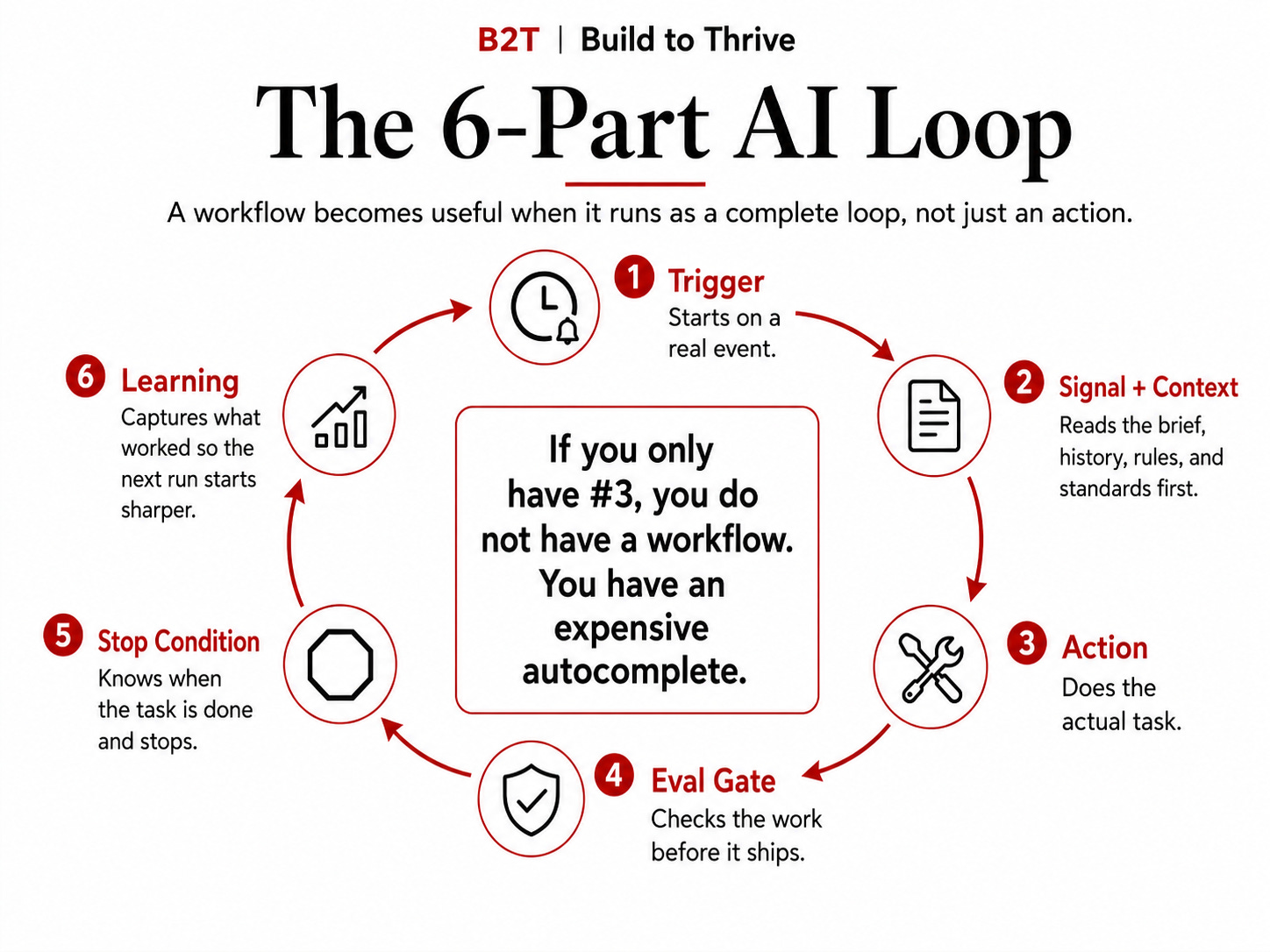
If your workflow is just a prompt that generates text without a clean start, a review, or a finish, you don’t have an automated worker; you have an expensive autocomplete. The “doing” is actually the least important part of the cycle if the beginning and the end are broken.
The Anatomy of a Perfect AI Loop
For an agent to be actually useful, it must operate within a structure that mimics a high-performing employee. There are five parts to a functional cycle:
A Trigger: A real business event (a payment, a form submission, a quiet lead). A clock is a poor trigger; a business event is a signal.
Signal and Context: The “memory file” or second brain. The agent must read your standards, history, and the brief before lifting a finger.
The Action: The execution. This is the one part everyone already has.
An Eval Gate: This is Andrew Ng’s “reflection pattern” in plain clothes. It is a logic gate or a second agent reviewing the work before a human—or a customer—ever sees it.
A Stop Condition: A declared finish line or budget cap to ensure the task doesn’t run indefinitely.
The Sixth Step: The Compound Interest of AI
The first five steps make the work run. The sixth step—Learning—is what makes the work compound. This is the rarest stage of AI management and the most vital for long-term strategy.
In a true loop, the agent captures what worked and what didn’t during a run and updates its own brief for the next time. This transforms the AI from a repeating cost into a compounding asset.
“You can offload a task, you can even offload a whole job, but you can never offload your learning.” — Satya Nadella
The software tool you use is rented and gets cheaper every month, but the “sharpening” of the process lives in your own files. If you skip this, your AI will be exactly as good in month six as it was on day one. If you include it, you are building an asset that you actually own.
The 60-Second “Vibe Check” for Your Workflows
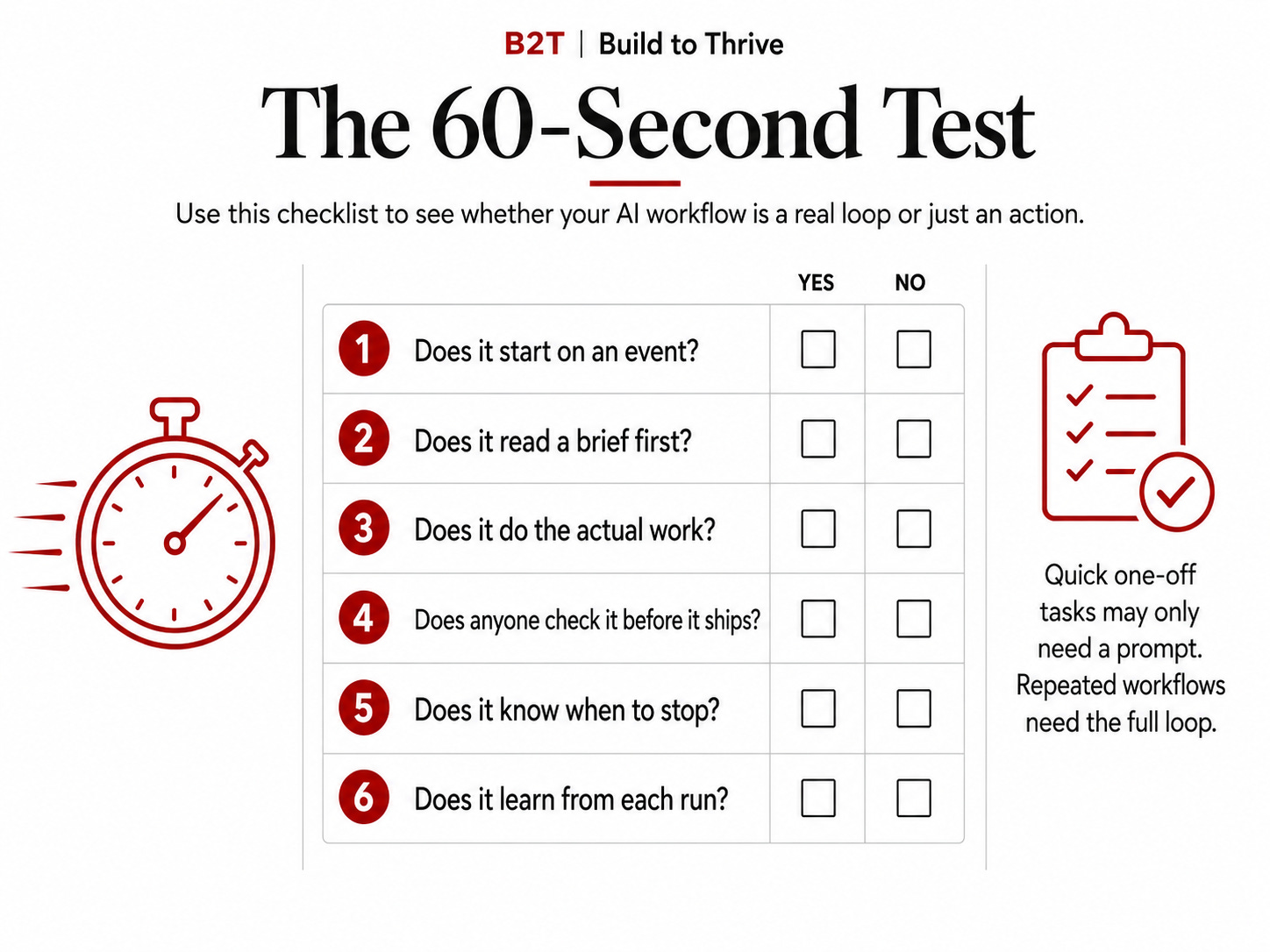
To see if you are a manager or a babysitter, audit your current AI use against this checklist. If you are missing these parts, your process is exposed.
[ ] Does it start on an event, or a vibe? If the answer is “whenever I remember to run it,” you are the bottleneck.
[ ] Does it read a brief first? Does it pull your past decisions, or do you re-explain the task every Tuesday?
[ ] Does it do the actual work? (The Action step.)
[ ] Does anyone check it before it ships? If the customer is the first one to see the AI’s mistakes, you’re missing an Eval Gate.
[ ] Does it know when to stop? Is there a budget or a finish line?
[ ] Does it learn? Does the next run start sharper because the results of the last run were captured?
The Engineer’s Caveat: Not every one-off question needs a six-part loop. Use the simplest thing that works for quick tasks. But for the recurring workflows you depend on, one out of six isn’t “simple”—it’s a liability.
From Firefighting to True Delegation
True leverage comes from building the loop around the work so the machine can manage itself. According to Anthropic’s “Cadences” report, which surveyed nearly 9,700 people, over a third of respondents expect AI to handle most or nearly all of their work within a year. The users who were most optimistic about this future were those delegating whole tasks, not just asking one-off questions.
The path from “more agents” to “complete loops” is the only way to get your time back. The babysitting ends when the loop handles the management for you.
Pick one workflow. Find the part you skipped. Close it this week.
Juan
Build Assets - Create Freedom - Thrive on your Terms.

I am excited to share a new tool to help operators find the constraint holding their business back, and where their next move (AI, automation, workflow redesign, clear ownership, or better measurement) creates the most leverage. It works whether they have no AI yet, are experimenting, or already use it everywhere.
Take a test drive!
learn.buildtothrive.co/mytimeback
Want to build the whole system with help? Inside my Founder 100 program I can help you turn your pile of half-working agents into a self-running operation: two hours of one-to-one work to help you streamline your process. I help you close the loops around your own work and build a self-running 5-person business, solo.
Join 5000 plus subscribers looking to thrive!
The stapler that talks line is such a good way to describe automation without judgment built in.
You define the job, which is right, but I’d push it one step earlier: the definition should decide whether you even need an agent, some will while others won’t, not just how to fill the loop. Fully deterministic work often doesn’t need one, a script beats an LLM that can drift. The deli and stapler failures both start there, a task too vaguely defined to tell you which architecture you’re building, so people reach for an agent by default. Define it precisely and it tells you how much loop it needs. I build these for clients, and it always starts with the workflow, not the agent.