



Former OpenAI researcher Andrej Karpathy, released a scoring of 143 million U.S. jobs on a zero-to-ten scale for AI exposure. A systematic look at the entire U.S. labor market, job by job, measured against one variable: how much of the work lives on a screen.
The findings don’t just challenge what we were taught about career safety. They dismantle it.
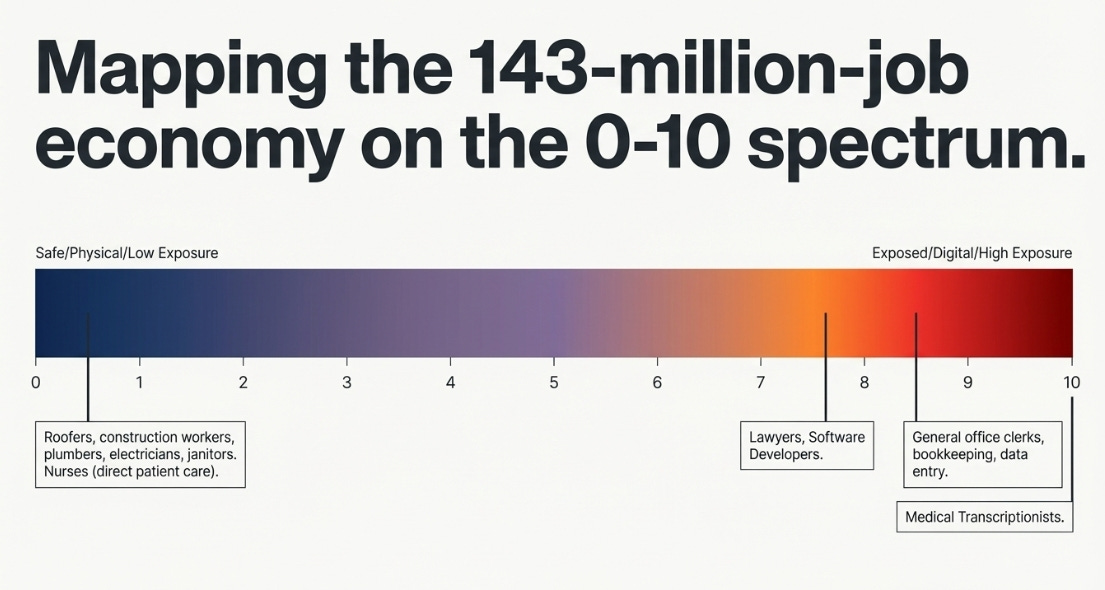
The rubric is deceptively simple. How much of your job involves moving information, generating documents, processing data, producing digital outputs? The more screen-based the work, the higher the exposure score. The more your work requires physical presence and real-world judgment, the lower.
This isn’t a prediction of who gets laid off next. It’s a map of overlap, where AI capability and human work currently intersect. That intersection is larger, and sits higher up the income ladder, than most professionals want to admit.
What the data actually shows
Jobs under $35,000 a year average an exposure score of 3.4. Jobs over $100,000 average a 6.7. Software developers score 8 to 9. Lawyers sit around an 8. General office clerks, bookkeepers, data entry roles score even higher.
Roofers, plumbers, electricians, nurses doing direct patient care: zero to one.
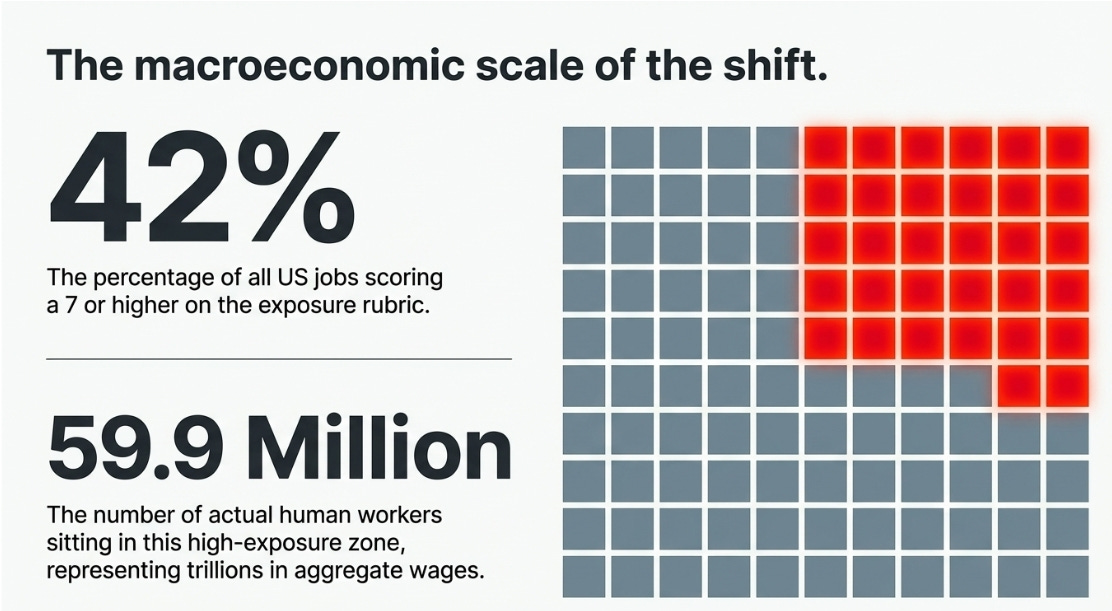
42% of all U.S. jobs, nearly 60 million workers, trillions in wages, score a 7 or higher.
We spent decades optimizing for the wrong kind of safety. The jobs society told us to pursue, the ones that required expensive degrees and prestigious titles, are the ones sitting deepest in the crosshairs. The trades we were quietly discouraged from are structurally protected in ways most corner offices simply are not.
Physical presence cannot be shipped to a server farm. Digital work increasingly can.
What exposure actually means
Your job isn’t disappearing tomorrow.
But the layer of work that justified your seat at the table: the execution, the deliverables, the structured task completion, is being repriced. Quietly. Systematically. Without announcement.
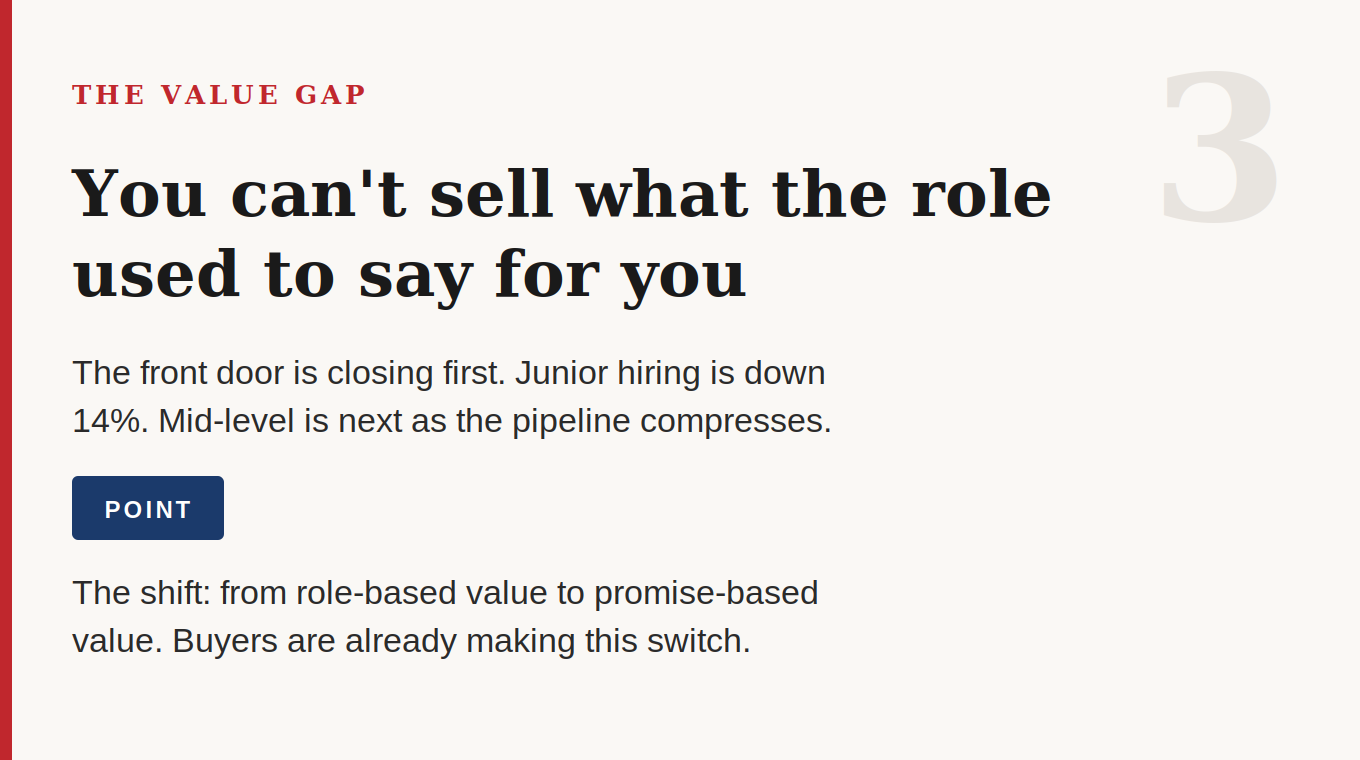
Junior hiring is already down 14%. Mid-level roles are compressing next. AI doesn’t eliminate jobs all at once. It absorbs the tasks that justified the headcount. The headcount follows.
This is not a future problem. It’s a current one most people aren’t looking at directly.
Most of my career has been spent building things and developing businesses. That path has made me a go-to resource for people in my network, many of them long-tenured corporate professionals who are thinking about making the leap to entrepreneurship. Lately, those conversations have been coming with increasing frequency.
What I started noticing isn’t panic. It is something quieter.
Something I named the AI shadow in one of my artiles. The slow blur that happens when the identity you built around your work starts losing definition. Not a crisis. A lag. Technological disruption, or even just the perception of it, moving faster than your sense of self can absorb.
Most people don’t name it. They just feel it.
The deeper problem isn’t the technology.
It’s that most professionals were never taught to see their value clearly. They were taught to perform it inside a structure that made it legible for them. The title did the explaining. The org chart did the positioning. The role description told the market what you were worth.
That layer is thinning. When it thins enough, the title stops carrying you.
What the market rewards now is different. Not what you’re called. but what you can deliver, who you can help, and what you’re willing to stand behind. Your skills, your judgment, your relationships, your insight, these were never just a job description. They were always assets. You just never had to package them yourself.
That’s changing.
Now, more than ever, companies with 50 employees or more, where jobs are, often times, a small link in the value chain, are restructuring around outcomes, not headcount. Hierarchies are flattening. the professionals who thrive won't simply be the ones who upskill the fastest. They'll also be the ones who learn to unbundle what they know and deliver it directly.
The truth is, you are not your role. You never were. Now is becoming evident.
The work now is learning to operate like you believe that.
We all need to think like entrepreneurs.
Entrepreneurs don’t have the luxury of hiding behind a title or job description. They create value, deliver value, and capture value, and take accountability for the outcome.
I know for some, this will not be easy, but what the market is beginning to reward is something different. Not what you’re called, but what you can reliably deliver and stand behind. That shift is already underway. The data confirms it. So does the rapid growth of fractional and consulting work at the senior level. This is something I have been tracking recently in my Going Fractional Live Sessions.
How to prepare
I want to be direct here. Most experienced professionals already have what’s needed. The problem isn’t the depth of your expertise. It’s the packaging, and here is what I have been advising.
Three moves matter right now.
First, diagnose where your experience creates real impact. Not the tasks you perform, but the problems you consistently solve. Most people have never separated those two things, and the difference is everything.
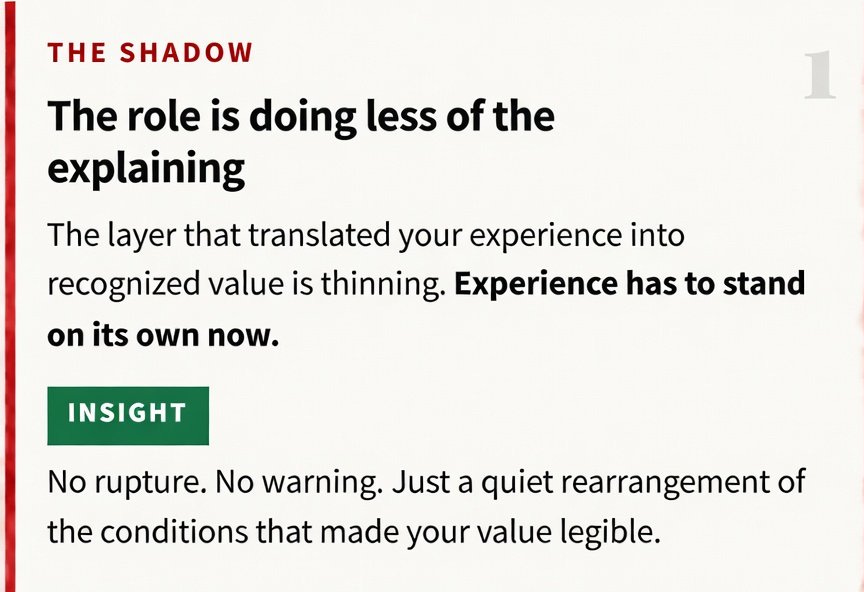
The layer that translated your experience into recognized value is thinning. No rupture. No warning. Just a quiet rearrangement of the conditions that made your value legible. Experience has to stand on its own now.
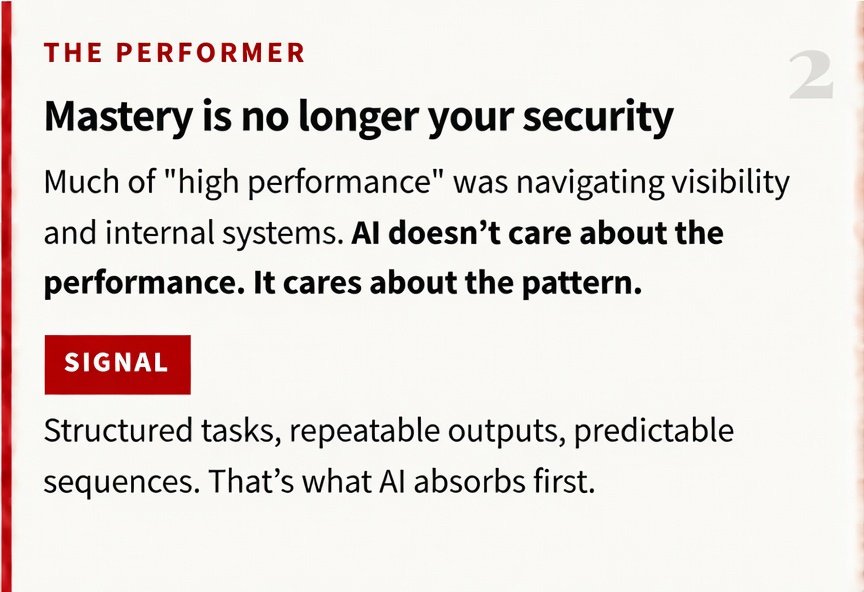
Second, recognize that being good at your job is no longer enough on its own. Much of what passed for high performance was really navigating internal visibility and organizational systems. AI doesn’t care about the performance. It cares about the pattern.
Structured tasks, repeatable outputs, predictable sequences. That’s what AI absorbs first. If your value lives in execution, it’s being repriced right now.
Third, define who has that problem and what it costs them to leave it unsolved. That’s the gap between having experience and having an offer. One lives on your résumé. The other has a buyer. I talked about this in my upcoming webinar.
After working with a dozen professionals on this subject, I designed an assessment that will help you define the specific problem you solve and identify the ideal customer who needs it most. Click below to start.
Stop letting your job description position you. In a market where AI handles more of the execution, the premium shifts entirely to judgment, accountability, and the willingness to put your name on an outcome. That can’t be automated. But it has to be made visible by you, deliberately, before the market decides what you’re worth.
The title never protected you. Your ability to stand behind a promise that’s worth paying for that does.
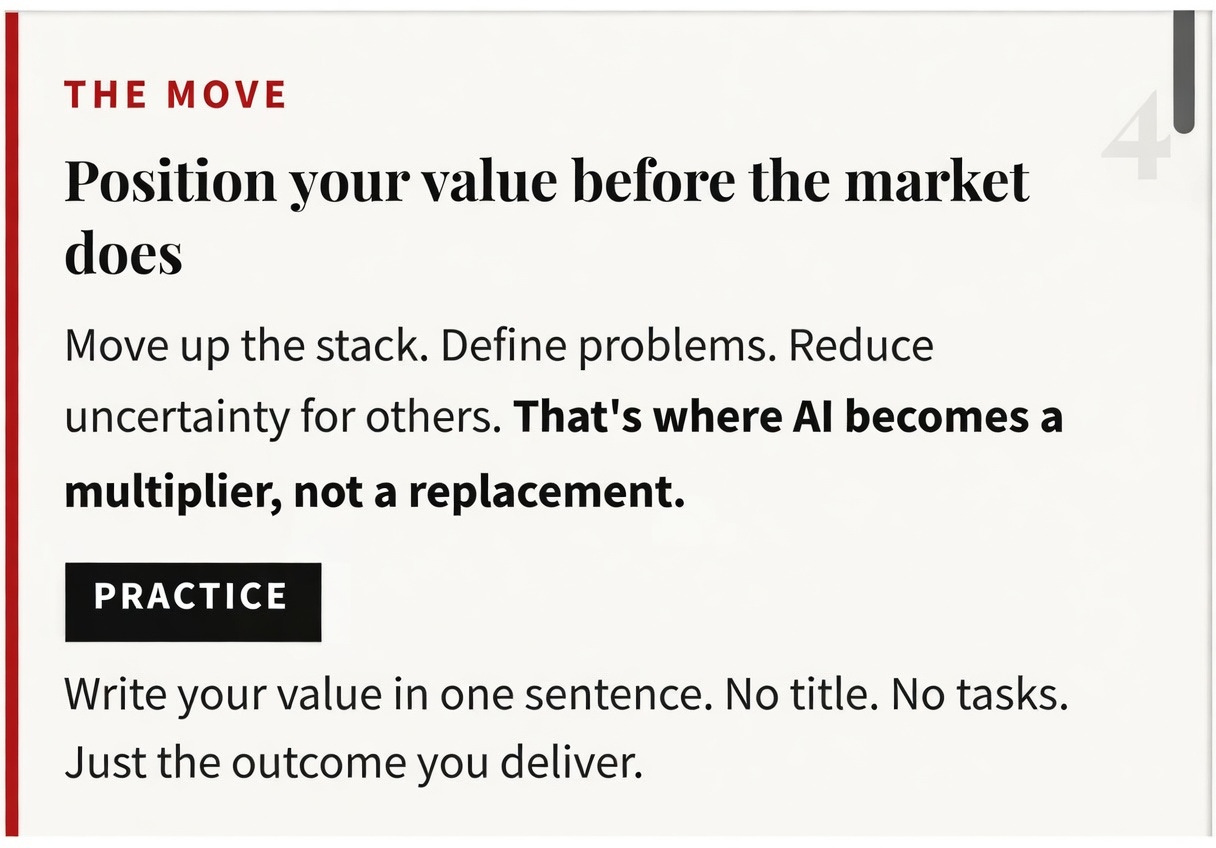
The professionals who internalize that now will set the terms of the next chapter. The ones still waiting for their role to explain their value are running out of time for that to work.
Because of the importance of this subject, and the demand I am seeing, I started to run webinars, and workshops on this subject. You can find all resources and upcoming sessions at learn.buildtothrive.co.
I’m also building a small coaching cohort — 50 professionals total at a special price. The first dozen already underway. If you’d like to join, visit buildtothrive.co/subscribe and look for the private coaching promo: $99 gets you 2 hours of 1:1 coaching, plus a full year of premium tools, prompts, workflows, and articles.
Karpathy's work serves as a wake-up call about AI's potential to reprice and in some cases eliminate white-collar jobs. But fixating on the threat misses the more urgent question: how do you make your value legible before someone else defines it for you? Stop waiting for the system to explain what you're worth. You are the promise people are willing to pay for.
Thank you for reading. Juan
Thank you for sharing Martin
Employees will shift from processing towards transactions and where the value is exchanged