


TL;DR. I took my family of six to Iceland for a week, and instead of drowning in confirmation emails and a group chat that never slept, I fed the whole trip to an AI and turned it into a second brain. It read my inbox, saw the bookings it had already helped me make, and planned the days around them: light hikes, no drive longer than an hour, affordable food, and home in time for the World Cup. It gave me drive times, what to do at each stop, where to get the best ice cream, and a Plan B for bad weather. Then I turned all of that into an app my whole family could open on their phones, so everyone knew the day before it started. This is how it came together, tab by tab, and what it actually did for us. The real app is linked at the end. It is early, and I would love your feedback.
I just got back from Iceland, and I still cannot properly describe what I saw.
Someone asked me what surprised me most, and I meant to give one answer. I gave seven.
The light. It never went dark, not once in a week.
The weather has a temper: sun, sleet, and dead calm inside the same hour.
I counted about a dozen waterfalls, then gave up counting.
The mountains have no peaks. Most are flat on top, sliced clean, table after table.
How far you can see. On the flat stretches it is a full 360, nothing but distance, until a wall of mountain simply begins.
The earth is black. Black soil, black sand, black beaches.
And then, somehow, green everywhere, against all that black.
That is Iceland. It over-delivers on every promise the photos make.
But the country was never really the story. The story is the six of us: me and my wife, our two eldest (both past eighteen now, which still catches me off guard), and the younger two, fourteen and eleven. We saw puffins, swam on hot springs, learned about lava and the power of volcanoes, geysirs, black beaches, more than 20 waterfalls, hiked, went of a mega zip line (1 Km) and many more memorable events. And here we are doing the same little dance in nine different places.
We love traveling while been in contact with nature and I know exactly what that age spread means. An eleven-year-old and a twenty-year-old are not on the same trip. One wants the hike and wants it now. One would sleep until noon given the chance and no moral instruction. One has been looking forward to the show for a month. And one asks how long the drive is roughly every eleven minutes, with complete sincerity, as though the answer might have improved. I wanted this trip to be good for all six of them, not good on average with two people quietly enduring it.
It started with one prompt
Here is how it began, and I bet it is how you begin too. Months out, I opened an AI and typed something like this: give me the top 20 things to do in Iceland on a seven-day trip for a family of six, ages 22, 19, 14, and 11. We like light hikes. We do not want to drive more than an hour on any single leg. We like to eat in affordable places, so add a couple of cheap options too.
Then I did the thing that changed everything. I let it look at my email. It read the booking confirmations it had already helped me put together, the flights, the rental car, the lodging, the airport parking, and it planned the whole trip around them. It was not guessing where we were staying or when we landed. It knew.
It knew other things because I told it. It knew we wanted to watch the World Cup, so it shaped each day so we would be back at the lodging in time for kickoff, and when the final came around it suggested a few bars in Reykjavík where we could watch it. It knew Iceland’s weather turns on you without warning, so it built a Plan A and a Plan B for the days that might get rained out.
And it did not stop at a list. For every stop it gave me the drive time and how long to actually spend there, a short description of what to do when we arrived, where to get the best ice cream, which local traditions and events were worth catching, and, because we like the markets where locals actually shop, it pointed us to a flea market.
Then I made it something we could see
A list in a chat window is still a list. So I turned it into a brochure, a proper document with a picture of every site, so the family could see where we were going and not just read the names. That was the first time the trip felt real to them.
But a brochure is fixed the moment you make it, and on the ground you need to know what today looks like. A document cannot tell you that. So I kept going and turned it into an app.
The app, tab by tab
The whole point was simple. Any one of the six of us could open the web on a phone and know exactly how the day was planned and what to expect. That mattered more than I thought it would, especially for the older two, who wanted to see what was coming next. It built excitement. It gave everyone the same picture of the trip. For once, we were all on the same page.
Here is how it looks.
Days. The whole week, one day at a time. Each day opens with where we are sleeping that night, then a timeline of stops, each with a time, what to do there, and a tap straight through to Google Maps. The most-asked question of any family trip, what are we doing today, finally had a five-second answer that did not go through me.


Stays. Every place we slept, with the address, the host’s number, the check-in time, and whether it was already paid. These were the exact bookings the AI had read out of my inbox, now sitting where anyone in the family could find them.


Do. The activities, and next to each one, what it actually costs per person, adult and child. This is where the light-hikes-only and affordable rules show up, with an honest per-person total at the top so there were no surprises.
Eat. Where to eat without turning every meal into a conversation about money, which in Iceland takes some doing. Affordable spots, the famous hot-dog stand, the farm that does the ice cream, each with a price estimate so we could choose before we sat down.


More. Everything you only need once but are grateful to have on hand: emergency numbers and the official road and volcano pages, a before-you-go checklist that remembers what you have ticked off, the World Cup schedule with the bar booked for the final, and the airport parking details for the day we flew home.


Ask AI. And then the part that pulled everything together.
The second brain
Here is the idea in one line. I stopped asking AI about Iceland and started giving AI my Iceland. Because it held the whole plan, it could answer the specific questions, like what time we had to leave to make something, and the general ones, like where to find puffins after we struck out, going to the web when the question needed the web. Same assistant everyone has. This one had read our trip.
At Þingvellir we had a whole national park in front of us and Geysir still to reach before the day ran out. I asked it which two things to do if we only had time for two. It gave me the gorge walk between the continents and the waterfall at the end of it, and pointed out they sit on the same path, so we got both in one walk and still made Geysir on time.
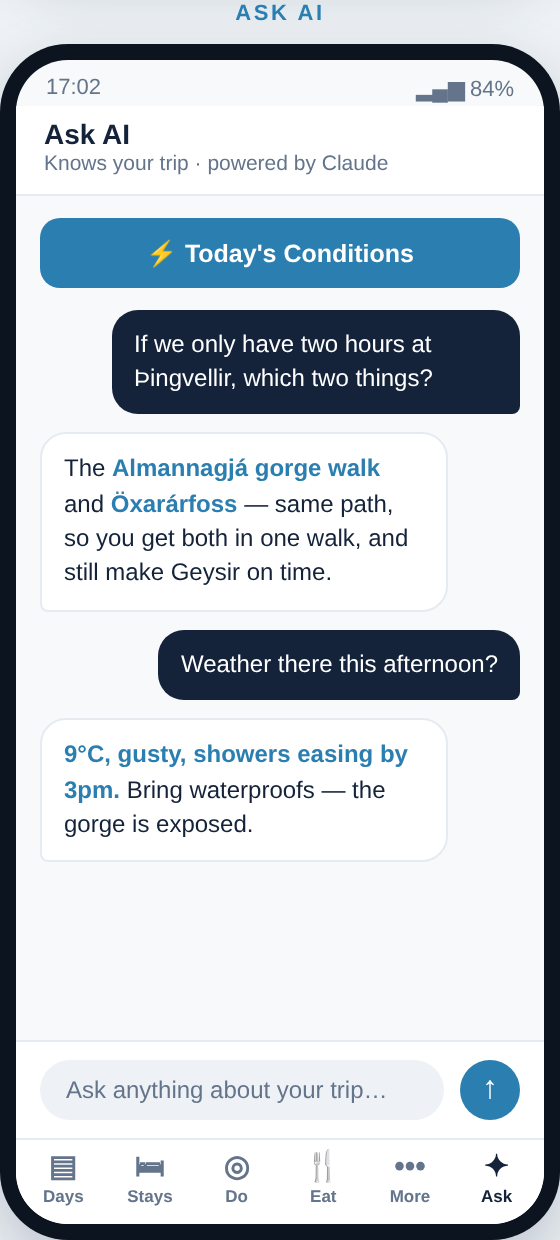
The day the plan broke, we had pinned our puffins on a clifftop stop and saw none. The useless question is where do you see puffins in Iceland. The one I asked was, we missed them, what is our real shot today, given where we are and what is still booked. One answer. A boat, a time, a place.
The difference was never that this AI was smarter. It was that it finally knew the one thing every other AI did not: our trip. That is the unfair advantage. Not an AI that knows more about Iceland than you do, one that knows your Iceland. Everyone else is asking a stranger for directions. You are travelling with someone who has already read the whole itinerary.
It is still there
Now that we are home, the live parts are quiet, but the whole trip is still on our phones, exactly as we did it, every day, every place, the map. It is not really an app anymore. It is the photo album that happens to be shaped like an itinerary.
I am shipping this early, and I want your feedback
One honest thing before I point you at it. This is early, and I am shipping it on purpose. The offline version and the deeper booking smarts are not done yet. I would rather put it in real hands, on real trips, and find out what breaks than polish it in private for another six months.
So here is the real app from our trip: iceland-itinerary.replit.app. Open it, walk the week day by day, and if Iceland is on your list, treat it as a starting map. Take the stops, the drive times, the picnic trick, and make your own notes. Then tell me what you would want for your own trip: what is missing, what you would change, what would make you actually use one of these.
I am improving it as I go, and I am honestly testing whether there is a business here at all. Your feedback is how I find out.
If you like me to help you with your next trip and build an app for you, or you want to know more about Iceland, feel free to reach out to me. I would love to talk to share with you my experience.
Visit juansalasromer.com if you like to learn more about my work and how I can help
I've found the same thing building systems.
People don't need more information.
They need the right information at the right moment.
Juan, Great memories for you and your family to have together. Technology made planning so much easier and interesting.