


Paid subscribers: at the end of this piece is the scorecard I use to rate each of these businesses for your own skills. Read to the end.
I spent most of my career in finance, real estate, and hotels. Not technology. So when Greg Isenberg shared 13 categories of businesses still worth building in the age of AI agents, something caught my attention.
Near the top of his list were businesses built around things I knew well: physical places, real assets, relationships, trust, and deep industry knowledge.
That surprised me. We hear so much about AI creating entirely new businesses that it’s easy to overlook the value of businesses that have been around for decades.
But as I worked through all 13 categories, I started noticing something else.
AI is making it cheaper and easier to do work that once took years to master. Research, analysis, marketing, customer service, even parts of running a business are becoming more accessible to everyone. I talked about this in a podcast with Maribeth Martorana (AI Is Changing How Companies Create Value, Not Just Jobs)
And that’s where things get interesting.
If everyone can do the work, what makes someone choose your business?
Think about your favorite restaurant. You don’t keep going back because the owner has better accounting software. You go back because of the food, the people, the atmosphere, and the experience you’ve come to trust.
Or think about the real estate agent who knows a neighborhood so well that people call her before a property even hits the market.
AI can help both businesses operate more efficiently. But it can’t instantly recreate what makes their customers return.
And here’s the uncomfortable part.
The work you’ve spent years getting good at might be the easiest part of your business for someone else to copy.
Your processes, your research, your proposals, even some of your expertise are becoming easier to replicate.
Your reputation, relationships, location, access, and place in a customer’s life are much harder to reproduce.
That distinction matters whether you’re running an established business or thinking about starting one.
So here’s a question worth asking:
Imagine a competitor opens tomorrow with the same AI tools, the same prices, and a free weekend to copy everything you do. What’s the one thing they still couldn’t take from you?
That’s what I wanted to understand.
I went through all 13 categories, looked at real companies making money in each, and identified six potential competitive moats that could help protect them.
Some are surprisingly accessible to someone starting from scratch. Others favor business owners who have spent years building something valuable without realizing just how valuable it has become.
Let’s look at where those advantages are hiding.
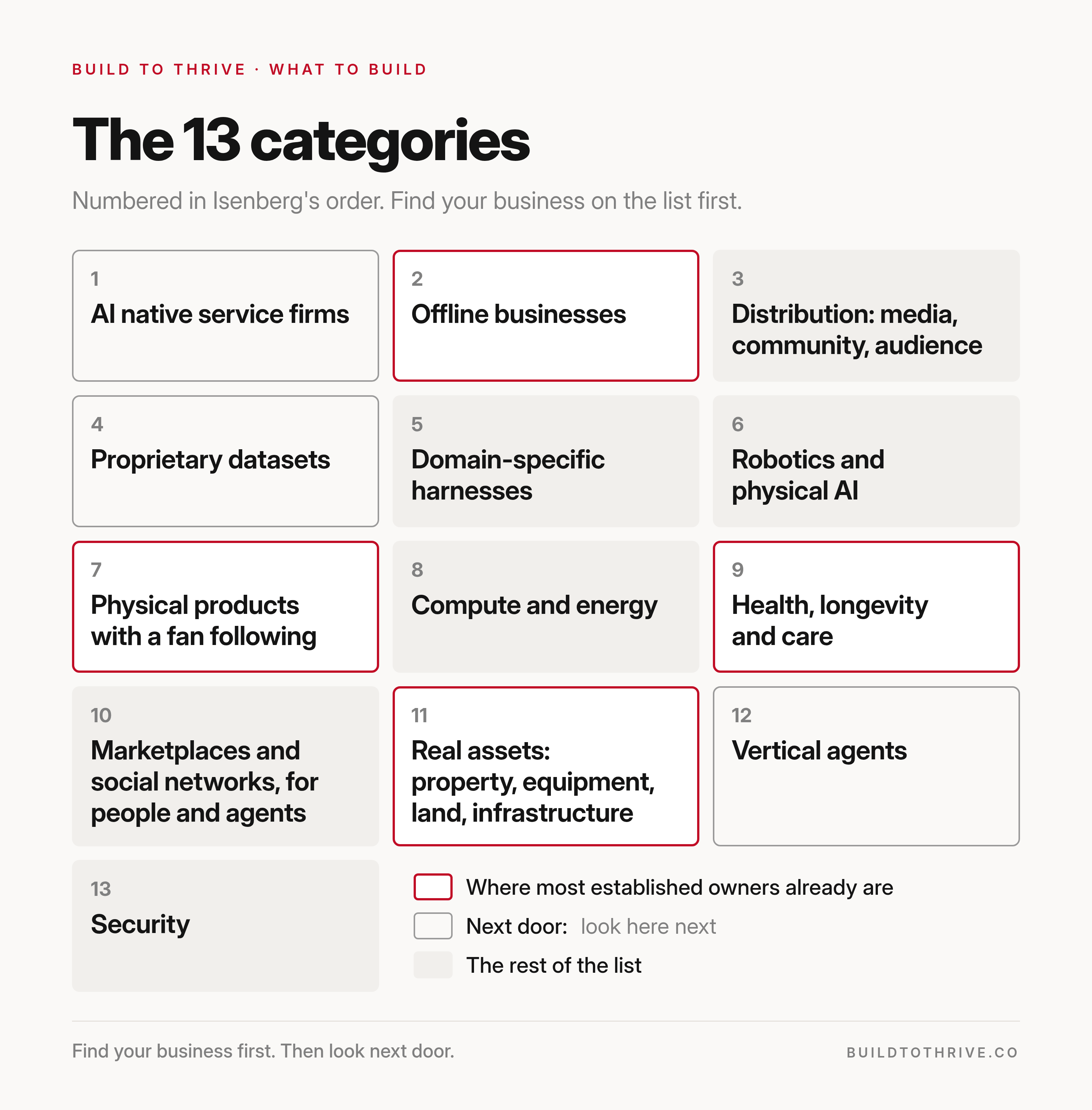
TL;DR
Greg Isenberg proposes 13 categories of business worth considering as AI agents change how work gets done. I used his list as a starting point (not an exhaustive forecast) and examined real companies, published prices, recent research, and potential competitive advantages. The pattern favors established owners: trust, footprint, know-how and customers.
What you’ll learn
The 13 categories, with companies, published transaction examples and business models
Recent research and company-reported numbers for each category
The six potential competitive advantages I use to assess these businesses, what each can earn you, and a first step for each
Why I went deeper on this list
Isenberg’s list caught my attention because it puts places, real assets, trust and industry know-how near the top.
For each category I looked for who is making money, how one sale is priced, what may protect it, and what recent research says about it. It builds on my April piece, 8 AI Business Models That Didn’t Exist Two Years Ago, and asks which you are already close to and what would make yours harder to copy. Isenberg posted the list on September 12 and walked through it in a 25-minute video on October 6. His post is the source of the framework, not proof that these are the only viable business categories.
The six moats I used
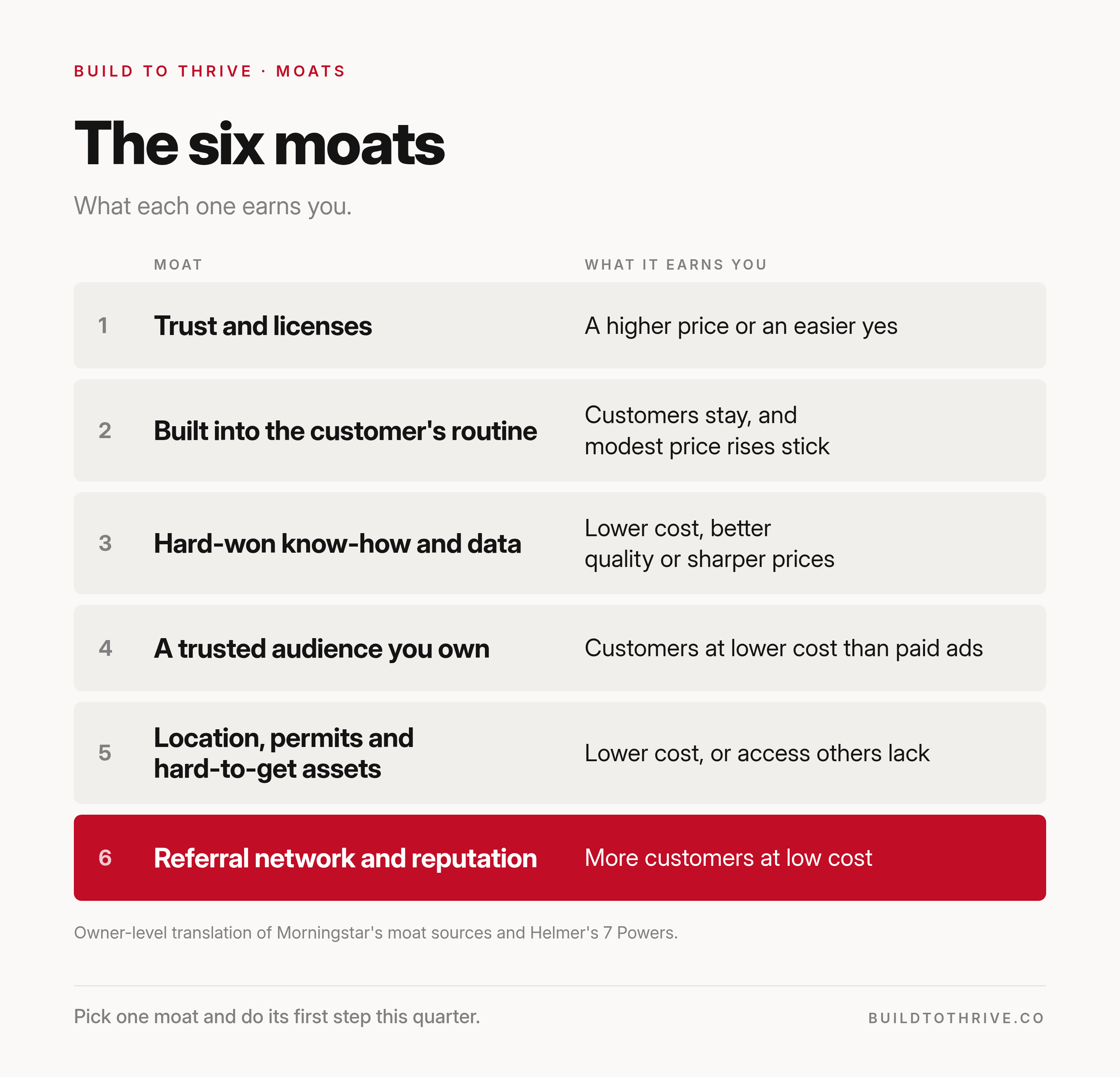
Across all 13, the businesses most likely to endure appear protected by some mix of six things. These are potential advantages, not guarantees: each one needs evidence of scarcity, switching friction, durable pricing power, or a structural cost advantage.
Trust and licenses
What it is: Customers, regulators or partners accept your signature or your word
What it earns you: A higher price or an easier yes
Why a rival can’t copy it quickly: Licenses, bonding and a track record take years and rules to earn
Closest classic moat: Morningstar: intangible assets. 7 Powers: Branding, Cornered Resource
Built into the customer’s routine
What it is: You sit inside their books, calendar or systems
What it earns you: Customers stay, and modest price rises stick
Hard-won know-how and data
What it is: Process skill and job history built over years that change your prices, costs or decisions.
What it earns you: Lower cost, better quality or sharper prices
A trusted audience you own
What it is: People who chose to hear from you directly and prefer you when they buy
What it earns you: Customers at lower cost than paid ads
Location, permits and hard-to-get assets
What it is: Scarce space, equipment, permits or sites that a newcomer would find difficult or slow to obtain
What it earns you: Lower cost, or access others lack
Referral network and reputation
What it is: Partners who send you work and a track record that brings more
What it earns you: More customers at low cost
These six are my owner-level translation of the moat frameworks investors use, chiefly Morningstar’s economic moat rating and Hamilton Helmer’s 7 Powers, adapted for a small business. Morningstar judges a moat by how long it can keep a company earning excess returns: more than 10 years for a narrow moat and more than 20 for a wide one. Helmer counts an advantage as a lasting power only when it has both a benefit and a barrier, which is why the table names both for each moat. Some of the six match the classic sources closely, with switching costs the cleanest fit, while a trusted audience is a looser translation for a small business. Each category below names the potential moats that may protect it.
How to read the evidence
Prices are published examples accessed on October 12, 2026, not market averages. Company operating metrics are attributed to their issuers and are not independently audited. Research findings apply to the populations studied. The moat assessments are my interpretation, not formal ratings from Morningstar or Hamilton Helmer.
The transaction blocks show published pricing and revenue mechanics, not complete unit economics. They do not establish delivery costs, customer-acquisition costs, contribution margins, retention, or profitability for a new entrant.
Here are the 13 in Isenberg’s order:
1. AI native service firms
A service firm that sells the finished result (books closed, a contract reviewed) where agents do most of the production and licensed people review and sign. Isenberg’s example: a bookkeeping firm for one business type where “the agents prepare the books, and then the human reviews exceptions.”
Who’s doing it
Integral (Berlin): AI agents plus licensed sign-off for SME accounting, tax and payroll (€18 million Series A in September).
Limetax buys stakes in practices and rebuilds delivery on ATLAS (€36 million equity-plus-facility raise in September).
Fearn is an AI-native patent law firm ($5.5 million seed) that files at a fixed fee (pricing below).
Arceus Legal quotes a flat price before each matter; a licensed attorney approves everything.
What the data says: Deloitte (August), surveying 501 U.S.-based leaders at organizations already piloting or implementing agentic AI, found that 15% reported scaled, orchestrated multi-agent adoption, while nearly two-thirds were reevaluating their business model for agentic AI. Limetax (September) cut first bookkeeping jobs from about twenty hours to six with human review still required; Integral (September) says agents prepare books end to end for more than half of clients while licensed pros still sign every filing. I found no recent study measuring whether AI-native service margins match software margins; ServiceTitan (September) notes a $2-$3 million near-term subscription headwind from how agentic Max upsells are recognized.
Related view: Reid Hoffman on Integral: “AI’s real promise is amplifying what people can do, not replacing them ... agents that multiply the reach of licensed professionals.”
Representative transaction: Fearn
Customer: a founder needing a U.S. utility patent filed
Problem it solves: conventional patent work is slow and billed by the hour
Offer: AI-assisted drafting with licensed attorney review and filing
Typical pricing: fixed $9,000 for a full application (fees included; fee refunded if no claims allowed); provisional $2,500
Value of one sale: $9,000 per full application (or $2,500 per provisional). Filings per client: not published.
Business models you could run: fixed-price packages for one client type, per-unit outcome pricing, or buy-and-modernize a practice.
What may protect it: Trust and licenses, Built into the customer’s routine, and Hard-won know-how and data from every exception a person reviews.
2. Offline businesses
The product is a room, a visit or an experience with other people. Isenberg’s line is that “you can have agents do a lot of the admin, but the room, the experience, is what people are buying.”
Who’s doing it
Othership, his example: social sauna and cold-plunge in Toronto and New York, with memberships, drop-ins and session packs (Isenberg says the first version was in the founder’s backyard).
Med spas as a membership version of the same idea (AmSpa August).
What the data says: In the sources reviewed for this article, I did not identify a major-firm trend report since July focused specifically on offline experience businesses. AmSpa (August) found members spent 2.5x non-members, median practice revenue up 19.2%, new-patient growth only 1.2%. Nearby caution: NRA data (September) showed full-service median pretax income down to 2.8% from about 4% in 2019.
Related view: Rich Shank of Technomic, on why rooms still matter: “There’s been this pretty strong re-emergence of the importance of experience, social occasions, and service.”
Representative transaction: Othership
Customer: an adult booking a guided sauna and ice-bath session
Problem it solves: wants a shared, facilitated thermal experience
Offer: drop-ins, memberships and session packs at social bathhouses
Typical pricing: NY drop-in $64; about $51 per session via membership on the same page; Flatiron Intro 2-week $135 for 14 sessions. Clear monthly membership total: not published on pages opened.
Value of one sale: $64 per NY drop-in, or $135 per Intro pack.
Business models you could run: memberships, prepaid plans, private events, or a cheaper pop-up before a lease.
What may protect it: Location, permits and hard-to-get assets (the space, lease and permits that slow new entrants) and Referral network and reputation with regulars and the neighborhood.
3. Distribution: media, community, audience
People who know you and pay attention when you speak. Isenberg describes it as an “audience, community, product” funnel, where the audience comes first and tells you what to sell. His reason is cost: early Facebook ads charged “5 cents a click,” and today he puts a click at “$3 $4 depending on who you’re trying” to reach.
Who’s doing it
From Boise is a free local newsletter with 25,400 subscribers that has brought in more than $123,000 so far this year, mostly from local sponsors ($107,000), plus a $16 dinner club about 120 people join each month.
This Is Raleigh sells advertising placements in its twice-weekly local newsletter to Raleigh businesses and posts its rate card publicly (below).
Community Impact runs more than 40 daily newsletters across more than 60 Texas communities; 1,234 businesses advertised in its CI Morning Impact in a single year.
Skool and beehiiv run many paid communities and newsletters. Skool charges owners $9 or $99 a month plus a transaction fee; beehiiv pays creators through its ad network and takes no cut of paid subscriptions.
What the data says: In an IAB survey of more than 200 brand and agency buyers (September), adapting to consumer behavior, including AI-driven search, was the top media investment challenge (44%), and optimizing content for AI-generated answers the No. 1 area of increased focus (76%). Gartner (September) notes customers “increasingly receive answers without visiting a company website,” which it calls “zero-click” experiences. Chartbeat’s 2026 Publisher Playbook, via Search Engine Journal (September), reports a 40.2% year-over-year decline in Google Search across its publisher network, after a 21.9% drop the year before. The accessible reporting cautions that it is unclear whether the decline measures referral pageview volume or traffic share, and that the network skews toward news and media publishers. A preregistered field experiment by Penn and Northeastern researchers (August preprint) found that assigning participants to an AI Mode-only search experience for seven days reduced external click-through rates by 18.8 percentage points compared with unmodified Google Search. Paid reach costs more in one ecommerce benchmark: across more than 40,000 brands, Triple Whale reports median Meta CPM up 13.24% from August 2025 to July 2026. CPM measures the cost of 1,000 impressions, not cost per click. beehiiv (September) counted 448 million AI crawler requests on its publications in 30 days, producing about 58,000 referrals.
What cuts against it: Money is not flowing mainly to owned lists. In the same IAB study, customer acquisition jumped to 63% as a goal while repeat purchases held flat at 24%, and creator and influencer partnerships led ad types with more focus (54%). Lists are also harder to grow: in Chartbeat’s data, loyal readers held steady while new readers fell 14% and returning readers 8%. These figures describe the publisher network in Chartbeat’s playbook, not all newsletters. Digital Content Next (July 28), summarizing beehiiv’s benchmark, reports the typical publication converts fewer than 1% of free readers to paid, the median price has sat at $10 a month since 2024, and subscriber lifetime runs from about six months in money newsletters to nearly 20 in food and drink. Most lists also sit on rented software, so pricing and rules can change under you.
Related view: Joseph Enever, Senior Director Analyst at Gartner, cautions against reading every traffic drop as lost demand: “Declining organic traffic may reflect a measurement failure, not a performance failure.” Chris Bruderle of the IAB frames the new question for marketers: “Now the question is becoming, ‘How do I reach a consumer who uses AI?’”
Representative transaction: This Is Raleigh
Customer: a Raleigh business promoting an event, a sale or a new opening
Problem it solves: reaching engaged locals directly, without a platform algorithm deciding who sees the post
Offer: advertising placements in a twice-weekly local newsletter
Published pricing, accessed October 12, 2026: a 12-month Feature package with two placements per month lists at $2,880; three- and six-month Feature packages list at $810 and $1,530. Other placement options and audience metrics were not independently verified from the page text.
Value of one sale: $2,880 for the published 12-month Feature package. Number of advertisers: not published.
Business models you could run: a sponsored local or trade newsletter sold by the send or by the year, a paid community, events, or pre-selling to the list. An established business can run its own list and sell slots to non-competing businesses that want the same customers.
What may protect it: A trusted audience you own, such as an email list people open and buy from, and Referral network and reputation earned by showing up consistently.
4. Proprietary datasets
Information only you have, built up by doing the work. Isenberg calls it a coming “gold rush for getting and acquiring data.”
Who’s doing it
Micro1, one of his examples, pays experts to produce training data and sells it to AI labs at a markup (per-unit list pricing not public).
Reddit licenses its user conversations to AI companies.
RSMeans is the contractor-facing version: construction cost data sold by annual subscription.
What the data says: Deloitte (August) names the lack of a unified, accessible data foundation as the top blocker to scaling AI agents, cited by 72% of leaders surveyed. Company-reported figures illustrate the market: Micro1 (August) reported a $500 million gross run rate; Reddit (July) reported Other revenue of $43 million, up 24%. Scarce data is also a breach target (Fortune July on a class action alleging Mercor lost about four terabytes).
Related view: Reddit CEO Steve Huffman: “In an increasingly automated web, the value of real human perspective has never been higher.”
Representative transaction: RSMeans Data Online
Customer: a contractor or estimator who needs construction unit costs
Problem it solves: building estimates without assembling every cost by hand
Offer: annual web subscription to cost datasets
Typical pricing: Core from $408/year (Site Work package) up to Full Library at $2,620/year
Value of one sale: $408 for one year of the lowest listed Core subscription.
Business models you could run: monetize your own job-cost data; pool peer benchmarks; or produce/grade data for AI buyers.
What may protect it: Hard-won know-how and data, when it changes your prices or decisions and is kept secure. Mercor is a reminder that a data moat without controls is a liability.
5. Domain-specific harnesses
Isenberg describes the AI model as the engine and the harness as “the tools it can access, the workflow rules, the memory, the checks.” It’s what turns a general AI into something that knows how one industry works.
Who’s doing it
Harvey, his legal example, sells an enterprise subscription to law firms and in-house teams; list pricing is not public.
ServiceTitan added agents to software contractors already run, priced by technician count plus usage; management said the full agent package can roughly double monthly revenue per customer (list dollars not published).
Toast launched agents on October 6 for scheduling, reviews, menus, offers and phone answering, built on each restaurant’s own sales, labor and guest data.
What the data says: Deloitte (August) found that 16% of surveyed leaders said business processes were prepared for agents (5% highly prepared), while 74% expected nearly half of processes to be redesigned around agents within four years. These are expectations, not observed outcomes. Harvey (September) raised $550 million at $15.5 billion, and ServiceTitan said Max now has more than 30 agentic capabilities.
Related view: ServiceTitan CEO Ara Mahdessian: “When routine coordination is handled automatically, leaders spend less time coordinating work and more time coaching people, serving customers and growing the business.”
Representative transaction: Toast
Customer: a restaurant needing POS, payments and agent-ready workflows
Problem it solves: running orders and front-of-house without a tool patchwork
Offer: cloud POS (agents sit on the restaurant’s own data)
Typical pricing: $69/month Point of Sale starting price; agent add-on dollars not broken out
Value of one sale: $69 per month for one location on that plan ($828 over 12 months at that rate). Hardware and processing: extra.
Business models you could run: SOPs as an internal harness; license the playbook; or power a category-1 outcome service.
What may protect it: Hard-won know-how and data and Built into the customer’s routine, sitting where the work happens.
6. Robotics and physical AI
Machines doing physical work, usually sold as a monthly service. For people who aren’t engineers, Isenberg suggests to “buy a few and rent it to people.”
Who’s doing it
Bear Robotics makes Servi, a robot that runs food and buses tables, sold outright or leased monthly (Bear also offers a 28-day trial).
Isenberg’s own example is window cleaning sold as a service to building owners, with the operator owning and running the robots.
What the data says: Gartner (October) says orchestrating physical AI at scale will deliver more value than individual machines, predicts that by 2035 AI that cannot physically interact with the world will be obsolete, and warns that true cost includes facility retrofit and software integration as well as hardware. On the floor, Restaurant Business (September) reported 40% of restaurants saw no cost benefit or higher costs from tech, and Technomic found only 23% of consumers find AI drive-thru ordering appealing.
Related view: National Restaurant Association chief economist Chad Moutray acknowledged that tech’s impact on costs is “not as high as I would have expected.”
Representative transaction: Bear Robotics Servi
Customer: a restaurant that wants help running food and bussing tables
Problem it solves: long carries burn server time on busy floors
Offer: Servi robot sold or leased as robot-as-a-service
Pricing: Bear says Servi can be purchased outright or leased monthly and offers a 28-day trial. A third-party reseller listing has reported $399 per month on a 36-month term and an $11,990 purchase price, but those terms were not independently verified for this draft.
Value of one sale: if the third-party reseller terms are current, $399 × 36 months = $14,364 over the lease, or $11,990 to buy one unit.
Business models you could run: lease a robot for a disliked task, own a small fleet, or become the local installer/reseller.
What may protect it: Location, permits and hard-to-get assets (local service and territory rights), Hard-won know-how and data from keeping machines running on site, and Built into the customer’s routine through service contracts.
7. Physical products with a fan following
Things people buy because they love the maker, the design or the story. Isenberg’s point is that AI design tools and cheap prototyping now make products viable that were “too niche before.”
Who’s doing it