


What makes a good offer?
I can’t believe I’m saying this, but these answers may sound impressive when someone asks what you do:
“I work in AI and help entrepreneurs.”
“I use technology to help business leaders make critical decisions.”
“I’m a tech geek. I take care of the parts of your company that could put you at risk.”
They sound good. But none of them is a strong offer.
About a year ago, a friend called me. He knew I had experience developing companies in different industries, and he wanted to ask how I decide which opportunities to pursue, and whether I’m the right person to build them successfully.
There’s a lot that goes into that decision. One factor is whether I have an advantage that others don’t, in a market where people are already making money.
Then he told me he was thinking about starting a company of his own. He had spent more than 15 years in corporate roles and was ready for something different. He was anxious about AI because some of the skills he was known for were becoming available through AI tools. At the same time, he was excited by the possibility of building a lean, scalable company with AI.
We ended the call. The following week, he called back.
“Juan, can you help me turn what I know into an offer people will buy?”
“Sure,” I said. “Let’s start with a clarity assessment.”
Your offer isn’t your job title or a list of the things you’re good at. It starts with the impact you can have in someone else’s life or business. What do people come to you for? What need or desire can you address?
A strong offer helps someone reduce a risk, grow, or reach a better position.
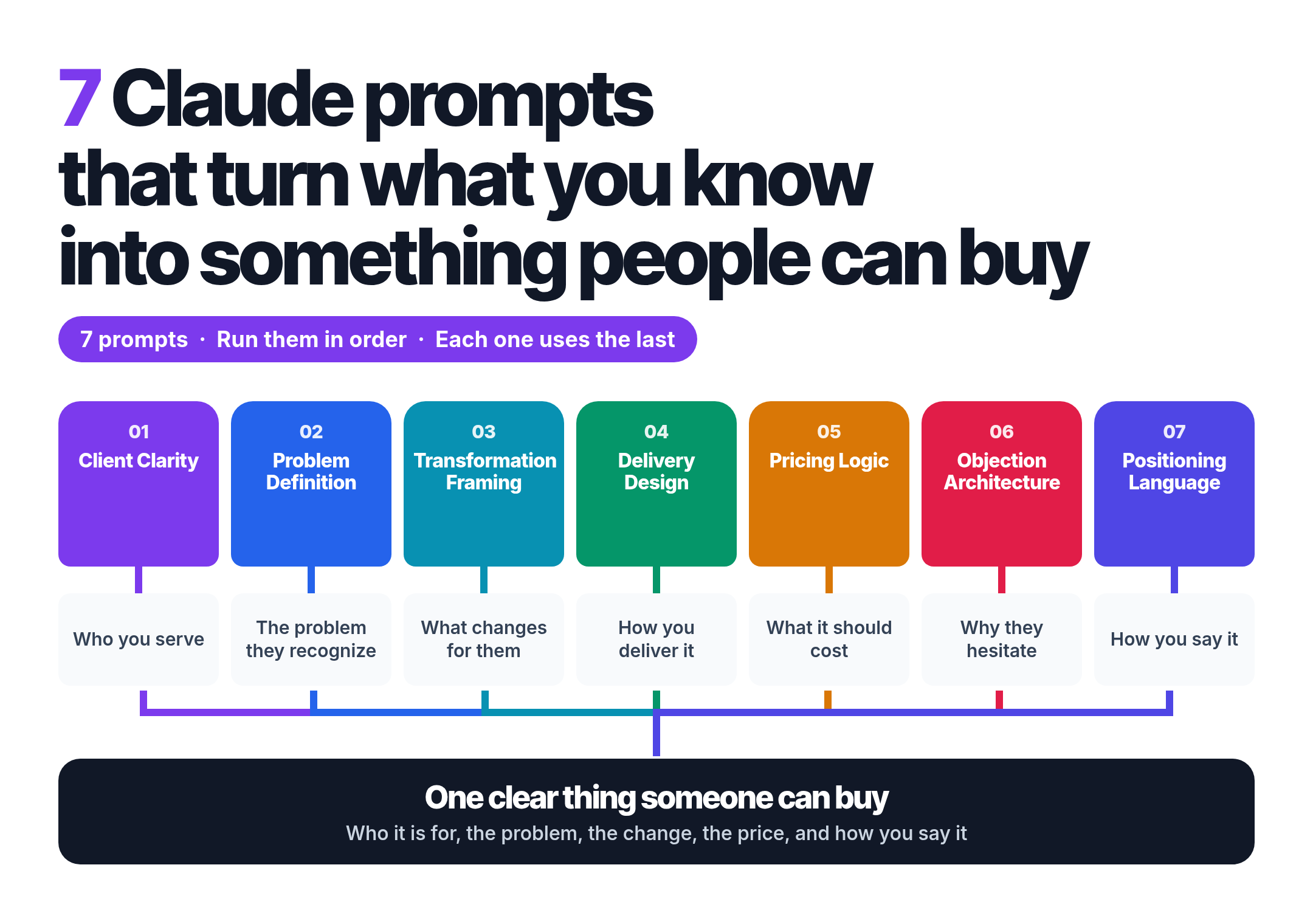
Since that conversation, I’ve worked with many professionals like my friend. I’ve developed a sequence of seven prompts to guide them through the process of turning their experience into a thoughtful offer.
Working through the prompts carefully can take two hours or more. Some people prefer to do the work on their own, then come to me for coaching and follow-up. Others want me alongside them at every step. I address this later in the article.
This time, I wanted to open these prompts to my paid subscribers because I’ve seen how much it can change the way professionals think about their experience, their value, and the offer they bring to the market.
Here are the 7
The buyer, the price, or the words
When an offer isn’t clear, it’s usually stuck on one of three decisions. The buyer. The price. Or the words.
The buyer is who you serve, written in their language. If this is stuck, your bio could describe ten different people. You can do the work. You just can’t point at one person and say, that’s who this is for. Client Clarity and Problem Definition work on this first, because everything after it depends on it.
The price is built from the value of the change, not from your hours or from what other people charge, plus the reasoning so you can stand behind it. If this is stuck, the number is a guess. You know what you’d like to charge, and you can’t explain why. Pricing Logic is the prompt for that. It comes after you can name the change, and how you deliver it.
The words are a sentence under 25 words: who it is for, the problem, and what changes. Then a three-sentence description, and a one-line version for a bio or an intro. If this is stuck, you can do the work, but when someone is interested and hesitates, you’re not sure what to say. Or every version of the sentence sounds like it could belong to anyone in your field. Objection Architecture and Positioning Language come last, so the sentence is built on decisions you already made.
If you feel like rewriting the sentence again, check the buyer first. If that’s still fuzzy, the sentence has nothing solid to stand on.
Write it down before you touch a tool
That’s the test. Take a blank page and write three things, in one sitting.
Who this is for, in their words, including the moment they start looking for help. One paragraph.
What you charge, and why that number matches the change in their world, not your hours.
One sentence, under 25 words: who it’s for, the problem, and what changes.
Then read what you wrote.
The buyer is stuck if the paragraph could describe ten different people, or if you couldn’t name the moment they start looking.
The price is stuck if you wrote a number and couldn’t write the why, or if you never wrote a number at all.
The words are stuck if you don’t have a sentence you’d actually say when someone is interested and hesitates.
You might have trouble with more than one. Start with the first one that broke. The buyer comes first for a reason. If that’s fuzzy, the price and the words are built on a guess.
The seven prompts walk those decisions in order. The full sequence is for paid members.
Try it this week
Write the three things on a blank page, in one sitting. Read which decision broke, and start there. If you go through the sequence, give it two hours or more, and finish each prompt before you start the next.
This article is the prequel to another one I wrote, Before You Build the Offer, Run a Market Check. That one is where you test the offer, and find proof it could get traction.
Like I said before, some people I work with like to go solo and reach me at the end for coaching and follow ups. Others like me to go on the journey with them. So here is the deal: if you become a paid subscriber, I’ll include your first session with me as part of it. Only $117 a year, about $9.75 a month.
Here are the prompts.