


Hey! Juan here. Thank you for reading Build to Thrive, the newsletter for operators and professionals turning hard-won experience into leverage, income, and opportunity in the AI economy. More than 5000 of you read along each week.
I’ve spent most of my career building businesses, advising founders, and trying to figure out the same thing most entrepreneurs eventually run into:
How do you build something that grows without requiring more and more of you? AI has changed what’s possible. One person can now research, create, sell, serve clients, and operate with capabilities that used to require a much larger team.
But that’s also created a new problem. There are thousands of AI tools, prompts, agents, workflows, and opinions about what you should automate next.
I don’t think the answer is more AI. AI isn’t the destination. A better business is.
Most entrepreneurs start the same way: they are good at the craft, so they open the shop, and for a while that is enough. Then loving the work and running the company turn out to be different jobs, and the week fills with fires, so the time to think about growth shrinks to almost nothing.
Before AI, a shared inbox and a good checklist could only take you so far. By 3pm you were still hunting the same email, re-explaining the same scope, walking the same task from person to person by hand.
That tension, between the craft you love and the company you now have to run, isn’t new. What’s new is a way to close part of that gap without hiring your way out of it. Done right, AI doesn’t replace your judgment, it buys back the hours the fires were eating, and often the money too, so the growth you’ve been meaning to get to actually earns a slot on the calendar.
The fires don’t stop on their own, and you can’t out-work a business that has no clear picture of where the time is actually going. If you are still trapped in the fires with no room to think about growth, this piece walks through the method, one room at a time, then shows you how Sage runs that diagnosis with you tonight.
You already sense the drag. You need a method, not a hunch.
Most business owners already sense where the drag is. It’s the task you dread. It’s the thing you do the exact same way every single week and think, “there has to be a better way.” The mistake isn’t a lack of awareness; it’s a lack of structure around that awareness. You need a method, not a hunch. Here it is, and you can run this yourself with nothing but a notebook.
1. Name the room. Not the whole business, one department or function. If your answer sounds like a slogan, or doesn’t match where your actual hours went last week, rename it and say why in one sentence.
2. Get specific about the task. Not “customer service is slow,” the exact recurring task. Walk through one real, recent example step by step: what triggered it, what you actually did, what happened.
3. Map the dependencies. Most bottlenecks aren’t one broken task, they’re a handful of parts that are supposed to talk to each other and don’t. List the systems, people, and information sources involved. For each one, does it connect automatically, or does a person manually bridge the gap every time?
4. Find where it breaks, and how often. Not “sometimes,” a real frequency. This is usually where the actual leak lives, not the task itself, the specific point where the handoff fails.
5. See the loop. Ask what happens after it breaks. Does it change how you or your team behaves going forward, extra double-checking, a workaround that’s become permanent. That’s the difference between a one-off annoyance and a pattern that quietly keeps costing you.
6. Cost the leak. Hours per week the task consumes, times what that time is worth. One sentence: “this job costs about $X a week.” That number is your ceiling, and here’s a concrete rule of thumb whenever you work with an AI advisor. Never pay more than 20% of the annual savings that you will get for the AI system. This is a rule of thumb and the way I price my work. Put another way, you should be making at least five times in annual savings compared to what you are getting charged.
7. Split chore from judgment. Go through your step map and mark each one CHORE or JUDGMENT. Hard rule, no exceptions: price, fit, the yes, relationship language, blame, and the send are always JUDGMENT. Never hand those to a system, no matter how tempting the automation looks.
8. Define done. One outcome, by when, one number. Not “make it better,” a finish line you’d actually know if you hit.
9. Pick one fix, prove it. One chore step, run on five real live items. You still decide. You still send. No new tools, no second room, not yet.
Where This Falls Apart Alone
Here’s the honest part. Steps 3 and 7 are where most people quietly cheat, not out of laziness, but because the brain fills gaps faster than it admits them. You already half-know your dependencies, so instead of naming them specifically, you say “it’s kind of a mess over there,” which sounds like an answer but isn’t one. And judgment steps get relabeled as chores because “just automate it” feels like progress, even when the step in question was the send, or the yes, or the price, the exact things that were never supposed to move.
That’s the real reason most business owners get as far as “I know something’s wrong over there” and stop. Not a lack of insight, a lack of something holding them to finishing the thought.
Talk to Sage
Most bottlenecks aren't one broken task, they're a handful of interdependent moving parts, and untangling that on your own, while you're also running the business is often times very challenging. One way that has helped me and my clients think clearly is by having a conversation that can guide them through diagnosing and defining the system or function that needs to be intervened. To do this systematically I created Sage. Sage is my Voice agent, and her job is to walk you through this exact method in a real, ten-minute conversation and won’t let “kind of a mess” stand as an answer. If a response is too vague, it’ll ask the same question a different way until you land on something specific. It pushes for the one real recent example, maps the dependencies with you, and holds the same hard rule on judgment steps that the method does.
One thing it deliberately doesn’t do: pitch you anything. No tool names, no recommended platform, no “here’s your fix” mid-conversation. Its only job is to get the diagnosis right. It’ll only attach a number to the problem, hours per week, and a dollar figure if you name a rate, if you actually say it out loud yourself. It never invents one.

The Report You Get Back
Before the call ends, Sage reads the whole picture back to you in your own words and asks you to confirm or correct it. Nothing moves forward until you say it’s right.
What comes back isn’t a transcript, it’s a structured report:
The problem, in your own words. The room, the task, the specific example, how often it breaks, hours a week, exactly as you said them.
Where the dependency actually breaks, named specifically, not a vague “communication issue.”
What has to stay judgment, in your words, so nothing gets automated you never agreed to hand off.
What done looks like, based on the finish line you set.
The real cost, using only the numbers you confirmed. No invented dollar figures, nothing rounded up to sound worse than it is.
What’s still open. If something never got specific enough, even after a few tries at asking differently, the report says so instead of quietly filling the gap.
That report is the actual deliverable. Take it to an AI consultant, hand it to your own team to implement, or use it as your build spec if you’re doing this yourself. If you’d like me to review your report and recommend specific tools and solutions, I’m offering a free fifteen-minute assessment. Your report comes with a link you can use to set up that call.
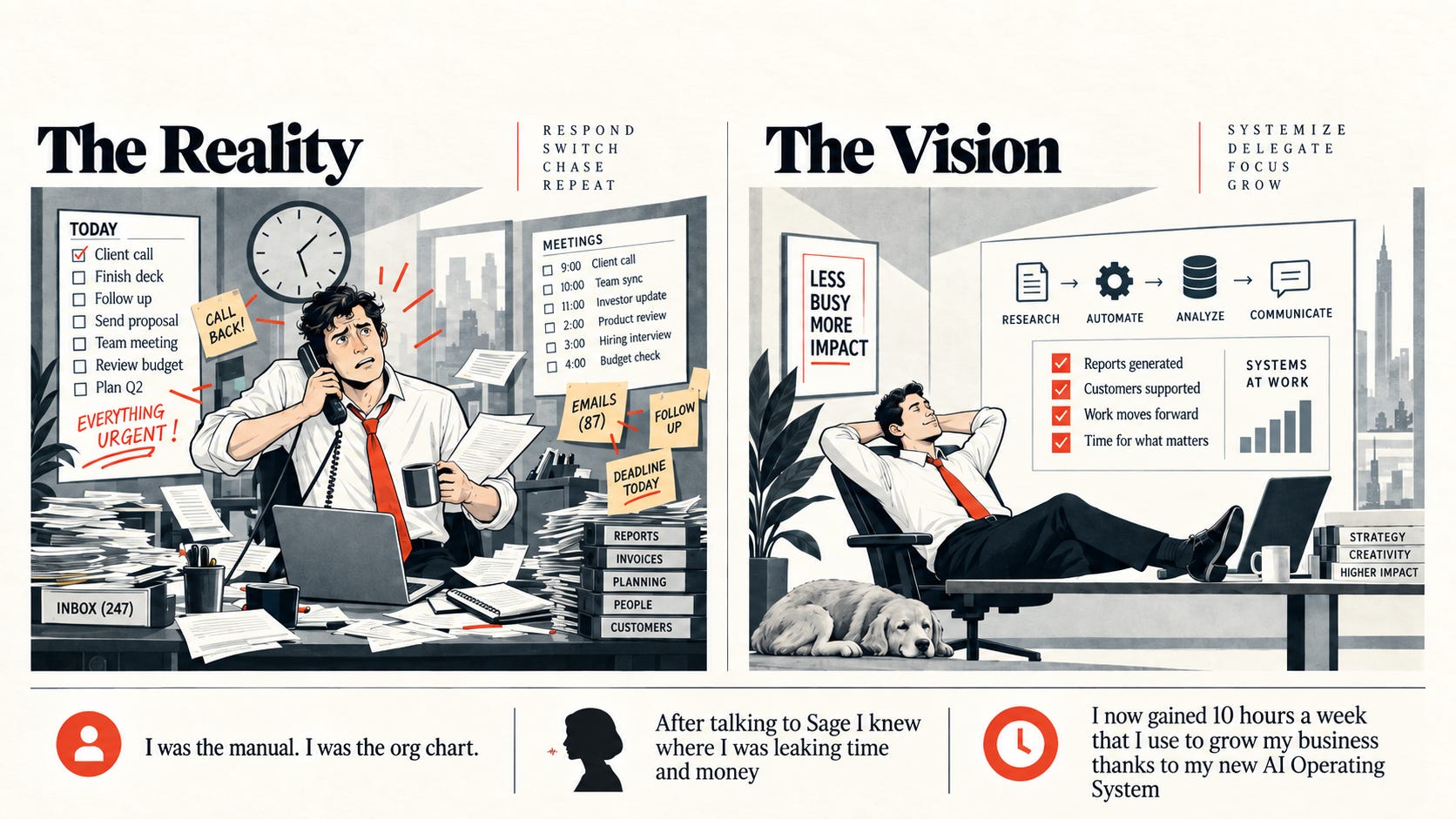
Just Start the Conversation
You don’t need an AI strategy document or a six-month roadmap to get moving. You need one honest look at what’s actually costing you time and money, walked all the way through instead of half-thought. Name the room, cost the leak, split chore from judgment, and prove one fix, whether you run that with a notebook or let Sage hold you to it.
If you’ve got a task that’s been bugging you for months, that’s the one to start with. Talk to Sage, and get the picture in front of you, finally, complete. The fires won’t ever fully go out, but every hour you win back from one is an hour that belongs to the growth you started this for in the first place.
Build smart. Build with purpose. Build to Thrive.
Juan
The “won’t let a mess stand” part is the hard bit to build.
We do insurance claims by voice, and the same problem shows up. Someone says, “I dropped my phone,” and that can mean: I dropped my phone on the floor and the screen is cracked, or I dropped my phone off a mountain. 🙂
The sentence sounds complete. A human knows how to follow up naturally. An AI agent needs training to get it right.
Costing the leak in real dollars is what actually makes people act on it.