


Build to Thrive is for professionals stepping into entrepreneurship and founders who need clarity, operating leverage, and practical paths to monetize in the AI-driven economy. As a subscriber you get deep dives, timely insights, and operating systems that shape tomorrow’s business. As a paid subscriber you unlock all articles, gain access to our library of tools and become part of our active community of more than 4000 aspiring entrepreneurs and founders.
Editorial Note
Hello folks
I hope you all had a wonderful New Year’s Eve. I wish this year brings you all you need, enjoying good health, moments filled with meaning, and the comfort of being surrounded by your loved ones.
The start of a new year invites reflection across all areas of life. I find myself grateful for the good that unfolded last year, and especially for the people who played a part in it. This is also time try to learn from what didn’t go well. Last year was very particular, as I sold my business at the beginning of the year and started creating content with no clear compass. In this article The Year I Stepped Into a New Identity I give a brief recount of my journey.
This is the 21st edition of the Blueprint and the 22nd week since I started it. It is a commitment to my readers who have supported me along the way with their feedback and a commitment to myself to continue improving the quality of the content and tools that help you deliver results.
So what’s in store for this week?
I’ve been noticing a quiet shift over the past few months. AI isn’t just helping us work faster anymore. In many cases, it’s finishing the work for us. And that changes the job in ways most founders haven’t fully absorbed yet.
Clarity is no longer about productivity. It’s becoming judgment support. When systems can execute on their own, the advantage shifts to deciding what deserves execution at all. The real change isn’t hours saved; it’s how quickly decisions now turn into outcomes.
That’s why this edition includes a curated snapshot of five automation and leverage trends worth paying attention to.
The same shift shows up in strategy segment of this edition. When routine thinking is handled by software, advantage accrues to founders who can frame problems precisely and own the consequences. This week’s signal reflects that reality.
The narratives are changing too. Markets are no longer rewarding AI promises. They’re rewarding proof. Durable earnings. Real margins. ROI matters again.
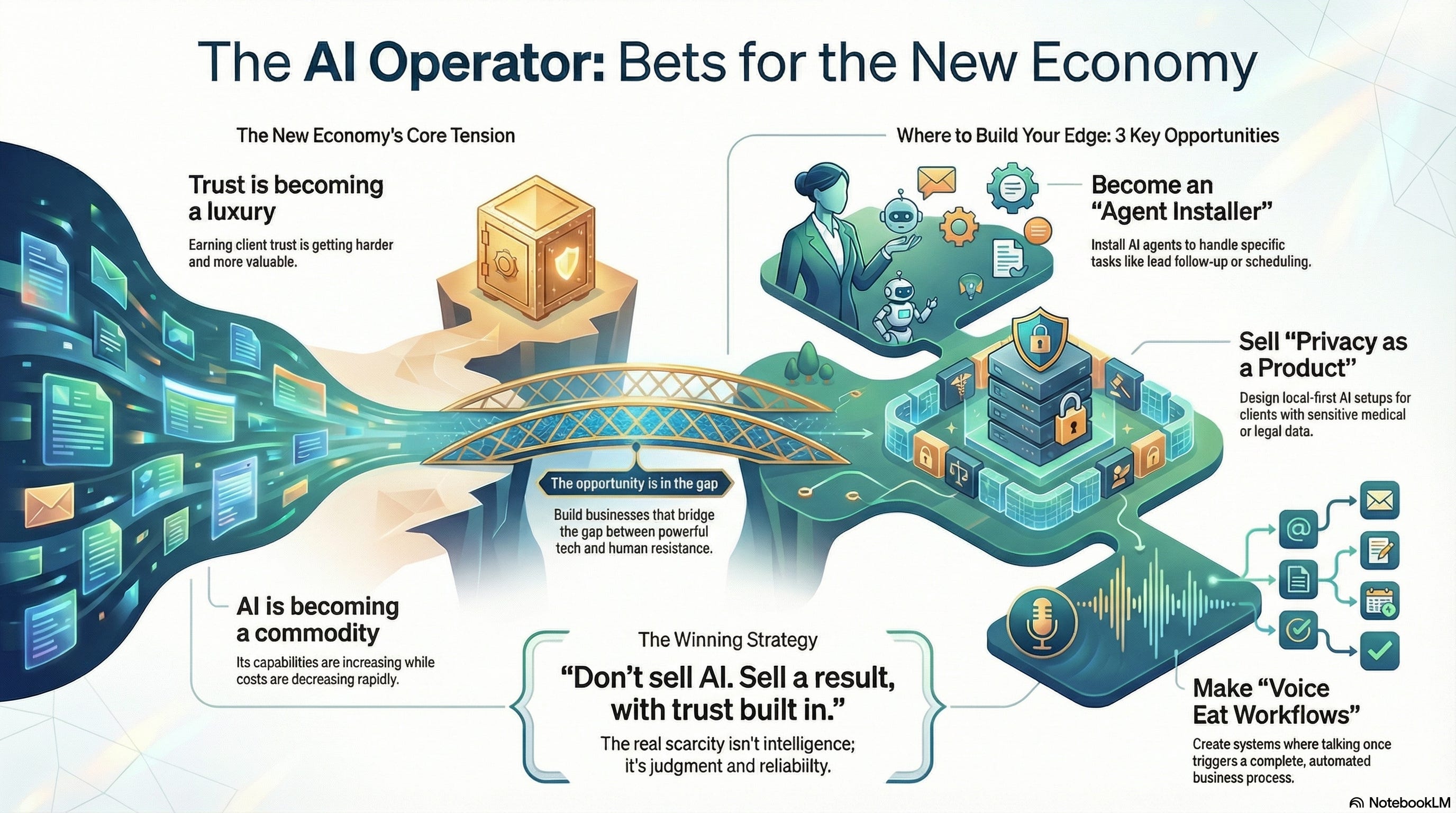
The featured article presents seven near-term AI opportunities where founders win by selling outcomes and trust, not tools, hype, or predictions.
Underneath all of this is an outdated belief I’ve had to unlearn myself. Better tools don’t reduce the founder’s burden. They concentrate it. As execution friction drops, the cost of unclear intent rises, in other words, when execution becomes cheap, discernment becomes the business.
Hope this edition earns your time, and as always, I’d love to hear what you want me to explore next.
JS
Table of Contents
Clarity Prompts
The Technical-to-Human Copy Translator
The Competitive Intelligence Prompt
The Noise Filter
Featured Article: 7 AI Small Business Opportunities for 2026
AI Automation Leverage
Practical automations that increase output without adding headcount
Strategic Terrain
How AI is reshaping operating models and competitive advantage
AI Capital Market Narratives
The stories shaping risk, margins, and valuation
Clarity Prompts
This week’s Clarity Prompts focus on three moments where founders often lose clarity: thinking, deciding, and explaining.
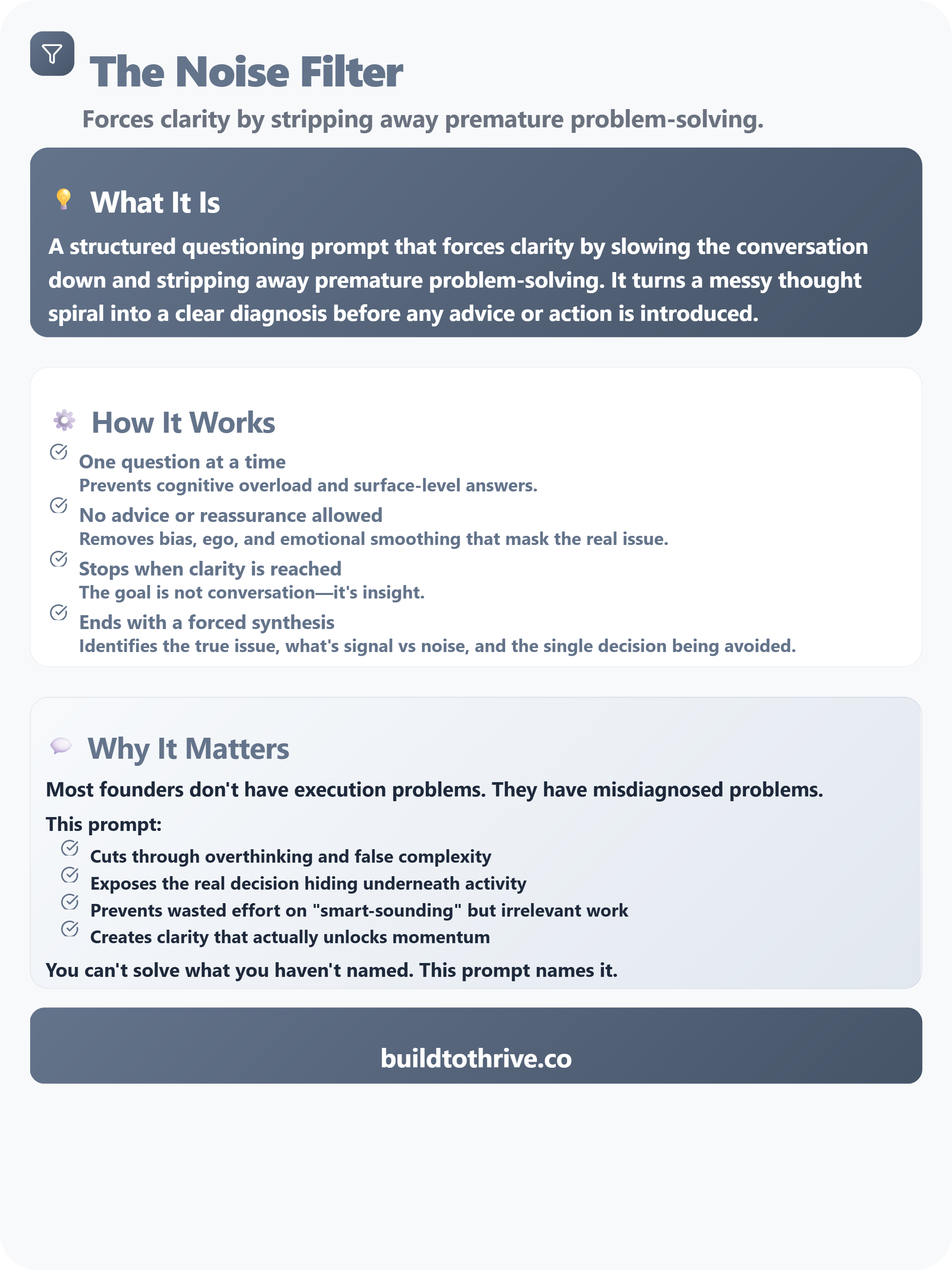
The first prompt helps you cut through noise. It slows the conversation down and strips away premature problem-solving so you can see what actually matters and name the real decision in front of you.
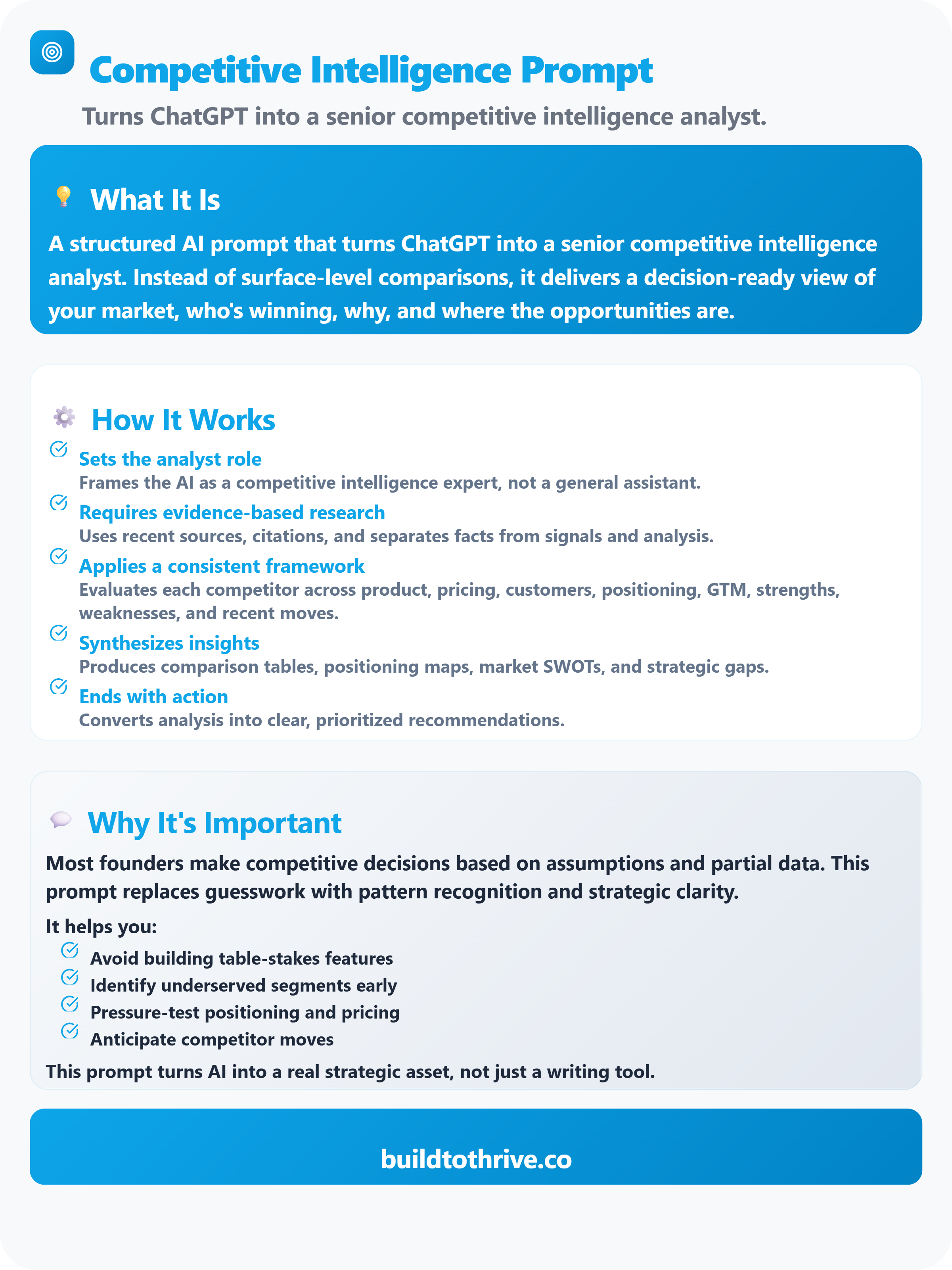
The second sharpens competitive judgment. It moves you past surface-level comparisons and helps you understand who’s winning in your market, why, and where opportunity or risk is truly emerging.
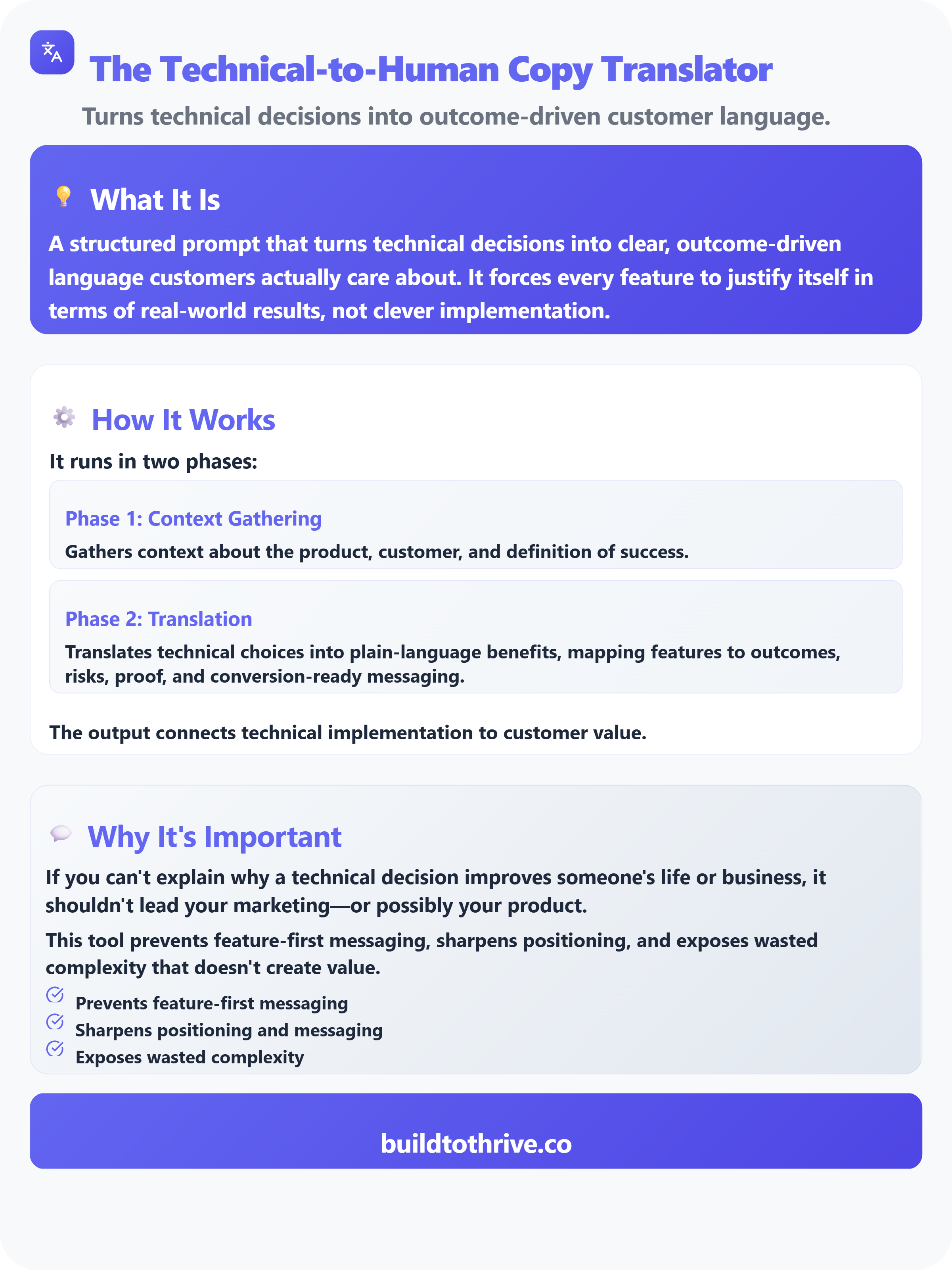
The third focuses on expression. It translates technical choices into clear, human language so your work communicates intent and value, not just information.
Together, these prompts help you think more clearly, decide with evidence, and communicate with purpose.
The Technical-to-Human Copy Translator
By Dan Cucolea
Vibe Stack Lab is a free newsletter for developers using AI to build modern web apps faster without getting lost in tutorials that overpromise and underdeliver.
It shares the practical knowledge most docs and blog posts skip: short, time-respectful tutorials, tools and AI models that actually improve vibe coding, prompts that work in real projects, and curated resources worth paying attention to. Everything is focused on helping you ship, not just learn.
If you already know the basics of JavaScript and web development and want to level up your AI-assisted workflow, Vibe Stack Lab is designed for you.
COMPETITIVE INTELLIGENCE PROMPT
One Million Goal is a public build-in-the-open journey by Marco Santonocito.
After selling a scrappy side project for €220K and spending years as a CTO and CPTO, Marco stepped away from the corporate path to build again—solo, with no investors and no big teams. Just one laptop and a clear goal: reach €1M in revenue by creating digital products in public.
The newsletter documents the process honestly. The ideas that work, the ones that fail, and the lessons learned along the way. It’s grounded in the belief that AI is democratizing entrepreneurship, making it possible for anyone, anywhere, to build something valuable—fast.
If you’re curious about modern, solo-first entrepreneurship and want a front-row seat to what it really takes to build, One Million Goal shares the journey step by step.
THE NOISE FILTER
whatisthat.ai | AI Tool Report is an independent newsletter and data platform that tracks what’s actually happening across the AI product landscape.
Built for builders, investors, and operators, it goes beyond tool lists by continuously scanning the web, analyzing traffic and search data, and surfacing real market signal, launches, traction shifts, pivots, and quiet failures.
If you want a clearer view of where the AI ecosystem is really moving, this newsletter maps the terrain.
Featured Article: 7 AI Small Business Opportunities for 2026 by Juan Salas-Romer
AI Automation Leverage - Grow Margins
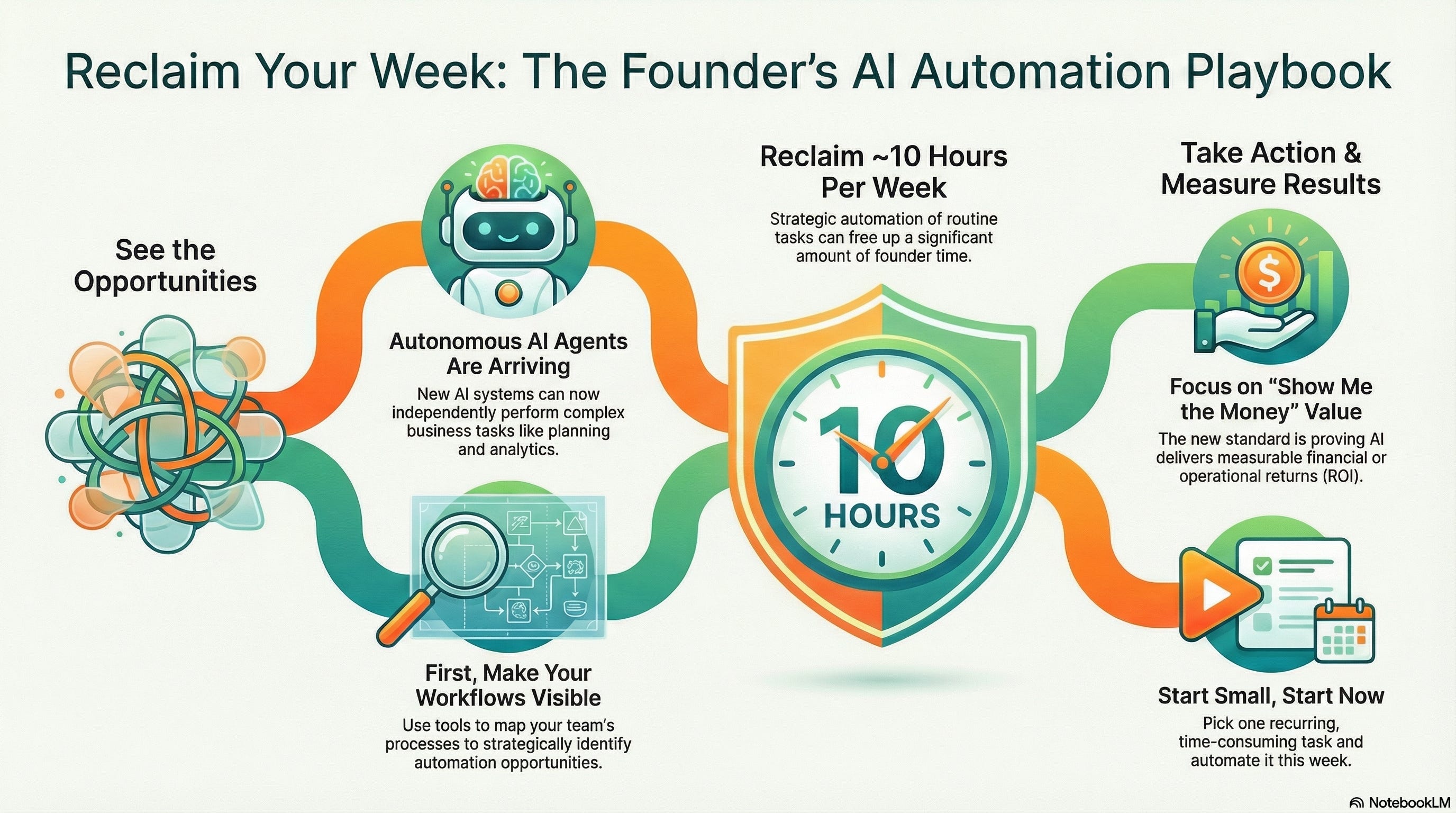
A weekly snapshot of practical AI automations founders can deploy immediately to increase output without adding headcount
This week’s AI landscape is pushing real automation beyond experimentation and into execution for small teams. From Big Tech’s aggressive moves in general-purpose AI agents to tools that spot workflow inefficiencies, the message is clear: founders can automate more of the repetitive work that eats capacity while keeping headcount stable. Small teams must deploy the right tools in real workflows now to gain measurable time and cost savings.
Trend 1: Meta’s Acquisition Signals Agent-Powered Automation for All.
Meta buys Manus to accelerate autonomous AI agents
Meta acquired AI agent startup Manus for over $2 billion, betting on AI systems that can independently perform complex tasks like analytics and planning. (TechRadar)
Practical Takeaway: Explore early-stage autonomous agent platforms or beta tools that act on your behalf (e.g., research summaries, automated data pulls) to reduce repetitive work.
Trend 2: Workflow Visibility Becomes the First Step to Automation
Scribe raises $75 million to help companies document and optimize workflows
Scribe’s tools auto-capture and document workflows and now suggest where AI can improve processes, making automation more strategic than ad hoc. (Business Insider)
Practical Takeaway: Use workflow recording tools this week to map high-friction tasks and identify automation opportunities before buying subscriptions.
Trend 3: AI Workflow Automation Tools Dominate Implementation Choices
Best AI workflow automation tools guide shows where automation delivers quick wins
Recent guides list top AI workflow automation tools that handle tasks across apps, from emails and CRM to scheduling and customer support. (HubSpot Blog)
Practical Takeaway: Pick one AI workflow tool (e.g., a no-code integrator with AI triggers) and automate a core process like follow-ups or ticket tagging.
Trend 4: Strategic Focus on ROI and Practical Value
2026 is shaping into the “show me the money” year for AI adoption
Analysts say that beyond model hype, companies must prove AI actually delivers financial and operational returns. (Axios)
Practical Takeaway: Start measuring time saved or costs cut with every AI automation you introduce so you can iterate based on measurable ROI.
Trend 5: Automation Saves Founders Time That Small Teams Can Reinvest
Small business report shows AI automation can reclaim approx. 10 hours per week
New analysis indicates strategic AI automation can free significant time across scheduling, support, and content tasks. (FinancialContent)
Practical Takeaway: Identify one recurring task that costs you hours weekly and automate it with an AI tool this week to reclaim founder time.
Why It Matters
This week’s developments show AI automation moving from experimental to operational, with tools and investments aligning around agents and workflow optimization. Founders who use AI to document processes, identify bottlenecks, and execute automation will outperform peers because they free time from routine work. The emphasis on measurable ROI means early adopters can avoid wasted spend and focus on the automations that truly increase capacity without headcount. Small teams that act now with practical tools will compound these advantages over the year.
Founder Reflection
What repetitive task that costs you hours every week could you fully automate this month with today’s AI tools?
Strategic Terrain - Decide Smarter
A weekly map of how AI shifts the ground beneath how companies build and compete.
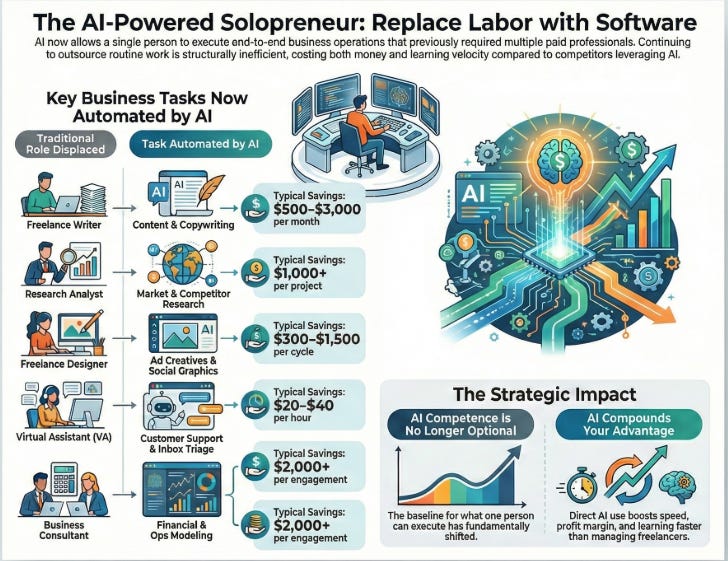
The biggest change this week is that one person can now execute end-to-end business ops that used to require three paid humans. Solopreneurs and micro businesses are still overpaying for writing, research, basic design, scheduling, and first-pass analysis that AI now does instantly. Every week you delay, you lock in higher costs and slower execution than competitors who already replaced labor with software.
Signals
Content drafts no longer require a writer
Task replaced: blog posts, emails, landing page copy
Saved: $500–$3,000 per month or 10–20 hours
✔ Many AI tools today (ChatGPT, Jasper, Writesonic, etc.) generate blogs, emails, landing page copy, and marketing content that previously required paid writers — reducing labor, time, and cost. mycaribbtech+1
✔ AI content creation dramatically speeds up writing and reduces manual workload in business content workflows. SonixMarket and competitor research no longer needs an analyst
Task replaced: summaries, comparisons, positioning docs
Saved: $1,000+ per project or days of turnaround✔ AI research tools today can summarize, extract insights, and assist with analytical summaries across topics and competitive landscapes. Paperguide: The AI Research Assistant
✔ Fast AI utilities handle broad info synthesis tasks that used to require human research time. Fast CompanyDesign mockups no longer require a freelancer
Task replaced: ad creatives, social graphics, pitch visuals
Saved: $300–$1,500 per cycle
✔ AI-powered design tools (e.g., Canva AI design features, generative visual tools) are explicitly highlighted as replacing freelance design for many tasks. Wisp Willow+1
✔ Articles on AI replacing freelance design work show wider adoption among solo professionals who use AI to generate visual assets. mycaribbtechCustomer support and inbox triage no longer need a VA
Task replaced: first responses, categorization, FAQs
Saved: $20–$40 per hour continuously
✔ AI chatbots and support automation tools handle initial responses, categorization, and FAQs much like a virtual assistant. mycaribbtech
✔ Solopreneurs use AI to automate administrative tasks without ongoing VA costs. Wisp WillowBasic financial and ops modeling no longer needs a consultant
Task replaced: forecasts, pricing scenarios, KPI tracking
Saved: $2,000+ per engagement
✔ Multiple sources on AI increasing productivity include tools that automate forecasting, KPI tracking, and scenario analysis — tasks historically done by consultants. Wisp Willow
✔ AI business assistants and plan generators aim to replace manual planning and consulting workflows. arXiv
Why It Matters
AI competence is now assumed at the solo level, not optional. The baseline for what one person can execute just jumped, which means hiring humans for routine work is now structurally inefficient. Owning execution with AI compounds speed, margin, and learning in a way rented labor cannot.
How It Affects Solopreneurs and Small Teams
The leverage just expanded across marketing, ops, and decision support at once. Execution quality improves faster when one person iterates directly with AI instead of managing freelancers. Continuing to outsource now costs you margin and, more importantly, learning velocity.
AI Capital Market Narratives - Move Early
A concise snapshot of the AI narratives currently shaping how markets, media, and institutional investors are reframing risk, margins, and valuation
Top 5 AI Narratives
AI Is Becoming a Capital-Cycle Story, Not a Growth One
What authoritative voices are saying. Bloomberg and WSJ coverage increasingly frame AI investment as sustained capex that pressures free cash flow and resets return expectations for US megacaps.
What critics are arguing. Bulls argue balance sheets and operating leverage make current spend manageable.
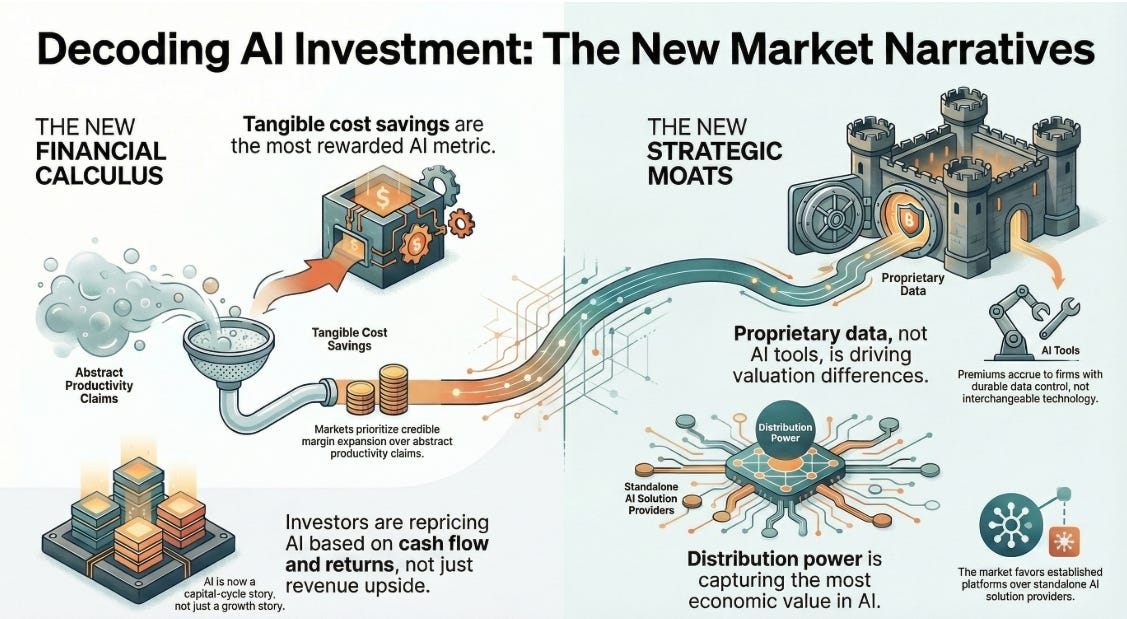
Signal: AI exposure is being repriced through ROIC, cash conversion, and equity duration, not revenue upside.
Cost Takeout Is the Only AI Metric That Matters Right Now
What authoritative voices are saying. US executives and strategists emphasize AI-driven SG&A efficiency as the clearest near-term earnings lever.
What critics are arguing. Productivity gains often stall before reaching the income statement due to execution and labor dynamics.
Signal: Markets reward credible margin expansion, not abstract productivity claims.
Proprietary Data Is Quietly Driving Valuation Dispersion
What authoritative voices are saying. Bloomberg Intelligence and sell-side research highlight exclusive datasets as the most defensible AI advantage.
What critics are arguing. Open-source models and synthetic data could erode data-based moats over time.
Signal: Valuation premiums accrue to firms with durable data control, not interchangeable AI tooling.
AI Is Repricing the US Services Economy From the Inside
What authoritative voices are saying. Commentary notes AI compressing demand for junior-heavy professional services, marketing, and BPO models.
What critics are arguing. High-value advisory and complex work remain resistant to automation.
Signal: Service firms face margin risk before revenue risk, changing how defensiveness is priced.
Distribution Power Is Reasserting Itself in the AI Stack
What authoritative voices are saying. Analysts observe that cloud platforms, search, and app ecosystems are capturing disproportionate AI economics.
What critics are arguing. Direct-to-user and open models could bypass platform tolls.
Signal: The market favors AI beneficiaries with distribution control over standalone solution providers.
Thanks for having me, Juan! I really liked your take on the market shifting from promises to proof. It feels true everywhere right now.. People are sick and tired of hearing about potential and want to see actual results.
That actually makes Marco's section on competitive strategy even more important because you need to understand WHAT is actually working and not just what sounds good.
My own work is similar in trying to strip away the jargon and get to what people actually care about.
This was a really practical edition and I appreciate the collab. Looking forward to many more! 💪
This blueprint meets each voice where they are:
Nurturers settle when people are named early.
Guardians feel steadier with clear priorities.
Creatives appreciate space to think before acting.
Connectors engage when focus is shared.
Pioneers move decisively once direction is clear.
When these needs are met upfront, the week carries less hidden tension.
It feels like checking the map before setting off, rather than recalculating at every wrong turn.
The journey becomes lighter simply because the direction is known.