


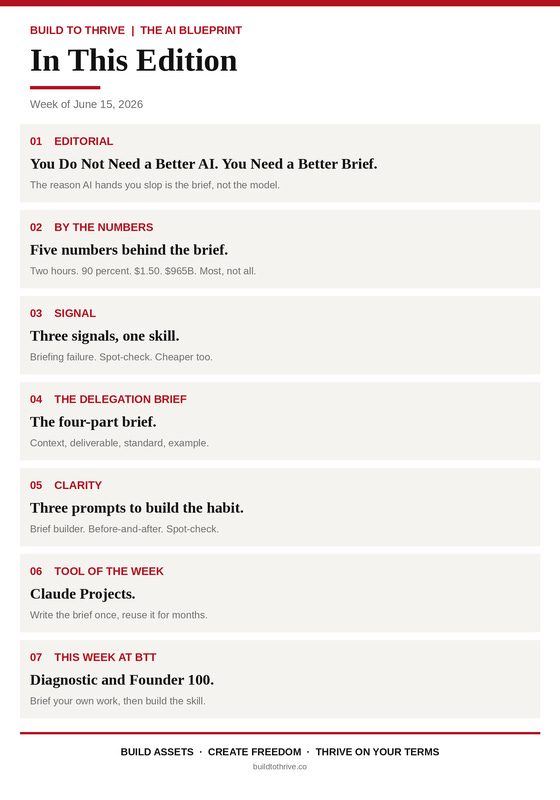
EDITORIAL
The post that got operators talking last week was not about a new model. A growth and operations operator, Jordan Murphy, promoted a tool on one promise: it does not hand you back a rough draft you then spend two hours fixing (LinkedIn, week of June 12 - Tier 3, market observation). It struck a nerve, and the replies were a wall of operators saying the same thing. After eighteen months of the “70 percent draft,” they do not want a co-pilot anymore. They want a finisher. And almost nobody is telling them how to get one.
Here is the part I keep coming back to. The reason your AI hands you a rough draft is almost never the model. It is the brief. Two operators on the identical model get wildly different output, and the only variable between them is how they specified the work. Tsedal Neeley, a Harvard Business School professor who studies how companies actually absorb new technology, has made the same point: sharp context produces better output at a fraction of the cost (Tier 1, voice; exact-quote verification owed). The model layer is commoditizing in front of us, Opus 4.8 and Anthropic’s trillion-dollar filing are the same story, so the durable, ownable skill is not the AI. It is what you wrap around it. This week, that wrap-around is the brief.
If you are a professional building your own thing, this issue hands you the one skill that turns AI from a research assistant into an actual employee. If you are an operator handing off delivery work, it is the difference between AI that saves you time and AI that quietly makes more of it. The May 4 Stack Audit (https://www.buildtothrive.co/p/build-to-thrive-the-ai-blueprint-3e5) and the May 11 Money Stack (https://www.buildtothrive.co/p/the-money-stack) walked the tools and the pricing. This issue walks the skill that makes the tools pay off.
You already know how to do this. When you hand work to a sharp new hire, you give them context, tell them what good looks like, and show them an example. You skip all of it with AI because the little box invites a one-liner, and a one-liner gets you an average draft no matter how good the model is.
So pick one deliverable you run every week, write it a real brief this week, and see what comes back. The free one-page Delegation Brief at the bottom is the template.
Juan
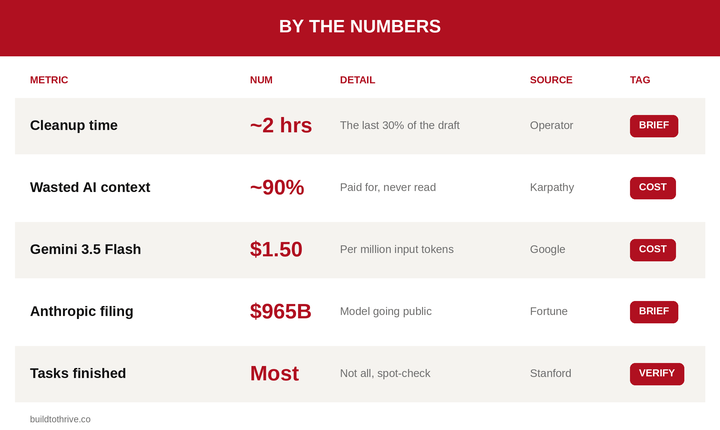
Five numbers behind why the brief, not the model, is your constraint.
Two hours. The time operators keep losing to cleaning up an AI draft that should have come back finished, which is the exact pain a real brief removes. It is the complaint under every “AI saves me time” caveat: the draft arrives at 70 percent and the last 30 eats the afternoon (operator observation - Tier 4).
~90%. Andrej Karpathy, a well-known AI engineer, estimated that about 90 percent of a typical AI bill pays for context the model never needed (via Ronin, mid-May 2026 - Tier 3). A sloppy brief is not just lower quality. It is also where the waste lives, because you pay for everything you dump in whether the model uses it or not.
$1.50 and $9.00 per million tokens. Gemini 3.5 Flash runs there (Google Gemini pricing - Tier 2: https://ai.google.dev/pricing). When the model is this cheap, the output quality is almost entirely in your hands, not the price tier. The brief is the lever, not the spend.
Close to a trillion dollars. Anthropic filed to go public at a $965B valuation while the model keeps getting cheaper (Fortune, June 1, 2026 - Tier 1: https://fortune.com). The model is becoming a commodity. The skill you wrap around it is the part that stays yours.
Most jobs, not all. Briefed well, today’s AI finishes a clear majority of tasks but not every one, a sharp jump from a year ago (Stanford AI Index 2026 - Tier 1, primary-source confirmation owed before publish). That gap is why a one-minute spot-check on the predictable failure points stays part of the job.

Three signals, one skill: brief the AI like a staffer, not a search box.

Story 1: The Rough Draft Is a Briefing Failure, Not a Model Failure
What happened. Jordan Murphy’s post hit a nerve because it named the thing operators are tired of: the draft that should have been finished but comes back needing two hours of cleanup (LinkedIn, June 12 - Tier 3, market observation). The reaction was not about the tool. It was operators recognizing their own daily frustration in one line.
What it means. Give a model a thin instruction and it fills the gaps with generic, average assumptions, because that is the safest guess. A new hire in the same spot would stop and ask you three questions first. The model does not ask. It guesses, and it guesses average. So a one-line prompt guarantees an average draft no matter how capable the model is. The quality you are missing is not locked inside a better AI. It is sitting in the four things you did not tell it.
What I am observing. The operators getting finished work are not on a secret model. They write the AI a real brief, the same way they would brief a person they respect. The skill is plain and teachable, and almost nobody is teaching it, which is exactly why the demand has nowhere to go.
Story 2: Even Briefed Well, Spot-Check It
What happened. The same operators raving about AI finishers are quietly still checking the work. Briefed well, today’s agents finish most tasks cleanly, a large jump from a year ago, but not all of them (Stanford AI Index 2026 - Tier 1, primary-source confirmation owed). The successful teams keep a quick human check in the loop while they learn where the workflow breaks.
What it means. A good brief gets you finished work. A quick spot-check keeps it honest. The failures are predictable, which is what makes them fast to catch: invented specifics, facts that were true once and are now stale, and numbers that do not hold. You do not re-read the whole thing. You check those three places, the way a manager skims a new hire’s first few deliverables, and then you ship. Speed without a check is how a good workflow ships a bad fact.
What I am observing. The operators who trust their AI most are the ones who still spot-check it, because the check is what earns the trust. Drop it and you are one fabricated source away from an embarrassing send.

Story 3: A Tighter Brief Costs Less, Too
What happened. Karpathy’s line that about 90 percent of an AI bill pays for context the model never needed spread among builders for a reason (via Ronin, mid-May 2026 - Tier 3). With Gemini 3.5 Flash at $1.50 and $9.00 per million tokens (https://ai.google.dev/pricing), the model is cheap, so the waste is almost entirely in what you send it.
What it means. A vague brief is expensive twice. You pay for the rough draft you have to fix, and you pay for the pile of context you dumped in hoping the model would sort it out. A tight brief is the opposite: it tells the model exactly what to use, so it reads less, guesses less, and bills less. If you sell AI-leveraged work at a fixed fee, the brief quietly sets your margin. This is the money beat under the skill, not the headline, but it is real.
What I am observing. The operators running the best margins treat the brief as a cost control as well as a quality control. Same habit, two payoffs.
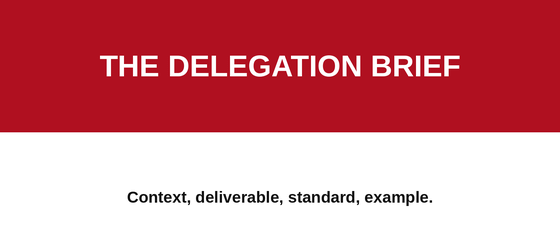
The four parts of a real brief. You already give all four to a person. Give them to the AI and the draft comes back finished.
1. Context. What a smart new hire would need to know about the situation, the audience, and the goal. Not the whole company history, the part that changes the work.
2. The deliverable, defined. What exactly should come back: the format, the length, the structure. “A competitive analysis” is a wish. “A one-page table comparing five competitors on price, positioning, and one weakness each” is a brief.
3. The standard. What good looks like here, and the two or three things that would make it unusable. This is the part everyone skips, and it is where average output hides.
4. One example. A reference, a sample, or a past piece at the level you want. One good example does more than a paragraph of description.
Before and after, on a real deliverable. Before: “Write me a go-to-market plan for my new service.” Back comes a generic plan built for an average business that is not yours. After: the four parts, your buyer, your constraints, your price band, and one plan you admired as the reference. Back comes something you can edit in ten minutes instead of rebuild in two hours. Five minutes to brief beats two hours of cleanup on a deliverable you run every week.
________________________________________
Three prompts that build the briefing habit, so you leave with the skill, not just the idea. Full versions in the Notion Prompt Library, linked in each card.
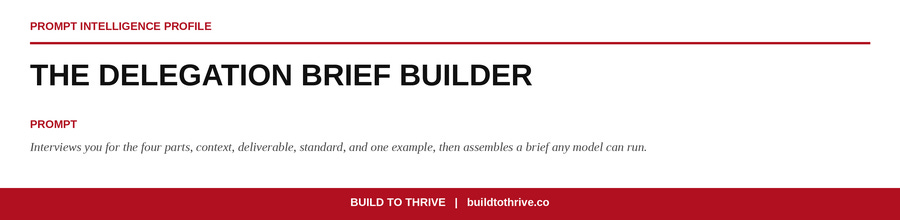
The Delegation Brief Builder. It interviews you for the four parts, context, deliverable, standard, and one example, then assembles a clean brief you can paste into any model and flags the part you left thinnest. Walks you out with a brief tight enough that a stranger could run the task. GO TO PROMPT

The Before-and-After Rewrite. Paste your one-line prompt and it shows you the average draft that prompt is quietly asking for, names the three missing inputs, and rewrites it as a real brief side by side. The fastest way to feel why the one-liner fails.
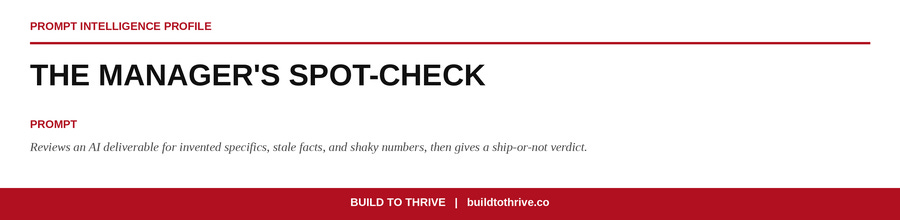
The Manager’s Spot-Check. Paste an AI deliverable and it runs a manager-style review of the three places AI work breaks, invented specifics, stale facts, and shaky numbers, and gives you a ship-or-not verdict. Keeps the speed without shipping a mistake.
Run in order, the three are the delegation loop: write the brief, see why it works, check the result. Management, not prompt tricks.
Claude Projects (https://claude.ai) is the tool this week, and ChatGPT Projects work the same way. It is where you write your brief once and reuse it on every task.
What it is, plainly: a Project is a workspace that holds a standing set of instructions plus a few reference files. Everything you do inside it starts already knowing your business, your voice, and what good looks like, so you stop briefing from scratch every session. It is the four-part brief, made permanent.
How to set one up, in about five minutes:
1. Create a new Project and name it after a deliverable you run often, like “Weekly Competitive Scan.”
2. Fill out the Standing Brief context file once (the free template below): who you are, your audience, your voice and standards, your default format, and one example.
3. Paste it into the Project’s instructions, then upload one or two reference files, a past piece you were proud of, a style note, a data source you reuse.
4. From then on your prompt can be a single line, because the brief already lives in the Project.
5. When the output drifts, fix the context file once instead of re-explaining yourself every time.
Grab the fill-in-the-blanks Standing Brief context file, spend ten minutes on it, and you have turned the briefing skill from a per-task chore into an asset that compounds. You are not writing better prompts. You are building a better-managed employee whose onboarding doc you only write once.
For the thesis underneath this week, read James Presbitero The Only Moat Left In The AI Age - by James Presbitero. His argument is that the only moat left in the AI age is the thing a competitor cannot copy or prompt their way to. The brief is the operator-scale version of exactly that. The model is the commodity everyone shares. How you direct it is the part that is yours, and it is the part that finishes the work.
Two ways to turn this issue into your move.
Grab the free one-page Delegation Brief. It is the four-part template from this issue on a single page, the thing to keep next to your keyboard until briefing the AI like a staffer is automatic. It ships free to subscribers this week. While that is going out, the fastest way to see where your own operating model is leaking is the free Diagnostic, a roughly 12-minute, question-asking assessment at learn.buildtothrive.co/valueoffer (https://learn.buildtothrive.co/valueoffer).
Want to build the skill out fully? Inside Founder 100, $99, typically $360, the briefing discipline is where the “Your Head of Content” and Chief of Staff work begins: two hours of one-to-one with me to turn your recurring deliverables into briefed, finished AI workflows. I help you turn your experience into income and build a self-running 5-person business, solo. learn.buildtothrive.co/founder-100 (https://learn.buildtothrive.co/founder-100).
Join 4500+ subscribers: https://buildtothrive.co/subscribe

50 Creators Shared Their Rock-Star Prompts. Here They Are
Six months ago, I started reaching out to creators I was curious about, plus a few I was lucky enough to get referred to. Mostly one virtual coffee at a time.
The ask was simple: would you be open to sharing your rock-star prompt with the @Substack community in my Monday AI Blueprint edition, and have your newsletter featured alongside it?
Nothing here was scraped or borrowed. Every prompt was shared deliberately and generously, by people who had no reason to hand over their sharpest work — except that they believe knowledge is worth more when it moves.
And move it did. The depth, the ingenuity, the sheer practicality of these creators left me humbled. This edition is a small monument to their generosity.
So today, with a lot of gratitude, I’m sharing a consolidated volume of 50 prompts from 50 creators. Thank you to every one of you who said yes. I hope you all enjoy it.

I love the reminder of the 90% tax. Ought to clean up my system prompt and irrelevant bloat in .md files haha. Thanks for putting this together, Juan!
A one-line prompt gets you an average answer every single time, no matter the model.