


Editorial
I have been mapping how operators get AI to run without them through, and one word keeps deciding who pulls it off: the loop. I had written about this last February as a shift in competitive advantage for business operators. (Stop Renting Labor: Why “Owning the AI Loop” Is the New Solo Competitive Advantage). The signal sharpened last week when Satya Nadella, Microsoft’s CEO, told a room of executives that the advantage in an AI economy will not come from picking the best model. It comes from owning the learning loop between your people and your systems, what he called your token capital (News9Live). The enterprise crowd heard validation. The solo operator should hear a warning: if the advantage goes to whoever owns the loop and you do not have one, you have a pile of prompts you run by hand. If you read the June 1 Anthropic chain-reaction Blueprint and The Death of the High Performer, this is the build that follows. In this ediiton, I will walk you through the three forces that turn a prompt into a loop.
If you are a professional sizing up your first system, this issue gives you the five parts of a loop so you can build one this week. If you are an operator running a business, it names the part of your work worth encoding so it becomes an asset no competitor can rent. If you are deep in delivery, it shows you where loops quietly run badly and how to catch it.
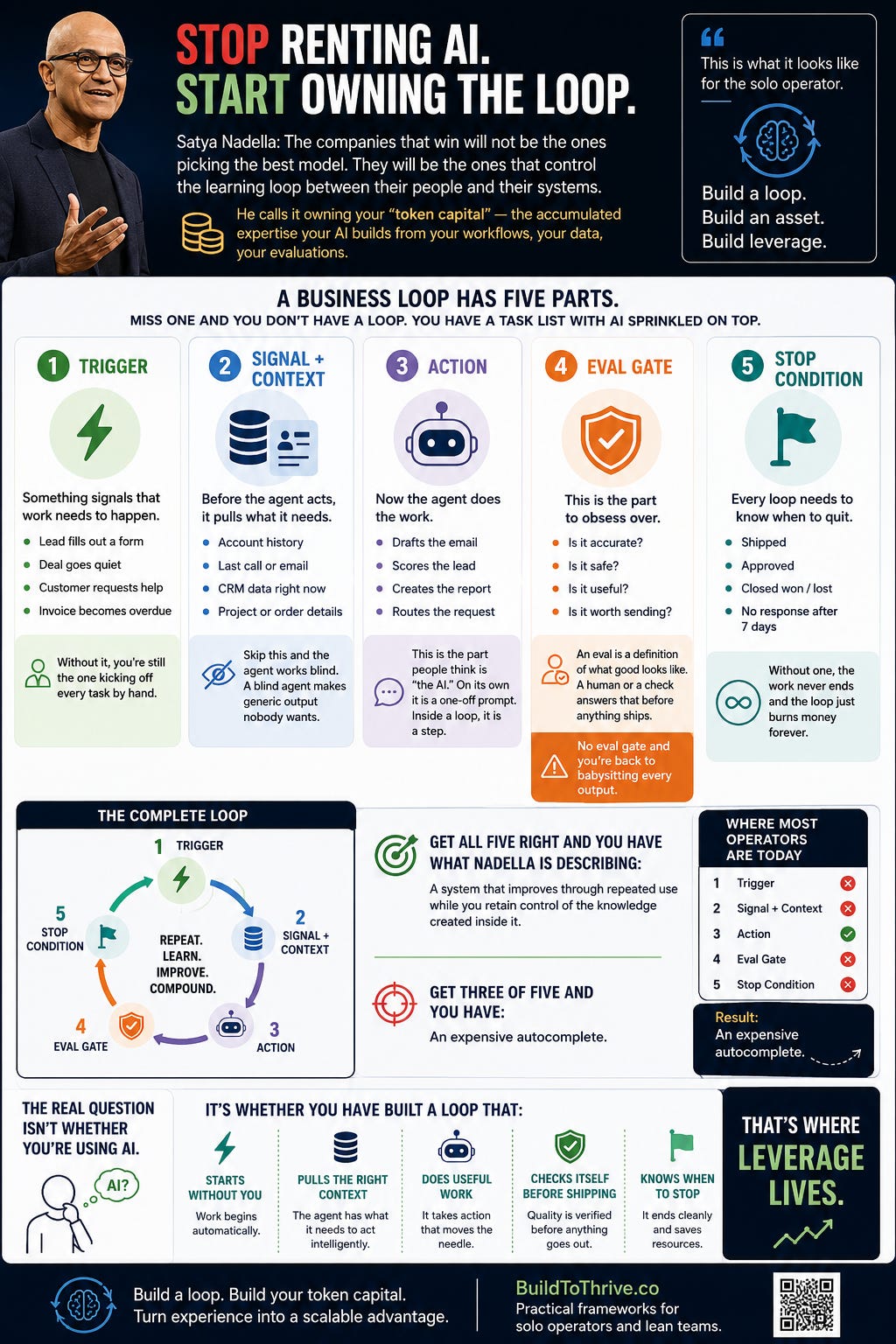
Force one: a loop, not a prompt. A prompt is something you type, wait for, and read. A loop starts without you, pulls what it needs, acts, checks itself, and stops. Most operators built only the acting part, the AI that drafts an email or a proposal. That is a power tool, not a loop. The five parts are the trigger, the context, the action, the eval gate, and the stop. Miss one and the system stalls or runs badly without you noticing.
Force two: own the loop, own the asset. Nadella’s point in plain terms: the model gets cheaper and everyone rents the same one, so the durable advantage is the loop you built from your own work (News9Live). McKinsey’s State of AI 2025 found the firms capturing real value are the ones redesigning whole workflows, not automating single tasks (McKinsey).
Force three: the gate is where it holds. The eval gate is your definition of good, applied before anything ships. It is where your judgment gets encoded, the part no competitor can buy from OpenAI or Anthropic.
The loop is the structure, owning it is the advantage, and the gate is where your standards live. Pick the one force that fits where you are this week.
Juan
Build to Thrive caters to ambitious professionals and founders reinventing themselves in the AI economy. It explores how people can use their experience, tools, and ideas to create leverage, income, and opportunity in a business world being rewritten.
Copy the infographic below and save it….this sums up the concept and structure of loops. Keep reading if you like to have the prompts, tools and tactical moves that help you build loops for your business.
What happened. Nadella named the shift in enterprise language: competitive advantage comes from controlling the learning loop between staff and systems, where people supply judgment and corrections and the system improves future work (News9Live). The operator version is more concrete: a system that handles the execution layer of a recurring task end to end.
What it means. You can build one this week if you map the five parts. The trigger starts it without you (a Monday 8 AM timer, a new intake form, a deal gone silent for five days). The context is what it reads first so it acts on your situation, not a blank guess. The action is the draft or the score. The eval gate checks it against your standard. The stop tells it when to quit. Build those five and the Monday morning that used to take 90 minutes of piecing things together takes 15 minutes of decisions.
What I am observing. What keeps landing for me is that most operators already have the action and call it AI. The other four parts are where the leverage hides, and they are the cheap part to build.
What happened. Nadella drew the line between two kinds of capital: human capital (your judgment and relationships) and token capital (the AI capability you build and own) (EdTech Innovation Hub). McKinsey’s read points the same way: whole-workflow redesign is what separates the firms capturing value (McKinsey).
What it means. The model is a rental everyone shares, so it cannot be your edge. The loop you built from your own clients, your own data, and your own standard is the thing that holds value, and the capacity it frees is what you sell. When the execution layer of a recurring task runs without you, you take one more client or buy back two hours for business development. That is the loop converting into revenue.
What I am observing. The way I read Nadella is that this is permission, not theory. The operator who owns one real loop owns something a competitor cannot rent from a model provider.

What happened. The reason people say AI almost works is the missing gate. An eval gate is a definition of good applied before anything ships: a human read, an automated check, or a second AI pass. Skip it and you ship the 80 percent and spend your hours fixing the last 20. The math is unforgiving: an 85 percent reliable step, run 10 times, lands near 20 percent end to end (Cash & Cache).
What it means. The gate is where your standard gets encoded, and the stop condition is what keeps the loop from sending its fourteenth email to a prospect who left nine emails ago. Build both and you stop babysitting the AI, because you only ever see output that already passed. Over time the gate gets tighter and the loop learns what good means in your specific business.
What I am observing. What I keep seeing is that the gate is the part operators want to skip and the part that decides whether they trust the system. It is also the part that is purely yours.
Move 1: Pick the most boring task in your week. Not the strategy or the client calls. The Monday pipeline review, the Friday status update, the daily lead check. The repetitive work that feels the same every time is where a loop pays off first.
Move 2: Map the five parts. Write down what triggers it, what context it needs, what it produces, what good enough to ship looks like, and when it stops. Those five answers are the spec for your first loop. You walk away with a build plan, not a vague intention.
Move 3: Build the eval gate before the action. Define the check that catches the 80 percent stuff before it reaches a client. This is the part that turns a first-draft machine into a system you trust.
Move 4: Set the stop condition out loud. Decide the rule that ends it (”three follow-ups, then mark cold and stop”). Writing the stop forces you to define success and failure, which is worth more than most plans in your drive.
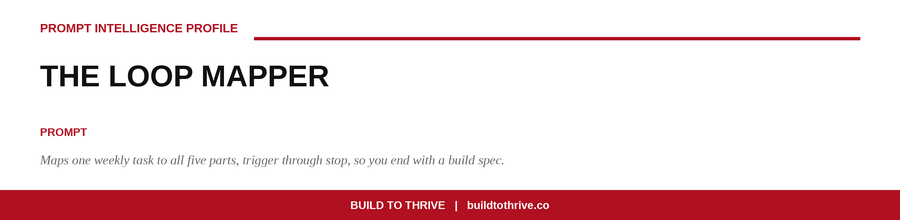
The Loop Mapper. Walks away with one weekly task mapped to all five parts, trigger through stop, ready to build. Turns a vague “I should automate this” into a concrete spec. Open the prompt
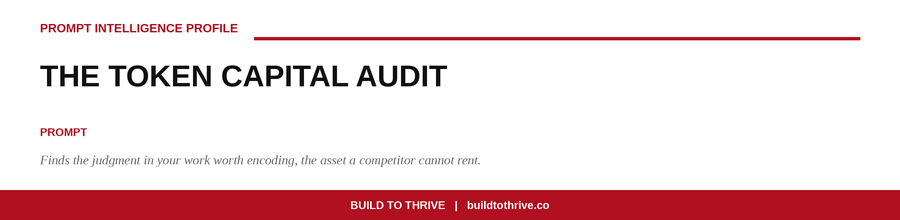
The Token Capital Audit. Walks away with the part of your work worth encoding into a loop, the judgment a competitor cannot rent. Names the asset hiding inside your recurring work. Open the prompt
The Eval Gate Builder. Walks away with a written definition of good enough to ship plus a stop condition for one loop. Turns the reliability risk into a check the system runs before you see anything. Open the prompt
Run together, the three prompts are this week’s playbook: map the loop, name the asset, build the gate.
The tool that fits this week is Claude Code’s /goal command, which gives an agent a verifiable finish line so it stops when the work is actually done Claude Code /goal: Stop Babysitting Your AI Agent. That is the stop condition and the eval gate in tool form: the agent keeps going until a check says the goal is met, then quits.
You do not have to use the command to take the lesson. Before you build any loop, write the finish line a stranger could check. That one habit is what separates a loop that runs from one you have to babysit.

If you want to build your first loop with help, Founder 100 is $99 for two sessions of 1:1 coaching plus 12 months of the Vault and premium newsletter, at learn.buildtothrive.co/founder-100. Session one names the constraint and builds the loop. Session two pressure-tests it after two weeks in the field.
That’s all for this edition, thank you for reading!
…and remember.
Build assets. Create freedom. Thrive on your terms.
The hardest piece, but the greatest value-add to me, is the quote from McKinsey:
"McKinsey’s State of AI 2025 found the firms capturing real value are the ones redesigning whole workflows, not automating single tasks"
It's lazy to automate existing processes. Way harder to reimagine what is only now just becoming possible.
Strong framing of AI value shifting from prompts to systems; durable advantage comes from owning workflows, evaluation, and feedback loops, not just model access.