


EDITORIAL
One operator I work with changed a single sentence in how she describes her engagement. Within 60 days, her retainer moved from $8K to $14K. Same pipeline. Same LinkedIn. Same audience. She did not get more visible. She fixed the reason people were not buying.
Most operators right now are solving the wrong problem. Visibility is easier than it has ever been. AI handles the posts, the outreach, the follow-ups. Profile views are up. And revenue has not moved.
Here is what the research says: 40 to 60% of qualified B2B deals end in “no decision.” Not a competitor win. The prospect chose to do nothing. They were interested. They had budget. And they froze. The reason breaks down into three layers: they could not tell you apart from everyone else (clarity), they did not feel safe making the decision (confidence), or you lost them after the conversation ended (follow-through).
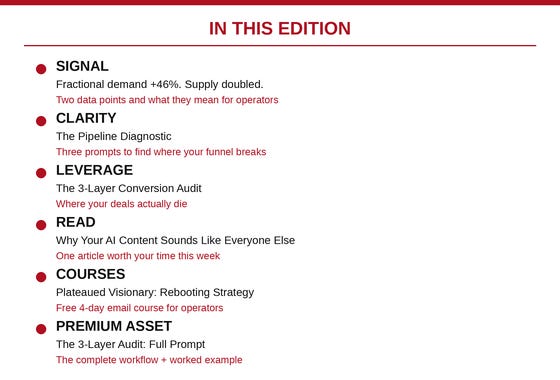
In this edition, I am breaking down all three layers with the prompts to audit each one on your own practice this week. There is a 3-layer conversion audit that will show you exactly where your deals are dying. There is a prompt that maps every activity you do to whether it actually produces revenue. And there is one follow-up system most operators have never built that is faster than any new lead source.
The audit is in LEVERAGE. The prompts are in CLARITY. Q2 pipeline decisions are locking in now. This is the week to find the leak.

Fractional demand is up 46% year over year. Supply doubled. There were 60,000 fractional professionals in 2022. By 2024, that number hit 120,000. Demand from companies surged 46% in the same window, and 72% of CEOs say they plan to increase fractional hiring in the next 12 months. As of Q1 2026, the fractional executive market is valued at $9.4 billion and projected to grow at 11.3% CAGR through 2034. (Fractional Work Statistics, Column Content; Dataintelo Market Report 2026)
What it means: The market is growing, but the talent pool is growing faster. Two years ago, being fractional was a differentiator. Today it is a category with 120,000 operators in it. When supply doubles and 90% of operators sound identical (The Visible Authority), the operators who win are not the most visible. They are the ones who have fixed the three layers where deals actually die: clarity, confidence, and follow-through. The 3-layer conversion audit in LEVERAGE will show you which one is broken.
91% of businesses now use AI. 80% see no bottom-line impact. A February 2026 Fortune study of thousands of CEOs found that despite near-universal AI adoption, the vast majority report zero measurable effect on productivity or revenue. Meanwhile, a separate 2026 Zapier survey found 63% of solo operators use three or more AI tools daily, with 44% reporting significant revenue gains. (Fortune, Feb 2026; AI Daily Shot, 2026)
What it means: Large companies are buying AI tools. Solo operators are building AI systems. The difference is integration. Operators who wire AI into their actual decision-making (pipeline diagnostics, proposal generation, client onboarding) are seeing revenue move. Companies that added AI to existing workflows without changing the workflow are not. This is a positioning opportunity for Q2: if you help clients adopt AI, the service is not “here are the tools.” The service is “here is how the tools change how you decide.”
Three prompts to find where your pipeline breaks

Prompt 1: The Pipeline Diagnostic
When to use: Monthly, or any time you feel busy but revenue is flat. Run it before Q2 pipeline reviews lock in.

Prompt 2: The Activity-to-Revenue Map
When to use: Before planning your next month. This prompt exists because most operators fill their calendar with visibility work while their conversion pipeline runs dry. They confuse activity with progress.

Prompt 3: The Warm Lead Re-engagement
When to use: Any time you have 5+ warm leads who went quiet. Most operators are sitting on a pipeline they already built and forgot about. This is the fastest revenue move in the edition because it works on contacts who already know you.

The 3-Layer Conversion Audit
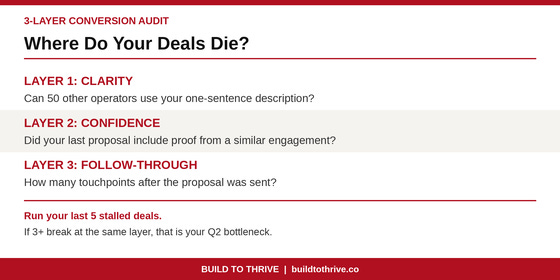
Most operators assume lost deals are a marketing problem. The research says otherwise. 40 to 60% of qualified B2B deals end in “no decision,” not a competitor win (Sharpstance). Your prospects are not choosing someone else. They are choosing to do nothing. The reason falls into one of three layers. Run this audit on your last 5 lost or stalled deals this week. One layer will stand out.
Layer 1: Clarity. They could not tell you apart.
90% of consulting firms and solo operators sound identical (The Visible Authority). The prospect understood your category but not your specific offer. They visited your LinkedIn, read your content, maybe had a call, and still could not explain to their boss or partner what you do differently.
The test: Pick one prospect who went dark in Q1. Write down in one sentence what you do for clients. Now ask: could that sentence describe 50 other operators? If yes, this layer is broken. The fix is not more content. It is a sharper sentence. One operator I work with went from “I do fractional CMO work” to “I decide which channels to kill and which to double.” Her close rate moved from 1 in 5 to 3 in 5. Same pipeline. Different sentence.
Layer 2: Confidence. They did not feel safe deciding.
Once a prospect is interested, their psychology shifts. They stop asking “will this help me?” and start asking “what if this fails?” (HubSpot). Omission bias kicks in: doing nothing feels safer than making the wrong active choice. Your proposal landed, they liked it, and then they froze. This is not ghosting. This is fear.
The test: Look at your last proposal that went silent. Did you include proof from a similar engagement? Did you name the risk of inaction (not just the benefit of action)? Did you give them exactly one option, or did you present three and let them spiral? Research shows more than three options increases the chance of no purchase at all. If your proposal had a “menu” of packages, this layer is broken. The fix: one recommendation, one price, one proof point from a client who looked like them.
Layer 3: Follow-through. You lost them after the conversation.
Karl Sakas at Sakas & Company found that the most common reason prospects ghost is not disinterest. It is that life got busy and the operator never re-engaged (Sakas & Company). No follow-up sequence. No value after the proposal. Just silence on both sides.
The test: For each of your 5 stalled deals, count the touchpoints after the proposal was sent. If the answer is zero or one, this layer is broken. The fix is not a “just checking in” email. It is a follow-up that delivers something useful: a relevant data point from their industry, a short case study from a similar engagement, or a framework they can apply whether or not they hire you. Prompt 3 in CLARITY will generate this for you.
How to score: Run all 5 deals through the three layers. If 3+ deals broke at the same layer, that is your conversion bottleneck for Q2. Fix that layer first. The 3-Layer Conversion Audit prompt in the Premium section walks you through the full analysis with AI.


The reason your AI content sounds like everyone else’s
If 90% of operators sound identical, and most of them are now using AI to write their LinkedIn posts, proposals, and follow-ups, AI is not fixing the problem. It is scaling it.
James Presbitero at Unpromptable. wrote about why. The issue is adjective-based prompting. When you tell AI to “be professional” or “be witty,” you are asking it to match a subjective standard. AI does not know what your version of professional looks like. It knows the statistical average of “professional” across millions of documents. That is how 120,000 operators end up sounding like the same person.
His method is to treat your voice like a spec, not a vibe. He calls it Voice DNA: a reference document built from annotated examples of your actual writing, with explicit style rules and constraints. Instead of telling AI what to sound like, you show it why your writing works the way it does. The test: show the output to someone who reads your work regularly. If they cannot tell the difference, it is working.
Here is the Build to Thrive take: this is where AI creates real leverage on the Layer 1 problem from this edition’s audit. Once you have the sharper sentence from the clarity test in LEVERAGE, Voice DNA is how you make every piece of content, every proposal, and every follow-up carry that differentiation consistently. The operators who fix Layer 1 and then encode it into their AI systems will not just sound different. They will sound different at scale.
How to build your Voice DNA this week (adapted from Presbitero’s method):
Step 1: Extract your structural and emotional DNA. Pull 3 pieces of content you have written that sound most like you (a LinkedIn post that performed, a proposal that closed, an email a client responded to). Paste them into Claude or ChatGPT with this prompt:
Analyze these 3 writing samples from the same author. Identify the structural patterns (average sentence length, paragraph structure, use of questions, formatting habits), emotional tone (rate directness, warmth, humor, formality, and urgency each on a 1-5 scale), and semantic patterns (recurring phrases, vocabulary preferences, words the author never uses). Output a Voice DNA reference document I can attach to future prompts.
Step 2: Annotate why, not just what. Go back to those 3 pieces. For each one, add margin notes explaining why you made specific choices. Why did you open with a number instead of a story? Why did you cut that paragraph? Why did you use “operators” instead of “founders”? These annotations teach AI your decision-making process, not just your finished output. Add the annotations to your Voice DNA document.
Step 3: Set constraints. List what you never do. No em dashes. No “I’m excited to announce.” No motivational closers. No more than two sentences per paragraph in LinkedIn posts. Constraints are more useful than instructions because they create a boundary AI cannot cross. Add them as a “Rules” section at the bottom of your Voice DNA document.
Attach the finished Voice DNA document to every AI prompt you run. The test: show the output to someone who reads your work regularly. If they cannot tell the difference, the spec is working.
Source: How to Train AI on Your Brand Voice by James Presbitero, Unpromptable
BUILD TO THRIVE COURSES
If your visibility is up and your revenue is flat, you are probably a Plateaued Visionary.
That is one of five operator archetypes in the Build to Thrive framework. Each one maps to a different structural gap, and each has a free 4-day email course designed to close it.
Plateaued Visionary: Rebooting Strategy & Alignment. Four days, one insight per day, one action per day. Built for operators who are doing well on paper but know the growth has stalled underneath. You will get a sharp lens on what is actually holding back revenue, a method to reconnect your strategy with your current reality, and tools to realign around what converts, not what gets likes.
If the SIGNAL data in this edition made you uncomfortable, this is where to start. Free. Delivered by email. Starts the same day you register.
Not sure which archetype fits? Take the Founder Clarity Diagnostic first. It maps you to the right course in 3 minutes. Five archetypes, five courses: Chaos Operator, Plateaued Visionary, Growth Builder, Scaling Skeptic, Lone Strategist.
PREMIUM ASSETS

The 3-Layer Conversion Audit: the full prompt + worked example
Most operators who read this edition will tweak their LinkedIn profile this week. That is a Layer 1 fix applied to a Layer 2 or Layer 3 problem. It will not work.
The free version of the audit in LEVERAGE gives you the framework and the tests. The Premium version gives you the full AI-assisted workflow:
The 3-Layer Conversion Audit Prompt. Paste in your last 5 lost or stalled deals. The prompt walks you through each layer (clarity, confidence, follow-through) with specific diagnostic questions, scores which layer broke on each deal, identifies your dominant bottleneck, and generates a fix plan for Q2 with concrete next steps per layer.
Worked example included. A real operator audit (anonymized) showing how 4 of 5 stalled deals broke at Layer 2 (confidence), and the specific changes to her proposal structure that moved her close rate from 20% to 55% in one quarter.
Why this works: You are not guessing where the problem is. You are running your actual pipeline data through a diagnostic that tells you. One layer. One fix. One quarter.
Q2 is when pipeline decisions lock in. This is the week to find the leak.
Clarity and confidence matter more than visibility.