


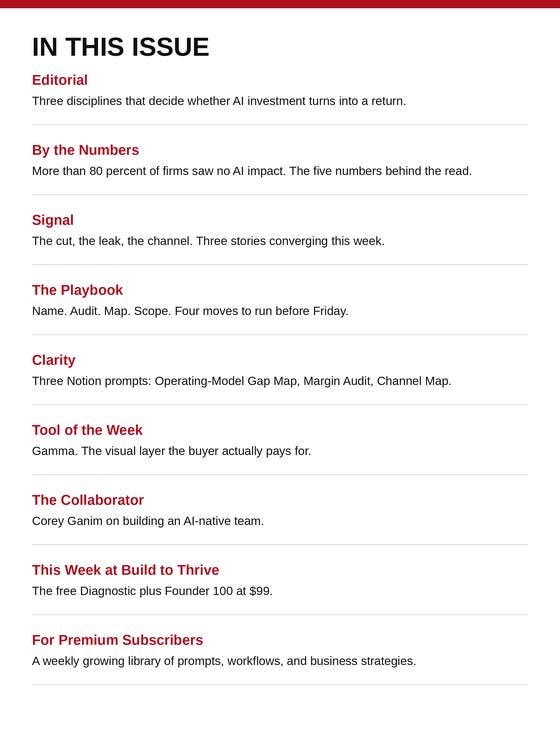
Editorial
I have been mapping where the AI economy is actually paying operators in May 2026, not for buying tools but for closing the gaps the tools leave open. Three gaps converged this fortnight on one international research paper and two pricing patterns visible in operator practice. The May 4 Stack Audit walked the stack. The May 11 Money Stack walked the three rungs operators are charging. This issue walks the three disciplines that decide whether the work turns into a return.
If you are running AI inside a company that just restructured, this issue names the three places the return is hiding. If you are a fractional selling into those companies, these are the three priced conversations you can open this month. If you are watching from a role being repriced, the same disciplines map the offer you package next.
Discipline One: The Operating-Model Gap. NBER Working Paper 34836 surveyed roughly 6,000 executives across the US, UK, Germany, and Australia. More than 80 percent reported no AI impact on employment or productivity over the past three years. The work the buyer now pays an operator to do: write the new process, train the team, redesign the handoff, build the metric that says whether AI is working. (NBER WP 34836)
Discipline Two: The Margin in AI-Leveraged Delivery. Andrej Karpathy posted in mid-May that roughly 90 percent of an AI coding bill pays for context the user did not need to send. The mechanism generalizes to any fixed-fee AI work. Two cost lines decide the margin: which model the workflow runs, and how much context each call sends. (Karpathy via Ronin)
Discipline Three: Owned vs Rented Acquisition. SparkToro and Datos put roughly 60 percent of Google searches now ending without a click, with AI Overviews now appearing in 58 percent of queries. Searchable raised $14 million on May 18 at an $85 million valuation to help brands rank inside AI answers, a service category that did not have a name a year ago. The 30-day move: convert one rented channel into an owned mirror you control. (SparkToro, 2026)
The three do not move in isolation. The operator who can name the gap, audit the margin, and own the acquisition is the one the freed budget goes to.
Pick the discipline that fits where you are this week.
Juan

More than 80 percent. The share of firms reporting no measurable impact from AI on either employment or productivity over the past three years, per a 2026 NBER working paper covering roughly 6,000 executives across the US, UK, Germany, and Australia. The same paper’s three-year forecast: plus 1.4 percent productivity, plus 0.8 percent output, minus 0.7 percent employment. The cut has not produced the return. (NBER Working Paper 34836, 2026)
90 percent. Andrej Karpathy’s estimate of how much of an AI coding bill pays for context the user did not need to send. Itemized by Ronin in May 2026: auto-context loading 50 files for a 30-line fix at roughly $1.20 per turn, with about 80 percent input waste per session. (Ronin / @DeRonin_, mid-May 2026)
60 percent. The share of Google searches now ending without a click, per SparkToro and Datos. Google AI Overviews appear in roughly 58 percent of queries, up from about 12 percent in 2024. The largest single-year move the zero-click metric has recorded. (SparkToro, March 2026)
$14 million. What Searchable, a London company that launched in January 2026, raised on May 18 to help brands track and improve how they appear inside AI-generated answers. Round led by Headline at an $85 million valuation, roughly double its January round. (PR Newswire, May 18, 2026)
$40 million. What Dust raised on May 18 in a Series B led by Abstract and Sequoia, with Snowflake Ventures and Datadog. 3,000-plus organizations using it. 51,000 monthly active users. 300,000 agents deployed. Zero churn in 2025. The venture syndicate is pricing the layer agents run on. (Axios, May 18, 2026)


What happened. In 2026, the National Bureau of Economic Research published Working Paper 34836, “Firm Data on AI,” by Yotzov, Barrero, Bloom and co-authors. The paper draws on a survey of roughly 6,000 executives across the United States, United Kingdom, Germany, and Australia. The headline finding: more than 80 percent of firms reported no measurable impact from AI on either employment or productivity over the past three years. The three-year forward forecast lands modest in the same direction. Plus 1.4 percent productivity. Plus 0.8 percent output. Minus 0.7 percent employment. The cut has not produced the return at scale, and the forward math does not project a step-change either. (NBER Working Paper 34836, 2026. The pattern shows up at the Fortune-tier in public: Bayer collapsed roughly 12 management layers to 6 and removed close to 5,500 roles in the same window.)
What it means. A layoff is a payroll move. A return is an operating move. For a decade, the assumption inside enterprise AI rollouts was that cutting headcount and adding AI tools were the same motion. The institutional measurement just landed otherwise across 6,000 firms in four countries. If you sit across from a buyer who restructured in Q1 or Q2 and is now staring at a number the board expects in Q3, the missing piece is not another tool license and not another round of cuts. It is the operating model that turns the freed budget into output. That work is unglamorous: writing the new process, training the team that survived, redesigning the handoffs the AI now sits in the middle of, building the metrics that show whether the AI is actually doing the work it was bought to do. None of that gets done by the AI vendor. None of it gets done by the layoff. It is the work an operator is paid to do, and right now there is almost nobody doing it.
What I am observing. Two operators landed on the same finding in May 2026, the same window the NBER paper circulated. Corey Ganim, on May 19, wrote that employees who cannot build AI skills do not belong on the operator’s stack. The team and the system, not the tools, are where the return lives. John Brewton, on May 25, named the role that closes the gap inside companies collapsing to four management layers: the Micro-CEO who owns the outcome and the agent manager who runs the agents. The institution and the practitioners arrived at the same place. The opening for an operator this quarter is to walk in and name the operating-model gap as the actual problem the buyer is being paid to solve.

What happened. In mid-May 2026, Andrej Karpathy posted a line that spread widely among AI builders: roughly 90 percent of an AI coding bill pays for context the user did not need to send. Ronin (@DeRonin_) itemized what that looks like in practice. An IDE or agent loads 50 files into the context window to answer a question about 30 lines. The single turn costs roughly $1.20. Across a working session, 80 percent of the input tokens are waste. The specific case was software development, but the mechanism generalizes. Most of what an AI workflow costs is not the model. It is the volume of material the workflow sends the model on every run. (Karpathy, via Ronin, mid-May 2026)
What it means. If you sell AI-leveraged work at a fixed fee, your margin lives in two numbers you may not be watching. The first is which model you run. An operator who priced a productized service against frontier-model costs six months ago can run much of the same work on a mid-tier model now and either widen the margin or lower the floor to win a deal. The second is how much context the workflow sends. A workflow that dumps every document into every request burns money on input the model will never read. Neither number shows up on an invoice. Both decide whether a $2,000 fixed-fee engagement clears a healthy margin or a thin one. This is the unit-economics piece for a solo operator running an AI-leveraged practice. The piece that has had almost zero coverage in the operator economy until this month.
What I am observing. The operators running the best margins this month are often not the ones charging the most. They treat delivery as a system instead of a pile of one-off prompts. They pick the cheapest model that clears the quality bar for the job rather than defaulting to the most capable one. They trim what each workflow sends. Raghav Mehra at Cash & Cache made the structural version of the same point on May 12, naming persistent structured memory and trigger-based automation as the three properties that make AI compound. The buyer never sees any of it, and that is the point. The discipline is invisible, and it is the line between a productized service that scales and one that just keeps the operator busy.

What happened. SparkToro and Datos data put roughly 60 percent of Google searches now ending without a click. Google AI Overviews appear in around 58 percent of queries, up from about 12 percent in 2024. That is the largest single-year move the zero-click metric has recorded. The traffic that used to land on a website is now answered on the search page. Underneath that shift, a new service category has a name now (Generative Engine Optimization) and a venture-funded floor under it ($14 million to Searchable on May 18, $85 million valuation). The acquisition channel a marketing-positioned operator used to sell into is shrinking, and the replacement is forming in public. (SparkToro, March 2026; PR Newswire, May 18, 2026)
What it means. Every operator I know runs on at least one acquisition channel they do not actually own. Newsletter recommendations on a network platform. Inbound from a search engine. Followers on a social graph. The channel feels like an asset, but the platform owns the rules, and the rules just changed. For a marketing-positioned operator, the SEO deliverable that paid for half of last year’s pipeline is shrinking on the same curve as zero-click search. For a content-positioned operator like Build to Thrive, free subscriber growth runs almost entirely on Substack Network recommendations, which is a rented channel. The honest question every operator owes themselves this quarter: which of your acquisition channels do you own outright, and what happens to your pipeline when the one you rent changes its rules.
What I am observing. The operators building durable practices right now are the ones answering that question first and then doing two things differently. They are publishing on an owned channel (a Substack on a custom domain, a podcast feed they control, an email list they export weekly) instead of treating a rented audience as if it were their list. And they are packaging the audit for buyers in the same position. James Presbitero made the companion case in his May 7 piece on relationships as the moat AI cannot copy. The owned channels you build directly with the people you serve are the ones the next platform algorithm change cannot touch. That packaged audit is the new acquisition offer this quarter.
THE PLAYBOOK

How to reposition around the operating-model gap. Four moves to run before Friday.
Move 1: Name the operating-model gap in one real buyer. Pick one client or one prospect that has already spent money on AI. Write one sentence. “They have access to X. They are not getting the return because Y.” The Y is almost never the tool. It is a missing workflow, an untrained team, a handoff nobody owns. That sentence is your opening line for the next conversation.
Move 2: Audit one delivery margin you sell. Pick one productized offer in your stack. Two numbers: which model is currently doing the work, and how much context the workflow sends per request. If you are running a frontier model on work that a mid-tier model would clear, swap the model and pocket the margin. If your workflow loads context that the model will never read, trim it. The buyer never sees the change. The margin shows up immediately.
Move 3: Map one acquisition channel from rented to owned. Pick one channel that today brings you leads. Mark it rented (you do not control the rules) or owned (you can export the list, you own the domain, you control the delivery). For every rented channel, name the move that converts it to an owned mirror within 30 days: an email list with weekly export, a custom domain, an RSS feed on infrastructure you control. Stop confusing audience size on a rented platform with an asset.
Move 4: Send one repositioned scope by Friday. Take the buyer from Move 1, the model audit from Move 2, and the channel map from Move 3, and write a one-page scope. Reposition the work away from “I help you adopt AI” and toward “I close the gap between the tools you already bought and the result they were supposed to deliver, with the margin discipline and the owned-acquisition motion that make the return durable.” Put a price on it. Put a timeline on it. What the buyer says back is the calibration.
The cut frees the budget. It does not close the gap. The operator who can name the gap, audit the margin, and own the acquisition is the one the freed budget goes to.

Three prompts. Each produces something you can use the same day. Run them in order to turn this week’s signals into your own move.

The Operating-Model Gap Map. You give it a description of a buyer that has already spent money on AI tools. It returns a map of the operating gap, names the single highest-leverage missing piece, and writes the opening line of your next conversation. Built for the fractional or consulting operator selling into mid-market post-restructuring buyers.

The Margin Audit. You paste in one productized offer and how you deliver it. It identifies where you are running a frontier model that a mid-tier model would handle, flags context the model does not need, and tells you whether to widen your margin or lower your floor to win a deal. Built for the Path 2 Fix buyer.

The Rented vs Owned Channel Map. You list your top five sources of inbound. It scores each one rented or owned and names the one channel to convert in the next 30 days. Built for the Path 3 Scale buyer.
The Operating-Model Gap Map gets you into the room with language the buyer is paying for. The Margin Audit keeps the work you sign profitable. The Rented vs Owned Channel Map makes sure your pipeline is yours.
TOOL OF THE WEEK

Gamma is the tool this week. The consulting-grade visual layer for the deliverable a buyer actually pays you for.
The audit-style work this issue points at lives or dies on the report you hand over. An operator who sends a Notion doc or a Google Doc loses on first impression. An operator who sends a Gamma report wins the second meeting. Gamma takes a structured outline and ships a 12 to 18-slide consulting deck in 20 minutes that would take three hours in PowerPoint. Story 1’s recommendation only lands when the buyer can hold the report in their hands and walk it through their leadership team. That is the artifact Gamma is built for.
For the end-to-end workflow that uses Gamma as the report layer in the four-step productized-audit delivery, see the May 11 Money Stack Blueprint.

For the practitioner version of this week’s operating-model thread, read Corey Ganim. In his May 19 piece, “Build a team that ships without you,” Ganim argues that employees who cannot build AI skills do not belong on the operator’s stack, and walks through how to set up an AI-native team for autonomous execution. The operating-model gap Story 1 named at the institutional tier shows up at the solo-operator scale here.
THIS WEEK AT BUILD TO THRIVE

Two ways to take what is in this issue and turn it into your move.
Start with the free Diagnostic. Before you can close the operating-model gap for a buyer, it helps to see your own. The Build to Thrive Diagnostic is a roughly 12-minute assessment on where you and your offer sit against the AI economy. If this week’s NBER number made you wonder which side of it you are on, take it at learn.buildtothrive.co/valueoffer

Want to become one of Build to Thrive Founders? For a limited time I am offering the Founder level membership at $99, which is typically at $360. I help you turn your experience into income and build a self-running 5-person business, solo. Go to learn.buildtothrive.co/founder-100. to learn more.
This week’s companion article, Owned and Rented: The Operator’s Acquisition Question, drops Thursday. Premium subscribers get it first.
FOR PREMIUM SUBSCRIBERS

Paid subscribers gain access to a weekly growing library of prompts, workflows, and business strategies. This week’s three Clarity prompts (Operating-Model Gap Map, Margin Audit, Rented vs Owned Channel Map) ship into the library. Plus early access to Owned and Rented: The Operator’s Acquisition Question, the companion article that drops Thursday. Upgrade at buildtothrive.co/subscribe to get the library, the companion, and 12 months of the Vault when you take a Founder 100 spot.

Build assets. Create freedom. Thrive on your terms.
Thanks for reading,
Juan
AI native businesses are on fire but 99.9 % of businesses aren't AI native. Those pilots are experiments. Experiments are prone to fail. So AI transformation remains in its infancy for the 99.9% which is a huge opportunity IMHO
Great article, Juan! I really believe the margin audit and owned vs rented channels are the two places most operators are missing out on.