


TL;DR
In this edition you will walk away with one number that tells you whether your AI is an asset or a leak: cost per outcome. You learn why 70% of agents fail in production (no stop condition) and how to fix it. You get a simple follow-up rhythm that stops opportunities from disappearing. Three prompts you can use today: an outcome cost calculator, a stop-condition builder, and a follow-up rhythm designer. You understand why “my AI made more stuff” is not the same as “my AI made me money,” and the exact moves to close that gap before you spend another dollar automating.
Free mega resource for our readers
50 Creators Shared Their Rock-Star Prompts. Here They Are
EDITORIAL
Your AI made the output faster. That does not mean it made you richer. 93% of businesses report AI improved production. 57% still cannot show ROI that beats the spend. The gap is in one number: cost per outcome. This week we show you how to measure it.
Last week, we introduced the Thrive Business System: nine parts of a healthy business grouped into three clusters. This week we go deep on one: Numbers & Decisions. It is the lever that sits between “my AI made more stuff” and “my AI made me money.”
Here is what Numbers & Decisions means: the business can see what is actually working and make better decisions about what to fix next. When it is weak, the founder operates on gut feel. When it is strong, the numbers tell the story.
If you are an operator running AI work and seeing output up but margins flat: you need Numbers & Decisions working. If you are a consultant packaging AI-leveraged offers: you need it to price by outcome, not by input. If you are a founder automating a bottleneck: you need it to tell you whether the bottleneck was designed wrong first.
Three practical questions close the gap: What did the AI work cost? When should the loop stop? Which opportunities are worth following up on?
The numbers that tell you whether your AI is an asset or a leak.
Juan
BY THE NUMBERS
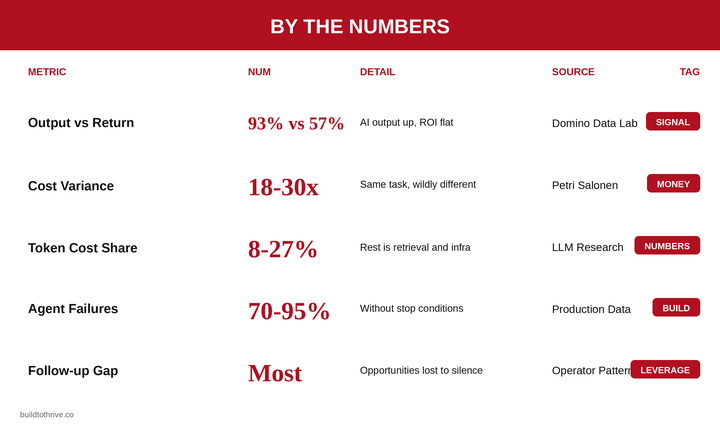
The gap between AI output and AI return is measurable. Here is what that gap looks like in five numbers.
1. 93% of businesses report AI improved their output. 57% still cannot show a return that beats the spend. The gap between more output and more return is the whole game. Domino Data Lab, State of AI 2026 — verify exact figures before publish
2. Agent workflows cost 19 to 50 times more than a single model call. The variance comes from context window size, retrieval complexity, and how many steps the agent needs to take. One run might cost $0.10. The next run on the same task costs $5. Pricing off an average misses the gap entirely. Atlan
3. In cost breakdowns for AI workflows, model tokens typically represent 8 to 27% of total expense. Infrastructure, retrieval, storage, and human review make up the rest. Optimizing tokens alone leaves 73% of cost unaddressed.
4. Agent systems in production often encounter reliability issues when designed without clear stop conditions and validation gates. The problem is usually not the model. It is that the operating loop was never designed with reliability in mind.
5. Most sales opportunities are not lost to rejection. They are lost to no follow-up. A simple rhythm beats a complicated CRM nobody uses.
SIGNAL
Output and Return Are Not the Same Thing
The gap is real, and it is expensive. While most organizations report AI improved their output, fewer can demonstrate that AI improved their return. There is a measurement gap, and it is costing money.
Why it matters: Faster work does not automatically mean richer work. Your AI made the task faster. That does not mean it made you more money. The gap sits in Numbers & Decisions, the lever that shows what is actually working. Most operators never measure it.
What I am observing: The operators closing this gap first do one thing different. They price AI-leveraged work by outcome, not by input. Petri Salonen has written about this: the cost per run varies wildly depending on model load, retrieval complexity, and what the AI actually uses. Pricing off the average is how you automate yourself into a loss. The fix is not faster AI. It is outcome-based pricing.
Stop Conditions Come Before You Scale
Many AI agents fail in production. Not because the model is weak, but because the operating loop was never designed with reliability in mind.
Why it matters: An agent without a stop condition is a loop without an exit. It will run until it costs you. The real fix is not better prompts. It is better design. Two things matter: an eval gate that asks “is this output worth keeping” and a stop condition that asks “should we keep going.” Those happen before you let AI run it at scale.
What I am observing: The operators building reliable systems do this backwards from the usual AI workflow. They design the operating loop first. They test the stop conditions with small batches. Then they let AI run it. The difference between that approach and “just turn on the agent” is the difference between “output worth keeping” and “output that costs you.”
Story 3: Relationships Die in Silence, Not Rejection
Most opportunities disappear because nobody followed up. Not because the opportunity was bad.
Why it matters: An opportunity without a rhythm becomes an opportunity that gets lost. A follow-up rhythm is simpler than it sounds: who owns it, when does it happen, what is the next step. The business keeps it moving.
What I am observing: The operators who win this stop buying CRM software and start designing a rhythm. AI can help send the message, summarize the call, surface what is stale. But AI only helps after the rhythm is designed. Bolt AI onto scattered follow-up and you get faster scattered follow-up.
THE PLAYBOOK
Measure outcome cost, not input cost.
You need one number that tells you whether the AI work paid for itself. Build that number this week. It rewrites how you price and what you automate next. The number is cost per successful outcome, not cost per token or per run.
Design the stop condition before you scale the loop.
Ask: when should this agent stop running? When the output is unreliable. When we have spent enough. When the job is done. Design that exit before you let it run. Then the loop is worth multiplying. More on loops in this article: Why Your AI Is Making You Busier: The 6-Part Framework for Real Delegation
Move 3: Own the follow-up rhythm.
Pick one day a week. Pick who owns it. Pick what “next step” means. The rhythm keeps the relationship moving. Everything else is noise.
Move 4: Let the numbers decide what to fix next.
Your business has multiple moving parts working together. Most operators fix the one that screams loudest. The numbers show you which one actually holds everything back. Fix that first. That is the difference between activity and leverage.

Three prompts to measure and design what works this week.

You walk away with a spreadsheet that shows the real cost of one AI-leveraged workflow. Input: task description, model used, success rate, cost per run. Output: cost per successful outcome and the threshold for profitability. This is the number that changes your pricing.

You walk away with a two-part test for any agent: (1) how do we know this output is worth keeping, (2) when do we stop the loop. Without these, the loop runs until it costs you. This is how reliability gets designed in.

You walk away with a repeatable rhythm: cadence (weekly, bi-weekly), owner (who is responsible), next step (what moves the relationship forward), and how to surface what is stale. This is how opportunities stop dying in silence.
The three prompts are the three redesigns that come before you multiply with AI. Cost clarity, loop reliability, and relationship rhythm. Together, they close the gap between output and return.

B2T Prompt Vault — Own the prompts you use instead of chasing new tools. This week’s three prompts live here: outcome cost calculator, stop condition builder, follow-up rhythm designer. These prompts work inside Claude, ChatGPT, Notion, or your internal company drive. Save them. Use them. Build your library. Learn.buildtothrive.co/vault

Petri Salonen — Business Models in the AI Era. Salonen names the exact problem: the cost per run varies wildly, and pricing off averages fails. His work is the proof that Numbers & Decisions is the lever holding back ROI for operators scaling AI work. Read his latest on Business Models in the AI Era

See how your whole business is organized. There are nine moving parts to a healthy business. One is under strain. Most operators fix symptoms instead of finding the real constraint. The Thrive Business System Assessment shows you all nine and helps you find which one matters first. Numbers & Decisions might be it. Or it might be something else. The map shows you. Start at learn.buildtothrive.co/build
Run the AI Leverage Assessment. If you already know the strain is operational drag, time leaks, or workflow bottlenecks, this is the faster path. It shows you the cost of friction and where AI actually helps. Start at learn.buildtothrive.co/mytimeback
The Thrive Business System Assessment. Run this diagnostic to see all nine moving parts of your business and surface which one is under strain. Most operators fix symptoms instead of finding the real constraint. This assessment walks you through each lever—Clarity, Opportunity, Follow-Through—and names where the bottleneck sits. Numbers & Decisions might be it. The Thrive Business System
Thank you for reading.
Juan
Some news I want to share before you go.
Build to Thrive just hit #26 Rising in Business on Substack last week
Thank you for reading my newsletter and helping me grow at a pace of 600 subscribers per month. I started this newsletter in April of last year and it is now a resource to more than 5000 entrepreneurs. I would love for you to take the next step by offering a 25% discount over my paid subscription. By becoming a paid subscriber you have access to my library of prompts, workflows and timely content to help you gain your time back, improve your income and have happier customers and stakeholders. All for the price of a latte or capucchino. (Offer valid until July 31st)
An agent without a stop condition just runs until it costs you money.
Juan, the cost per outcome framing is such a useful shift: I love that you're pushing people past output volume towards whether any of it actually made money. The bit about checking whether the bottleneck was designed wrong before automating it is the part I'll be thinking about most. Which of the three questions do people find hardest to answer honestly?