


EDITORIAL
I was searching what was AI actually changing about how a small business gets found, gets chosen, and gets paid and found three signals worth sharing. A company called Searchable raised $14M to tell brands how AI search talks about them. A company called Dust raised $40M on the idea that an AI assistant is now a buyer. And Andrej Karpathy, a well-known AI engineer, reminded people that most of an AI bill pays for words the model never actually needed to read. Put them side by side and they say what I have shared in the May 4 Stack Audit and the May 11 Money Stack circled from other angles: a machine now stands between you and your buyer, and it plays by its own rules. This issue walks all three.
If you are a fractional consultant, this issue hands you a service you can scope and price before the lane fills. If you are a productized operator, it names the two numbers quietly setting your delivery margin. If you are repositioning an established practice, it gives you three machine gates to audit this quarter, in order.
Found. When someone asks Google or ChatGPT a question now, they often get the answer right there and never click a link. About 60% of Google searches already end this way, heading for 70% by late 2026, and only about 45% of the brands Google ranks are the ones AI actually names (SparkToro, Yext). Getting found now has three layers, and most operators only guard the first: ranking on Google (SEO), showing up inside Google's own AI answers that sit above the blue links (AEO), and getting named by ChatGPT or Perplexity when the user never opens Google at all (GEO). This issue is about the last two, where the answer is still half unclaimed.
Parsed. Dust closed a $40M round with 300,000 of its AI assistants in active use and not one customer lost last year (Axios). When a buyer turns one of those assistants loose to find a provider, your offer gets read by a machine that does not skim. It reads every word and decides whether to put you on the shortlist.
Priced. Karpathy’s point, that about 90% of an AI bill pays for material the model never reads, is true of any AI-run service. Two numbers set your margin: which AI you run the job on, and how much you make it read each time. Neither shows up on an invoice.
You can see exactly where you stand on the first gate right now. This week I built a free AI Visibility Audit: paste your website in and within a minute it tells you whether AI can find, read, and cite you, gives you a score, and spells out the fix for each gap. It is the fastest way to find out which gate is costing you the most. Run your free audit.
Pick the gate costing you most this week and walk through it.
Juan
BY THE NUMBERS
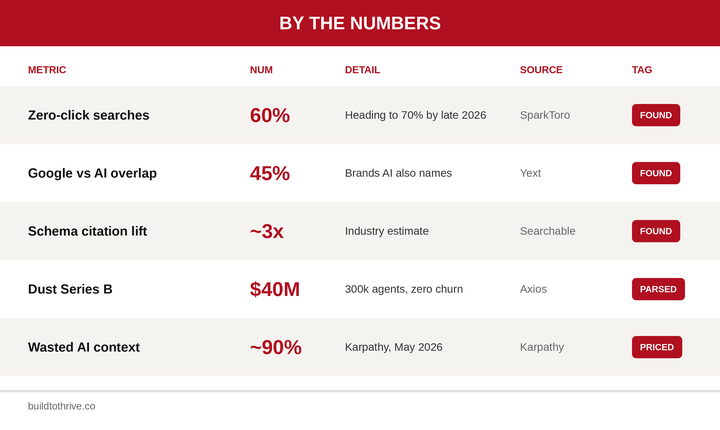
60%. Most Google searches now end with no click at all, because the answer shows up on the page. On track for 70% by late 2026. Your search traffic is not shrinking, it is being answered before anyone reaches you (SparkToro / Datos).
45%. Only about that many of the brands that win on Google are the brands AI recommends. So half the competitors who outrank you are invisible to AI, and half the names AI gives never ranked at all (Yext).
~3x. Add a few lines of hidden labels to your page, the kind that tell a machine “this is a product, this is a review,” and by industry estimates you get quoted by AI roughly three times as often. Most small business sites have none (Searchable).
$40M. What Dust just raised, with 300,000 of its AI assistants in daily use and zero customers lost last year. Investors are betting real money that an assistant, not a person, now does the first screen of your offer (Axios).
~90%. Roughly the share of an AI bill that pays for words the model never needed. Every job you run also pays for everything you pasted in first, and most of it is waste that comes straight out of your margin (Karpathy).


What happened. A year ago, getting a brand mentioned inside an AI answer was not a thing anyone sold. In May 2026 a company called Searchable raised $14M, at an $85M valuation, to do exactly that (PR Newswire). The work now has a name, Generative Engine Optimization, and a venture-funded price tag.
What it means. The old service was getting a business to show up in Google. That deliverable is shrinking on the same line as zero-click search, where the answer appears and the click never happens, now about 60% of searches (SparkToro). The replacement is forming in the open: get the business named when a customer asks an AI instead. For a consultant, that is a service you can package this week, a one-time audit plus a monthly check, for a buyer who already knows they have gone missing and does not know why.
What I am observing. When a service gets a name and a buyer who already feels the pain, the lane is briefly open and uncrowded. Name it and price it before a dozen agencies sell the same audit.

What happened. Dust raised a $40M round led by Abstract and Sequoia in May 2026, with 300,000 of its AI assistants in active use across 3,000 companies and no customers lost last year (Axios, Tech.eu). Greg Isenberg put the point simply: the new buyer on the internet is an AI assistant.
What it means. You already write your offer for a human who skims your headline and decides in a few seconds. Now there is a second reader. When a buyer sends an assistant to go find a provider, the assistant reads offers to decide who to put forward. It does not fall for a clever tagline. It looks for a clear statement of what you do, who you do it for, and what it costs. The operators who get shortlisted are the ones whose one-sentence offer a machine can read back correctly.
What I am observing. The money is moving to the place these assistants run, not to another chatbot. The cheap, lasting move is not technical. It is rewriting your offer so both readers, the person and the assistant, come away with the same answer.

What happened. Karpathy posted a line in May 2026 that spread fast: about 90% of an AI coding bill pays for material the user did not need to send in the first place. Raghav Mehra walked the same math for everyday operator workflows that week (Cash & Cache).
What it means. This is not really about coding. Every time you ask an AI to do something, you also pay for everything you handed it to read first. A workflow that dumps in 50 files to handle a 30-line job pays for 50 files of reading the model never uses. If you sell AI-run work at a fixed price, two numbers decide your profit: which AI you run it on, and how much you make it read each time. Your client never sees those numbers, and neither do you until you go looking.
What I am observing. The operators who keep their margin as AI prices move around are the ones who check this the way they once checked billable hours. It is dull, and it is the line between a service that scales and one that just keeps you busy.
THE PLAYBOOK
Move 1: Run the visibility test before you change anything. Open ChatGPT, Perplexity, and Gemini and ask the exact questions your customers would ask, like “best [your service] for [their situation].” Write down who gets named and which sources the AI quotes. You trade a vague worry for a specific gap and a list of places to go earn a mention.
Move 2: Make one page easy for a machine to lift. Take your most important page and put a short, direct answer, two or three plain sentences, at the very top of each section. Add clear question-style headings and a simple table. AI pulls your page apart in chunks, so a page it can lift gets quoted while a page it has to untangle gets skipped.
Move 3: Earn three mentions you do not own. Get onto one “best of” list for your category, claim one strong outside profile (Crunchbase, G2, or Trustpilot), and post once on LinkedIn about your core topic. Your own site gets you into the running. Mentions on sites you do not control are what actually get you named, and this is the step almost everyone skips.
The three moves are one habit: see the gap, fix your page, earn the mention. Run it monthly, not once.


“Act as a buyer looking for [my service]. Here are five questions you might ask an AI assistant before hiring someone: [list]. For each, tell me what kind of source or page would most likely get a provider named in the answer, and what I would need to publish to earn that mention.” Walks you out with a target list, not a guess.

“Here is my most important page: [paste]. Rewrite the top of each section as a short, direct answer an AI could quote word for word. Keep my voice, cut the warm-up, and flag any claim that needs a number or a source to be worth quoting.” Walks you out with a page built to be lifted.

“Help me scope an AI-visibility audit I can sell to a small business. Give me the five things I check, the deliverable I hand over, a one-page report outline, and a price for the audit plus a monthly check. Assume the buyer knows they are missing from AI answers but not why.” Walks you out with a sellable offer, not a favor.
Together the three prompts are the playbook in order: see the gap, fix the page, sell the fix. Full versions live in the Notion Prompt Library, linked in each card.
TOOL OF THE WEEK
Searchable. is an AI visibility tracker: it shows you how AI search engines describe and rank your brand. Type your business into its free checker and it tells you, in plain language, whether ChatGPT, Claude, and Perplexity name you when a customer asks, what they say about you, and which competitors they name instead. It turns the vague worry from this issue, "am I missing from AI answers," into a specific list of gaps you can fix. Built by Chris Donnelly, the founder in Story 1, so the free tool is also the front door to a paid product. Use the free read first.

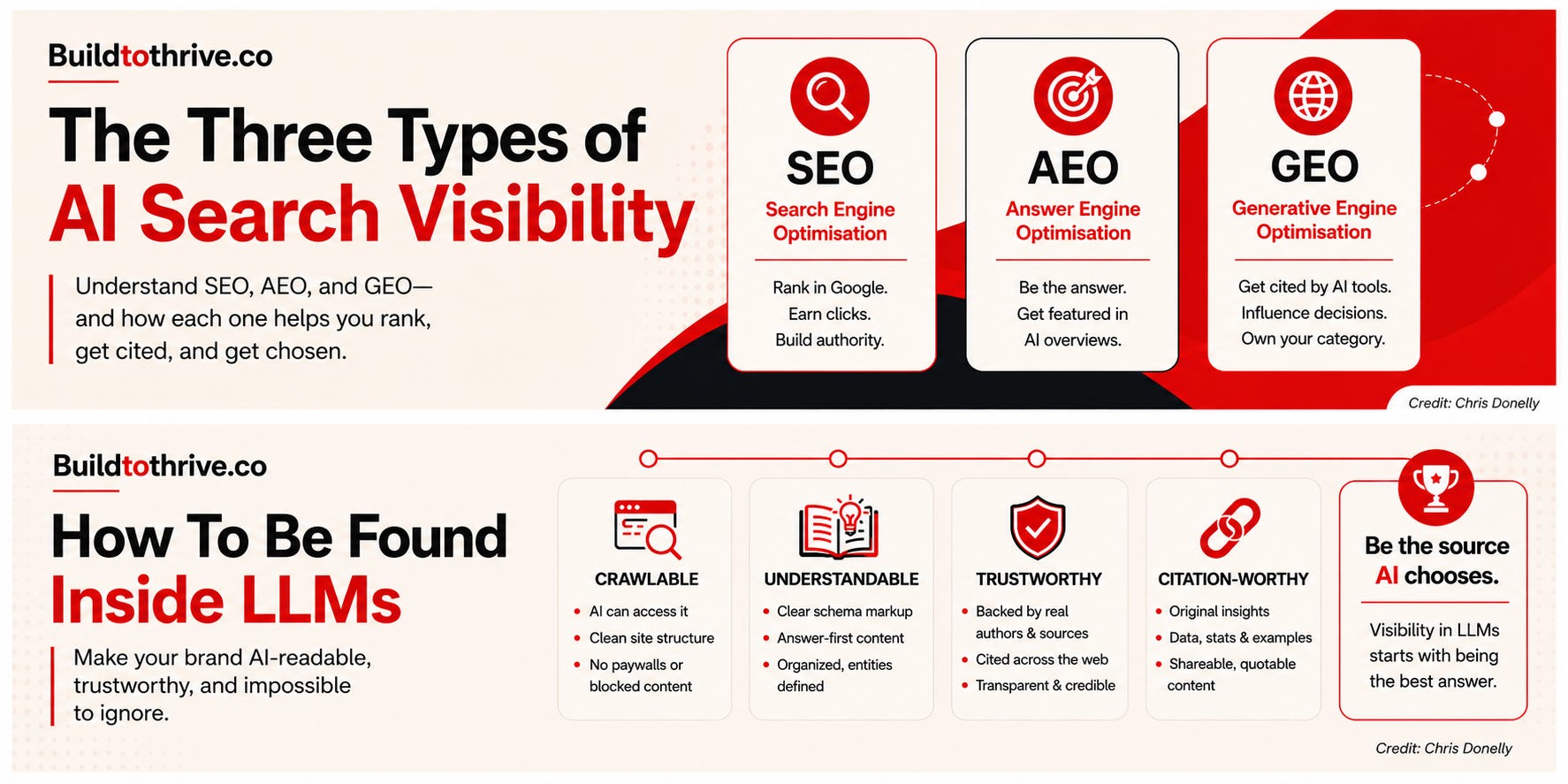
DONNELLY’S “FOUND INSIDE LLMS” LADDER
Four levels, in order. You cannot skip one.
1. Crawlable. AI can read your page. Schema labels in place, clean question-style headings, a direct answer in the first 60 to 80 words.
2. Understandable. AI knows what you are about. Clear topic clusters, plain language, your name and category stated the same way everywhere.
3. Trustworthy. AI treats you as a credible source. Author credentials visible, cited by high-authority sites, claimed on Wikipedia and Google’s Knowledge Panel.
4. Citation-Worthy. AI picks you as the answer. Original data or a named framework, updated within 90 days, already cited by three or more outside sources in your category.
Want to see where you stand? Run the free Build to Thrive AI Visibility Audit: paste your URL and in about a minute it grades your site against these markers and tells you exactly what to fix and how. It is built on Donnelly's 16 points, with the fix for each one spelled out. Free, no signup. Run the audit.

Two ways to take what is in this issue and turn it into your move.
Start with the free Diagnostic. Before you can close the operating-model gap for a buyer, it helps to see your own. The Build to Thrive Diagnostic is a roughly 12-minute assessment on where you and your offer sit against the AI economy. If this week’s NBER number made you wonder which side of it you are on, take it at learn.buildtothrive.co/valueoffer

Want to become one of Build to Thrive Founders? For a limited time, I am offering the Founder level membership at $99, which is typically at $360. I help you turn your experience into income and build a self-running 5-person business, solo. Go to learn.buildtothrive.co/founder-100. to learn more.
Build assets. Create freedom. Thrive on your terms.
Re: Move 2: Make one page easy for a machine to lift...As someone with ADHD who writes for people with ADHD, I appreciate that writing so it's easier for AI to read your content (clear headings, direct answers) also makes it easier for people to read it.
Staggering stats... 60% zero click searches.
That's where we're headed... best to be building a strong personal brand.