


TL;DR
The expensive part of a new offer may be discovering too late that you were wrong about the buyer, the problem, or what they would pay to receive.
AI can produce a convincing name, landing page, sample, and sales emails before any of those questions has been answered. I recommend a five-step Market Check: write down what must be true, investigate the problem, show a small concept, ask for a meaningful commitment, and decide what the evidence earns next.
You will see the method through an illustrative case: an experienced consultant who almost builds a paid AI newsletter for small-business owners. Her conversations change both the buyer and the offer.
Free readers get the method, interview questions, sample-size guidance, recruiting math, and a two-week plan here. The planned paid Field Kit will add copyable templates, an evidence tracker, an AI analysis prompt, and a decision scorecard.
I sold my second business in September 2024. Six months later, after taking courses, reading, and trying to figure out what came next, I started Build to Thrive. At first, I wrote about entrepreneurship and my own experience. Then AI changed the direction. I became convinced that learning how to use it well was one of the best investments I could make in the next chapter of my career.
A year later, I can build things with AI that I could not have imagined when I started. But there is one thing I would do differently: I would spend more time testing the market before deciding what to build. I have always believed in getting close to customers, but I also learned how easy it is to fall in love with an idea, especially now that AI can turn that idea into something polished almost overnight.
That is what this piece is about.
An owner sees an opportunity. Clients have been asking the same question for years. The entrepreneur knows how to answer it, and suspects others would pay for that answer too.
They open an AI tool. By Friday, the idea has a name, three pricing options, a landing page, a sample issue, and an email sequence. It looks like a business.
But no buyer has chosen it over another priority. No one has put money, time, data, or access to a decision-maker behind it. The owner has evidence that she can make the offer. She does not yet have evidence that people want it.
I understand the pull. Building feels productive. Asking someone why they would not buy feels uncomfortable. AI makes the comfortable part faster, so it becomes easier to postpone the question that matters.
The point is not to stop building. It is to make the next investment small enough that you can still change your mind.
Every offer mixes facts with guesses
A Short Story
Consider Maya, an experienced operations consultant. She has helped independent business owners find useful ways to apply AI. She now wants to sell a paid weekly newsletter called AI for the Owner’s Week. It will explain new tools and give subscribers one action to try.
Maya knows her material. She has heard owners say they feel behind and are unsure where AI fits into their business. Those are facts from her experience.
Almost everything else is still a hypothesis.
Who is actually most likely to pay: the owner, a manager, a professional adviser, or an association serving many businesses? What problem feels urgent enough to spend money on now? Are owners struggling to keep up with AI news, or do they already have too much information and not enough help applying it?
Is a newsletter even the right format? Would they rather have a checklist, a monthly workshop, hands-on help, or someone who helps them implement one change? How often do they need help? What outcome would make the subscription feel worthwhile?
Then there is the buying question. What are they already paying for? What would they stop doing or buying to make room for this? Is $20 a month easy, irrelevant, or still too much for something they are not sure they will use? Who makes the decision? What would have to happen for someone to subscribe today rather than say, “That sounds useful”?
And perhaps the most important question: if the newsletter is not the product, what is the problem underneath it that Maya could build around instead?
Maya could take her first answers and build a polished product around them. Instead, she gives herself two weeks to find out which assumptions survive contact with buyers.
Maya and her results are fictional and illustrative. The case shows how to make decisions with evidence; it does not claim that these conversion rates occurred in a client project.
Four ideas behind a better test
This discipline has a history. I have drawn the Market Check from four strands of work:
Rita McGrath and Ian MacMillan: write down what must be true. Their discovery-driven planning makes assumptions visible as you invest. Maya writes down the beliefs carrying the newsletter.
Steve Blank: treat the offer as a set of hypotheses. His customer development approach puts the customer, problem, solution, channel, and price in contact with real buyers. Maya talks to prospects before producing a season of issues.
Saras Sarasvathy: decide what you can afford to lose. Her affordable-loss principle helps Maya risk two weeks and a small pilot instead of months of production.
Daniel Kahneman and Dan Lovallo: look beyond your own plan. Their outside-view argument prompts Maya to examine what owners already read, pay for, and ignore.
The governing question: What is the smallest, honest test that could change my decision?
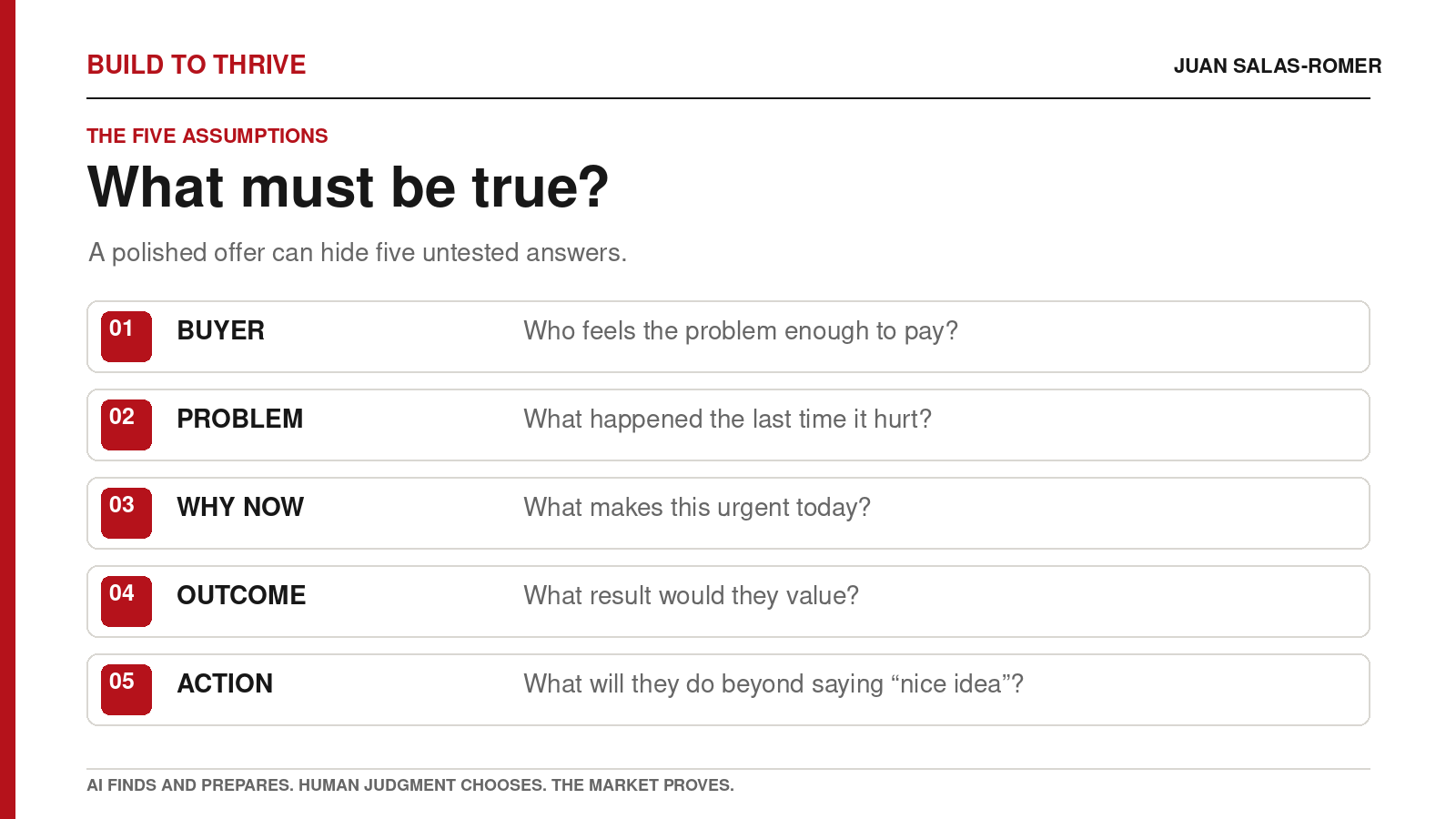
1. Write down what must be true
Before Maya interviews anyone, she completes five sentences:
Maya’s first answers are:
● Buyer: An independent business owner curious about AI.
● Problem: They cannot keep up with new AI tools.
● Why now: They worry competitors will move faster.
● Desired outcome: One useful AI action each week.
● Reason to act: A short paid newsletter will save research time.
All five sound plausible. None is yet a customer decision.
Write your own answers before talking to people. Otherwise, it becomes too easy to claim afterward that you “always knew” what the market meant.
Maya also writes down what would change her mind: if owners already get enough free AI news but repeatedly ask for help applying it, she will stop treating a paid newsletter as the obvious product. That sentence matters later. Without it, she could explain away every inconvenient answer.
2. Investigate the problem before showing the offer
Maya looks for owners who have recently tried to use AI in their business, not just people who enjoy discussing it. In each conversation she asks:
● Tell me about the last time you tried to use AI for a business task.
● What were you trying to improve: revenue, margin, customer service, or your time?
● What did you try, and what happened afterward?
● What are you using now to find advice or examples?
● Have you paid for help with this? Who approved that purchase?
● What would make this problem important enough to address this month?
She does not lead with the newsletter. If she does, the conversation can turn into feedback on her idea instead of evidence about their lives.
Maya aims for 12 completed conversations in one reasonably defined buyer group. That is a working target, not a validation threshold. A systematic review by Hennink and Kaiser found that studies with narrow objectives and relatively similar participants often identified recurring themes within roughly 9–17 interviews. A commercial decision still requires its own evidence of urgency and commitment.
For planning, if 40% of invited people agree and 80% of those attend, 12 completed interviews require about 38 invitations: 12 ÷ .40 ÷ .80 = 37.5. Your rates may differ. Start with five, adjust the questions, then continue where the uncertainty remains.
In Maya’s illustrative test, the funnel looks like this:
She personally invites 38 qualified owners. Fifteen agree to talk, 13 schedule, and 12 complete a conversation.
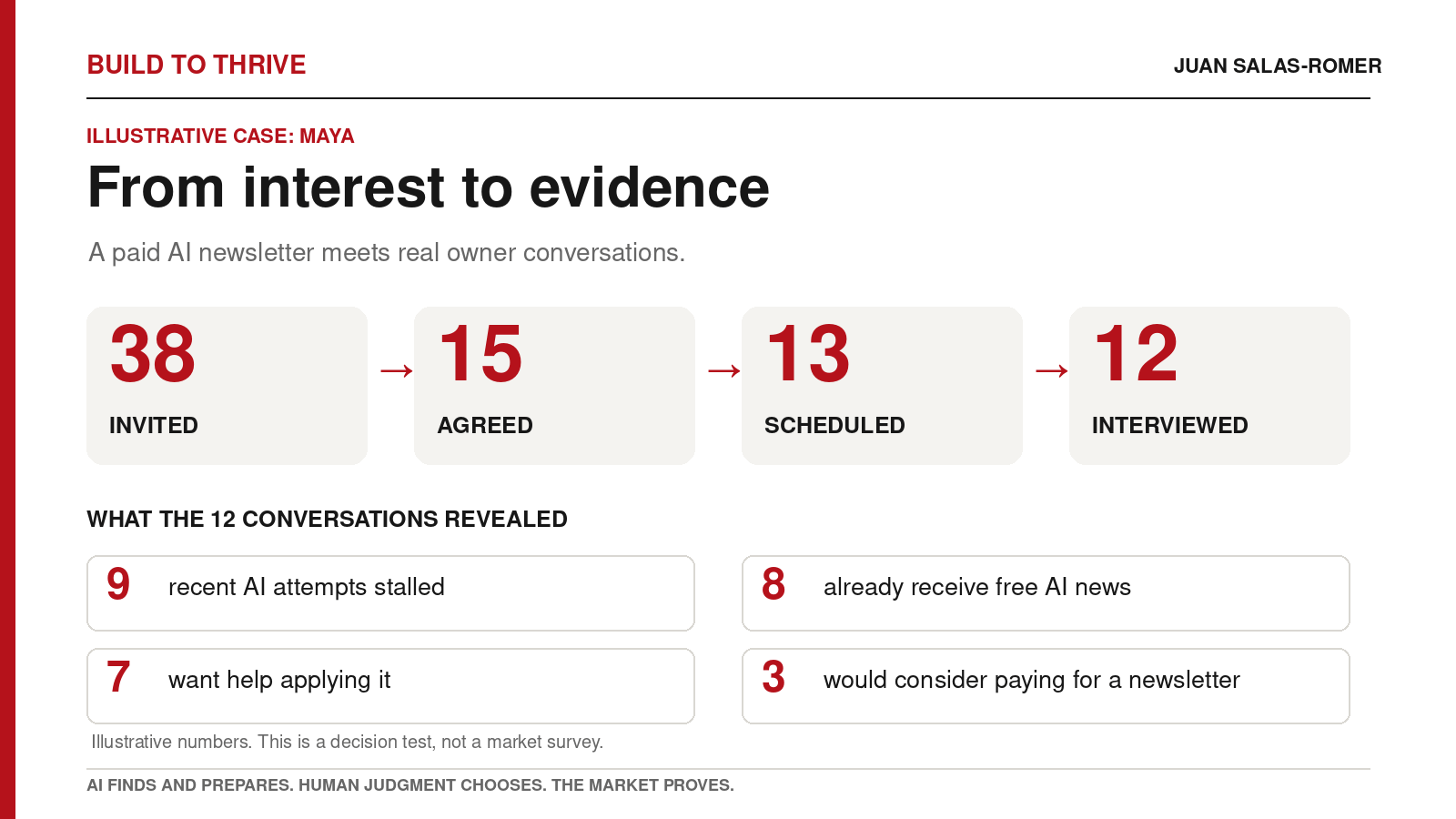
The sequence matters. An open poll of AI enthusiasts might produce encouraging answers, but Maya needs to hear from people who run businesses and have recently tried to apply AI. The recruiting funnel also shows how many invitations a modest interview target can require.
The first five conversations alter her questions. An owner says that AI wrote a decent promotion but could not tell whether it brought anyone back. Another tried to summarize invoices but stopped when the line items were wrong. Maya had been asking, “Where do you get AI news?” She starts asking, “What happened the last time you tried to use it?” That shift moves the discussion from curiosity to a business job and its consequences. These scenes are illustrative, not reported interviews.
Here is what Maya might hear in this illustrative round:
After the 12 conversations, Maya sorts the evidence:
● Nine describe a recent AI attempt that stalled after the first experiment. The practical problem is real for this group.
● Eight already receive free AI news through email or social feeds. More news alone may not stand out.
● Seven say they need help applying an idea to their own records or workflow. The proposed delivery format may be wrong.
● Three would consider paying personally for a newsletter. Interest in AI is not the same as demand for this offer.
Maya keeps three columns in her notes: what the person actually did, what they said they want, and her interpretation. “I would read that” belongs in the second column. An owner spending Saturday correcting invoice lines belongs in the first. “They need hands-on setup” is an interpretation she must still test.
Maya was right that owners want help. She was less right about what kind of help they would buy. The interview counts do not represent a market survey or prove how common this problem is among all small businesses. They tell her which assumption deserves the next test.
3. Create the smallest honest test
She could revise the newsletter’s headline and send another survey. That would mostly test copy.
Instead, Maya writes two one-page concepts and shows them to people who described a recent problem:
Concept A: a weekly AI newsletter. Each issue offers one practical action for a monthly fee. Maya wants to learn whether owners will pay for guidance they read and apply on their own.
Concept B: a four-week working pilot. An owner brings one recurring task and leaves with a working first version and a way to measure it. Maya wants to learn whether they will invest both money and time to solve a current problem.
She keeps both small. There is no full curriculum, membership site, or automated delivery system. A test should help decide what to build; it should not quietly become the full build.
On day eight she shows the same seven people the two one-page concepts and offers a sample newsletter issue. The sample translates one AI development into a practical task. The pilot concept asks the owner to bring an actual stuck task, their current way of doing it, and one measure of improvement. She explains the time commitment and a proposed price for each, rather than hiding those details until after someone says they are interested.
The seven are the people who described an urgent, recent problem, not a random sample. Maya is learning what these prospects will consider next; she is not running a controlled experiment between two product formats.
4. Ask for commitment, not applause
“What do you think?” invites politeness. Maya asks what each prospect would do next.
Would they pay for the first month of the newsletter? Would they forward a sample to the person who controls the budget? Would they bring a real business task to a paid pilot and reserve time for it?
In the illustrative case, five ask to see a free sample issue. One agrees to pay for the newsletter. Three agree to pay for the working pilot and identify the task they want to tackle.
Here is the decision trail she records:
Among those seven prospects:
● Five request the free sample issue. They want to inspect the content. That is useful feedback, but weak purchase evidence.
● One accepts the paid newsletter offer. That is a purchase commitment for one person, not proof of a broad market.
● Three identify a current task and accept a paid pilot. They commit money and working time to a specific outcome, a stronger signal for the pilot among this group.
● Two take neither next step. Maya keeps them in the record and asks why, rather than removing them from the story.
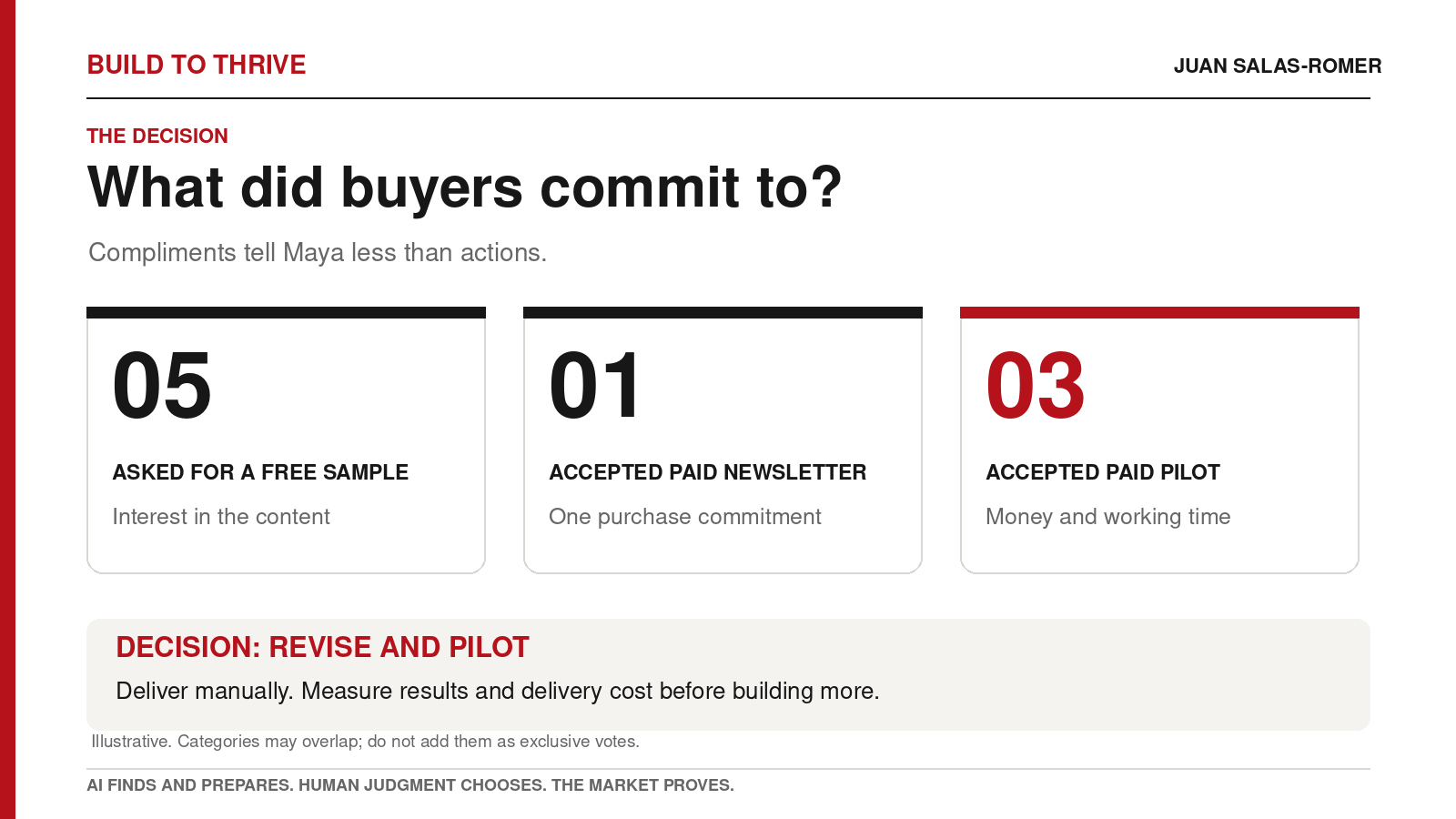
The categories can overlap: someone may read the sample and also choose a pilot. They are not seven exclusive votes to add together. Maya records names and actions rather than presenting the totals as a conversion rate.
That does not prove a larger pilot business will succeed. It does tell Maya more than five compliments would. The proposed format affects whether people act.
Commitments have different strength. A second meeting costs time. An introduction risks some reputation. A deposit or payment costs money. No single action is proof on its own, and the appropriate request depends on how developed the offer is. What matters is whether the customer does more than approve the idea in conversation.
5. Decide what the evidence earns next
Maya has not learned that “newsletters don’t work.” She has learned something narrower: among the owners she interviewed, free AI news was plentiful, while hands-on help with one stuck task prompted stronger commitments.
Her decision is revise and pilot. She delivers the three working pilots manually, records the time each one takes, and asks whether the promised outcome actually appears. Only then does she decide whether a repeatable offer is worth building. The newsletter may become a free channel that helps the right owners recognize the problem, rather than the paid product itself.
The two-week Market Check ends with a decision to run those pilots; their delivery happens afterward. For each, she records the starting task, hours spent before, the first working output, the owner’s review, and any correction or follow-up time. If the work takes her ten hours to save the owner one, the offer needs another revision even though someone paid for it.
She has learned something concrete, with limits:
Maya compares each original belief with what happened:
● “Owners lack AI news.” Eight already get it free. She will not build a paid content library yet.
● “A weekly action is enough.” Seven want help applying an idea to their own work. She will test delivery support.
● “Owners will pay for this newsletter.” One accepts it, while three accept a paid working pilot. She will pilot the stronger commitment and keep observing.
● “I can build a repeatable offer now.” Delivery cost and outcomes remain unknown. She will deliver manually before systematizing.
You can make the same decision using this table:
Your Market Check can end in one of four decisions:
● Build when the problem repeats, the buyer is clear, and customers make commitments that fit the offer.
● Revise when the problem is real but the buyer, promise, price, or format is off.
● Keep testing when signals are promising but inconsistent or come from different buyer groups.
● Stop when urgency is low and qualified customers will not take a meaningful next step.
Stopping an idea at this stage is useful. It is cheaper than discovering the same thing after building months of material.
Where AI helps, and where it can mislead
AI can prepare an interview guide, organize notes, surface repeated phrases, compare the findings with the original assumptions, draft the one-page concepts, and identify contradictions Maya should check herself.
It can also turn weak evidence into a persuasive story. If Maya asks it to write a case for the newsletter using only enthusiastic comments, she may get a very convincing answer to the wrong question.
Keep each quote and action tied to a real source. Label what someone said, what they did, what you infer, and what remains unknown. AI finds and prepares. Human judgment chooses. The market proves.
If you only remember one thing
A finished-looking offer is no longer expensive to make. That makes it easier to invest in the wrong buyer, promise, or format before anyone has had a reason to say yes.
Let a small amount of market evidence earn the next investment.
Run your Market Check in two weeks
Day 1: Write the five assumptions and the decision you need to make. You leave with an Assumption Card.
Days 2–3: Identify a narrow buyer group and invite qualified people. You leave with a recruitment list and invitations.
Days 4–6: Conduct an initial five conversations, improve the questions, and continue. Keep notes tied to real incidents.
Day 7: Compare what people do with what you assumed. Revise your view of the buyer, problem, and urgency.
Day 8: Create one or two small, honest concepts. Keep each to one page.
Day 9: Ask for a commitment appropriate to the offer: a meeting, introduction, pilot reservation, deposit, or payment.
Day 10: Decide whether to build, revise, keep testing, or stop. Record the evidence and what remains unknown.

This article gives free subscribers the complete method, questions, sample-size guidance, recruiting calculation, and schedule.
You can begin without another tool. Write down the five assumptions from step one and circle the answer that would be most costly to get wrong. Then invite five people who have faced that problem recently to tell you what happened. Listen before you show them the offer.
That first round may save you from building the wrong thing. It may also give you a better reason to build.
If you want the copyable materials for running the full check, the planned Field Kit begins below.
The Market Check Field Kit
The paid companion includes an Assumption Card, a five-minute questionnaire, invitation and follow-up templates, a recruitment calculator, an evidence tracker, a one-page concept template, a commitment-test menu, an AI analysis prompt, a decision scorecard, and the worked Maya example.