


Build to Thrive just hit #26 Rising in Business on Substack last week
As a token of appreciation to my readers, I am discounting my paid subscription by 25%, only $5 dollars a month takes you to timely information and tools to gain time, money and happy customers. (Offer valid until October 31st)
A few weeks ago I published a piece with 50 prompts from 50 creators. It was a compilation of prompts I accumulated over the first six months writing my Monday edition, The AI Blueprint, built with 50 content creators on Substack.
It became the most viewed article I have ever posted. More than 15,000 views in three weeks, and it keeps climbing. Here is the article if you have not seen it. 50 Creators Shared Their Rock-Star Prompts. Here They Are
Curious which prompt people clicked most, I was surprised the premortem prompt came out on top. It asked you to imagine a big bet had already failed, then work backward to figure out why.
That caught my attention because it says something about how people are actually using AI. They want to move faster, but they also want to feel less blind.
The most useful AI prompt might be the one that slows you down
Most AI content still orbits speed. Write faster, summarize faster, research faster. Speed matters, but speed is not judgment, and you can move quickly in the wrong direction. You can automate a broken process, launch an offer nobody wants, or build a funnel that earns attention and builds no trust. You can install AI into a workflow that nobody actually changes.
I see it with the clients I work with. They are moving confidently toward the wrong thing.
That is why the premortem is useful. It does not ask how to execute faster. It asks a more uncomfortable question: assume this failed, what happened? That question changes the room. It gives people permission to name the thing they were already worried about.
What a premortem is
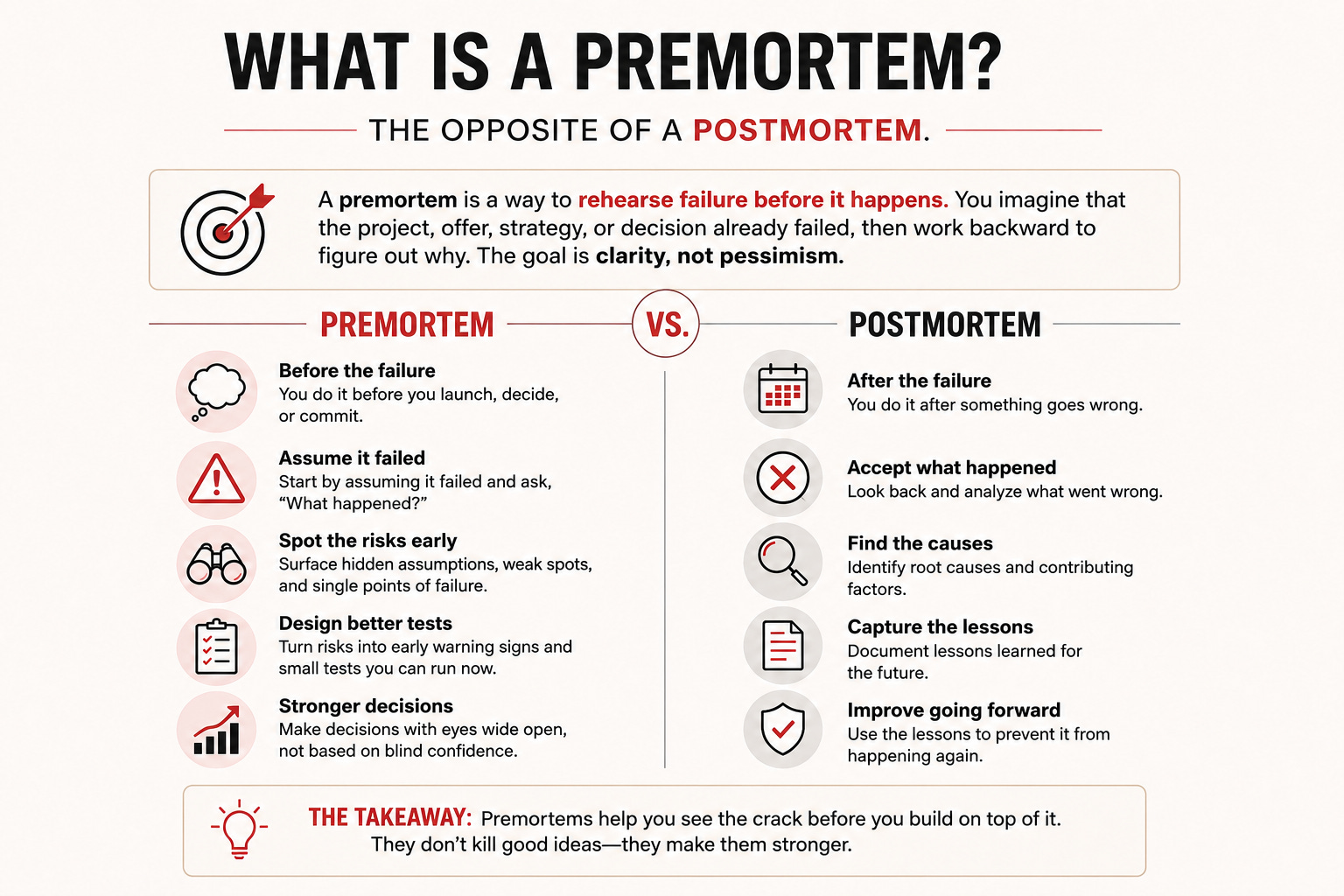
A premortem is the opposite of a postmortem. A postmortem happens after something fails, and the team looks back to ask what went wrong. A premortem happens before the failure. You imagine the project, offer, or decision already failed, then you ask why.
The value is clarity, not pessimism. Most planning conversations are biased toward confidence. The founder wants momentum, the team wants direction, the consultant wants the client to say yes, the creator wants the launch to land. So the conversation drifts toward “here is why this can work.” A premortem creates a different conversation: here is how this could break. That does not kill the idea. It improves it.
Smart people fail for predictable reasons
A lot of capable people fail for reasons you could have named in advance. They commit too early to an assumption they never tested.
The offer sounds good, but the buyer does not care enough. The content gets attention, but creates no demand. The AI system is powerful, but the team never uses it. The product works, but the onboarding confuses people. The partnership looks strategic, but the incentives are misaligned. The service sells, but delivery becomes too custom to carry. The business grows, but the operator becomes the bottleneck.
These are not random. They are failure paths. Once you can name the failure path, you can design a better test.
In case you are interested in more prompts, the prompt navigator (The Vault) provides you with more than 200 prompts and tools to leverage your capacity and enhance your cognitive abilities. It is on a paid subscription service and it grows every week. Now running a 25% discount ($5 dollars a month)
The real value is not the list of risks
A weak premortem hands you a long list of things that could go wrong. Market risk, execution risk, budget risk, competition risk. Mildly useful, not actionable. A strong premortem gives you the one or two assumptions that matter most.
If you ask AI “what could go wrong with this idea?” you get a generic list. That is the wrong question. The better ones sound like this:
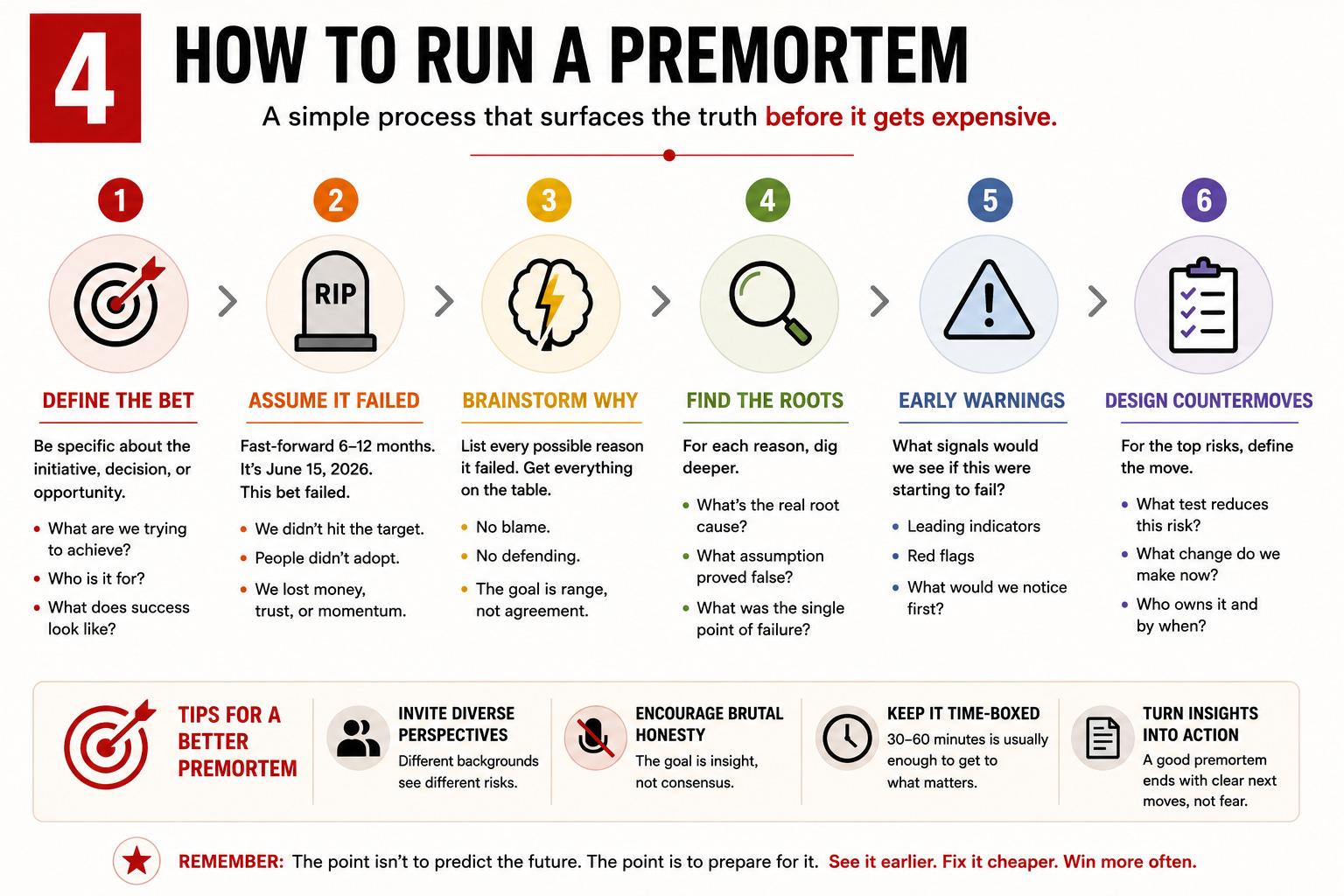
What would have to be true for this to work?
Which of those assumptions is most fragile?
What would we see early if it started to fail?
What is the smallest test we can run before we commit more time, money, or reputation?
That is where the value lives. A premortem is a decision tool, not a fear exercise.
Premortem is a family of tools
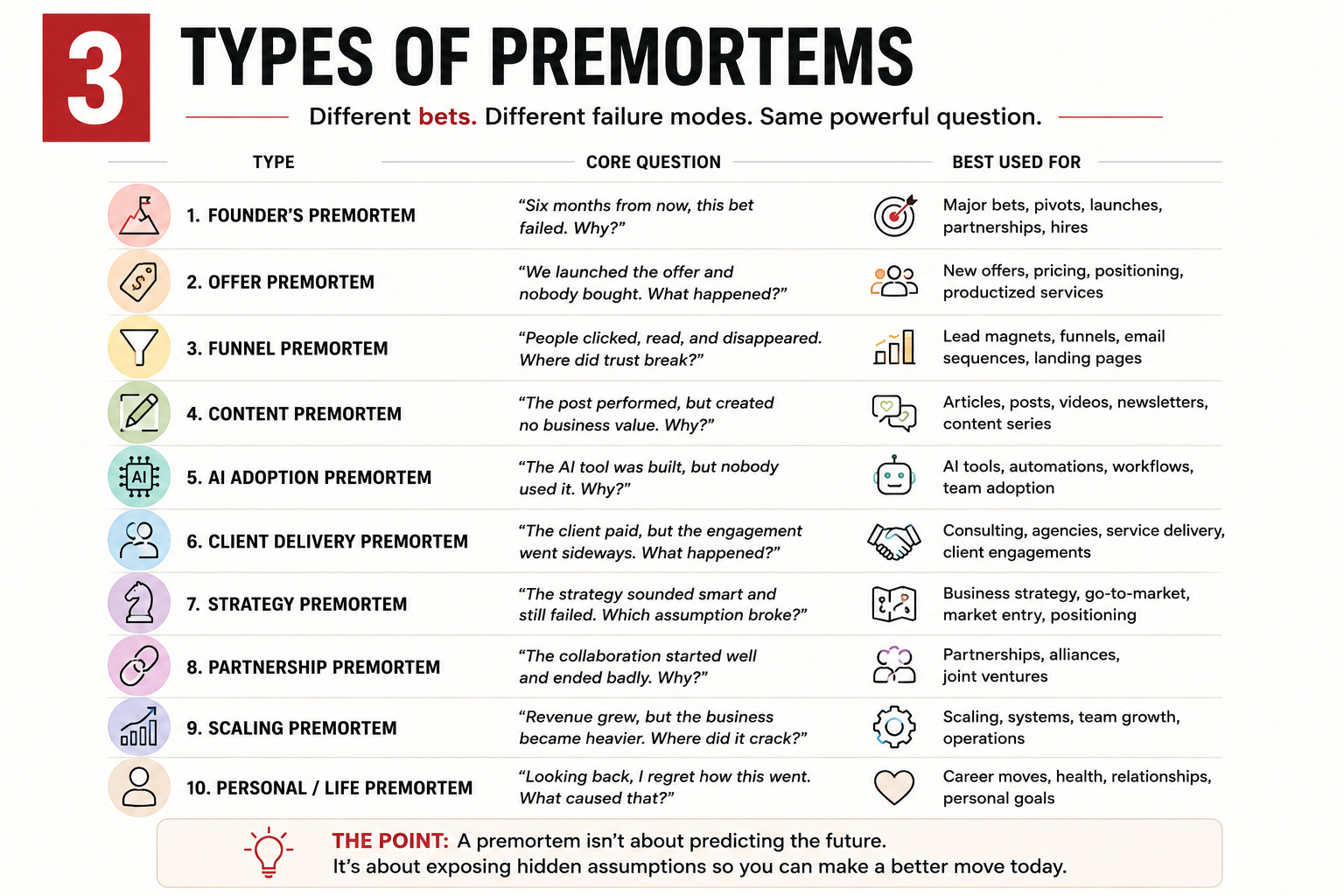
The more I worked with this, the more I saw that “premortem” is not one move. It is a family of them, and the specialized versions are the ones I run most. Each is more than a question. It names the moment to run it, the failure scenario to sit with, and the diagnosis to work through before you commit. I provide links to these prompts at the end of this article.
The Offer Premortem. The one that has saved me the most money, because many offers fail before the sales call. It is also the one I have built out the furthest, so it is worth showing in full (see link at the end of the article).
The Founder’s Premortem. “Six months from now, this bet failed. Why?” Run it before any major launch, pivot, hire, or partnership to find the single point of failure before it gets expensive.
The Funnel Premortem. “People clicked, read, and disappeared. Where did trust break?” Run it before you send traffic to a new lead magnet or sequence, because traffic is not demand.
The Content Premortem. “The post performed, but created no business value. Why?” Run it before you commit to a series, to tell applause apart from progress.
The AI Adoption Premortem. “We built the AI system, but nobody used it. Why?” Run it before you roll a tool out to yourself or a team, and design for behavior, not for capability.
The Client Delivery Premortem. “The client paid, but the engagement went sideways. What happened?” Run it before kickoff, while the scope is still soft.
The Scaling Premortem. “Revenue grew, but the business got heavier. Where did the model crack?” Run it before you add clients, channels, or headcount.
The Partnership Premortem. “The partnership looked strategic, but it stalled. Where did the incentives split?” Run it before you sign, while the terms are still open.
Why AI makes premortems more useful
Premortems are not new, but AI makes them easier to run, and that matters. Most people do not have a room of advisors on call every time they make a decision. They may not have a partner willing to challenge every assumption, and even when they do, social pressure gets in the way.
AI can help here, not as an oracle or the final decision-maker, but as a structured thinking partner. It can simulate objections, classify risks, ask follow-up questions, surface hidden assumptions, and force specificity. It turns vague anxiety into testable concerns.
The point is not to ask AI “will this work?” The point is to ask “where am I most likely fooling myself?”
A premortem prompt you can use right now
Here is a basic version to try today:
Assume this initiative failed six months from now.
Here is the initiative: [DESCRIBE THE BET, OFFER, PROJECT, AI BUILD, FUNNEL, HIRE, OR STRATEGY].
Analyze the five most likely reasons it failed. For each one, identify:
The hidden assumption that turned out to be false
The early warning sign I should watch for
The cost if I ignore it
The smallest test I can run this week to reduce the risk
The one change I should make now before committing more time or money
Then identify the single biggest point of failure and explain why it matters most.
It works because it does not stop at “what could go wrong.” It pushes toward action. A good premortem leaves you with a better next move, not a longer worry list.
Do not treat every risk the same
One reason risk planning fails is that everything gets flattened into another bullet point. But some risks are unlikely and catastrophic, some are likely and manageable, some are reversible, some are fatal, some are emotional distractions, and some are true constraints. A good premortem sorts them by four questions: how likely is this, how costly would it be, how early could we detect it, and how easily could we reverse it. The goal is not to eliminate risk. It is to avoid being surprised by the obvious one.
The best operators are more specific
I think this is why the premortem prompt drew so much interest. It gave people a way to be cautious without feeling stuck.
There is a real difference between vague fear and specific risk. Vague fear says “I do not know, something feels off.” Specific risk says “if buyers do not already believe this problem is urgent, this offer will need too much education to sell at this price.” One creates hesitation. The other gives you a test to run.
That might be one of the most valuable ways to use AI right now. Not to replace your judgment, but to sharpen it before the cost of being wrong goes up.
Before the next big bet
Before you launch the offer, rehearse the failure. Before you build the AI system, rehearse the adoption problem. Before you publish the content series, rehearse the conversion gap. Before you scale the service, rehearse the operational drag. Before you say yes to the partnership, rehearse the incentive conflict.
Not to talk yourself out of ambition. Ambition gets stronger when it has been pressure-tested. The best ideas do not need less scrutiny, they need better scrutiny, earlier. A premortem lets you see the crack before you build on top of it, and use AI as a judgment tool, not just a productivity one.
In a world where everyone is trying to move faster, that might be the more valuable advantage.
Get the Founder’s Premortem Kit and my 7 go to premortem prompts. The kit includes the main premortem prompt, five specialized versions (offer, funnel, content, AI adoption, and client delivery), and a one-page decision brief you can use before any major bet.