


Build to Thrive is for professionals stepping into entrepreneurship and founders who need clarity, leverage and ways to monetize in the new AI economy. As a subscriber you get deep dives, timely insights, and operating systems that shape tomorrow’s business. As a paid subscriber you unlock all articles, gain access to our library of tools and become part of our active community of more than 4000 aspiring entrepreneurs and founders.
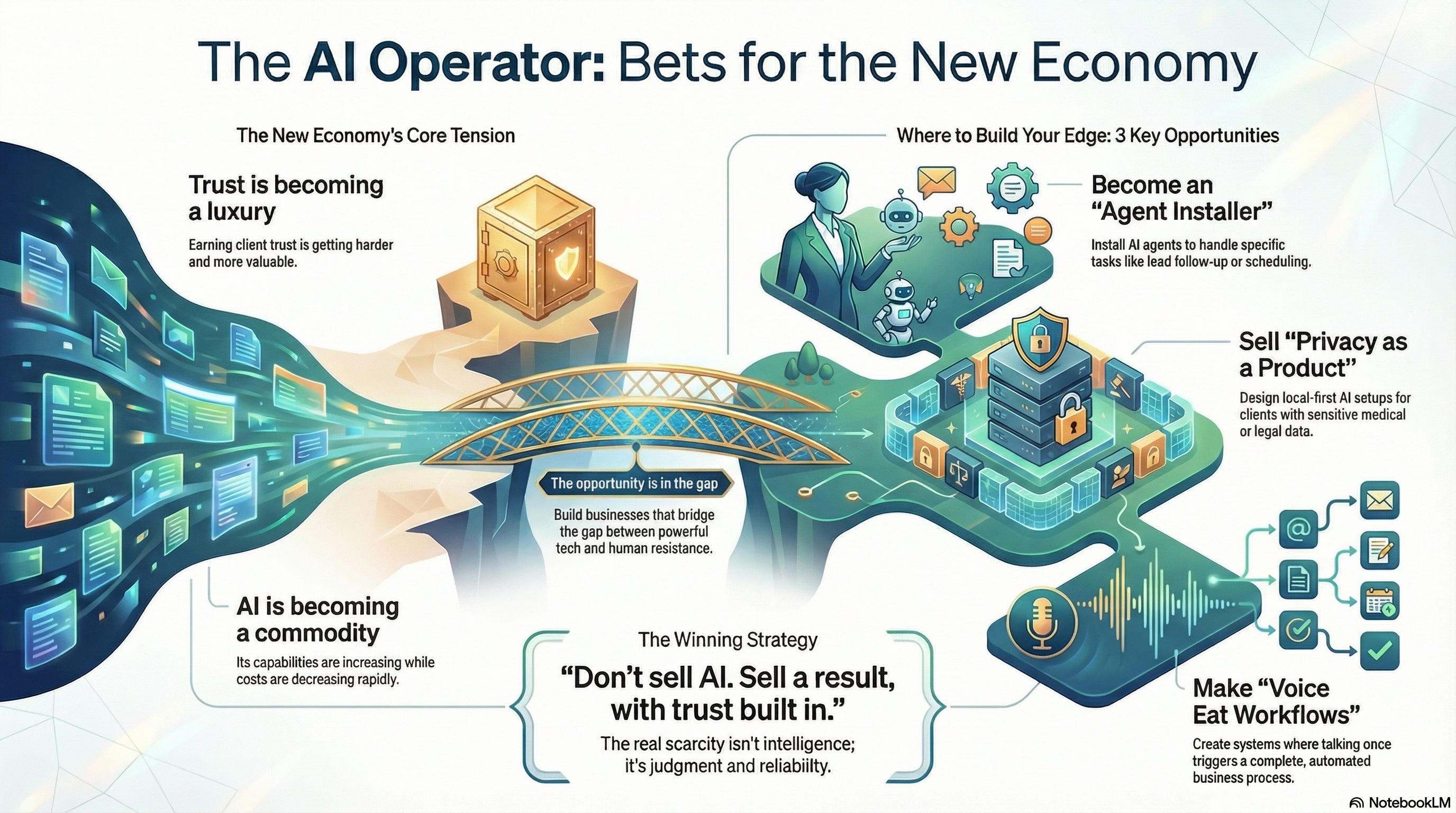
As regular Build to Thrive readers know, I can’t help myself. I like peeking around the corner.
Not because I’m trying to predict the far future, but because if you’re a professional thinking about escaping the 9–5, or you’re already running a small business, the future shows up early for you. It shows up as a strange client request. A competitor who suddenly moves faster. A tool that breaks your workflow. A new kind of hesitation in someone’s voice on a call.
You feel it before the headlines catch up.
The problem with predictions is timing. There are plenty of fascinating things that might happen in the AI economy. But what actually changes how you earn, sell, hire, and compete in the next 12 months?
That constraint matters. It forces me to stop daydreaming and think like an operator. Not just about technology, but about trust, behavior, and human resistance. Because even when something is inevitable, people drag their feet. They overreact. They underreact. They cling to what feels familiar.
And in that lag, opportunity tends to hide.
I’ve been tracking these patterns pretty obsessively for the last six months. Not in a lab. In reader replies. In coaching calls. In conversations where someone says, “This is working, but it feels off.” The more I listened, the clearer one pattern became:
AI keeps getting cheaper and more capable.
Trust keeps getting harder to earn.
So instead of vague “AI will change everything” predictions, I’m laying out seven 12-month bets. Each one framed the way I’d talk about it with a friend over coffee:
here’s what I’m seeing
here’s where the opportunity is
here’s what could break it
here’s how I’d approach it if I were starting now
If you’re trying to step into entrepreneurship, this is about where you can build leverage fast without getting wiped out by hype. If you’re already running a business, this is about where you can create an edge while others either over-automate or freeze.
Alright. Let’s get into it.
Opportunity 1: Agent installers for small businesses
Here’s what I’m seeing
Most operators don’t want “AI.”
They want fewer balls dropped, faster follow-up, fewer admin tasks, and sales that don’t quietly leak.
I keep seeing the same pattern repeat. A founder is buried in inbound emails. A service business admits half their leads never get touched. A solo operator says, “I could take on more work, but I’d lose control.”
Then someone installs an agent — not to be clever, but to absorb friction — and suddenly the business feels lighter.
What’s doing the work isn’t the model. It’s the installation. Someone still has to decide what the agent can touch, when a human steps in, and what “good” actually means.
That’s the signal.
The business
Be the person who installs AI into messy operations.
Not prompt engineering. Not tool lists.
More like lead triage and follow-up with clear handoff rules, inbox systems that resolve routine issues and escalate edge cases, or proposal drafts generated from calls with human review gates.
This is operational design, not tech theater.
What could break it
Vague ROI kills these projects quickly. If the workflow isn’t tied to a measurable outcome, it gets scrapped.
So does sloppy security. Agents touching email, calendars, CRMs, or payments introduce real failure modes if permissions aren’t explicit.
How I’d approach it
Sell it like plumbing:
one workflow at a time
one success metric
human override on anything sensitive
iterate weekly instead of “set and forget”
This is a clean bridge from “I’m good at ops” to “I sell AI outcomes.”
Opportunity 2: AI companions and bounded support systems
Here’s what I’m seeing
People are already talking to AI more than they admit.
Not publicly. Quietly. Late at night. To think things through. To journal. To calm down. To get unstuck.
What surprised me wasn’t that this was happening. It was how normal it felt once people said it out loud.
I keep seeing founders using AI as a thinking partner, habit-change tools with memory, guided journaling systems that surface patterns humans forget, and early attempts to replace emotional support instead of scaffolding it.
The pattern is simple: people want support without friction, shame, or scheduling.
The business
Build bounded support systems.
Not replacement relationships.
Think structured reflection, accountability, journaling with memory, and guided prompts that never pretend to be an authority.
What could break it
Overreach. The moment a system implies diagnosis, exclusivity, or authority, it attracts regulatory and reputational risk.
How I’d approach it
Lead with limits:
explicit disclosure
defined scope
escalation paths
transparency by default
The founders who win here won’t promise intimacy. They’ll sell reliability without illusion.
Opportunity 3: Local-first AI and privacy as a luxury
Here’s what I’m seeing
“I love AI. I just don’t want to feed it everything.”
I hear this constantly — especially from executives, doctors, advisors, and operators handling sensitive information.
These people still want AI’s benefits. They just want control over where thinking happens and where data lives.
This isn’t fear. It’s discernment.
The business
You don’t need new models.
You win by designing clear data boundaries: what runs locally, what can leave, under what conditions, and with what audit trail.
This shows up as privacy-first AI implementations for professionals and firms where trust is the product.
What could break it
Over-claiming privacy without being able to explain the architecture clearly. Buyers are getting sharper.
How I’d approach it
Sell clarity, not secrecy:
simple diagrams
boring explanations
explicit trade-offs
Privacy becomes a premium when it’s understandable.
Opportunity 4: Trust infrastructure for AI agents
Here’s what I’m seeing
The first time someone lets an agent do real work, the mood changes.
Excitement turns into anxiety.
Once an agent can send money, change records, or act on behalf of a business, people want answers. Who approved that? What happens if it’s wrong? What if it gets tricked?
I’ve noticed something else: trust collapses faster after AI mistakes than human ones.
People forgive humans. They audit machines.